Categories
Uncategorized

Coffee and Codes This Week: Guelph and Toronto

"Code Monkey" coffee mug

One quick announcement: I’m going to be at a couple of Coffee and Code events this week:

  • I’ll be at tomorrow’s (Tuesday, July 21st) Guelph Coffee and Code, which takes place at the Albion Hotel
  • and at the Toronto Coffee and Code on Friday, July 24th at the Dark Horse Cafe on Spadina.

Be there!

Categories
It Happened to Me

The “Name My Floater” Contest

Enter the Floater

The picture below is a very clumsy approximation of what my vision is going to be like for the next little while:

floater

(And no, that’s not my Karmann Ghia. I wish it was, but it ain’t.)

That thing bobbing around the right side of the photo above – the black clump that looks like a bunch of knotted-up string or a very small rotten banana – is my rendition of the floater currently bobbing about in my right eye. The motion isn’t as jerky as the animation shows; it’s much smoother, like a dead ant in a jar of baby oil that occasionally gets shaken about.

The floater appeared last Wednesday. It slowly travelled from right to left and I swatted at it. That’s when I realized that it was actually a little object in my eye.

Retinal Detachment

I’ve got a strong family history of retinal detachment. That’s when the retina – the paper-thin sensor at the back of your eyeball that catches light and turns it into electrical signals to be interpreted by your brain – comes loose. It’s common among nearsighted people, whose eyeballs are stretched so that the lens focuses light in front of the retina instead on on it:
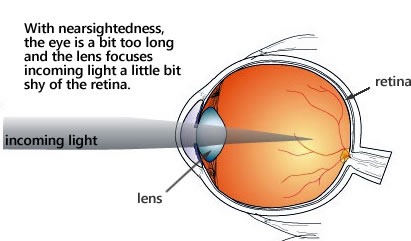
Diagram of the eye and nearsightedness

If you’re nearsighted, it typically gets worse as you get older and your eyeball stretches. This stretching pulls the retina taut, making it more susceptible to tears or holes, which let the vitreous (the clear goo in your eyeball) seep underneath, causing your retina to peel away like wallpaper in a sauna.

retinal_detachment

To complicate matters, the vitreous also shrinks as you get older, and it pulls on the retina as it does so.

Floaters are a sign of possible retinal detachment, so I was a little concerned.

A Visit to the Hospital

My original plan was to go to St. Joseph’s Health Centre, which is nearby and where they know me – my Mom’s the chief of cardiology there, and my brother-in-law also a cardiologist there. I figured it was best to go to a place where I had a little clout.

My brother-in-law suggested that I go to Toronto Western Hospital instead, since they are a big opthalmology hospital and would probably have an opthalmologist on call. The Ginger Ninja and I headed there, and sat in emergency, waiting to go through the Harry Potter Sorting Hat of triage.

Luckily for me, my mother and sister (she’s a doctor too) decided to come to the hospital. My sister prevailed on the emergency doctor (a PGY1 or “Piggy 1”, barely a couple of weeks into her first year of residence), who was going to send me home and have me come back in the morning. Our family has a history of retinal detachments progressing quite quickly, so the sooner my eye got looked at, the better.

While we waiting in the emergency examining room, I could hear a couple of family arguments in the adjoining areas. Emergency rooms often bring out the Jerry Springer guests in people.

In the end, the opthalmological resident, Dr. Mandell, gave me a full exam – including poking at my eye with a metal stick – and found a couple of small holes in my retina.

Frickin’ Laser Beams on My Frickin’ Head

“They’re tiny holes, but we can use a laser to seal them so that your vitreous doesn’t leak under them, which will eventually cause a detachment. The vitreous is tugging at your retina a little; I can tell from the tenting.”

I resisted the urge to go all Beavis and Butt-Head and say “Huh-huh-huh, you said ‘tenting’.”

It was after the clinic’s hours, so we had to wait for a security guy to open the locked room where the laser lenses were stored. While Dr. Mandell was going about trying to get his hands on the lenses, Wendy took this photo of me on her phone:
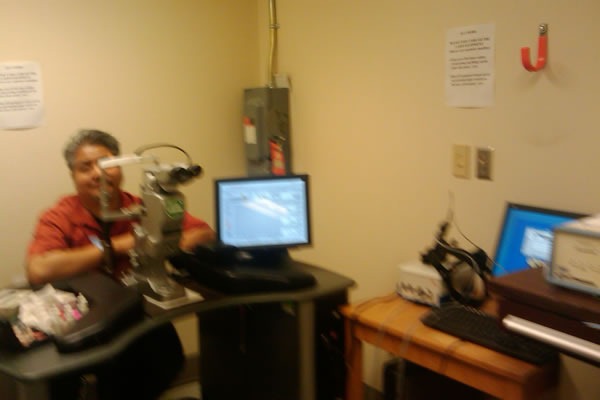
Laser eye thingy

The laser was computer-controlled, and guess what it ran:

windows_2000_professional

Win2K? I’ve got some Windows 7 discs,” I joked with Wendy. “Maybe I can upgrade him before he comes back.”

The procedure involved my holding my head very still in the headrest. Dr. Mandell held a lens covered with goop to my eyeball, through which he focused a laser to do the retinal spot-welding.

“Keep your head still,” he said. “You don’t want the laser to hit the wrong thing.”

“No, I don’t,” I said in agreement.

All I saw was about ten seconds of a bright flashing green light. Then another ten seconds. Then another ten seconds, after which he said “All done.”

The Floater Remains

There’s only one thing the laser couldn’t fix:

floater

I was told that it would eventually dissolve…”in weeks, perhaps months.”

It’s only slightly annoying when I’m looking at things that are an arm’s length away or farther. When I focus on objects at those distances, the floater becomes a blurred-out grey region and isn’t too hard to deal with. Reading, using the computer and driving aren’t really affected by it.

However, when I focus on objects close by, the floater comes sharply into focus and it seems as though I’m viewing the world through the aforementioned jar of baby oil with a dead ant floating in it. I noticed this when looking through my camera’s viewfinder. Any career aspirations to become a sniper, astronomer, diamond merchant or anything that requires me to look through a viewing lens will have to be put on hold.

Name the Floater!

Since I’m going to be stuck with this thing for a while, I might as well have some fun with it. I should give it a name. And that’s where you come in. I’m taking suggestions for names in the comments, and whoever comes up with the best name will get at $25 ThinkGeek or Amazon gift certificate from Yours Truly.

And no, “Floaty” is not a good name. Get creative!

Categories
It Happened to Me Toronto (a.k.a. Accordion City)

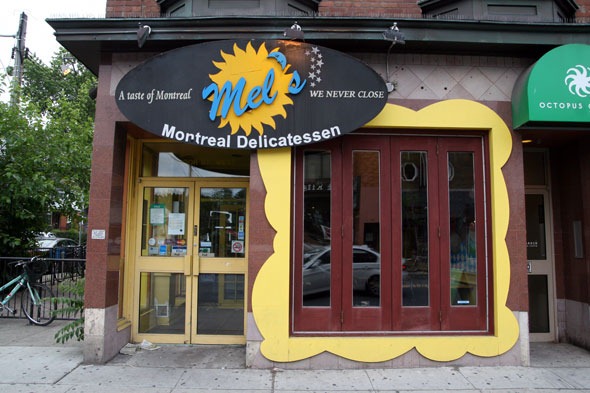
R.I.P. Mel’s Montreal Delicatessen

Mel's Montreal Delicatessen

BlogTO reports:

An Annex institution is no more. Mel’s Montreal Delicatessen, a late night spot on Bloor both loved and reviled by residents of this city, has closed its doors. Or rather, had its doors locked by the landlord after reportedly failing to pay rent that was months in arrears.

It started so full of promise and slid into a miasma of laziness, rudeness, incompetence and debt (rather like my deadbeat ex-housemate, now that I think of it). When it opened ten years ago in Pizzadelic’s old location, the food and service were decent; over the years, it became the Amy Winehouse of restaurants: looking bad for its age, barely functioning, somehow clinging to life after all the self-inflicted harm and willing to let just about anyone work in it.

Out of respect for the city of Montreal, that “Taste of Montreal” sign should be taken down as quickly as possible. Montreal doesn’t taste like failure.

I gave up on Mel’s after a streak of incredibly bad service ending with a visit where Wendy, Dave and I sat in their empty restaurant for ten minutes, in full view of the staff, without even being approached. They were lost in their own world, and as I wrote in a blog entry back in 2006, “I’ve seen bathroom mould with more ambition.”

I wonder what will open in its place.

Categories
Geek

Boo-Effing-Hoo

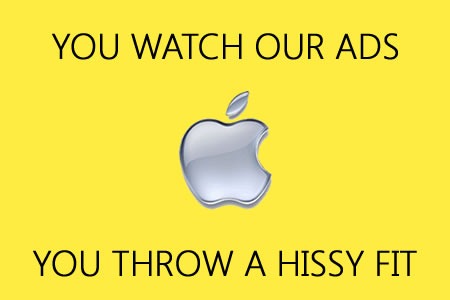
Parody of the "You Find It, You Keep It" graphic: "You watch our ads / You throw a hissy fit"with the Apple logo.

(Click the image to get the story.)

Categories
funny Music

“S” is for “Slayer”!

What happens when you take Sesame Street video and Slayer audio and mash them up? Pure metal goodness!

Categories
The Current Situation

“Because ‘White Male’ Equals Default Human ‘Normal’, See?”

Sonia SotomayorMichael Tomasky nails the real issue of the Sotomayor confirmation hearings perfectly:

Greg Sargent makes a great point about Jeff Sessions getting his knickers all in a twist about the "wise Latina" comment. Sessions said to Sotomayor this morning:

You have evidenced, I think it’s quite clear, a philosophy of the law that suggests that the judge’s background and experiences can and should and naturally will impact their decision — what I think goes against the American ideal…

Now read what Samuel Alito said at his confirmation hearing in 2006:

[W]hen a case comes before me involving, let’s say, someone who is an immigrant — and we get an awful lot of immigration cases and naturalization cases — I can’t help but think of my own ancestors.…

When I get a case about discrimination, I have to think about people in my own family who suffered discrimination because of their ethnic background or because of religion or because of gender. And I do take that into account.

Sessions voted for Alito of course. So it’s all right if you’re a white man, because as we all know, white men don’t have prejudices. Just amazing

Barbara O’Brien does a good job summarizing things in her article Senate Republicans, Sonia Sotomayor and the Default Norm, reminding us:

However, we can see plainly from the hearings yesterday that they can put on public displays of flaming racism and still hang on to their jobs. And, anyway, they don’t have to explicitly proclaim their superior virtues as white men, because it is implicitly assumed.  As Mo Dowd said, “After all, these guys have never needed to speak inspirational words to others like them, as Sotomayor has done. They’ve had codes, handshakes and clubs to do that.”

Categories
Geek Life

FutureRuby Talk: “Fighting the Imperial Californian Ideology”

This article was originally posted to my tech blog, Global Nerdy. Although it’s my notes from a presentation at a programmer’s conference, the subject matter should be just as interesting to non-nerds, as the presentation’s theis is that California — and particularly the Bay Area — has extended its imperial and deleterious influence all over the world.

The final speaker at last weekend’s FutureRuby conference was Jesse Hirsh, a Toronto-based internet consultant, researcher and “talking head” on CBC Newsworld and CBC Radio. As stated on the “About” page on his site, “his passion is for educating people on the potential benefits and perils of technology.”

"California Uber Alles" patch

His presentation, Fighting the Imperial Californian Ideology, was one of the less technical talks of the conference, whose topics ran the gamut from the expected – Ruby programming, programming languages and programming techniques – to topics you might not expect, such as nutrition for nerds, George Orwell and political languages, music and politics. In the end, it was all about building the future.

Here are the notes I took during Jesse’s presentation. I took the original notes and simply turned them into full English sentences and added context and links where necessary.

The Notes

Covers of "Snow Crash" and "Imperial San Francisco"

  • Books that influenced this talk include:
    • Snow Crash by Neal Stephenson, which plays with a lot of ideas for a single novel, including:
      • The overlap of technology and philosophy
      • Ancient history and the near future (as seen from circa 1990)
      • The concept of ideologies being viral
    • Imperial San Francisco by Gray Brechin, which looks at the role that San Francisco has played in the American Empire
  • I spent my life studying Pax Americana and have noted how Californian ideology affects us all
  • The latest version of Californian ideology comes from techies and technophiles:
  • This presentation is about how Californian ideology affects us all

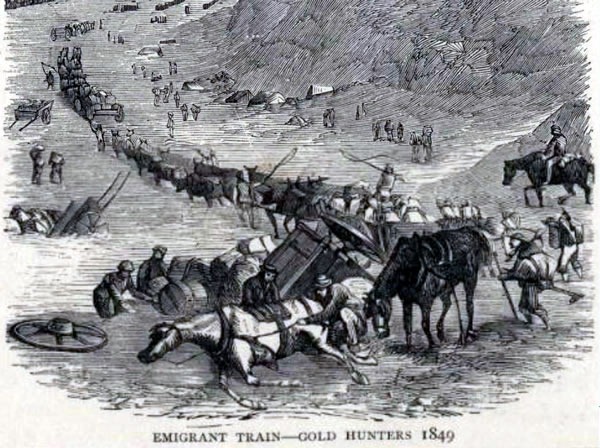
 Etching: "Emigrant Train - Gold Hunters 1849"

  • “California”, as we consider it, has its beginnings in 1846
    • The United States government sent surveyors down to Mexican territory and California in search of gold
    • Minerals and mines are important to empires – there was never any successful empire that wasn’t in control of its own mines
    • In 1846, the U.S. declared war on Mexico to acquire California
    • 1849 marked the beginning of the Gold Rush
  • We need to understand the term “Gold Rush” as it applies to people to work on the internet
  • The dot-com boom of the late 1990s has often been referred to as a new gold rush, and there are parallels
  • Both featured the wealthy and powerful destroying the environment

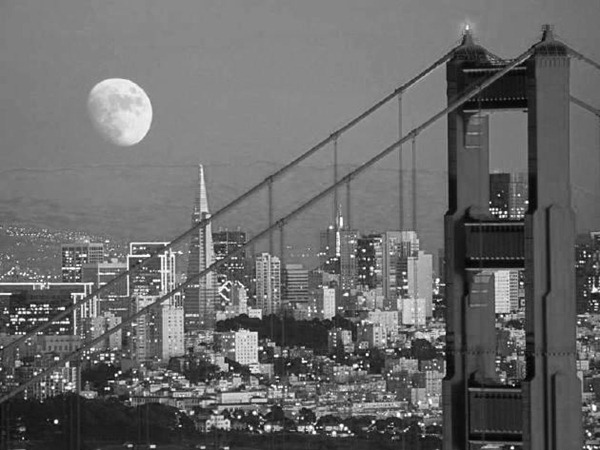
 San Francisco

  • The events of 1849 had many effects:
    • It created an elite whose wealth was based on mining that ruled San Francisco
    • It revolutionized the mining industry, with inventions such as the mineshaft
    • The mineshaft in turn affected cities:
      • At the 1893 World’s Fair in Chicago, the concept of the mineshaft was inverted and the skyscraper was born
      • Offices in skyscrapers take mining principles and apply them to human labour
      • In skyscrapers, instead of mining the earth, you mine people
    • It created William Randolph Hearst

      William Randolph Hearst

      • Hearst was from a family whose wealth had come about from mining; he was a child of the ‘49ers
      • Hearst mines are responsible for large amounts of environmental devastation:
        • 8 out of 10 “Superfund Sites” that are too expensive to clean up
        • Many environmentally devastated mine in Latin America
      • In addition to the deleterious effects of its mines, Hearst is also responsible for The Spanish-American War, a conflict “engineered by Hearst“
      • The prohibition of marijuana was also engineered by Hearst
        • Hearst owned many wood pulp-based paper mills
        • The production of paper using hemp was cheaper and was a threat to his business
  • California is the provider of armaments for the First and Second World Wars
    • Berkeley and Stanford were schools that provided brains for the military
  • California is the home of BALCO – the Bay Area Lab Cooperative – who are responsible for the designer steroids tainting Olympic and professional sports today

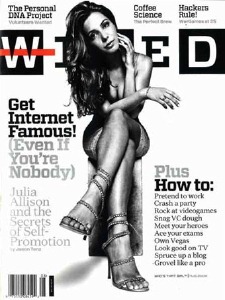
 The "Julia Allison" cover of Wired

  • The Californian ideology represents an elite community
  • There is a perception among its practitioners that the world is theirs for the taking
  • The ideology highlights a past that has been swept into myth
    • That past includes a “Frontier ethos”, and the frontier was not a place for fairness
  • The ideology came about around the time of the oil crisis of the 1970s, which is also when the dollar was de-linked from the gold standard and the U.S.’ influence was beginning to wane
  • It was formalized by Brand, Kelly and the global business network
  • It is a techno-utopian vision spread through publications like Mondo 2000 and later, Wired
  • Kelly’s critiques sold a false mythology of a frontier where anyone can create a business plan
  • This mythology is that of a biological techno-utopia, a hive:
    • Problem: there are many worker bees, but only one queen bee
  • It is a means by which the ruling class maintain their power
  • The idea of the Long Tail is a meme within the California ideology
    • It’s meant to engender complacency about being in the lower ranks
    • In the Long Tail, it’s more of the same: a lucky few get all the cheese

free

  • The latest manifesto is Free Cover of "Free"
    • It’s fundamentally wrong
    • It’s not the “free” part that’s wrong
      • “Free” is disruptive
      • It’s part of the social-centric desire for freedom
    • I went to the recent Free Summit held by TechDirt’s Mike Masnick, where Chris Anderson gave two keynotes
      • Why did it take us 15 – 20 years of online economic business models cause us to realize how important social relations are important? The Communists have been saying this for years
      • We are just realizing the value of social capital
      • What’s missing is the political economy of Free
    • I agree with a large portion of Free, except for one: its ethic of waste
      • Waste is the central ethic of Free
      • The thesis: Now that bandwidth, processor cycles and disk space are abundant, we must waste it. Only through waste will be we innovate
      • The problem is that “waste is an ethic that has fucked us up royally”

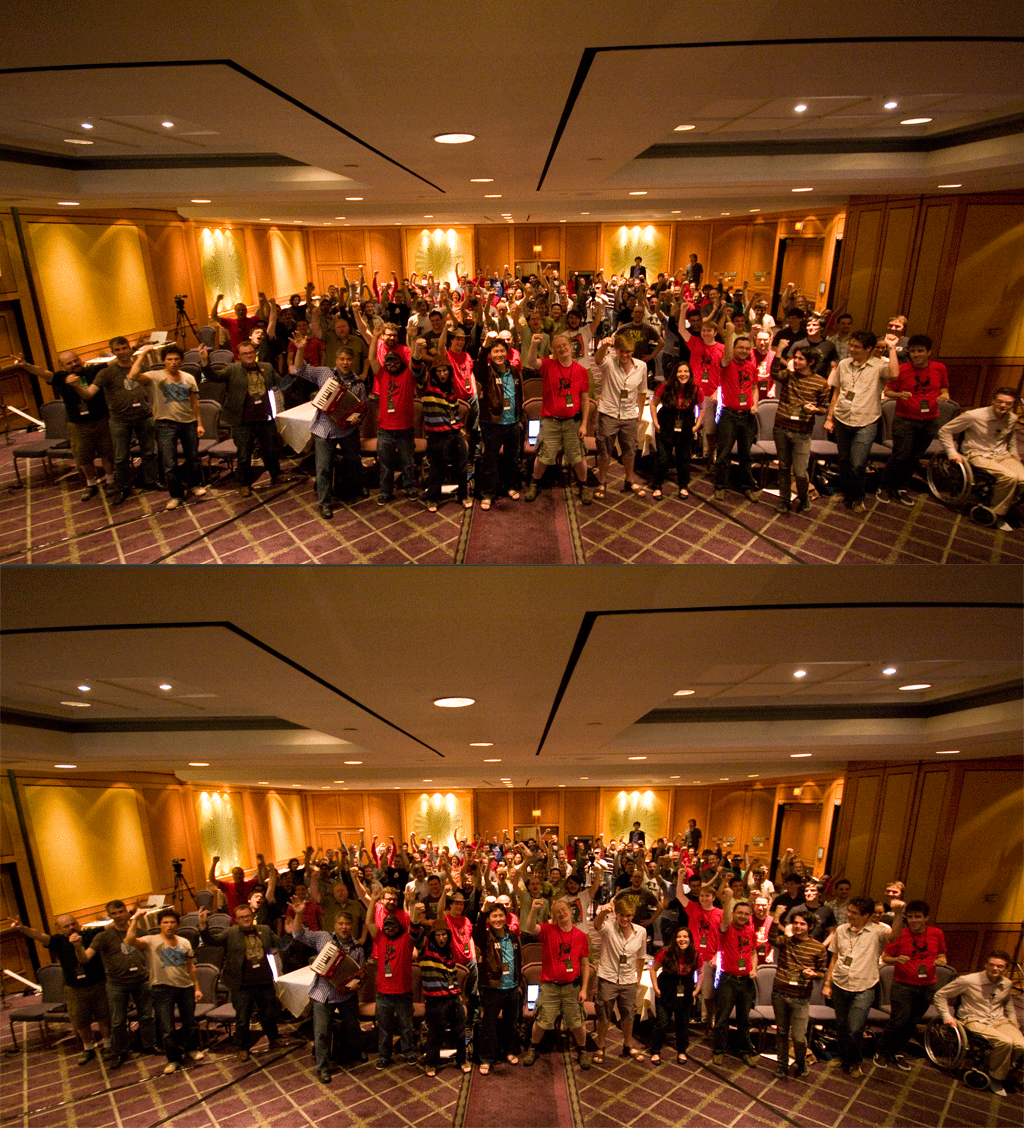
 Animated photo of the FutureRuby crowd

  • The counter to the waste ethic is “How do we make more with less?”
    • That is the revolutionary potential of the internet
  • This counter is revolutionary and anti-ideological
  • “In the 21st century, there’s just culture”
  • It involves holism, which is “a flip on relativism”:
    • “I’m going to take the best shit available and integrate it into a coherent vision”
  • Society is reaching a tipping point where all the stuff we techies do is mainstream:
  • We are:
    • Bowing to masters we don’t need (California)
    • Following business models based on cultures we don’t live in (once again, California)
    • Up against the California ideology, which professes freedom but delivers slavery
  • We need to:
    • Become community activists
    • Help the next generation of AOLamers
      • Remember when AOL joined the ‘net? Suddenly there was a flood of newbies and lamers “and the whole internet went to shit”
      • “Most of the people using the net are fucking idiots”
  • How do we, as the people who can create the tools, places and concepts, quickly get lamers into the metaverse of Snow Crash? It has a lot of positives:
    • Universality: Everywhere, and accessible to everyone
    • Geography: As a virtual reality environment, it provided waypoints and neighbourhoods for different purposes
    • Space: Another byproduct of its virtual reality nature – it gave a sense of place as an means of organization, vs. the “cloud of shit” of our own internet
    • We can create these neighbourhoods for people
  • There is a big problem with "doing whatever is best for business”
    • The free market “fucked us in the last year”
    • Who can you trust?
      • The people you know
      • As a techie and participant in RubyFringe, you’re already doing it; just be conscious of it
      • None of this is new
      • It’s not about ideology, but practice
      • What we think of as the nation-state is done
      • Think of the city-state instead
      • Think of (and participate in) the cities you live in
  • The struggle for human rights continues. Which side are you on?

Discussion

FutureRuby attendee Pat Allan shares his thoughts on this presentation on his blog, Freelancing Gods, in his article titled FutureRuby and Californian Conflict.