
Category: The Current Situation
Categories
Somali Tea Party
I see that couple of editorial cartoonists have connected the dots between the Tea Party crowd and Somalia:
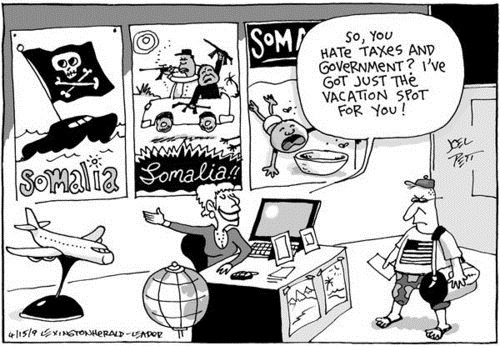
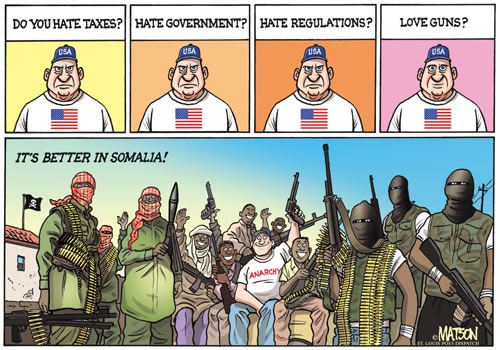
Categories
Chill, Nicolas!

The founding editor of the what’s-up-inside-the-Beltway blog Wonkette makes the suggestion in The Washington Post:
Name a major political story broken by a White House correspondent. A thorough debunking of the Bush case for Iraqi WMD? McClatchy Newspapers’ State Department and national security correspondents. Bush’s abuse of signing statements? The Boston Globe’s legal affairs correspondent. Even Watergate came off The Washington Post’s Metro desk.
Here are some stories that reporters working the White House beat have produced in the past few months: Pocket squares are back! The president is popular in Europe. Vegetable garden! Joe Biden occasionally says things he probably regrets. Puppy!
It’s not that the reporters covering the president are bad at their jobs. Most are experienced journalists at the top of their game — and they’re wasted at the White House, where scoops are doled out, not uncovered. The day of a typical White House correspondent consists, literally, of waiting to be told things. Legitimate security concerns and a tightly scripted political world keep the presidential press corps physically corralled and informationally hostage.
It looks as though even though Greg Gutfeld’s show on Fox News Channel, Red Eye w/ Greg Gutfeld, is consigned to the gulag of the oh-dark-thirty timeslot, his ignorant remarks about the Canadian military caught the attention of many people, including our own Defence Minister Peter MacKay:
Although Gutfeld has some access to the resources of a purported news network, his comments suggest that he was unaware of the fact that Canadian soldiers have been in Afghanistan since 2001, have been fighting in some of the most violent regions of the country and have even taken on friendly fire from their American allies. His timing couldn’t have been worse either; shortly after the broadcast of this show, four Canadian soliders were killed in Afghanistan.
In response, Gutfeld has made a weak half-apology:
I call it a weak half-apology, because it uses the “I’m sorry you were offended” time-worn cop-out instead of the proper “I’m sorry I offended you”:
However, I realize that my words may have been misunderstood. It was not my intent to disrespect the brave men, women and families of the Canadian military, and for that I apologize. Red Eye is a satirical take on the news, in which all topics are addressed in a lighthearted, humorous and ridiculous manner.
Was he not there when he did his piece on the Canadian military? There’s not much to “misunderstand”. Perhaps we should start referring to him as Greg Gutless.
Red Eye, which is a poor (and possibly brain-damaged) man’s attempt to capture some of the flavour of The Daily Show, often has commentary on the news with guests weighing in. One of the guests weighing in was comedian Doug Benson, who pitched in with his own ignorant remarks. He was scheduled to perform at The Comic Strip at the West Edmonton Mall later this month, but it has since been cancelled. After his remarks on Red Eye, doing stand-up at Canada’s murder rate capital might not be such a good idea.
Once you’ve read this piece and seen the video, see the follow-up story, Greg Gutfeld’s Gutless Apology.
This is even beyond Greg Gutfeld’s run-of-the-mill ignorant, this is the man – and I use the term very loosely – taking it to all-new lows in a piece on the Canadian military and its Afghanistan mission:
Categories
“The Big Takeover”
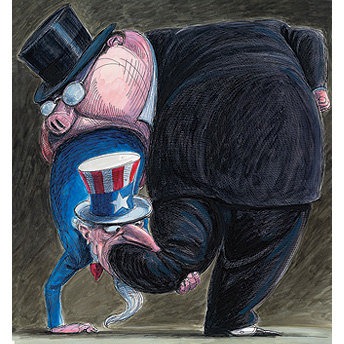
The Big Takeover (here’s the regular version, and here’s the single-page “printer-friendly” version) is a Rolling Stone article that suggests that the global economic crisis isn’t about money, but power, and that Wall Street insiders are using the bailout as fuel for an all-out move to take over. Here’s an excerpt from the end of the article:
As complex as all the finances are, the politics aren’t hard to follow. By creating an urgent crisis that can only be solved by those fluent in a language too complex for ordinary people to understand, the Wall Street crowd has turned the vast majority of Americans into non-participants in their own political future. There is a reason it used to be a crime in the Confederate states to teach a slave to read: Literacy is power. In the age of the CDS and CDO, most of us are financial illiterates. By making an already too-complex economy even more complex, Wall Street has used the crisis to effect a historic, revolutionary change in our political system — transforming a democracy into a two-tiered state, one with plugged-in financial bureaucrats above and clueless customers below.
The most galling thing about this financial crisis is that so many Wall Street types think they actually deserve not only their huge bonuses and lavish lifestyles but the awesome political power their own mistakes have left them in possession of. When challenged, they talk about how hard they work, the 90-hour weeks, the stress, the failed marriages, the hemorrhoids and gallstones they all get before they hit 40.
"But wait a minute," you say to them. "No one ever asked you to stay up all night eight days a week trying to get filthy rich shorting what’s left of the American auto industry or selling $600 billion in toxic, irredeemable mortgages to ex-strippers on work release and Taco Bell clerks. Actually, come to think of it, why are we even giving taxpayer money to you people? Why are we not throwing your ass in jail instead?"