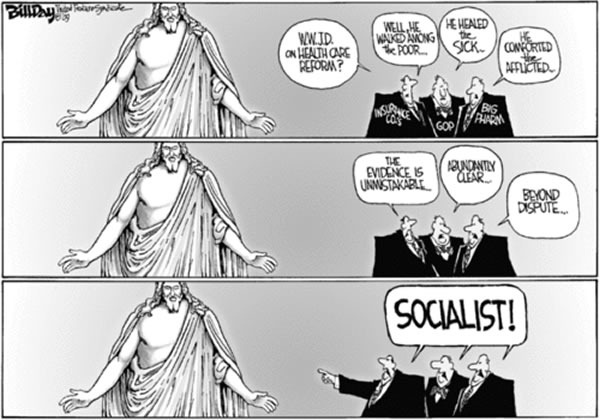
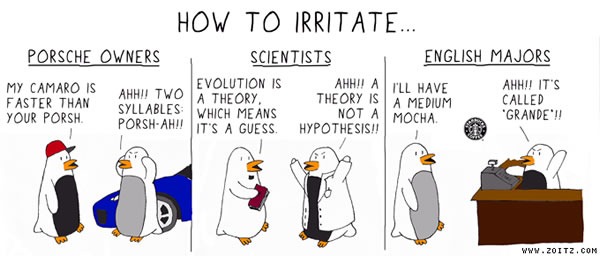
(Click the image to get the story.)
Author: Joey deVilla
What happens when you take Sesame Street video and Slayer audio and mash them up? Pure metal goodness!
Michael Tomasky nails the real issue of the Sotomayor confirmation hearings perfectly:
Greg Sargent makes a great point about Jeff Sessions getting his knickers all in a twist about the "wise Latina" comment. Sessions said to Sotomayor this morning:
You have evidenced, I think it’s quite clear, a philosophy of the law that suggests that the judge’s background and experiences can and should and naturally will impact their decision — what I think goes against the American ideal…
Now read what Samuel Alito said at his confirmation hearing in 2006:
[W]hen a case comes before me involving, let’s say, someone who is an immigrant — and we get an awful lot of immigration cases and naturalization cases — I can’t help but think of my own ancestors.…
When I get a case about discrimination, I have to think about people in my own family who suffered discrimination because of their ethnic background or because of religion or because of gender. And I do take that into account.
Sessions voted for Alito of course. So it’s all right if you’re a white man, because as we all know, white men don’t have prejudices. Just amazing
Barbara O’Brien does a good job summarizing things in her article Senate Republicans, Sonia Sotomayor and the Default Norm, reminding us:
However, we can see plainly from the hearings yesterday that they can put on public displays of flaming racism and still hang on to their jobs. And, anyway, they don’t have to explicitly proclaim their superior virtues as white men, because it is implicitly assumed. As Mo Dowd said, “After all, these guys have never needed to speak inspirational words to others like them, as Sotomayor has done. They’ve had codes, handshakes and clubs to do that.”
This article was originally posted to my tech blog, Global Nerdy. Although it’s my notes from a presentation at a programmer’s conference, the subject matter should be just as interesting to non-nerds, as the presentation’s theis is that California — and particularly the Bay Area — has extended its imperial and deleterious influence all over the world.
The final speaker at last weekend’s FutureRuby conference was Jesse Hirsh, a Toronto-based internet consultant, researcher and “talking head” on CBC Newsworld and CBC Radio. As stated on the “About” page on his site, “his passion is for educating people on the potential benefits and perils of technology.”
His presentation, Fighting the Imperial Californian Ideology, was one of the less technical talks of the conference, whose topics ran the gamut from the expected – Ruby programming, programming languages and programming techniques – to topics you might not expect, such as nutrition for nerds, George Orwell and political languages, music and politics. In the end, it was all about building the future.
Here are the notes I took during Jesse’s presentation. I took the original notes and simply turned them into full English sentences and added context and links where necessary.
The Notes
- Books that influenced this talk include:
- Snow Crash by Neal Stephenson, which plays with a lot of ideas for a single novel, including:
- The overlap of technology and philosophy
- Ancient history and the near future (as seen from circa 1990)
- The concept of ideologies being viral
- Imperial San Francisco by Gray Brechin, which looks at the role that San Francisco has played in the American Empire
- Snow Crash by Neal Stephenson, which plays with a lot of ideas for a single novel, including:
- I spent my life studying Pax Americana and have noted how Californian ideology affects us all
- The latest version of Californian ideology comes from techies and technophiles:
- …starting with Stewart Brand
- and the going to Kevin Kelly
- and now Chris Anderson
- This presentation is about how Californian ideology affects us all
- “California”, as we consider it, has its beginnings in 1846
- The United States government sent surveyors down to Mexican territory and California in search of gold
- Minerals and mines are important to empires – there was never any successful empire that wasn’t in control of its own mines
- In 1846, the U.S. declared war on Mexico to acquire California
- 1849 marked the beginning of the Gold Rush
- We need to understand the term “Gold Rush” as it applies to people to work on the internet
- The dot-com boom of the late 1990s has often been referred to as a new gold rush, and there are parallels
- Both featured the wealthy and powerful destroying the environment
- The events of 1849 had many effects:
- It created an elite whose wealth was based on mining that ruled San Francisco
- It revolutionized the mining industry, with inventions such as the mineshaft
- The mineshaft in turn affected cities:
- At the 1893 World’s Fair in Chicago, the concept of the mineshaft was inverted and the skyscraper was born
- Offices in skyscrapers take mining principles and apply them to human labour
- In skyscrapers, instead of mining the earth, you mine people
- It created William Randolph Hearst
- Hearst was from a family whose wealth had come about from mining; he was a child of the ‘49ers
- Hearst mines are responsible for large amounts of environmental devastation:
- 8 out of 10 “Superfund Sites” that are too expensive to clean up
- Many environmentally devastated mine in Latin America
- In addition to the deleterious effects of its mines, Hearst is also responsible for The Spanish-American War, a conflict “engineered by Hearst“
- The sinking of the U.S.S. Maine [the “False Flag Conspiracy Hypothesis”]
- The takeover of the Philippines
- The prohibition of marijuana was also engineered by Hearst
- Hearst owned many wood pulp-based paper mills
- The production of paper using hemp was cheaper and was a threat to his business
- California is the provider of armaments for the First and Second World Wars
- Berkeley and Stanford were schools that provided brains for the military
- California is the home of BALCO – the Bay Area Lab Cooperative – who are responsible for the designer steroids tainting Olympic and professional sports today
- The Californian ideology represents an elite community
- There is a perception among its practitioners that the world is theirs for the taking
- The ideology highlights a past that has been swept into myth
- That past includes a “Frontier ethos”, and the frontier was not a place for fairness
- The ideology came about around the time of the oil crisis of the 1970s, which is also when the dollar was de-linked from the gold standard and the U.S.’ influence was beginning to wane
- It was formalized by Brand, Kelly and the global business network
- It is a techno-utopian vision spread through publications like Mondo 2000 and later, Wired
- Kelly’s critiques sold a false mythology of a frontier where anyone can create a business plan
- This mythology is that of a biological techno-utopia, a hive:
- Problem: there are many worker bees, but only one queen bee
- It is a means by which the ruling class maintain their power
- The idea of the Long Tail is a meme within the California ideology
- It’s meant to engender complacency about being in the lower ranks
- In the Long Tail, it’s more of the same: a lucky few get all the cheese
- The latest manifesto is Free
- It’s fundamentally wrong
- It’s not the “free” part that’s wrong
- “Free” is disruptive
- It’s part of the social-centric desire for freedom
- I went to the recent Free Summit held by TechDirt’s Mike Masnick, where Chris Anderson gave two keynotes
- Why did it take us 15 – 20 years of online economic business models cause us to realize how important social relations are important? The Communists have been saying this for years
- We are just realizing the value of social capital
- What’s missing is the political economy of Free
- I agree with a large portion of Free, except for one: its ethic of waste
- Waste is the central ethic of Free
- The thesis: Now that bandwidth, processor cycles and disk space are abundant, we must waste it. Only through waste will be we innovate
- The problem is that “waste is an ethic that has fucked us up royally”
- The counter to the waste ethic is “How do we make more with less?”
- That is the revolutionary potential of the internet
- This counter is revolutionary and anti-ideological
- “In the 21st century, there’s just culture”
- It involves holism, which is “a flip on relativism”:
- “I’m going to take the best shit available and integrate it into a coherent vision”
- Society is reaching a tipping point where all the stuff we techies do is mainstream:
- Twitter: trending topics on Twitter are determining what CNN covers
- Local crime: these days, news reports on local crime always include some element of internet-based activity (e.g. “The Craigslist Killer”)
- We are:
- Bowing to masters we don’t need (California)
- Following business models based on cultures we don’t live in (once again, California)
- Up against the California ideology, which professes freedom but delivers slavery
- We need to:
- Become community activists
- Help the next generation of AOLamers
- Remember when AOL joined the ‘net? Suddenly there was a flood of newbies and lamers “and the whole internet went to shit”
- “Most of the people using the net are fucking idiots”
- How do we, as the people who can create the tools, places and concepts, quickly get lamers into the metaverse of Snow Crash? It has a lot of positives:
- Universality: Everywhere, and accessible to everyone
- Geography: As a virtual reality environment, it provided waypoints and neighbourhoods for different purposes
- Space: Another byproduct of its virtual reality nature – it gave a sense of place as an means of organization, vs. the “cloud of shit” of our own internet
- We can create these neighbourhoods for people
- There is a big problem with "doing whatever is best for business”
- The free market “fucked us in the last year”
- Who can you trust?
- The people you know
- As a techie and participant in RubyFringe, you’re already doing it; just be conscious of it
- None of this is new
- It’s not about ideology, but practice
- What we think of as the nation-state is done
- Think of the city-state instead
- Think of (and participate in) the cities you live in
- The struggle for human rights continues. Which side are you on?
Discussion
FutureRuby attendee Pat Allan shares his thoughts on this presentation on his blog, Freelancing Gods, in his article titled FutureRuby and Californian Conflict.
Where Does the Money Go?
Whether you’re part of the local tech community or a visitor from out of town who’s come in for the FutureRuby conference, you’re invited to the Developer Lunch taking place today at noon at Sky Dragon restaurant in Dragon City Mall.
This is going to be the 14th developer lunch organized by local developer and video-chronicler of local geekdom, Kristan “Krispy” Uccello. They’re not formal at all – there’s no agenda, set discussion topic or presentations – it’s just people who like writing software or who aspire to write software getting together to enjoy a nice dim sum lunch.
The lunch takes place at Sky Dragon restaurant, which is at the top floor of Dragon City shopping mall, which in turn is at the southwest corner of Dundas and Spadina. If you’re a FutureRuby attendee from out of town, that’s a five-minute walk from the conference hotel.
For those of you not familiar with Chinatown, here’s what Dragon City Mall looks like:
Use the elevator or stairs in the circular tower part of the building to go to the mall’s top floor, which is where the restaurant is located. We expect that we’ll be a big crowd, so they might put us in one of the private rooms in the back – if you don’t see a bunch of geeks in the restaurant, ask the waitstaff for the large group of computer programmers and they’ll lead you to us.
It’s dim sum, which means the food will be tasty, cheap and plentiful. Everybody pitches in equally towards the final bill and it’s typically $12/person including tip.
See you at noon!
Welcome to the second installment of The Unofficial FutureRuby Guide to Toronto! This is a series of articles aimed at showing out-of-town attendees of the upcoming FutureRuby conference around our fine city. (It’s useful even if you’re not planning on attending the conference).
In case you missed the previous installment, it’s here:
You might find last year’s Toronto guide for RubyFringe attendees useful as well:
This article will give you a quick run-down of all the conference and party venues: where they are, what they’re like and how to get there.
Conference Hotel: The Metropolitan Downtown
FutureRuby will take place at the Metropolitan Toronto Hotel, where RubyFringe took place last year. If you attended RubyFringe, it’ll be a happy homecoming. If this is your first conference at the Metropolitan, you’re in for a treat.
As I wrote in last year’s article series on RubyFringe, Toronto has two Metropolitan Hotels, and they’re a short distance from each other. FutureRuby’s venue is the Metropolitan Toronto, whose address is 108 Chestnut Street, which is behind City Hall, on the edge of Chinatown. If the hotel entrance looks like the photo above, you’re in the right place.
The other Metropolitan Hotel is the Metropolitan Soho, located at 318 Wellington Street West. If the hotel looks like the photo to the right (click to see a larger version), you’re in the wrong place. Both are owned by the same hotel chain. The Soho is the hip, swanky one near the club district and the Toronto one looks more like a traditional hotel and caters to both business and Chinese clienteles.
(In this article series, whenever I refer to “The Metropolitan”, I mean the Metropolitan Toronto.)
The conference setup at the Metropolitan is pretty nice. The conference hall is in the basement, fits the conference’s numbers nicely, and the entryway to the hall is stocked with water, coffee and ice tea throughout the day. There’s a continental breakfast just outside the hall before the conference starts, and the lunch food is excellent – it’s the best conference lunch I’ve seen at a developer conference, with the notable exception of the Fall 2006 Ajax Experience’s venue, the Westin Boston Waterfront, and that conference cost over twice as much. Of particular note was the Chinese lunch, which wasn’t a surprise – the hotel’s main restaurant is Lai Wah Heen, a Chinese restaurant, and it’s a popular venue for Chinese weddings (I’ve been to a couple here, and the food was great).
The hotel is situated right in the middle of town, which puts it a stone’s throw from a number of places. I’ll write more about these places in a later article.
You might also want to see my article from last year, Getting from the Airport to the Hotel.
FailCamp: Queen City Yacht Club
FailCamp will take place at Queen City Yacht Club on Algonquin Island, one of the Toronto Islands. The Toronto Islands weren’t always islands – once upon a time, they were a peninsula jutting out from the mainland from east of downtown, but a big storm in the mid-1800s separated them from the rest of the city. Most people get to the islands via ferry or water taxi.
The current strike by city employees means that there is no ferry service to the island, but that’s not going to be a problem. Queen City Yacht Club has its own launch – they call it a “tender” – that can carry just under fifty people at a time.
The launch typically picks people up from the dock just east of Queen’s Quay Terminal (207 Queen’s Quay West, the building pictured to the right). If you’re facing the front of this building, the dock is just to its left. I don’t know the exact details, but if you’re going to FailCamp, I suggest arriving at Queen’s Quay Terminal early, going to the dock to the left of the building and looking around for FutureRuby people or signs; I’m sure they’re going to take care to make sure that they’re really obvious.
I believe that the launch will be running continually throughout the night to shuttle people between Queen City Yacht Club and the mainland, but there’s a water taxi nearby, just in case.
The venue will be Queen City Yacht Club’s house clubhouse (pictured above), a large place with a nice large outdoor deck overlooking the water and the city. It offers some great vantage points for taking photos of Toronto. There’s a large barge permanently moored to a nearby dock; it’s also a good place from which to shoot photos or just stare at the lake.
Unlike the other FutureRuby events, you should bring some money for drinks and get a bite to eat before FailCamp (your FutureRuby registration fees cover the food and booze at the other events). The Yacht Club’s bar will be open during the event; I recall that they generally have pretty good beer on tap. As for getting food prior to FailCamp, there are lots of places near the Metropolitan Hotel and in the Queen’s Quay Terminal building.
Friday Night’s Party: Unspace HQ
Unspace’s offices are the venue for FutureRuby’s official opening night party. It’s located above the Lululemon store, which functions as both a store for sportswear and a temple for whatever religion is practiced by skinny blonde women in yoga pants. Apparently the store also sells clothes for men, but I reckon that a guy wearing a Lululemon logo is asking to have his manhood challenged, A Boy Named Sue-style. Unspace’s door is just to the right of Lululemon and leads to a steep set of stairs leading up to the third floor. I’m sure that there will be FutureRuby officials outside to make sure people find the place.
Unspace is located on Queen Street West (342 Queen Street West, to be precise), a long-time destination for people looking for someplace cool to go. Mike Myer’s character “Dieter” from his recurring Sprockets skits on Saturday Night Live was based on a real guy named Dieter who waited tables at The Rivoli (“Your order is boring me. I shall dance now”), a popular bar on Queen West. Perez Hilton needled Will.I.Am from the Black Eyed Peas and got (justifiably) clocked here. I’ve had many busking adventures on this street. It’s a fun, lively place.

Unspace has a gorgeous office, with exposed brick walls, a vintage pinball machine, Pete Forde’s “I am a villain in a classic James Bond movie” office and a large rooftop deck that’s been the venue for a number of excellent parties.
Saturday Night’s Party: Pravda Vodka Bar
Saturday night’s festivities will happen at Pravda Vodka Bar (44 Wellington Street East). This is the one party venue for which my first-hand knowledge is lacking owing to these factors:
- I’ve been there only once
- It was fairly late in the evening, the bar was packed, and I was already quite crispy from drinks at Biff’s, a nearby French restaurant with a lovely bar of its own.
I do remember a pretty good selection of vodkas. That’s to be expected; it is a vodka bar, after all. I had a couple of fingers of the Polish stuff straight up – the kind with a blade of grass in the bottle – and a pretty dirty Dirty Martini (a Martini seasoned with not just an olive, but olive juice).
I have vague memories of the room: lot of red velvet, gold trim and pre-Glasnost kitsch, a contradictory mash-up of imagery of from the Russian Revolution and a set designer’s ideas for a stage adaptation of Anna Karenina. It made a nice backdrop for the crowd, who were by and large ranged from twenty-somethings in clubwear to forty-something well-dressed professionals. I remember dancing and playing the accordion along to the DJ, who was playing Deee-Lite’s Groove is in the Heart (a song which turns twenty this year!).
The Saturday night party is the “dress-up night” of FutureRuby. Bring something nice and nightclub-appropriate!
Sunday’s Party: The Boat/Hotshot Gallery/Augusta Street, Kensington Market
Kensington Market is where the closing party will take place. It’s a lovely mishmash of secondhand clothing stores, fresh food markets, quirky shops and restaurants, patios and people’s homes. Here’s a slideshow of shots I took in Kensington Market last year; it should give you a “feel” for the place:
Created with Admarket’s flickrSLiDR.
It’s the home of a couple of great nerdy places, too:
- Function 13, a funky store catering to arty nerds, with lots of books on design and design-oriented technologies such as Processing and Flash (maybe I should see if they stock Silverlight books, and help them if they don’t). It’s also where a lot of people take lessons on multimedia programming.
- HacklabTO, Toronto’s very own hackerspace, where local nerds work on both software and hardware hobby projects, and where I sometimes work. It’s the home of the famous laser that does etching, cutting and even music playing.
The final party of FutureRuby will take place on a stretch of Augusta Avenue in Kensington Market. Augusta Avenue. Known venues for this street party will include:
- The Boat (158 Augusta Avenue), a Portuguese restaurant that also doubles as one of Toronto’s best “secret” party spots.
- Hotshot (181 Augusta Avenue) a gallery owned and run by my friend Karlen Chang, a spot that serves both excellent coffee and visual art.