Categories












































My move from Toronto to Florida — a little over eight years ago now — forced me to really apply a rule I try to follow: If you’ve been hanging onto something and never use it, let it go. Sell it, give it to someone who really needs it, or toss it. I’ve had to use this rule more since moving from Toronto to Tampa, as the move required me to take only what I could fit in my old car, and because I didn’t want to treat my mother’s basement in Toronto like a free storage place forever.
In spite of this rule, I’ve hung on to one piece of clothing that I’ve had since the very last days 1999 and that I almost never wear. It’s a grey zippered sweatshirt, which you can see below:

There’s nothing terribly bad about it; I like the color, but the cut’s all wrong, it’s a little too big, it has ridiculous snap-straps all over (in the photo, you can see one of them around the neck).
While it’s perfectly serviceable, I don’t like it enough to keep it under normal circumstances. It would’ve ended up at the drop-off of a Goodwill or some other charity ages ago. Still, I keep it, and I only get it dry-cleaned by professionals. Why? Because it’s a special gift from my dad.

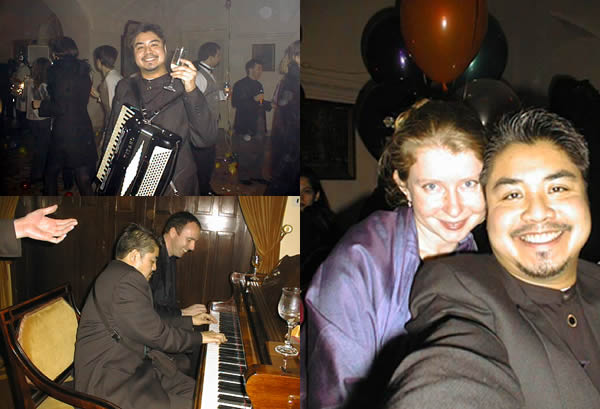
In 1999, my former high school classmate André Fenton was doing neuroscience research at the Czech Academy of Sciences and decided that he wanted to ring in the year 2000 by throwing a big New Year’s Eve party in the nicest place that he could rent somewhere near Prague.
He found a great place — Zamek Roztěž (although these days, it’s marketed as Casa Serena Chateau and Gold Resort). It’s a “hunting castle” originally built in the late 1600s in the village of Roztěž, located in the Kutna Hora district, about 80 kilometers (50 miles) east of Prague. I was invited to the party, and while there, had a grand old time:
Upon hearing that I would be staying at a castle somewhere in the central European woods in the dead of winter, Dad decided to surprise me by buying me something to keep me warm. That thing was the zippered sweatshirt, and he gave it to me just as he dropped me off at the airport to catch my flight to Amsterdam, and then Prague.
“I got this for you. I don’t want you to be cold when you’re in that castle.”
I thanked him for the sweatshirt, gave him a big hug, wished him a happy new year in advance, and told him that I’d send photos that I’d take with my still-newish digital camera (1024 by 768 pixels in super-fine mode!) to mom via email (he never had an email address).
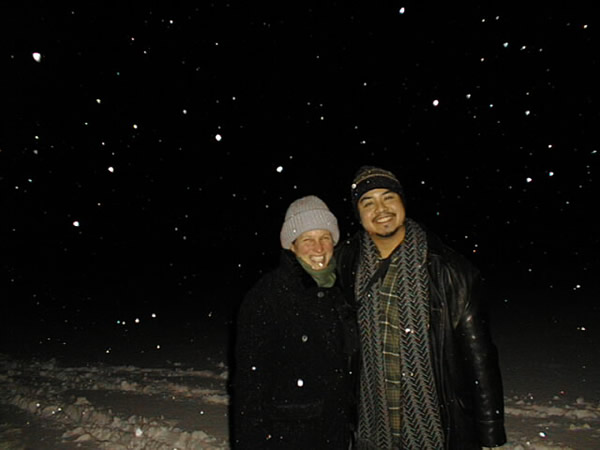
It’s not really what I would’ve bought, but it’s big and warm, I thought, and it served me well on the flight, in the castle (which wasn’t all that cold — they’d been doing a fair bit of renovating), and especially well on a hike around the castle grounds with some lovely company on the night of January 1st, 2000.
Because I am a big ol’ sentimental softie, not only have I kept this sweatshirt that I don’t really like all these years, but I take it with me whenever I go someplace cold, as a sort of comforting tradition.
I wore it walking through the streets of Prague. I had it on the slopes at Whistler while trying to figure out how snowboarding worked. I wore it when I was conducting mobile technology assessments in the bitter cold of Athabasca’s oil sands. As I drove through the snow-covered hills of West Virginia on those chilly days of March 2014 as I moved to Tampa to be with Anitra, I had it on. I bring it with me on our trips to Toronto in winter. I last wore it earlier this year when the temperatures in Tampa dropped to freezing and I had to cover the tropical plant in the front yard.
When I need it, it keeps me warm — not only in the physical sense, but also in the way that it reminds me of his kindness and generosity.
Dad died at the end of February 2006. But thanks to this sweatshirt that I normally wouldn’t be all that crazy about, I have a little bit of him that I can take with me when I’m cold and far from home. That’s why I’ll never part with it.
Happy Father’s Day, everyone.

In this video posted on Reddit’s “WallStreetBets” subreddit, you can see a cabbie who knows how to make the most of every moment. While at a red light, he’s on a tablet trading Bitcoin.

Consider the risks involved:
…this cabbie loves to live dangerously! I wish him lots of luck.

 Last night was just a tropical storm and not a hurricane, but Nebraska Avenue south of Sligh — not a tiny road, but a main thoroughfare — flooded so much that a number of cars had stalled out there. It gave me serious Philippines deja vu, where flooding often happens after a typhoon.
We flew home from Toronto yesterday, and fortunately, we landed about 20 minutes before the storm hit. I took the photo above from our ride.
Chad Baker posted this bit of advice on Facebook back in 2018, and I became aware of it yesterday thanks to Tim Tate:
Apparently this tribal knowledge has not been passed down.
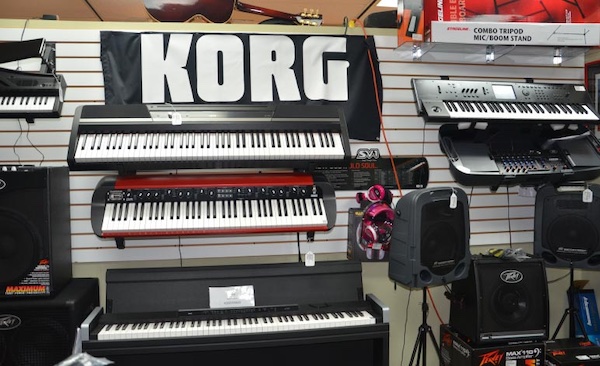
If someone at school is bullying you, go to any pawn shop (there’s one in every town) DO NOT GO TO THE RIFLE WALL, TURN AROUND and go to the OTHER wall, and buy one of these:
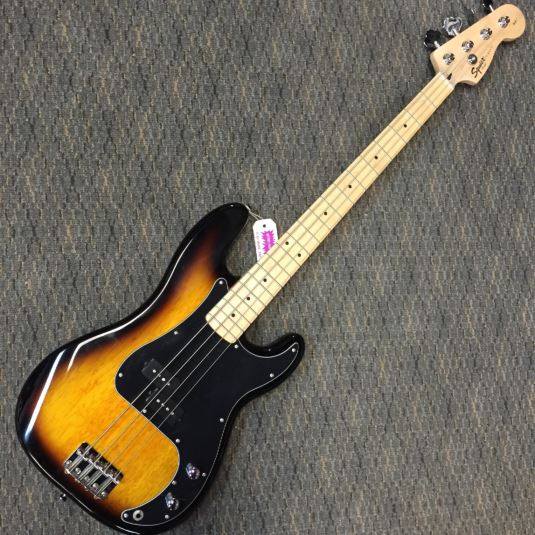
Or, if your preference is towards keyboards, something like this:

You can purchase one at any age. There is no background check. They are cheap. There is no waiting period. You can open carry them anywhere.
Take it home. Practice. Talk to other dorks that wear the same shirts you do. Start a band. Get loud. Scream about how rotten it is that everyone is against you and no one will sleep with you. Get it all out.
DO NOT KILL ANYONE.
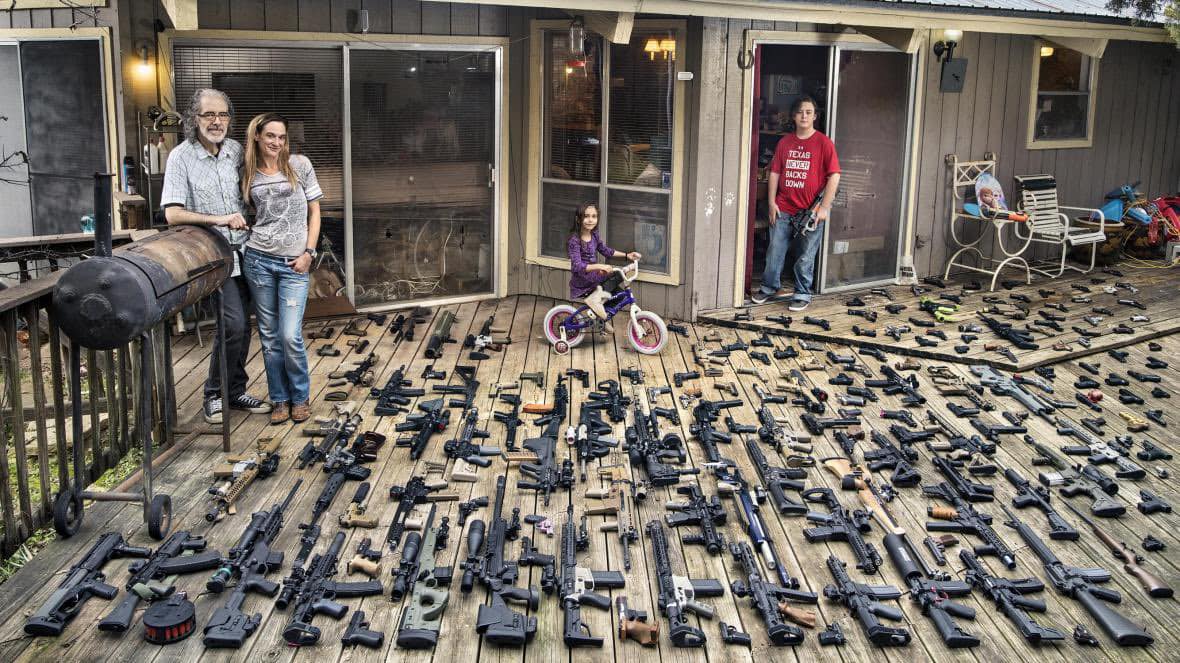
Now don’t get me wrong: guns are cool and fun to fire (my great-uncle’s company is the Philippines’ biggest Winchester importer), but too many people in the U.S. have either made it the god they worship, or at least a core part of their identity. And as a result, the guns come out whenever they feel threatened, or even just slighted — as a response to bullying, the bogus “Great Replacement,” or even when a fellow movie-goer throws popcorn at them.
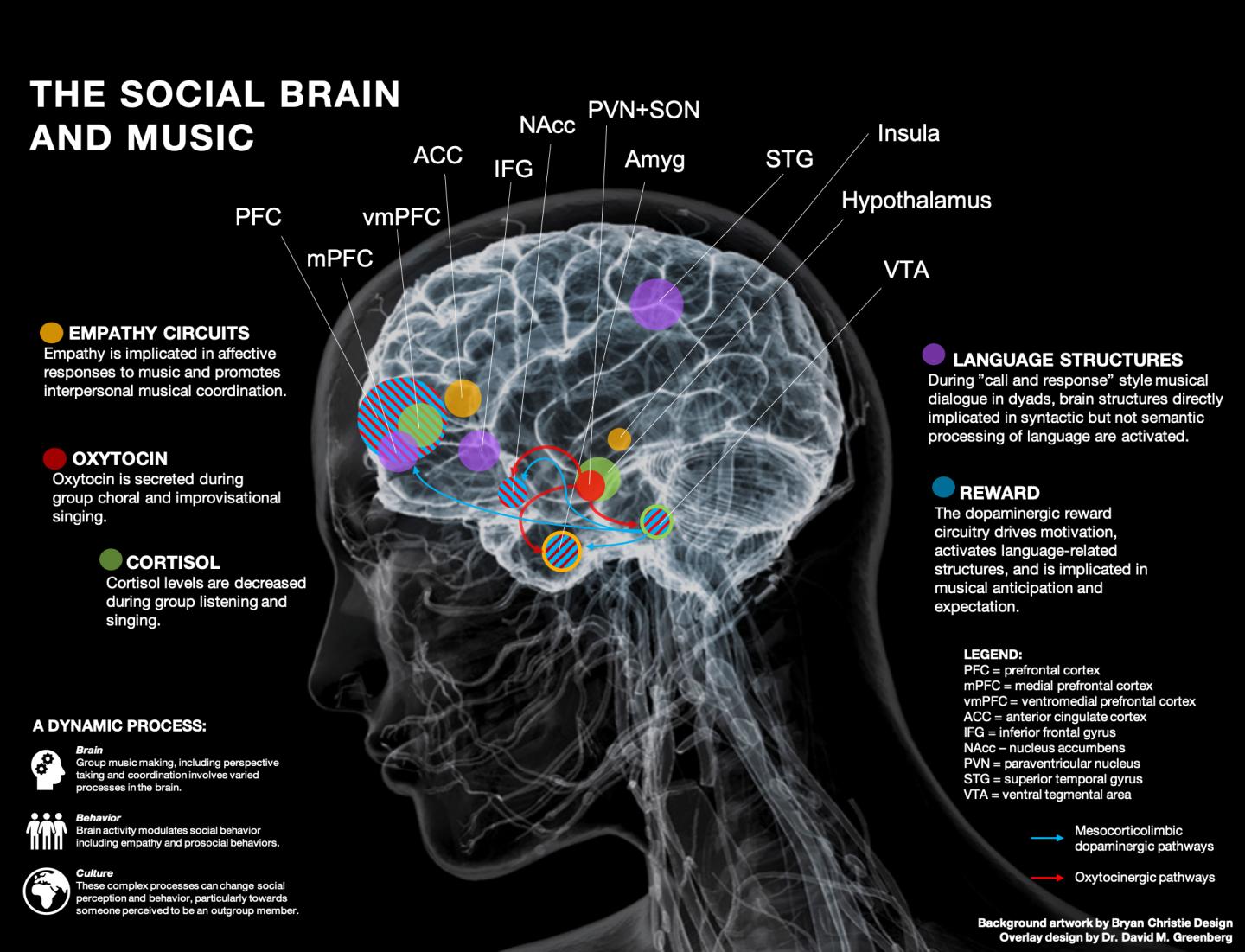
The old canard that hardcore misinterpreters of the Second Amendment like to pull out after every shooting is “We don’t have a gun problem, we have a mental health problem” (and while mental health does play a role, science — and Science — point out that the issue actually is an over-proliferation of guns).
But let’s assume that it’s just a mental health issue. Want a fix? Get more people to pick up musical instruments instead of guns. We have lots of research and evidence showing the cognitive and emotional benefits of listening and playing music, and lots of research on the deleterious effects of guns and “gun thinking.”

Pick up an instrument. Master a skill that will pay off in so many ways, from dexterity to improved brain function to confidence discipline and time management to creativity to making friends.