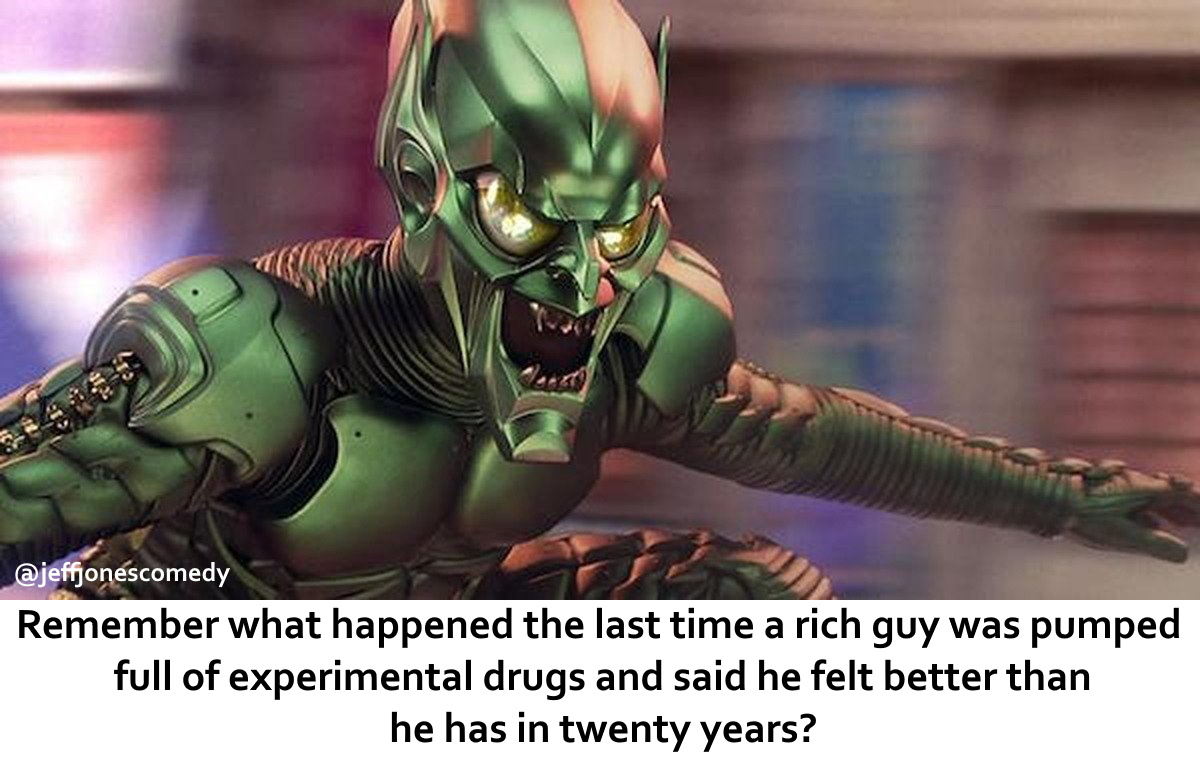
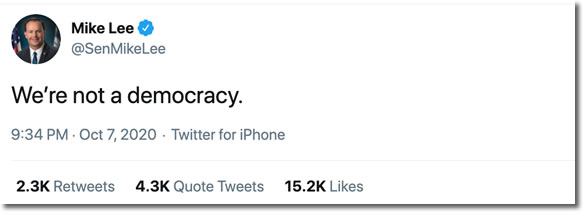
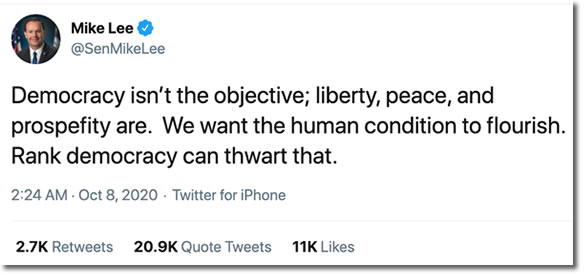
Yesterday afternoon, former Trump campaign manager Brad Parscale was “Baker Acted”. That’s a term that I’d never heard of before moving to Florida, and it refers to the Baker Act, the colloquial name for the Florida Mental Health Act of 1971. It’s for involuntarily institutionalizing a person who may have a mental illness and is posing a threat to themself or others.
The Fort Lauderdale Police Department said in a statement to Business Insider that officers responded to Parscale’s home shortly before 4 p.m. local time after his wife called the police.
Parscale, who was the only person inside the home at the time, “had access to multiple firearms inside the residence and was threatening to harm himself,” according to the statement.
“Officers made contact with the male, developed a rapport, and safely negotiated for him to exit the home,” the department said in the statement. “The male was detained without injury and transported to Broward Health Medical Center for a Baker Act.”
If you watched the Netflix dramatized documentary The Social Dilemma, you might be wondering who the advertisers who helped turned Facebook into a cesspool are. Parscale is chief among them, as he’s credited as the one who came up with the 2016 campaign’s Facebook strategy.
One of Parscale’s customers sat on a flight next to a passenger who would soon join the Trump Organization. Parscale’s work came up, and eventually he got an email from the seatmate asking whether he wanted to bid on developing a website for Trump’s company.
Parscale, a regular viewer of Trump’s reality show, “The Apprentice,” jumped at the chance.
“I just made up a price,” said Parscale, offering to do it for $10,000. He told Trump’s son Eric that the money was refundable if the work was unsatisfactory. “I recognized that I was a nobody in San Antonio, but working for the Trumps would be everything.”
Eric Trump became Parscale’s biggest supporter. “He wowed me,” Eric Trump said in an interview. “I found myself going to Brad over and over again.”
Over the next five years, the Trump Organization sent hundreds of thousands of dollars worth of website-related work to Parscale.
In mid-2015, Parscale got a call from Jared Kushner asking how he would run the Trump campaign’s digital strategy:
Since that time, Parscale’s companies — and yes, that plural companies — have been raking in millions from the Trump campaign, and he’s done well as a result.
he’s probably leveraged to the hilt, just from his real estate spending alone (over $4 million — he’s been trying to rent out the condos for some time), never mind the cars and other accoutrements of the Fort Lauderdale nouveau riche lifestyle.
Yesterday’s article, Long-Concealed Records Show Trump’s Chronic Losses And Years Of Tax Avoidance, got a lot of people talking about how little tax Trump has paid over the past couple of decades.
While the tax issue is irksome, what concerns me more is Trump’s debt. A key part of his campaign was that he was a successful businessman, and as a rich person, he couldn’t be bought.
Trump is personally responsible for over $300 million in loans which are due for payment over the next four years, and his sources of revenue are in the hospitality industry, which has taken a big hit due to the pandemic.
…Parscale’s accounts of his life and his work for the president comprise a classic Trumpian tale: They’re a combination of hyperbole, half-truths and the occasional fiction. Indeed, Parscale shares more than one trait with his most important client. He has embraced political beliefs not in evidence before the 2016 campaign. Like Trump, he has adapted to opportunities as they arose. And like Trump, Parscale is largely unencumbered by the concerns for consistency and accuracy that are the hobgoblins of smaller minds.
…who find themselves in similar situations:
Facing a reversal of fortunes,
under investigation, and
deeply in debt (Trump’s debt is certain, Parscale’s is probable, given that just a decade ago, he was doing low-ball bids on website work).
Faced with this crisis, Parscale had a meltdown. What happens when the President* has to reckon with a similar situation?
The resolution did not reference Trump by name or the presidency, yet it passed on a largely party-line vote — with 164 Republicans voting against it.
Some responses from the Asian-American community:
I just read this bill. All it basically says is that Anti-Asian sentiment, racism and discrimination is wrong. It asks for nothing more than that. Yet 164 members of Congress (all Republican) voted against it. #votehttps://t.co/GzSCEc8c77
Take note of the 163 Republicans who refused to condemn anti-Asian rhetoric. (And thank you to those from all parties who did.) https://t.co/cKONSTJgar
I compiled the 164 House Repubs who just voted AGAINST a resolution to condemn anti-Asian sentiment, racism, & discrimination. An easy slamdunk vote to publicly support our community as attacks on us rise. They were the ONLY “NO” votes. This is what unashamed racism looks like. pic.twitter.com/gaxFOIpiJl
This resolution had no action attached to it and was merely symbolic. It was a pittance to the Asian community that 164 Republican representatives in Congress refused to give.
I just need any As Ame contemplating voting for a Republican (either at the top of the ballot and/or down ticket) this Nov to know that 164 House members — ALL Republican — voted AGAINST a bill condemning anti-Asian racial violence in the wake of COVID19. https://t.co/gCaQynKtmU
Florida Senator Rick Scott — or, as I like to call him, “Senator Skeletor” — has proposed a new bill whose desired effect appears to be to reduce the number of eligible votes.
On Thursday, he proposed the ironically-named Help America Vote Act of 2020 (aren’t they always named ironically now?), which:
Requires that mail-in ballots be counted within 24 hours of when voting closes on Election Day, and
Prevents mail-in ballots received before Election Day to NOT BE PROCESSED and COUNTED before Election Day.
This bill drastically cuts the window of time for counting votes down to just over a day. Any votes not counted during this period are simply not counted.
This is a drastic reduction from the the way it is now, where the period to count votes can be weeks, because of advance absentee and mail-in voting. For example,
In Colorado, where all voting is mail-in, votes can be processed as early as 15 days before Election Day.
In Florida, Senator Skeletor’s home state (and mine!), votes can be processed as early as 22 days before Election Day.
This runs against a lot of election statutes across the U.S., where federal elections are handled at the local level and subject to local laws.
It’s probably too late to pass this law, as advance and absentee voting has already started, but there’s no reason why Senator Skeletor and company can’t try to get it enacted for the next election.
As to why the Republicans seem to like minimizing the number of votes counted, I present you with some reading material:
Florida’s governor, Ron “DipShantis” DeSantis, in a bid to help win the state for his lord and master Donald Trump in the upcoming election, has been pushing some really bad ideas this week.
It provides a loophole for people who run over protesters with their vehicles if they’re “fleeing for their safety”.
You can be arrested for attending a protest where someone decides to pick a fight.
You won’t be able to post bail if you’re arrested at a protest that turns violent.
If you organize a protest and someone who attends starts a fight or engages in vandalism, you’ll be liable under RICO (the Racketeer Influenced and Corrupt Organizations Act), which is not the intended purpose of that law.
“I personally think it’s incredibly draconian that a student would get potentially expelled for going to a party,” he said on Thursday. “That’s what college kids do.”
But proposing that we deny bail to protesters and charge protest organizers as if they were mobsters? That’s what corrupt governors do.
President Donald Trump found a new applause line at his Florida rally this week: “Normal life. O! I love normal life. We want to get back to normal life.” The next day, Florida Gov. Ron DeSantis moved to deliver on that promise — or the appearance of it.
The Republican governor of the president’s must-win battleground responded 24 hours later by canceling all state coronavirus restrictions Friday without warning, catching local governments and epidemiologists off-guard amid their own strategies to keep the coronavirus contained.
As of yesterday, we had over 18,000 cases in the past 7 days.
I used to think that the mayor of the beach town of Amity from Jaws was a bit over-the top. “No real-world politician would be that deadly a combination of foolish, power-hungry, and popular,” I thought, but I was wrong. We’ve got them in spades right now, and the governor is among the worst of them.
As Florida author, podcaster, and former Republican strategist Rick Wilson tweeted five months ago:
1/ Look at any ambitious GOP governor — and all the one’s jockeying either for re-election, Senate, or a 2024 WH run (a la DeSantis, which is the worst-kept secret in Tallahassee) and they’re all VASTLY more concerned with Trump than with the health of their states.
At this point, you’re probably wondering “What can I do?” And the answer, thankfully, is “plenty”.
Just because restaurants can open at full capacity doesn’t mean you have to go. You can still support your local eateries by ordering “to go” or delivery, and tipping generously. And be sure to support mom-and-pop operations!
Just because there’s a bangin’ party full of hot co-eds doesn’t mean you have to go. This is a hard sell to a college student (trust me, my own university career was Van Wilder-esque), but it’s not a true hardship, kids. You still have it easier than most of your forebears:
Use your voice. Tell your elected officials what you think. Discuss this with your friends. Vote.
Hope. The goal of disenfranchisement is for you to lose hope that you can make a difference and meaningful change, lose faith in democracy, and simply surrender to authoritarian power. Resist, take heart, disconnect from the internet and news when you need to, and remember Alasdair Gray’s words:
Work as if you live in the early days of a better nation.
Reading Shakespeare is torture. He wrote in verse, in 16th-century English, for a 16th-century audience whose only other entertainment options were bear-baiting and public executions.
Today’s high school students have it a little easier. Each of his plays has at least a dozen performances on YouTube (an example: Titus Andronicus, performed by the Seoul Shakespeare Company — and yes, that’s Seoul as in South Korea) and dozens of explainer pages.
Because you are a reader of this blog, you are an erudite, sophisticated person, and recognized this scene immediately.
One of the newer Shakespeare resources to appear is ForcedEntertainment, a group of six artists based in Sheffield. They’ve decided to tell the stories in all of Shakepeare’s plays, aided only by household items on their tabletops.