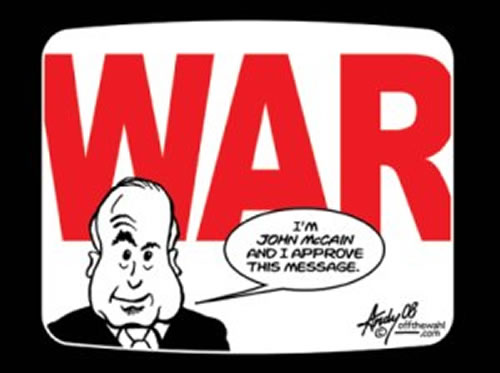
When McCain talks about ‘climate change’ he seems desperate and grasping, like he doesn’t really care about it one way or the other. It’s as if he’s saying, “I’ll give you your global warming, just let me get my hands on some bombs. Just let me get my hands on some bombs and I will agree to whatever you want that doesn’t involve not bombing.”
A couple of days ago, I got email from Rob Kutner, who is a writer for my 11 p.m. weekday ritual, The Daily Show. He sent his thanks for my (unsolicited) plug for Jewno and asked if I could plug his new book, Apocalypse How, which he describes as “my new book about how much better things are going to be after the end of the world”.
Click the photo of the book to visit its official site.
I wrote him back, saying:
Sure!
You know what you need for an apocalypse? Canned bacon, yo! (To which he replied: “Are there any words more delicious than shelf stable?“)
Here’s Apocalyptic Exercises, the first of two animated promos for the book:
That’s Daily Show correspondent (and actual Marine Corps Reserve Major) Rob Riggle doing the voiceover.
Here’s the second promo, Catastrophic Careers:
Here’s a sample of the book: the Opportunities page, a glass-half-full laundry list of the many options available to you once everything goes to Hell (there are more samples at the book’s site):
While clicking through the “Related Videos” on the YouTube page for Checkmate, the video about check-cashing services featured in the previous post, I stumbled into this ad for Cashcall.com featuring Gary Coleman. Take a look; it’s a mere 10 seconds:
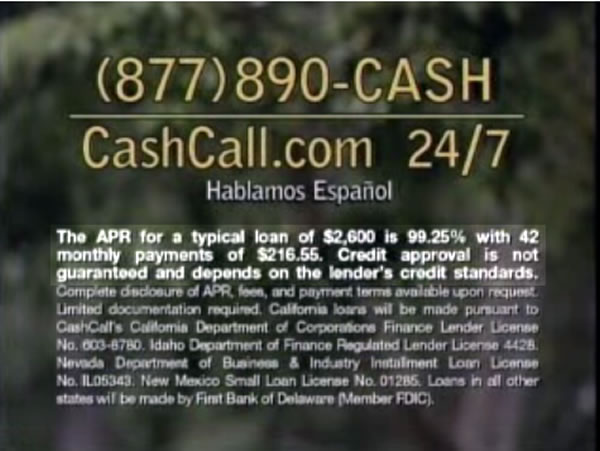
I vaguely recall seeing this ad on TV, and according to this article in Canadian-Money-Advisor.ca, they were running ads that you could see here in Canada on A&E back in February of this year. I didn’t pay much attention to the ad on TV, but noticed the “fine print” at the end when watching it on YouTube. Here’s a still frame from the end of the ad, enlarged for legibility with the really interesting stuff highlighted:
Let me repeat the most important part of the fine print:
The APR for a typical loan of $2,600 is 99.25% with 42 monthly payments of $216.55.
There’s a term that describes interest rates like this: usury. There’s also a term for people who charge interest rates like this: mobsters.
For those of you who are math-phobic, 42 monthly payments of $216.55 means that when Cashcall.com gives you a loan of $2,600:
You will pay it back over three and a half years…
…during which time you’ll pay them back 42 times $216.55, which comes out to $9,095.10. This is just a shade under three and a half times the money you borrowed.
(By the bye, you should become familiar with APR, as it’s supposed to reflect the true cost of a loan, and under the right conditions can make it easier to compare lenders. In addition to the Wikipedia article, consult this page and this page to find out more about it.)
If you want to find out more about their rates, here’s their Rates page. To calculate how much you’d end up paying for a loan, multiply the figure in the “Number of Payments” column by the figure in the corresponding “Payment Amount” column. For example, if you live in California and wanted to borrow $10,000 (a loan available to “Exceptionally qualified applicants only”), you would spend almost $31,000 paying it back over 10 years.
“Loans that fit your lifestyle” is Cashcall.com’s slogan. If that slogan applies to you, you might want to put your lifestyle (and financial planning skills) under review.
Dallas Penn and Rafi Kam, a.k.a. “The Internets Celebrities”, have a new video titled Checkmate in which they do a “ha ha, just serious” on-the-street report on those cheque-cashing places you see in urban areas.
“America’s most valueable resource,” says Penn, “is poor people. Poor people drive our economy, okay? Poor people…with checks”. In the report, they explore a number of themes, including why the poor favour cheque-cashing places over banks, usury, economic instability, commercial banks and their profit line, the cycle of poverty and how hard it is to cash a giant novelty cheque.
[This is a New York “street humour” piece, so yes, there will be swearing. You’ve been warned.]
A couple of interesting observations in the video:
There’s always a cheap jewelry store beside any NYC cheque-cashing place. As the Internets Celebrities put it, “Why would you want to leave a check-cashing place with all your money?
The banks-per-1000-people ratio is a very telling indicator of the neighbourhood’s socioeconomic status. Brooklyn Heights, where an ex of mine lived, has a bank for every 1,000 people. Bushwick has one for every 50,000.
Equally telling — and one idea I’ve covered before — is Starbucks. The more banks a neighbourhood has, the more Starbucks it has. “Bank workers love to drink Starbucks,” observes Penn.
Commercial banks don’t exist in the ‘hood. People with no money to save don’t need them. What they need is a facility that gives them the cash they need to buy their groceries, pay their bills and copp their drugs. Poor people need cash. It keeps them on the economic grid. What is more patriotic than going into debt? Our government has a zillion dollar deficit. If they can do it why shouldn’t the backbone of America also follow suit?
We vacillated on whether check cashing joints were really the devil in disguise. For many of us there are no other options. These establishments aren’t here to help poor people gain economic stability. They are here to provide a service and for that service they extract their blood, just like any other service that is contracted to the poverty class. Just be aware of that when you step inside of those doors.
Go watch the video. It’s a fun and informative 9 minutes and 44 seconds.
“Child is father to the man,” the old saying goes, and child is also mother to the shrill, desperate, Machiavellian-as-Karl-Rove politician. Here’s a great YouTube video, Young Hillary Clinton, created by Jerry O’Connell and Brandon Johnson, and starring Laci Kay who does a brilliant job playing Hillary: