Categories
Uncategorized

Session 2: The Power of Participatory Journalism

Warren Kinsella

  • Blogs are “punk rock” media: angry, do-it-yourself
  • “Corporate blog” is an oxymoron
  • Wag in audience during technical difficulties: “This may be the
    first time in history that Warren Kinsella has been silenced by
    technology.”
  • Daily blog campaign:
    • What is the big hairy deal about blogs?
    • Who is my target?
    • What is my message?
    • Why should anyone care?
  • What’s the big deal with blogs?
    • They’re free
    • Proudly biased
    • Really easy to access
    • Hegelian dialectic on speed
    • They’re populist
    • Google power
    • Specialists are welcome
    • Interactions are welcome
    • Pithy as heck!
    • Rather faddish at the moment, aren’t they?
  • Are they the digital pet rock?
  • Tips on ensuring blogs last past Christmas
    • Tell a story. Facts tell, stories sell.
    • Be brief: your readers demand it
    • Leave no charge unanswered
    • Take it seriously: hit back or lose!
  • Who is my target audience?
    • Nobody does it for themselves: otherwise they’d just write into a locked diary
    • Don’t try to be all things to all people
    • Your target audience isn’t the world, but the people you want to get onside
    • The Pyramid of power:
      • Top: Big bananas — presidents, prime ministers, etc
      • Next: Commentariat — senior staff, big-shot reporter
      • Third: Chattering classes — people who stay informed and involved
      • Bottom: The rest of us — little power and interest, but they
        vote governments in and out! “They are what blogs are for and about”
    • “You own personal computers, which means you are suspicious of the government, like me”
    • Don’t ignore layer 4: they’re the ones everyone is afraid of
    • The soccer mom vote in 1992 US elections / Canadian equivalent is “new Canadians” — watch out when they get angry!
    • More influential than big bananas, than bureaucrats, lobbyists and politicos put together
    • They are us — reach out and hold onto them
    • You (bloggers) are uniquely qualified to do that
  • Warren’s corporate media tips:
    • mainstream media will not be able to absorb blog culture
    • Mainstream media wired differently than us; different DNA
    • Failure, misery, disaster make their bells go off
    • Bloggers answer only to themselves
    • Bloggers have the last word
    • The
      media have a different focus. Consider Roger Ailes orchestra pit story:
      “If you have two guys on stage,” he said, “and one of the guys says ‘I
      finally have a solution to the Middle East problem,’ and the other guy
      falls into the orchestra pit, who do you think is going to be on the
      evening news?”
  • Why should anybody care?
    • Most of the time, people don’t — not because they’re dumb, but because they’re busy.
    • Make readers care: make it interesting, you’ll get read
    • Be unique — deliver a message the opposition can’t
    • Hebrew National story: competing against Oscar Mayer with “We
      answer to a higher authority” — something that Oscar Meyer couldn’t say
    • Be repetitive: simplicity, repetition, volume
    • Don’t let them change the channel on you!

Jay Rosen

  • Will cover how his blog, PressThink, decided to cover the convention
  • Wanted to try out blogging the DNC because it hadn’t been done before
  • PressThink tries to operate within a “newsy” way within its own domain
  • Story about who got credentialled
  • Instead of simplicity, repetition and volume, it’s complexity, depth and nuance (the opposite of Warren’s approach, BTW)
  • Jay’s approach: wants to limit the readership — it’s not for everybody, but it’s for a specific type of reader
  • “The very last thing I would assume about my audience is that they need something drilled into their heads.”
  • Interesting observation: media says that conventions are less and less relevant, yet they keep sending more people to cover it
  • Story about regimes of political convention coverage: see this entry in PressThink.
  • Another kind of coverage: inspiration from the past — Article on how Norman Mailer covered the 1960 convention for Esquire
  • “People have subscriptions to newspapers, people have relationships to the blogs they follow.”
  • Newsday’s reporting online had no links “because that’s the way they think”
  • Including links to the material you’re drawing from “is what any
    responsible journalist should do” — that’s an advantage that weblogs
    have
  • “The way you blog an event like this [the DNC] is that you participate in it.”
  • Story about Obama: Obama said he had a blog and met with the bloggers. He asked for tips. Rosen’s reply: “Write it yourself!
  • Thought it was amazing that the DNC had a CEO — asked to interview him.
  • Convention: communication vehicle for party message. People get
    news from different ways, hence they had different groups: bloggers,
    TV, talk radio, etc.
  • Interview with Thomas Edsall: Bloggers are breaking up the groupthink
  • “The most serious journalists are serious about blogging.”

Q&A

  • Chris Waddell: Does not believe in Kinsella’s “pyramid of
    power” — 50% of America is disenfranchised. How do we re-enfranchise
    them, via blogging?
  • Kinsella: Blogging — not sure the world changed with bloggers at the DNC, but I’m sure they changed
  • Rosen: Important to ask the questions about employees doing
    weblogs. What are the consequences of individual authorship? Suggests
    studying the most popular weblogs: what makes them good or effective?
    “Start local” — make it real to people in your area.
  • Rosen: The very first weblog that a mainstream journalist that becomes a success will point the way for the others
  • Rosen: There is a “phony competition between mainstream
    journalism and weblogs”. Suggests to journalists to learn from
    webloggers — “Every skill that a journalist has is tapped by the
    weblog”
  • Kinsella: The “mainstreaming” of blogging may “denude” blogs of their essence, which is to say “up yours!”
Categories
Uncategorized

Session 1: How Technology is Changing Public Journalism

Leonard Witt

  • Journalism, as we know it, is broken
  • 1988 elections were controlled by the “spinmeisters”: it was flag factories, Willie Horton and that photo of Dukakis in the tank
  • General idea: Move away from the “horse race mentality” (“Who’se
    ahead? Who’s behind?”) and bring back discussion into the public sphere
  • Because of public journalism, we have a body to critique mainstream journalism
  • Gillmor: “If you’re not sincere about something, over a period of time, you’ll stop”
  • Treating the audience as citizens, not consumers
  • PJ reporting is not only on the extremes, but the middle gound
  • PJ still not reaching out to all communities, especially disenfranchised ones (“judging by the ethnic makeup of the room”)

Dan Gillmor

  • Being blogged immediately teaches journalists a lot about how they’re doing
  • His publisher is handing out a free copy of his new book, We the Media, to everyone in the room later.
  • Showed
    video he took in Tokyo showing a handheld that scans RFIDs of bottles
    of drugs — scanning one, the handheld says “this will conflict with
    your prescription”; another bottle scanned makes the unit say “this has
    expired”
  • Not only will every person have a story — every thing will have a story too.
  • Image of Lynndie England and leashed prisoner at Abu Ghraib: it’s hard to keep secrets now
  • Image of Treo running RSS software
  • Image of man in surgical mask behind phone display: The news about SARS was spread long before the media did it via SMS
  • If journalists are going to be learning blogging, they should be using tools that make it easier
  • We the Media is “not just about weblogs, but something bigger than that.”
  • Image of GPS phone: Maps of Tokyo, a notoriously difficult city to navigate
  • Image of Swe-Dish: satellite dish in a briefcase. $100K now, $1M back during Iraq War I
  • Image of MoveOn.org: It’s possible for anyone with just basic off-the-shelf software and hardware to make their own agitprop
  • Self-assembling journalism: aggregator blogs, wikis (image of Wikipedia — “journalism is just beginning to understand wikis”)
  • Wikipedia: “First absolutely open-source journalism” project that he’s heard of — brief explanation of wikis.
  • Intriguing
    part of wikis: trolls can wreck the comments section of a blog or
    discussion board, but when anybody can fix the vandalism, it tends to
    get fixed.

David Akin

  • When he first made the leap from print to broadcast journalism, the best advice he got was to “just be a tourguide”
  • Praised Dan Gillmor as being one of the best tour guides to the tech world

Leonard Witt

  • Journalism is now in the middle of a transformative period, thanks to new tech
  • Everyone has their own printing press
  • “How can I use these tools to get my audience involved?”
  • Citizens are getting involved in public journalism at lightning speed
  • OhMyNews: Korean participatory newspaper — 30,000 contributors, all citizen-produced — there’s an English version now
  • Another example: Back-to-Iraq.com
  • “Through blogs, public journalism has new DNA”
  • The old way of public journalism: face-to-face meetings, took too much time, episodic, the journalists did all the talking
  • The new way: Now we all own presses. It’s the citizens who are now influencing things.
  • A first: the DNC letting bloggers in — they got more press than the press themselves
  • Quote from Orville Schell (see this NYTimes article),
    dean of the
    graduate journalism program at the University of California, Berkeley:
    “Obviously, the official media don’t quite know how to deport
    themselves in relation to the blogs. If they adopt them, it’s like
    having a spastic arm — they can’t
    control it. But if they don’t adopt it, they’re missing out on the
    newest, edgiest trend in the media.”
  • Newspapers still haven’t figured out how to incorporate blogging into how they work
  • We Media
  • Story
    about pictures from the war (Abu Ghraib / caskets /
    behadings): At a conference, journalists kept asked amongst themselves
    whether they should run these gruesome photos — they
    were, in their minds, still the gatekeepers. A journalist called up a
    site running the beheading video of Nick Berg on his laptop. It no
    longer mattered whether the mainstream media would show the pictures:
    other people would. “There are no more gatekeepers.”

Q&A

  • David Akin: This room is an elite talking to itself, talking about issues they find important
  • Leonard Witt: We all have to our own affirmative action
  • Dan Gillmor: Moore’s Law will make technology accessible in terms
    of affordability. The real hurdle will be intellectual and conceptual
    accessibility, and this will rely heavily on our educational system.
  • Peggy Kohr: How do you find time?
  • CTV news writer: Video of the beheading of Nicholas Berg — “It
    would be disastrous for journalists to engage in a race to the bottom”
  • Marie France: Videos like Nick Berg’s pose a challenge to teaching journalistic ethics
Categories
Uncategorized

Public & Participatory Journalism Conference, Post 1

Sitting here with David Janes to my right (positionally and politically) at the Sheraton Centre at the Exploring the Fusion Power of Public and Participatory Journalism conference. Anne Kothawala, President and CEO of the Canadian Newspaper Association (CNA)
has just finished the introduction and is showing a CNA video (mostly a
PR-driven montage of Canadian images overlaid with “Aren’t Canadian
newspapers great?” text with Jesus Jones’ Right Here, Right Now playing in the background.

David Akin has just finished introducing himself as the “traffic manager” of the conference and has promised to keep us on schedule.

Leonard Witt is now speaking on the topic of public journalism.

More updates as things happen.

Categories
Uncategorized

The Breakup Style of PowerPoint

The scene: The bar at the Bovine Sex Club, during Kickass Karaoke’s 5th Anniversary. I’m ordering a pint of Shanghai Stout from Deanna the bartender when a young woman approaches.

Her: Hey, Accordion Guy, got a minute?

Me: Sure. What’s up?

Her: You’re a computer guy, aren’t you?

Me: Yeah. Got a computer problem?

Her: Sort of. You see, I got dumped last week…

Me: Oh. Sorry to hear that.

Her: …by e-mail. What I wanted to ask was: Is that normal for computer guys?

Me: I don’t think so.

Her: And if that wasn’t enough, he fucking listed everything that was wrong with me. In fucking point form.

Me: That’s strange.

Her: Tell me about it!

Me: Wait. You know, maybe it’s not so unusual. I just remembered — you’re not the first to say this. You’re the third or fourth person this year to tell me that she got dumped by email and had reasons why listed in point form in the past year.

It’s true: since the beginning of the year, a handful of people have told me that they were dumped in this fashion. If you go farther back, you can add two more to that list.


The underlying idea of using email to deliver unpleasant news isn’t all that novel. You’ve probably had to phone someone to cancel plans and were relieved to get their voice mail or answering machine rather than the actual person, and you may have even heard of situations where people have broken up over the phone. Breaking up in writing was common enough for the term “Dear John Letter” to be coined. In these situations, the bearer of bad news is trying to weasel out of having to deal with the reaction.

Listing the reasons for a breakup, whether the breakup is taking place in person, by postal mail, over the phone or email, isn’t new, either. What is new is listing the reasons in point form.

I believe I know the cause of this phenomenon. Allow me to illustrate it:

1. We start dating. 2. ??????? 3. DUMPSVILLE!

PowerPoint.

Or more accurately, office culture, of which PowerPoint is a cornerstone.

(The slide above is part of a hypothetical PowerPoint presentation that I would’ve made for the New Girl from this story.)

I think that the “Dear Jane” emails that those people received were inspired by elements of office culture: PowerPoint, project post-mortems and annual performance reviews. Of the people who told me that they were dumped via email, all of their boyfriends worked white-collar jobs in which they either sat through or made PowerPoint presentations.

As Information Architecture guru Edward Tufte points out in his book, The Cognitive Style of PowerPoint, PowerPoint presentations sacrifice substance for style, are incredibly information-sparse, use abbreviations and syntactic shortcuts since you can’t fit that much on a slide and are really for the benefit of the speaker, not the audience. PowerPoint faciltitates getting through an unpleasant task as quickly as possible, which is a primary goal in both business presentations and breakups.

You might think I’m being facetious by blaming PowerPoint. However, history and everyday experience show us that our technology affects our culture, from things as simple as levers and the wheel to cell phones, computers and the internet.

Furthermore, the same technology can have a different “spin”, depdending on the manufacturer. Consider the general grittiness of PlayStation and XBox games (and note that both consoles are in imposing black cases) versus the relative kid-friendliness of Nintendo GameCube games (and the console’s cute white cube). Better yet, consider the “digital lifestyle” feel of the Mac and its applications versus Windows and its apps, which Danny O’Brien aptly summarizes with this sharp line in this blog entry:

Ultimately when you use MS software, you’re not the end user MS perceives at all: we’re just living off the scraps Microsoft leaves out after feeding its big customers.


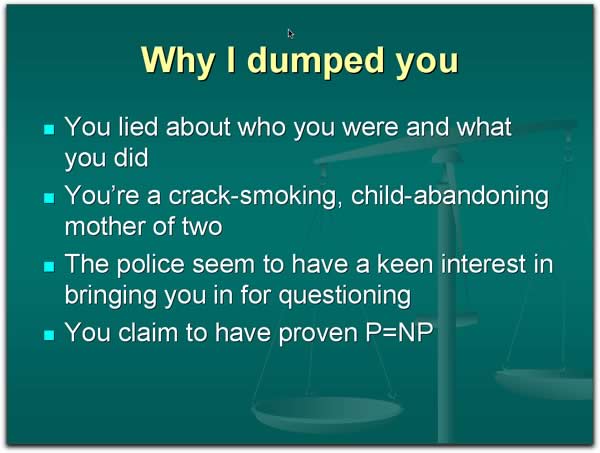
As software evolves and we move on to the next big thing, I figure that social software will provide us with new paradigms for breakups. Perhaps Orkut will lead the way, and one day we’ll get messages like this:

Categories
Uncategorized

Good grief, part deux

“I’m John Kerry…and I’m reporting for duty!”

“I’m not kidding: I was born in the west wing.”

(I think it’s time for me to catch up with my friends at John’s Italian Cafe.)

Categories
Uncategorized

Good grief…

I hear the baaa-ing of sheep from Animal Farm, and in real time, too!

They’re going to be completely unbearable when the RNC rolls around.

Categories
Uncategorized

Secret Asian Man on Asian Guys in Movies

While in Boston, I’m hoping to catch Harold and Kumar Go to White Castle with Wendy. (Let it be known that my friend Dhimant “Bhundi” Patel and I were Harold and Kumar back at Crazy Go Nuts University in the 90’s.)

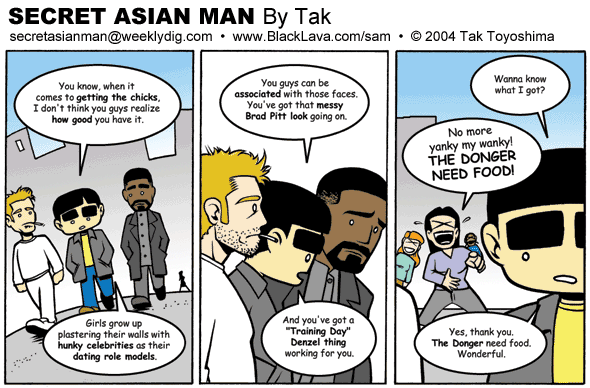
I thought I’d go look at Tak Toyoshima’s comic, Secret Asian Man, to see if he’d have any commentary on the movie. He didn’t, but he had this somewhat-related comic

Maybe Harold and my main man Jet Li in Hero will help fix that.

(And hey, I’ve done my part for Asian dudes on TV.)