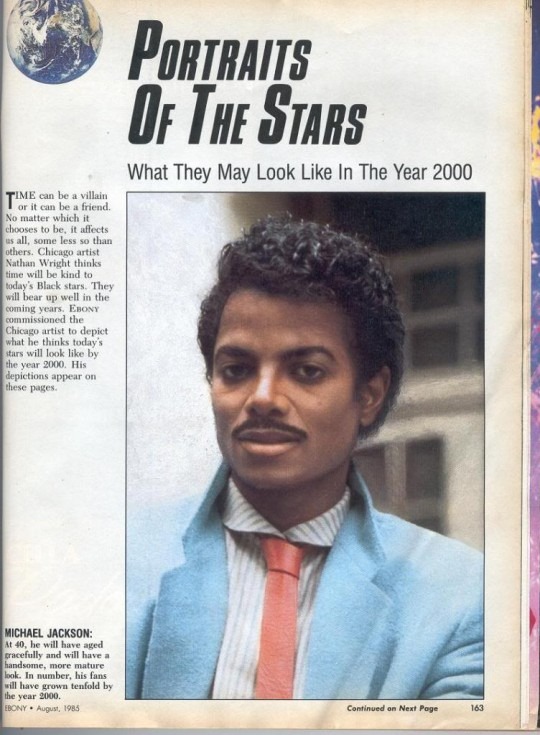
This scan from the August 1985 issue of Ebony features their prediction of what Michael Jackson would’ve looked like in the year 2000 (which, back then, seemed like a time in the far-off future):
“At 40,” the caption reads, “he will have aged gracefully and will have a handsome, more mature look.” Tacky 80s-era clothing aside, it’s a good look for him. Very Lando Calrissian.
Keep in mind that this photo was altered in the time before Photoshop, when you had to do it with knives, brushes, paints and a very steady hand.
It’s easy to laugh at the prediction in hindsight, but this was the mid-80s, before the accident while shooting the Pepsi commercial and well before celebrity extreme meltdowns were more commonplace.
This article was originally posted to my tech blog, Global Nerdy. Although it’s my notes from a presentation at a programmer’s conference, the subject matter should be just as interesting to non-nerds, as the presentation’s theis is that California — and particularly the Bay Area — has extended its imperial and deleterious influence all over the world.
The final speaker at last weekend’s FutureRuby conference was Jesse Hirsh, a Toronto-based internet consultant, researcher and “talking head” on CBC Newsworld and CBC Radio. As stated on the “About” page on his site, “his passion is for educating people on the potential benefits and perils of technology.”
His presentation, Fighting the Imperial Californian Ideology, was one of the less technical talks of the conference, whose topics ran the gamut from the expected – Ruby programming, programming languages and programming techniques – to topics you might not expect, such as nutrition for nerds, George Orwell and political languages, music and politics. In the end, it was all about building the future.
Here are the notes I took during Jesse’s presentation. I took the original notes and simply turned them into full English sentences and added context and links where necessary.
The Notes
Books that influenced this talk include:
Snow Crashby Neal Stephenson, which plays with a lot of ideas for a single novel, including:
The overlap of technology and philosophy
Ancient history and the near future (as seen from circa 1990)
The concept of ideologies being viral
Imperial San Francisco by Gray Brechin, which looks at the role that San Francisco has played in the American Empire
I spent my life studying Pax Americana and have noted how Californian ideology affects us all
The latest version of Californian ideology comes from techies and technophiles:
The production of paper using hemp was cheaper and was a threat to his business
California is the provider of armaments for the First and Second World Wars
Berkeley and Stanford were schools that provided brains for the military
California is the home of BALCO – the Bay Area Lab Cooperative – who are responsible for the designer steroids tainting Olympic and professional sports today
The Californian ideology represents an elite community
There is a perception among its practitioners that the world is theirs for the taking
The ideology highlights a past that has been swept into myth
That past includes a “Frontier ethos”, and the frontier was not a place for fairness
The ideology came about around the time of the oil crisis of the 1970s, which is also when the dollar was de-linked from the gold standard and the U.S.’ influence was beginning to wane
It was formalized by Brand, Kelly and the global business network
It is a techno-utopian vision spread through publications like Mondo 2000 and later, Wired
Kelly’s critiques sold a false mythology of a frontier where anyone can create a business plan
This mythology is that of a biological techno-utopia, a hive:
Problem: there are many worker bees, but only one queen bee
It is a means by which the ruling class maintain their power
The idea of the Long Tail is a meme within the California ideology
It’s meant to engender complacency about being in the lower ranks
In the Long Tail, it’s more of the same: a lucky few get all the cheese
It’s part of the social-centric desire for freedom
I went to the recent Free Summit held by TechDirt’s Mike Masnick, where Chris Anderson gave two keynotes
Why did it take us 15 – 20 years of online economic business models cause us to realize how important social relations are important? The Communists have been saying this for years
We are just realizing the value of social capital
What’s missing is the political economy of Free
I agree with a large portion of Free, except for one: its ethic of waste
Waste is the central ethic of Free
The thesis: Now that bandwidth, processor cycles and disk space are abundant, we must waste it. Only through waste will be we innovate
The problem is that “waste is an ethic that has fucked us up royally”
The counter to the waste ethic is “How do we make more with less?”
That is the revolutionary potential of the internet
This counter is revolutionary and anti-ideological
“In the 21st century, there’s just culture”
It involves holism, which is “a flip on relativism”:
“I’m going to take the best shit available and integrate it into a coherent vision”
Society is reaching a tipping point where all the stuff we techies do is mainstream:
Local crime: these days, news reports on local crime always include some element of internet-based activity (e.g. “The Craigslist Killer”)
We are:
Bowing to masters we don’t need (California)
Following business models based on cultures we don’t live in (once again, California)
Up against the California ideology, which professes freedom but delivers slavery
We need to:
Become community activists
Help the next generation of AOLamers
Remember when AOL joined the ‘net? Suddenly there was a flood of newbies and lamers “and the whole internet went to shit”
“Most of the people using the net are fucking idiots”
How do we, as the people who can create the tools, places and concepts, quickly get lamers into the metaverse of Snow Crash? It has a lot of positives:
Universality: Everywhere, and accessible to everyone
Geography: As a virtual reality environment, it provided waypoints and neighbourhoods for different purposes
Space: Another byproduct of its virtual reality nature – it gave a sense of place as an means of organization, vs. the “cloud of shit” of our own internet
We can create these neighbourhoods for people
There is a big problem with "doing whatever is best for business”
The free market “fucked us in the last year”
Who can you trust?
The people you know
As a techie and participant in RubyFringe, you’re already doing it; just be conscious of it
None of this is new
It’s not about ideology, but practice
What we think of as the nation-state is done
Think of the city-state instead
Think of (and participate in) the cities you live in
The struggle for human rights continues. Which side are you on?
Here’s a great scene from a Judge Judy case (never thought I’d write those words) in which a high school student learns about rhetorical questions the hard way: in front of millions of viewers!
And technically speaking, it’s astronomers and cosmologistswho find out things about space, and what we think of as “rocket science” is really rocket engineering.
I met science fiction author, software developer and computer security guy Marc Stiegler at the first incarnation of O’Reilly’s Emerging Technology Conference in 2002, but I’d been acquainted with his work prior to that. I’d heard of his programming language called E and had read his science fiction novel Earthweb, whose plot could be grossly oversimplified down to the summary “Twitter saves the world” (it’s a little bit more than that, but I think it conveys the idea nicely).
Marc’s Final Exam
However, when I think of Marc, what comes to mind first is the final exam that he gave to students at his “Future of Computing” course and published online in 1999. In it, he posed a set of problems and asked them how a specific set of proposed web technologies could be used to solve them. The course and exam have a very strong sense of “technology trumps legislation”, an idea that was surfacing in the late 1990s.
In the exam, students had to pick 5 out of 11 problems that Marc posed and then explain how any combination of the following technologies could be used to solve them:
Unforgeable pseudonymous identities
Bidirectional, typed, filterable links
Arbitration agents
Bonding agents
Escrow agents
Digital Cash
Capability Based Security with Strong Encryption
(If some of these ideas are unfamiliar to you, don’t worry. They’re not important in the context of this article, and you can always Bing them.)
Here’s a selection of the problems posed in the exam. Remember, this exam is from ten years ago!
1) Searching for a decision analysis tool on the Web, you find a review in which the reviewer raves about a particular product. You buy the product and discover it just doesn’t work. You desire to prevent this person’s ravings from harming anyone else–and you desire to prevent the product from disappointing anyone else.
4) You start receiving thousands of emails from organizations you don’t know, all hawking their wares. You want it to stop, just stop!
5) You wish to play poker with your friends. They live in Tampa Florida, you live in Kingman. This is illegal in the nation where you happen to be a citizen. You want to do it anyway.
6) You hear a joke that someone, somewhere, would probably find offensive. You wish to tell your precocious 17-year-old daughter, who is a student at Yale. The Common Decency Act Version 2 has just passed; it is a $100,000 offense to send such material electronically to a minor. You want to send it anyway–it is a very funny joke.
7) Someone claiming to be you starts roaming the Web making wild claims. You want to make sure people know it isn’t really you.
The Final Question
The most compelling question on the exam is the final one. It required a far more extensive answer than the other ten – so much more extensive that Marc actually suggested that it might be better not to answer the question in the exam, but to at least think about it:
But…if you can answer Question 11 in your own mind, even though you choose not to write up that answer for this examination, then a most remarkable thing will happen: you will walk out of this class with something profoundly worth knowing.
Here’s that final question:
11) You live in North Korea. Three days ago the soldiers came to your tiny patch of farmland and took the few scraps of food they hadn’t taken the week before. You have just boiled the last of your shoes and fed the softened leather to your 3-year-old child. She coughs, a sickly sound that cannot last much longer. Overhead you hear the drone of massive engines. You look into the sky, and thousands of tiny packages float down. You pick one up. It is made of plastic; you cannot feed it to your daughter. But the device talks to you, is solar powered, and teaches you how to use it to link to the Web. You have all the knowledge of the world at your fingertips; you can talk to thousands of others who share your desperate fate. The time has come to solve your problem in the most fundamental sense, and save the life of your daughter.
The final question really stands out. Unlike the other questions in the exam, this one really pulls at the heartstrings, and it sparked a lot of discussion among geeks back around 1999 and 2000, in settings both online and real-life.
Iran and the Final Question
If you follow the American news cycle, the mental distance between North Korea and Iran is a short one; both are countries in the “Axis of Evil” (a term invented by a Toronto guy, by the way) run by repressive regimes and working on their nuclear weapons capabilities. What if we changed the final question’s setting from North Korea to Iran?
Unlike North Korea, Iran’s people have access to technology and communications with the outside world (there’s a recent Daily Show segment in which Jason Jones finds people in Iran who know Jon Stewart’s George Bush “I’m the decider” schtick). They don’t need to have Marc’s hypothetical iPhones delivered to them in care packages; they have things like Twitter and YouTube at their disposal. So I propose another slight modification to the final question: What if we changed the hypothetical hardware into actual working software like Twitter and YouTube?
(It’s another “software, not hardware, is really the trick” situation. Just as we found out in Terminator 3 that SkyNet was really software, it turns out that what might save Iran was social networking software, not portable internet-accessing hardware dropped by parachute.)
With my two suggested changes, it becomes very apparent that we’ve moved from theory to practice. The people of Iran are taking Marc Stiegler’s final exam, and they’ve picked its most difficult question.
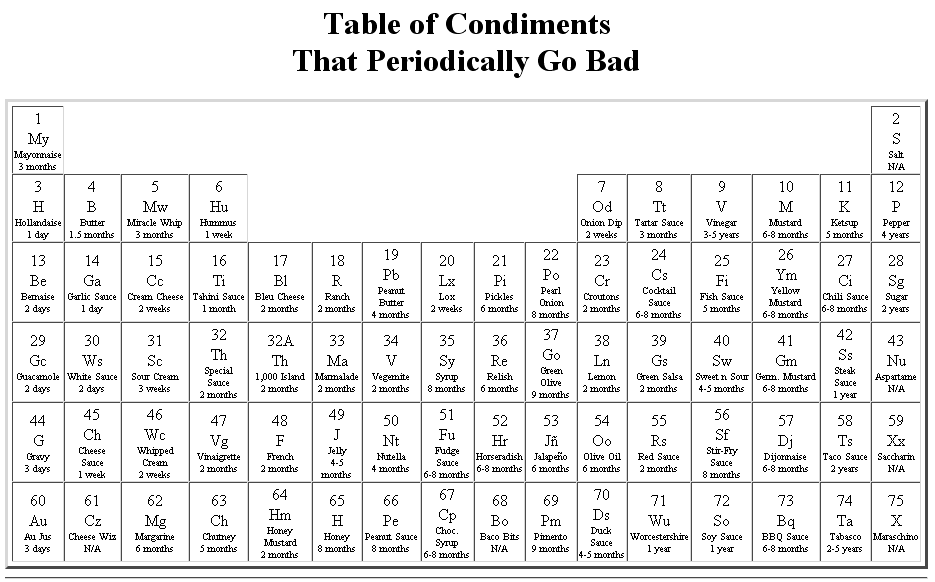
Click the table below to get a closer look at the table that tells you when it’s time to throw out those condiments. And yes, Hollandaise sauce doesn’t last terribly long.