Categories
Between getting ready for Hurricane Irma, which is headed our way in a couple of days and is threatening to become a category 5 storm…

…and doing some “round tuit” household chores (“I’ll do it when I get a round tuit”) on Labor Day Monday…

…it was time to gather up the flashlights at home.
Anitra ran to get me one, and came back annoyed.
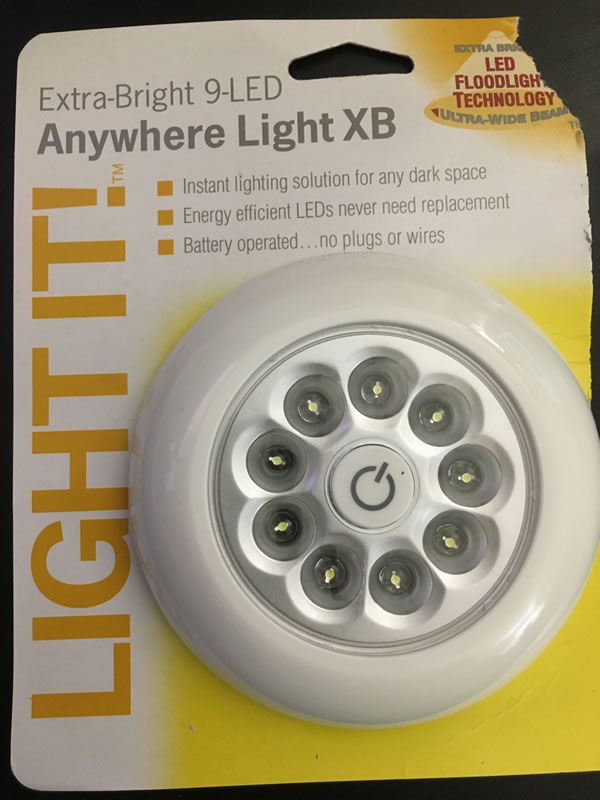
“I bought this ages ago,” she said, “and it was still in the packaging. The battery compartment’s all screwed up!”
“Screwed up how?” I asked.
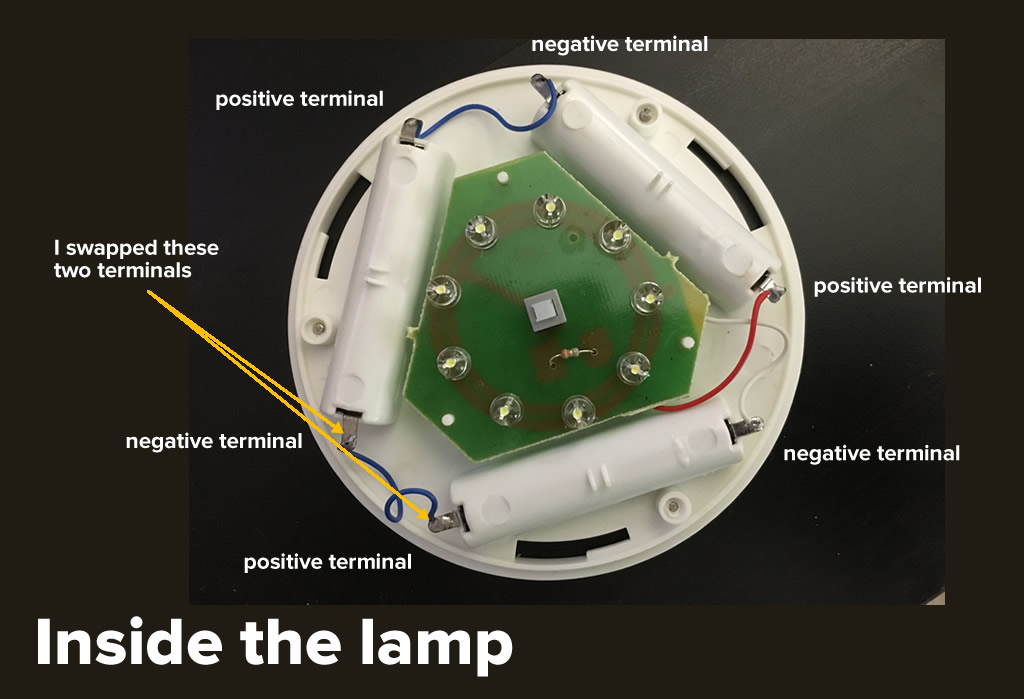
She opened up the back of the flashlight to show me what she meant. This is what I saw:

In the photo above, the leftmost battery receptacle is set up properly. It has a negative terminal (the one with a spring) and a positive terminal.
The other two terminals are a carnival of half-assery:
“Wow,” I said. “That is screwed up. I should submit this to the You Had One Job Twitter account.”

From an electric circuit point of view, this isn’t really a problem. As long as the terminals can make contact with the battery, current will flow, and the bulbs will light up.
The problem is more about fit:
“I can’t even return it!” Anitra said. “I don’t have the invoice anymore.”
“Maybe we won’t have to,” I said, and I took the flashlight to my desk in the home office. I wasn’t going to be beaten by a simple manufacturing defect.

I removed the three screws holding the flashlight together and saw that the fix was easy. It would be a simple matter of swapping two terminals, which would result in each receptacle having one positive and one negative terminal. The terminals slide out of the receptacle easily once you bend the metal tab holding them in place:
However, in the process of swapping the terminals, you need to disconnect at least one of them from the wire. Once you swap them, you have to reestablish the connection. It was time to break out the Christmas present that my in-laws gave me:
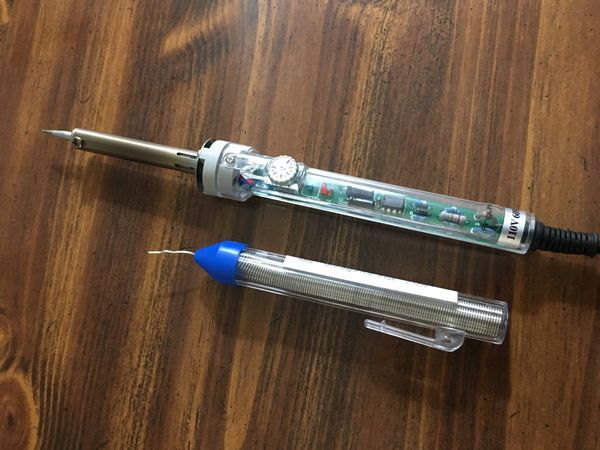
Late last year, they’d asked me what I wanted for Christmas. I suggested that I could use a soldering iron, and they delivered. Then things got crazy, what with suddenly having to search for a job and all the madness that ensued, so this ended up being my first chance to break it out.
I plugged in the iron, let it heat up, and moments later, I unsoldered one of the terminals. I then swapped the terminals, and then reconnected the loose terminal with a proper joint:

With the repair complete, I screwed the unit back together, and the battery receptacles now looked like this:
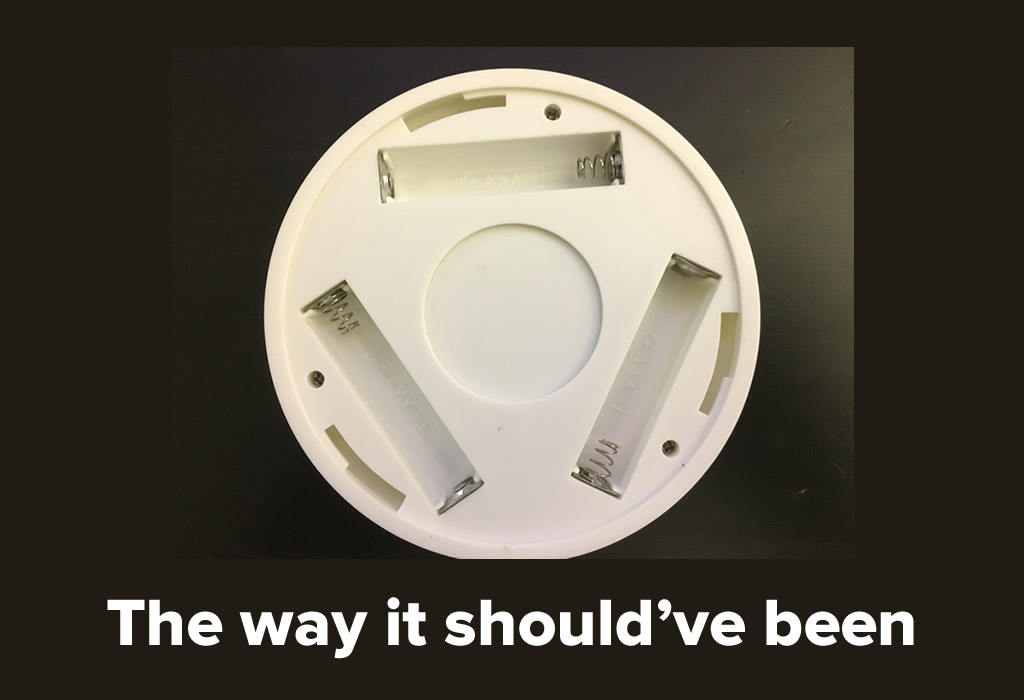
I inserted three fresh AAA batteries into the flashlight, closed the battery compartment, flipped it over, and pressed the power button. Here’s what happened:
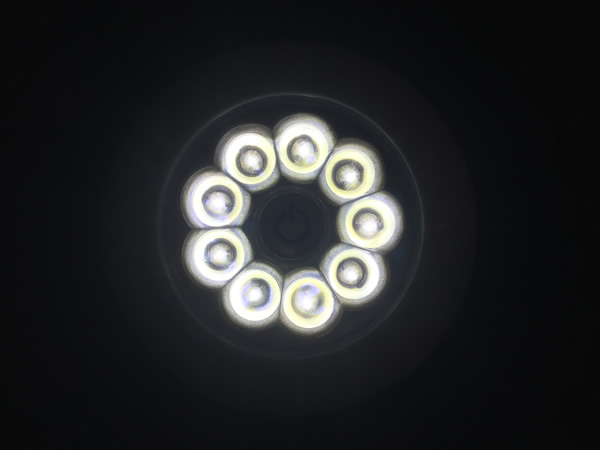
Success!
I brought the flashlight to Anitra, who was impressed with my work. Red Green was right:

I am mindful of the fact that I’m fixing only one flashlight at my leisure, in the comfort of the ergonomic chair in my air-conditioned home office, and not hundreds or thousands every day on a barely-maintained assembly line in a non-air-conditioned factory in the Third World for a laughably tiny wage.
The repair I made would be considered laughably simple by an electrician or electronics tech, and I’m willing to bet it would’ve been within the abilities of most of the regulars at Tampa Hackerspace. They might even be amused that I found this incident worthy of writing a whole blog article, complete with photos.
But it is worthy of a blog article. I’m willing to bet that this repair would’ve been beyond most people, who — without a way to return or exchange the flashlight — would’ve simply tossed it in the trash or recycled it. That’s a pity, because in spite of the increasing complexity of our devices, a good number of them are still repairable with a modicum of skill, and as the do-it-yourselfers say, “If you can’t fix it, you don’t really own it.”

I’m not going to claim that I can do every kind of repair, but I’m glad that I’ve been able to do a number of them around the house, from this flashlight to the sensor in our washing machine to patching the chip in our granite kitchen counter to replacing the faucet in our kitchen sink.
It may actually be easier to perform a lot of household repairs yourself these days, thanks to the proliferation of YouTube repair videos. I wish I’d thought of recording one while repairing the flashlight. If you find yourself needing to fix something, search YouTube — the odds are goods that there’s a “how to fix it” video.
Another good source of “repair recipes” is iFixit, which is home to tens of thousands of electric and electronic repair guides, and they’re the people behind the Repair Manifesto featured above. I don’t know if they’ll ever come close to their stretch goal — a repair manual for every device in the world — but I applaud them for it.

And finally, if there’s a hackerspace or makerspace in your area — here in Tampa Bay, we’ve got places like Tampa Hackerspace, The Hive, and others — check it out, join it, support it, learn, and take control of the things you own.

There’s a price to be paid for fixing things yourself: time. What you save in money and from the landfill, you pay in the time invested in the repair, and if need be, learning how to do it.
But there’s a payoff — being able to fix things helps build a “can do” mindset. That’s something that you’ll bring with you wherever you go, and it’ll take you far in work, life, and play.

One of the songs in my MP3 collection that’s on heavy rotation is Cage the Elephant’s Beck-ish, slide-guitar southern-rock-y ode to “doin’ what you gotta”, Ain’t No Rest for the Wicked. It practically begs for an accordion version, so I’m learning it in order to add it to my repertoire, which could stand a little refreshing.

While I haven’t learned the song well enough to perform it unaccompanied, I’ve had just enough practice to do it as an accordion karaoke number, which I did at last week’s Loser Karaoke. Loser Karaoke is a regular Thursday night event at Tequila Sunrise where having a good time trumps singing ability. It helps that Jason Rolland is an entertaining karaoke host. As an added bonus, it’s where a lot of the people from Accordion City’s high-tech, startup, social media entrepreneur scene come to cut loose. For more on Loser Karaoke, check out their Facebook page.
I should feel ashamed to say this, but a decade’s worth of public accordion playing has attenuated my ability to feel shame: the reason I know about Ain’t No Rest for the Wicked isn’t because I’m dialed into the alt-rock music scene. Thanks to middle age, I used to be with it, but they’ve since changed what “it” was. I know about the song because of…well, a video game. Namely, Borderlands, which uses the song in its intro sequence:
For the curious (and the fans), here’s Cage the Elephant’s official video for Ain’t No Rest for the Wicked. Enjoy!

Say the word “silicon” and chances are, you’ll think of technology. After all, silicon’s relationship to tech – it’s part of what makes transistors and chips – has been part of popular culture for decades, from the “Silicon chip inside her head” opening line from the Boomtown Rats’ song I Don’t Like Mondays to “Silicon Valley” as the nickname for the suburban expanse between San Francisco and San Jose.
Silicon is only part of the equation, however. The chips that drive our computers, mobile phones and assorted electronica are actually a “layer cake” consisting not only of silicon, but also oxide and metal.
There’s also the matter of key non-chip components like capacitors, which momentarily store an electrical charge. They’re made of thin layers of conductive metal separated by a thin layer of insulator. We use their “buffering” capabilities to smooth out “spiky” electrical currents, filter through signal interference, pick out a specific frequency from a spectrum of them and other “cleaning up” operations.
One of the metals used in the manufacture of capacitors is tantalum, which you can extract from a metal ore called coltan, whose name is short for “columbite-tantalite”. About 20% of the world’s supply of tantalum comes from Congo, and proceeds of from the sale of coltan are how their warlords – the scum driving the world’s most vicious conflict, and who’ve turned the country into the rape capital of the world – are bankrolled.
I’ve never reported on a war more barbaric than Congo’s, and it haunts me. In Congo, I’ve seen women who have been mutilated, children who have been forced to eat their parents’ flesh, girls who have been subjected to rapes that destroyed their insides. Warlords finance their predations in part through the sale of mineral ore containing tantalum, tungsten, tin and gold. For example, tantalum from Congo is used to make electrical capacitors that go into phones, computers and gaming devices.
Electronics manufacturers have tried to hush all this up. They want you to look at a gadget and think “sleek,” not “blood.”
Yet now there’s a grass-roots movement pressuring companies to keep these “conflict minerals” out of high-tech supply chains. Using Facebook and YouTube, activists are harassing companies like Apple, Intel and Research in Motion (which makes the BlackBerry) to get them to lean on their suppliers and ensure the use of, say, Australian tantalum rather than tantalum peddled by a Congolese militia.
He also points to the Enough Project’s latest video, which used humour and a reference to the “I’m a Mac / I’m a PC” TV commercials to draw the public’s attention to conflict metals and to encourage them to contact electronics manufacturers and ask them to be more vigilant when sourcing components:
The Enough Project says that auditing component supply chains at the smelters to see whether the metal was sources from “clean” places like Australia or Canada instead of lining the pockets of Congolese warlords would add about one cent to the price of a cellphone, and that this figure originates from within the industry. I’d happily pay a thousand times that for each of my devices – a mere ten bucks – to ensure that I wasn’t bankrolling rape and murder.
I’ll close this post with the closing paragraph from Kristof’s op-ed:
We may be able to undercut some of the world’s most brutal militias simply by making it clear to electronics manufacturers that we don’t want our beloved gadgets to enrich sadistic gunmen. No phone or tablet computer can be considered “cool” if it may be helping perpetuate one of the most brutal wars on the planet.

That most hated of typefaces, Comic Sans, gets anthropomorphized and bad-assified in Mike Lacher’s piece for McSweeney’s titled, (in)appropriately enough, I’m Comic Sans, Asshole.

The best antidote for a day full of meetings in boardrooms in a suburban office park is to finish it in different surroundings. So when my last meeting on Friday ended with a couple of hours of business day to spare, I made a beeline for one of my favourite “field offices” – Cafe Novo, located across the street from High Park, and a very short walk from home.
The photo above was the view from my “workstation” at 4 p.m. on Friday: the bar facing the roll-up front wall which in turn faces the park. Pictured are the tools of my trade – my trusty Dell Latitude XT2 tablet with the memory maxed out at 5 GB and the so-last-century mechanical hard drive replaced with a solid state one, my favourite portable mouse and an iced mocha.
Working in settings like this is one of the perks of the job.