
Original photo provided by Miss Fipi Lele.
Categories
Original photo provided by Miss Fipi Lele.
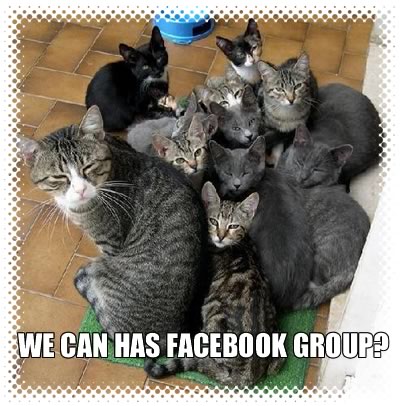
Over at the Tucows Developer Blog, I have another installment in my series of articles on developing Facebook Apps in PHP: Using the FacebookRestClient Class’ “Group” Methods, Part 1.
 I’ve always found information and propaganda from the early days of the Cold War rather fascinating. If you feel the same way, I’ve got some interesting reading for you — a Flickr photoset of scans of fallout shelter literature.
The set is made up of scans from:

Since I mentioned the bar called “Not My Dog” in the previous article, I thought I’d post a couple of reviews. Here’s an excerpt of one from the Martini Boys site, which specializes in bar and restaurant reviews:
Enter Not My Dog and you get the sense of something cool going down. The exposed brick walls, a 1957 Nordheimer honky-tonk piano and a guitar tucked away in the corner, all add to a comfortable, DIY enclosure. A walk further out to the secluded back patio provides more of the same coziness.
The virtues of Not My Dog are considerable. The most immediately obvious is its unceremonious sense of being in a friend’s apartment. There’s a small bar near the back and a smattering of tables and chairs to accommodate a few dozen trendy Parkdale denizens.
“Parkdale,” begins the Toronto Life article on the area, “now trimmed with sweet cafés, bars and vintage boutiques—cleans up good.” Here’s what they have to say about Not My Dog in their review of places in Parkdale:
About the size of a room at the Y, this tiny, glamorously unglamorous hole in the wall is long on pogey chic. Locals, decked out in Value Village’s finest, swill organic brew and couture cocktails (wasabi martinis and cucumber saketinis) to indie folk rock strains. A 1957 Nordheimer honky-tonk piano invites Johnny Cash tributes; local band Makita Hack performs weekly. TIP: Look for the occasional Tuesday-night movie screening on the back patio.
For those of you not familiar with Canadian slang and who were uncertain about the phrase “pogey chic”: pogey means welfare. Depending on where your head’s at, you can read that to mean either “scruffy” or “authentic, duuuuude“, take your pick.
Be sure to check out the rest of the article to see their reviews of other spots in Parkdale, including one of my favourite breakfast spots, Easy.

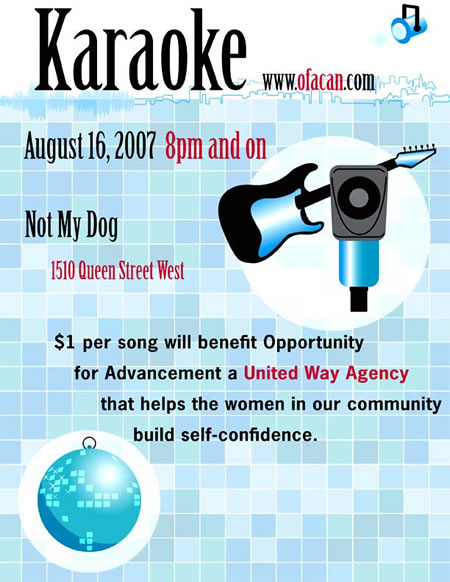
Carson T. Foster, host of Kickass Karaoke, is hosting a special karaoke night tomorrow (Thursday, August 16th) at Not My Dog (located at 1510 Queen Street West). If you want to sing, you have to make a minimum donation of $1.00 per song; the money will go to Opportunity for Advancement (OFA) who describe themselves as:
Opportunity for Advancement works with women in disadvantaged life situations. While poverty is an issue for almost all of the women with whom we work, other factors create additional barriers to well-being and equal participation in society. These include being a sole-support parent, being an immigrant or woman of colour, being lesbian, being disabled or chronically ill, or having experienced violence. OFA is involved in program delivery and social advocacy with the goal of supporting women to achieve greater economic sufficiency, increased personal well-being and enhanced participation in their communities.
The fun starts at 8:00 p.m. and wraps up at 2. I’m hoping to catch some of it and perform as well.
(If you’re on Facebook, this event has its own Facebook page.)
“To get Mondo Pasta on everyone’s mind,” says the copy that explains this clever bit of sticker work, “we created a bigger than life promotion at the most frequented place in Hamburg: the harbor. Hug stickers of faces turned ships into permanent pasta slurpers.”

Click the photo to see the full version.
Photo courtesy of Miss Fipi Lele.
 Here’s the latest news item I could find on the case of Alexandra Flanagan, who’s been missing for over a month, courtesy of the Barrie Examiner:
Friends and family members of missing Barrie woman Alexandra Flanagan are leaving no stone unturned in their search to find their loved one. Most recently, they set up a booth at Kempenfest to get the word out to a mass audience about the fact she has still not been found.
“Still no activity with her bank accounts,” said long-time friend Darlene Pestill, who helped staff the booth over the weekend. “We’ve been organizing search efforts almost every day. We won’t stop our efforts until we find her.”
Pestill said many people stopped by the booth to ask questions about Flanagan, take an information flyer, or offer their support.
“One good thing is that some people who didn’t know about the fact she is missing, now do. Being here at Kempenfest has helped to get the word out even more,” she said.
Flanagan has been missing a month. She was last spoken to on July 7, and has had no contact with friends or family since.
Wendy Flanagan, the mother of the missing girl, said no solid tips came in at Kempenfest, despite the well-meaning efforts.
“We just want to find out one way or the other. I’m really at a total loss as to what has happened to her. We’ve got posters all over the place – somebody has to have seen her,” she said. “People need to know she has never done this before; it is totally out of character.”
She added that although it has been reported in the news that there were sightings of Flanagan in Toronto, none of the leads have yet panned out and she isn’t confident that the people who called in actually saw her daughter.
“Nobody who knows her personally has seen or heard from her. Absolutely nobody,” she said. “I’m no further ahead about where she is than I was a month ago when she first went missing.”
Police are continuing their investigation into the case.
For more details about what is known about Alex’s disappearance, see:
