As I mentioned in the previous entry, I wasn’t always an accordion player; I’ve been playing for only just over five years.
Prior to that, I was a synth player. I’ve always loved synthesizers, and back in my high school days in the eighties, Depeche Mode was one of my favourite bands. The first synth I got to play on a regular basis was my friend Anthony Famularo’s Roland Juno 106, a fat-sounding beast of an analog synth. My first live gigs were with a band called A.K.A., which specialized in covering Billy Idol and Platinum Blonde as well as playing our guitarist Nick Catre’s abominable original prog-rock wankfests.
After a performance so disastrous that I no longer have stage fright, I went to Crazy Go Nuts University where I joined a couple of bands, the most notable being Volume, in which my good friend George Scriban played bass. I also met Karl Mohr in an electronic music composition class; we bonded because we were synth guys in a guitar rock town. It was cool to sound like Pavement or Dinosaur Jr, not Nine Inch Nails or the not-yet-existent Ladytron.
After the Great Accordion Saturday of May 1st, 1999, I became an accordion player. I still have my main axe, a Korg Wavestation A/D rack and a Yamaha SHS-200 “keytar” style keyboard to control it, but I’m not much of a synth player anymore.
But I may become one again. Steph has offered me an old Korg Poly-800, and there’s also the release of this baby:
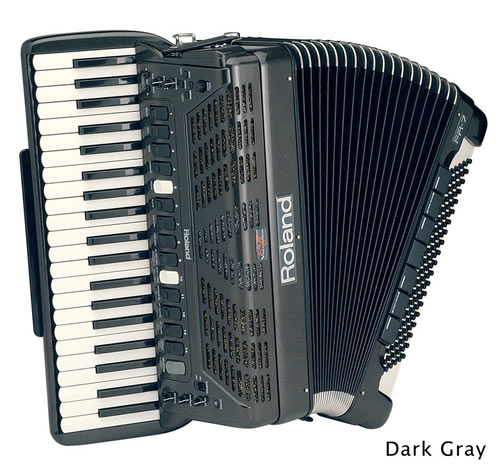
This, my friends, is a Roland FR-7 V-Accordion.
And yes, that’s Roland as in the synth company. This is a digital
accordion — a synth, really — with a built-in battery pack, amplifier
and speakers.
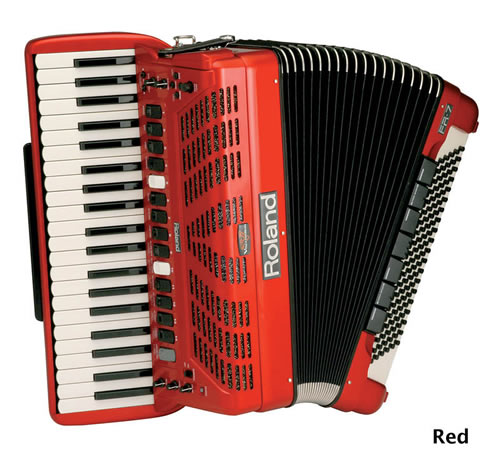
It also comes in red:
Here’s what the Roland site says:
Roland is pleased to introduce another milestone in digital musical instrument history —the V-Accordion. Models FR-7 and
FR-5
are the first instruments of their type to successfully integrate
powerful digital technology such as new Physical Behavior Modeling
(PBM) into a traditional accordion design, offering performance
features and authentic sounds that appeal to a wide range of musical
styles.
|
– PBM (Physical Behavior Modeling) enables true sound reproduction and dynamic expression.
|
|
– Realistic tone and expressive simulations of a wide range of traditional accordions.
|
|
– 22 onboard Orchestral sounds and 7 Orchestral Bass sounds that can be mixed together with traditional accordion sounds.
|
|
– Portable, lightweight and expandable via MIDI.
|
|
– Expand creative possibilities and explore new performance options not achievable using traditional instruments.
|
|
– The FR-7 is a complete, all-in-one model with powered speakers.
|
Holy crap. I want one of these for my birthday!