Categories
Accordion, Instrument of the Gods It Happened to Me Music

Because This Blog’s Been a Little Lacking in Shameless Self-Promotion Lately

Photo: Joey deVilla plays accordion at the OPML meetup on Tuesday,

  August 2, 2005.

Click the picture to see the video (26MB,

QuickTime)

Brian McKechnie pointed me to this video [26MB,

QuickTime] that he shot of my Baby One More Time performance at the end of

last week’s OPML

meetup.

Thanks, Brian!

The accordion and I will be at Thursday’s TechTV

Meetup, which takes place at No Regrets, deep in “the dingy alleys of Toronto’s Porn

District”, Liberty Village

Categories
Uncategorized

African Bits Per Capita [Updated]

(Attention Ethan Zuckerman! You might might have seen the map below, but just in case, I thought I’d call it to your attention.)

Update: Ethan wrote back — see the end of the post!

Yesterday, I found out about a map produced in 2002 by

Canada’s International Development Research Centre (IDRC).

It’s titled The Internet: Out of Africa and shows a relatively new

metric of internet use: bits per capita. A smaller version is shown below; click it to see it at full size.
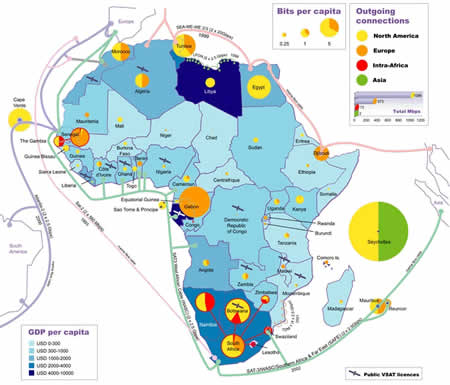
African bits per capita. Click the map to see it at full size.

The IDRC page introducing the map reads:

The size of the Internet in a country indicates an element of its

progress towards an information-based economy. International Internet

bandwidth provides a measure of Internet activity because many people

share accounts, or use corporate and academic networks along with cyber

cafes and business centers. Outgoing bandwidth also takes better

account of the wide range of possible use, from those who write a few

emails each week, to users who spend many hours a day on the net

browsing, transacting, streaming, and downloading. Because of this, the

often used ‘Number of Internet Users’ indicator may have less relevance

in the developing world than in other places.

There’s

a circle for each country; the size of the circle is proportional to

the outgoing bandwidth for that country. Each circle is a pie chart

showing the proportion of bandwidth destinations. For example, Seychelles

(the teeny island on the eastern end of the map) has way more outgoing

internet traffic than anywhere else in Africa, 50% of which is bound

for North America and the other 50% bound for Asia. Chad, among whose neighbours are the fun bunch of Niger, Libya and Sudan, has the least bits per capita.

Countries are colour-coded by GDP per capita. Clearly, I’m not up on Africa, as I would’ve guessed that Egypt’s (US$4,200 per capita in 2004) would’ve been higher than that of Libya (US$6,700 per capita in 2004) or Gabon

(US$5,900 per capita in 2004). I think the map is wrong when it comes

to South Africa; I’d have bet that even in 2002, its GDP per capita

would be the highest, as it was in 2004: US$11,000 per capita.

For comparison’s sake, Canada’s GDP per capita for 2004 was US$31,500, the United Kingdom’s was US$29,600 and the United States’ was US$41,000, about 10 times that of Egypt.


Update (Tuesday, August 9, 2005 — 2 p.m. EDT):

Ethan writes:

Thanks, Joey. It’s a very famous map, and

has been in almost everyone’s slide deck for ICT4D presentations for

the past couple of years. It’s wildly out of date, though, and more

than a little bit deceptive. It’s got a very strong bias for

fiber-based internet access and against satellite, which may be a

technically sound bias, but doesn’t reflect commercial reality on the

ground… It also doesn’t visualize Internet Exchange Points, either

countrywide or regional, which are a critical part of the Africa

connectivity picture. Still, it’s a very useful image for folks trying

to explain some of the challenges of connectivity on the continent. And

it’s interesting to see that a good map still gets circulated almost

four years after its creation…

Thanks for the info, Ethan!

Categories
Uncategorized

Public Service Announcement

Categories
Toronto (a.k.a. Accordion City)

TechTV Meetup This Thursday!

Photo: Tech TV Meetup featuring Andy Walker, Leo Laporte and Amber MacArthur with Joey deVilla sneaking in.

Amber “Call for Help” MacArthur attended last week’s OPML meetup, where she announce this week’s must-attend geek event in Accordion City: a TechTV gathering featuring her along with Leo Laporte, Andy Walker and Kevin Rose, with Techphile.ca’s Frank Linhares doing the podcast! Diggnation will also be making their first Canadian episode, as they’re coming up to shoot the event

The event takes place this Thursday, August 11th at 7:30 p.m. at No Regrets, a great resto-bar located just down the street from Tucows in Toronto’s Porn Distri…er, Liberty Village.

I plan to attend, as does the accordion.

More details here:

Categories
It Happened to Me

And Speaking of Blogrolling.com…

Graphic: Blogrolling.com logo.

I’ve been working on some Blogrolling.com-related projects that should see the light of day soon. Can’t talk about them yet, but will be able to soon

Categories
Geek

Blogrolling Hot 500!

Last Tuesday, Jason “Weblogs, Inc.” Calacanis wrote in his blog:

Well, I’m sick of the Technorati 100. Now, it’s good to have a list (more on this later), but we need a better list

that is more accurate and includes many more people, and both old-school and new-school bloggers.

… and I’m willing to pay for it—sort of (more details on that to come). 🙂

Some background: Having created what became an absurdly powerful 100 list with my last company, Silicon Alley

Reporter, I’ve seen the controversy, venom, and power such lists can create. I’ve got some mixed feelings about

them truth be told. These lists are really powerful at building an industry. They help define emerging spaces, and they

get new players press, readers, and clients (i.e. advertisers). So, a good list is good, and a bad list is—well—bad. We

have a bad list now and we need a good list.

Where is the Feedster 500, the Blogpulse 500, the Pubsub 500, the Yahoo Blog Search 500, the Bloglines 500, and the

IceRocket 500?

Well, we’ve got the Blogrolling Hot 500, located at hot.blogrolling.com!

Graphic: Blogrolling Hot 500 button.

The Blogrolling Hot 500 is list of the 500 weblogs most linked to by subscribers to Blogrolling.com’s

service. Yes, you’ll find the usual suspects on the Hot 500, but there

are a number of not-so-well-known blogs that make the list — I’ve

discovered dozens of blogs I’d never heard of before.

(Unfortunately, this blog doesn’t make the list. Poop.)

Someone observed that since the list’s ranking are determined by

outgoing links from Blogrolling.com users only, it is skewed in favour

of the blogosphere’s early adopters. We’d like to point out that two

thirds of Blogrolling’s user base joined after we purchased it in February 2004. Our Hot 500 engine is tracking some interesting data in the form of over 7 million outgoing link URLs.

If you’ve made the Top 500, feel free to take the “Hot 500” button

shown above. It’s the official Blogrolling Hot 500 button and was

whipped up by Yours Truly.

By the bye, Blogrolling.com’s service is still free for one blogroll,

and US$19.95 gets you a gold account, which lets you have up to ten

blogrolls and a number of advanced features.

Categories
Toronto (a.k.a. Accordion City)

Dateline NBC Re-Christens My Work Neighbourhood "Toronto’s Porn Alley"

In 1993, Dateline NBC ran an infamous piece on safety deficiencies in trucks. In that story, they performed an experiment that made it appear that certain GM Trucks’ side-mounted fuel tanks were prone to exploding if the truck were hit
from the side. It was revealed that they rigged the tank with model rocket engines that were triggered by remote control in order to ensure that an explosion took place during the experiment.

They had to make an embarrassing mea culpa, which included this statement:

NBC’s contractor did put incendiary devices under the trucks to ensure that there would be a fire if gasoline were released from the truck’s gas tank. NBC personnel knew this before we aired the program, but the public was not informed because consultants at the scene told us the devices did not start the fire. We agree with GM that we should have told our viewers about these devices. We acknowledge the placing of the incendiary devices under the truck was a bad idea from start to finish.

A dozen years later, Dateline NBC is still around, and they have retained their knack for — ah, how shall I phrase it? — being at variance with the truth. This time they’re doing a story on porn spam and LizVang points out how they have described the neighbourhood in which we both work:

There is one place in Toronto that might help us: It’s called Tucows.

That’s the place that registers those Web site names. It’s what led us to Toronto to begin with.

The receptionist is happy to look up the name “Spunkfarm” for us. We get another address, this one very nearby.

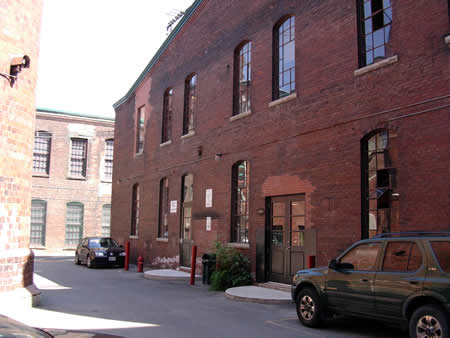
We discover that down these dingy alleys of old industrial buildings, and a man on the street tells us that the whole area here is all dot-coms.

“Mostly, mostly porn though,” he adds.

We’re at Toronto’s Internet porn district. The man takes us around back to the freight elevator and gives an idea what goes on inside this building. There are more companies that seem to see porn within the building.

I won’t challenge the statement that many of the offices in the Liberty Village area are occupied by people in the adult entertainment business. Neither will I challenge the fact that porn companies do register their domains with us (but via resellers, not
directly — see my earlier entry on our business model).

However, I take exception with the “dingy alleys” description of the area, a falsehood presumably used to underscore the fact that people are producing or distributing online porn.

Liberty Village, for those not familiar with the area, an old industrial park surrounding Liberty Street, hence the name. Liberty Village has a number of large brick buildings that were once factories and now function as hipster office complexes. Yes, there are a number of companies specializing in online porn, but like Tucows, there are also a number of companies that provide internet-based services of a less tittilating variety. In addition, there’s at least one recording label, the Corus group of television channels (including YTV, CMT and Scream), several good restaurants, a rock-climbing gym, an executive training centre, a book publisher, a couple of architectural firms, a Vespa dealership, a 24-hour grocery and living spaces (both “genuine” warehouse lofts and “loft-o-miniums”). Calling Liberty Village the “porn district” is like calling Central Park West between 70th and 80th Streets the “Beatle Death Zone”.

The “dingy alleys” of which Dateline NBC speaks are actually often-used walkways for all of us who work in the neighbourhood; they’re no dingier than the alleys between warehouses in New York’s South Street Seaport or Cleveland’s “Flats” (and considerably less dingy and poop-filled than most alleys in San Francisco’s SOMA). When Dave Winer came to Tucows to speak at the OPML Meetup we hosted last week, I took him through the alleys behind the old Carpet Factory Building, and he found them quaint and charming.

Photo: Carpet Factory building, Liberty Village.
The Carpet Factory Building in Liberty Village.
Image taken from OneDegree.ca.

You needn’t take my word for it. I happen to have a collection of photos that I shot in the summer of 2003 when I first got my new Nikon Coolpix SQ camera. They’re a study of these allegedly dingy alleys; you be the judge. Some preview pictures are below:

Photo: Liberty Village alley.
Can’t you just see the sleaze oozing all over this alley? Check out the hot Volkswagen-on-Volkswagen action that’s about to transpire!

Photo: Liberty Village alley.
Gateway to porn!

Photo: Liberty Village alley.
The alleyway that connects Mowat and Fraser Avenues. You can’t tell, but that’s a K-Y Jelly delivery van.

Photo: Liberty Village alley.
One of the so-called dingy alleys ends with this seedy courtyard, the patio of a pornographic Italian bistro.

One Degree has more to say about the Dateline NBC story


Of course, the photographic evidence I’ve presented may end up being overwhelmed by Dateline NBC; this neighbourhood may be branded “the porn district” for life. In the spirit of going with the flow, here’s a little song from the oddball musical Avenue Q, titled The Internet is for Porn [2.7MB MP3, May not be safe for work, but relatively tame — the nastiest word used is “dick”.] I hereby declare this song the official anthem of Liberty Village!