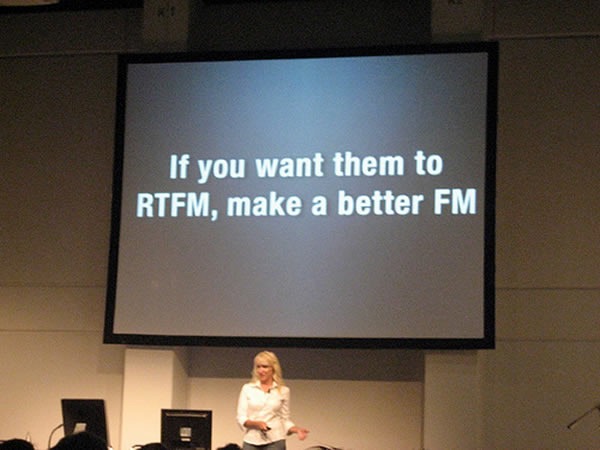
Sound advice from Kathy Sierra (pictured giving one of those mind-blowing presentations that are her stock in trade). Her blog, Creating Passionate Users, while dormant, is still worth reading.
Sure, I’d still do South by Southwest, but I’m at the age where festivals in the vein of Coachella have lost their appeal, and I think things have devolved to this:
Got a project and can’t decide on a typeface? This chart is by no means complete, but it might help steer you in the right direction. Click it to see it at full size.
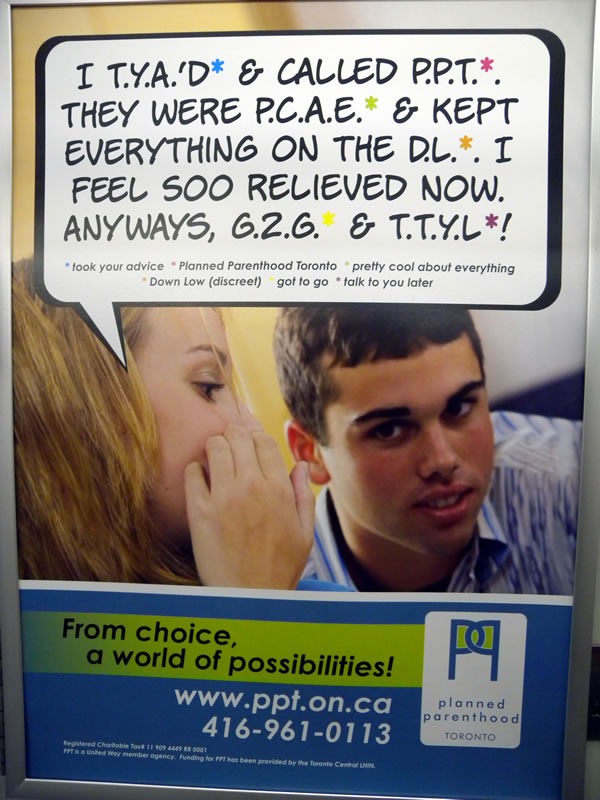
When I was young, I used to cringe when adults made clumsy, if well-intentioned, attempts to speak in what they thought was “youthful slang” in order to make a connection with us.
Now that I’m one of those adults, I can’t tell for sure whether the message in this poster (which I saw in the Toronto subway yesterday) comes across to today’s net/text-speaking youth as clever or clumsy. I’m torn – should my reaction be LOL or WTF?
(And is it me, or does the expression on the guy’s face say BRB?)
Today’s going to be a bit of a whirlwind, starting with a flight to Kelowna by way of Vancouver, with Damir and me doing an EnergizeIT presentation tonight running from 9:00 p.m. to midnight, at least as far as our “body clocks” are concerned. Break out the Jolt Cola!
Here’s Damir getting a little work done while we were hanging out in the Air Canada lounge at Vancouver airport, waiting for our connecting flight to Kelowna:
I’ve already been asked “Did you bring the accordion?” Of course I did. One of the reasons I picked a little Silvetta accordion is that it fits in the overhead bin of just about every plane:
This article also appears in Canadian Developer Connection.
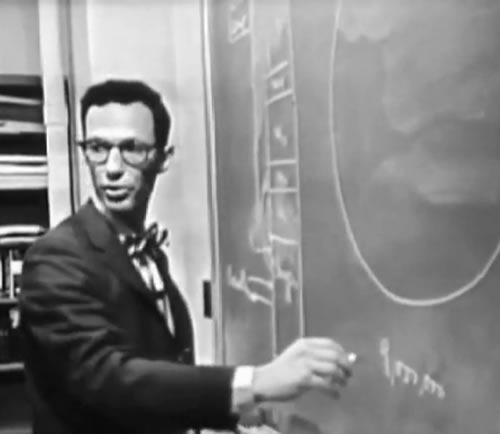
Here’s a great video from 1963 featuring the great-granddad of today’s web servers and cloud computing systems. It was just posted by Boston’s Computer History Museum titled Solution to Computer Bottlenecks. Filmed in May of that year, it features MIT Science Reporter John Fitch – who has a classic 1960’s announcer’s voice – interviewing MIT computer scientist Fernando J. Corbato, the guy behind Corbato’s Law (“The number of lines of code a programmer can write in a fixed period of time is the same independent of the language used”).
The subject of the film is the then-new approach of timesharing, which Corbato describes as “connecting a large number of consoles to a central computer”, which made the great (and very necessary – it even gets mentioned in Malcolm Gladwell’s book, Outliers) leap from batch to interactive processing possible. Here’s the video; enjoy all the retro-tech goodness:
This may have been really deep nerd stuff back in 1963, but today, it the sort of thing that you might see covered in a grade school class. Even if you’re not a programmer or IT pro, I think you’ll find it entertaining.
Some Gems from the Video
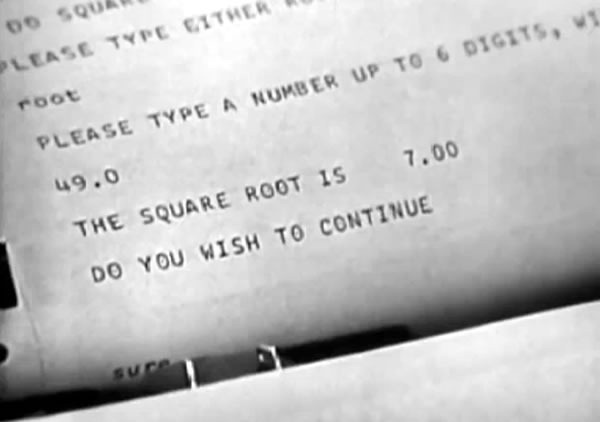
A computer terminal in one’s office isn’t unusual in this day and age, but back in 1963, such a thing must’ve been incredibly super-1337. Here’s the console in Corbato’s office, which he introduces by saying “Here’s one of the consoles we might be using in the future.” Even to the reporter of that era, it looked like an ordinary IBM Selectric typewriter:
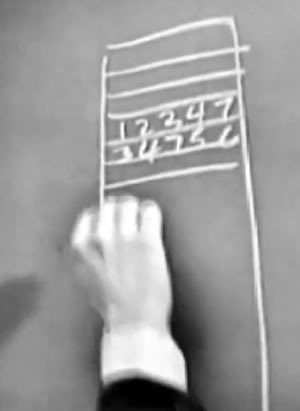
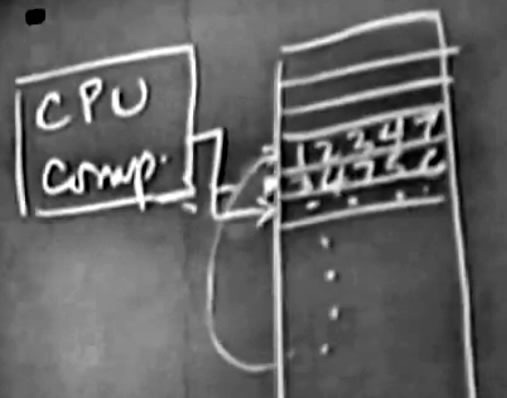
The general principles of digital computers haven’t changed much since those days. Corbato describes memory as “a bunch of pigeonholes” that store numbers, some of which function as data, some of which function as instructions.
The concept of a CPU, the program counter stepping through memory and looping already existed in 1963:
He describes the new setup “a set parallel consoles which are not all near the computer in fact, most of them are remote…and let the users use these with a reaction time of a few seconds instead of a few hours.”
He says that eventually they’d like to switch from “typewriter” consoles to "graphic displays”, but at the time there were still some kinks to be worked out.
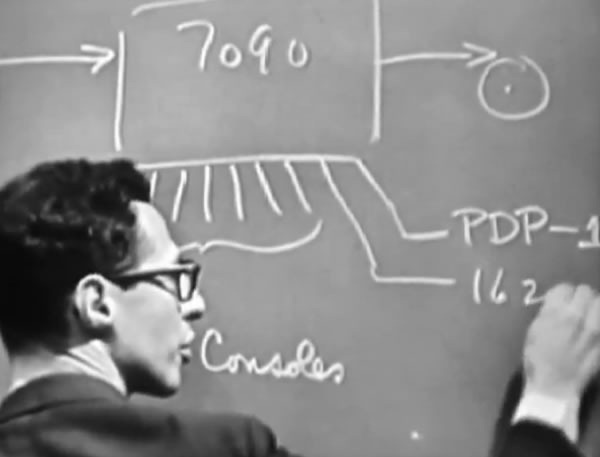
One of the “elaborate advanced ideas” that he hints at but says is beyond the topic of the film is going beyond hooking up dumb terminals to the mainframe and attaching smaller computers to it as well, such as the DEC PDP-1 and 1620:
When discussing the hard disk and its capacity (9 million words), Corbato has to explain to Fitch that it isn’t a big whirling disk on which you store tape, but a platter coated with a magnetic material like tape. This is old hat to us in the 21st century, but at the time, disks weren’t household items:
At the time, disks had been around for about a year. Corbato confesses that there are still some problems with them: they “haven’t figured out how to keep things from getting mixed up”.
And on it goes with ideas that are still in use today: programming languages (“a particular synthetic language which is largely technical, and which is to some extent algebra too”), the organization of different programs in memory at the same time, multitasking with a scheduler that determines which program gets the processor’s attention at the moment, file loading and management by the operating system, the concepts of “brute-force solutions”, context switching (which they can “keep down to 10%”), input validation and even the phrase “it’s a feature”.
The line of Corbato’s that I love most is his prescient statement about usability and demand: “We’ve really made the computer extremely easy to use here. And so it’s very clear that in the long run, we’re going to increase in the need for computer time by a large amount.”
This video is all sorts of old-school awesome. If you’ve got nothing to do on your lunch break, check it out!


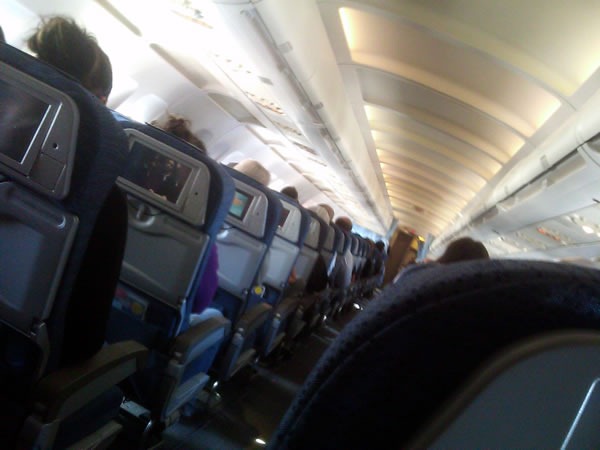 The view from my seat.