Categories
Uncategorized

Multitasking in the “Mad Men” Era

square root

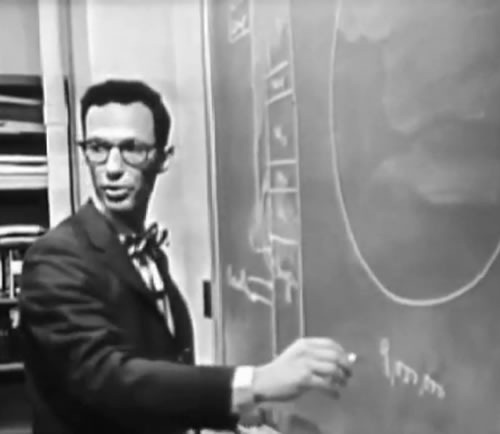
Here’s a great video from 1963 featuring the great-granddad of today’s web servers and cloud computing systems. It was just posted by Boston’s Computer History Museum titled Solution to Computer Bottlenecks. Filmed in May of that year, it features MIT Science Reporter John Fitch – who has a classic 1960’s announcer’s voice – interviewing MIT computer scientist Fernando J. Corbato, the guy behind Corbato’s Law (“The number of lines of code a programmer can write in a fixed period of time is the same independent of the language used”).

The subject of the film is the then-new approach of timesharing, which Corbato describes as “connecting a large number of consoles to a central computer”, which made the great (and very necessary – it even gets mentioned in Malcolm Gladwell’s book, Outliers) leap from batch to interactive processing possible. Here’s the video; enjoy all the retro-tech goodness:

This may have been really deep nerd stuff back in 1963, but today, it the sort of thing that you might see covered in a grade school class. Even if you’re not a programmer or IT pro, I think you’ll find it entertaining.

Some Gems from the Video

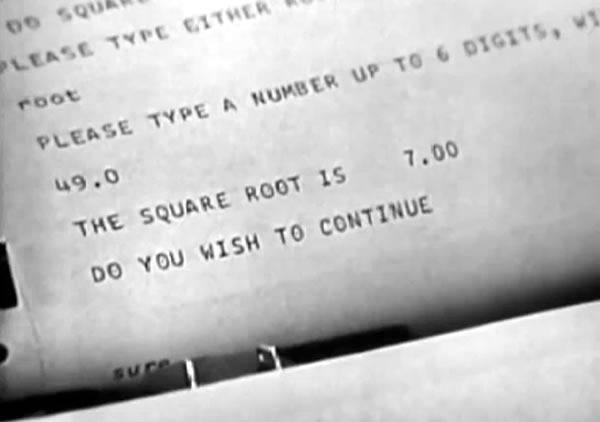
A computer terminal in one’s office isn’t unusual in this day and age, but back in 1963, such a thing must’ve been incredibly super-1337. Here’s the console in Corbato’s office, which he introduces by saying “Here’s one of the consoles we might be using in the future.” Even to the reporter of that era, it looked like an ordinary IBM Selectric typewriter:

1963 future console

The general principles of digital computers haven’t changed much since those days. Corbato describes memory as “a bunch of pigeonholes” that store numbers, some of which function as data, some of which function as instructions.
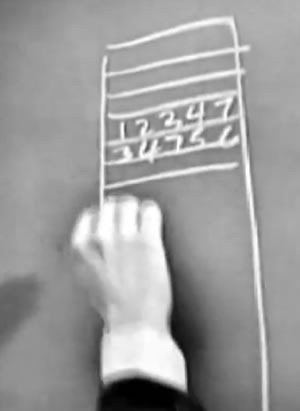
memory pigeonholes

The concept of a CPU, the program counter stepping through memory and looping already existed in 1963:
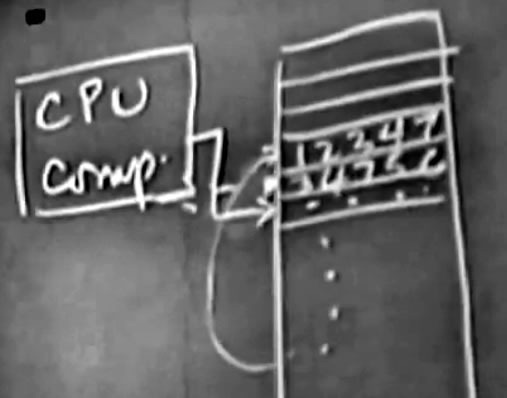
cpu program counter

He describes the new setup “a set parallel consoles which are not all near the computer in fact, most of them are remote…and let the users use these with a reaction time of a few seconds instead of a few hours.”

7090

He says that eventually they’d like to switch from “typewriter” consoles to "graphic displays”, but at the time there were still some kinks to be worked out.

One of the “elaborate advanced ideas” that he hints at but says is beyond the topic of the film is going beyond hooking up dumb terminals to the mainframe and attaching smaller computers to it as well, such as the DEC PDP-1 and 1620:
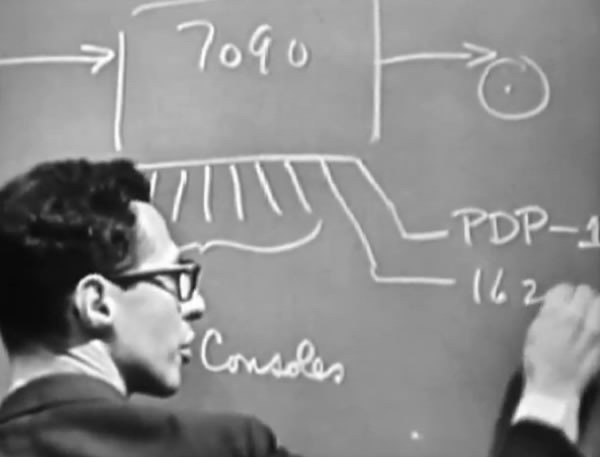
advanced elaborate ideas

When discussing the hard disk and its capacity (9 million words), Corbato has to explain to Fitch that it isn’t a big whirling disk on which you store tape, but a platter coated with a magnetic material like tape. This is old hat to us in the 21st century, but at the time, disks weren’t household items:
hard disk

At the time, disks had been around for about a year. Corbato confesses that there are still some problems with them: they “haven’t figured out how to keep things from getting mixed up”.

And on it goes with ideas that are still in use today: programming languages (“a particular synthetic language which is largely technical, and which is to some extent algebra too”), the organization of different programs in memory at the same time, multitasking with a scheduler that determines which program gets the processor’s attention at the moment, file loading and management by the operating system, the concepts of “brute-force solutions”, context switching (which they can “keep down to 10%”), input validation and even the phrase “it’s a feature”.

The line of Corbato’s that I love most is his prescient statement about usability and demand: “We’ve really made the computer extremely easy to use here. And so it’s very clear that in the long run, we’re going to increase in the need for computer time by a large amount.”

This video is all sorts of old-school awesome. If you’ve got nothing to do on your lunch break, check it out!

This article also appears in Global Nerdy.

Categories
Uncategorized

Mathew Ingram Joins GigaOM

mathew ingramIt’s another “local guy makes good” story: Mesh Conference co-founder, Globe and Mail writer and editor for the better part of two decades, all-round respected Canadian voice in tech journalism and fixture of the Toronto tech scene, Mathew Ingram is leaving the Globe to join GigaOM as one of its full-time reporters.

This is great news all ‘round: for GigaOM, who are getting a great writer to join their ranks, for Mathew, because this is a great opportunity, and for Canada – whose techies since Alexander Graham Bell have been punching above their weight class – who now has a voice in one of technology’s most important and influential blogs.

Congratulations, Mathew, and see you online!

This article also appears in Canadian Developer Connection.

Categories
Uncategorized

Folda Lisa

http://www.joeydThe Mona Lisa, made up of folders in different shades of yellow and brown
Found via Certified Bullshit Technician.

This article also appears in Global Nerdy.

Categories
Uncategorized

The “Spock, Paper, Scissors” T-Shirt

The T-shirt of the day at Tee Fury is sure to be a big hit fans of Star Trek and classic games. It’s the “Spock, Paper, Scissors” shirt:

Powder blue and slate versions of the "Spock, Paper, Scissors" T-shirt

Here’s a closer look at the design:

Close-up of the design: hand-drawn illustrations of Mr. Spock, a sheet of line 3-hole paper and a pair of scissors

The shirt sells for US$9 plus shipping. It comes in two versions:

  • Men’s: Slate blue, in sizes S, M, L, XL and XXL
  • Women’s: Powder blue, in sizes S, M, L, XL

If you want it, you’ve got until the end of the day today (Monday, January 4th) to place an order. Once the day ends, Tee Fury will retire the design from production.

This article also appears in Global Nerdy.

Categories
Uncategorized

Something to Kick Off the New Year and Decade

Here’s a graphic I found the other day while doing a little computer “housekeeping”. I thought it would be perfect for the first post of the new year and decade:

When I was 5 years old, my mom told me that happiness was they key to life. When I went to school, the asked me what I wanted to be when I grew up. I wrote down "happy". They told me I didn't understand the assignment and I told them they didn't understand life.

Do the assignments, but don’t forget to do life!

Categories
Uncategorized

The Vendor/Client Relationship

How’d I miss this video? At TechDays Winnipeg, Dylan Smith of ANVIL Digital (and speaker in the “Fundamentals” track), showed me this it’s-funny-because-it’s-true video that’s been around since May that looks at the vexing expectations that clients have of vendors in IT and the creative industries:

This article also appears in Canadian Developer Connection.

Categories
Uncategorized

Demo Night in Canada

01 demo night in canada

The TechDays conferences that we’ve been holding across Canada span two days and have no evening events. This means that the venues are “lying fallow”, with plenty of A/V, presentation and demo equipment doing nothing on the evening of the first day. That seemed like a waste.

“Why not,” we thought, “open up our venues to community events on the evenings of Day 1?”

We were able to do this in four out of the seven TechDays cities this year:

We put together each event with local people in order to make sure that each one had its own “local flavour” and fit the needs of the local audience. For Ottawa, we decided to approach two very different groups: the Ottawa IT Community, which comprises a number of .NET user groups, and Startup Ottawa, who are the Ottawa analogue of DemoCamp Toronto.

The event had two hosts: Glenn Schmelzle, from Startup Ottawa:

02 glenn schmelzle

and Colin Melia, representing Ottawa IT Community:

03 colin melia

The first presentation of the evening was This is My Language by Charles Wiebe and John Hansen, who showed us their programming language, Jetfire, which is built on top of the .NET Dynamic Language Runtime:

04 jetfire

Next up were Scott Lake:

05 scott lake

…and Craig Fitzpatrick:

06 swix

…who presented Swix, their social media marketing metrics system. It looks both useful and beautiful (its UI shows the sort of rich interfaces you can build with jQuery), and Christian Beauclair and I both agreed that we could make us of it in our developer evangelism work.

09 swix

After the Swix presentation came Islam Gomaa, who took us into the land of enterprise IT by talking about implementing ISO 27001 security:

10 islam

The event went smoothly thanks to Christian, who once again provided invaluable assistance by helping the presenters get their machines hooked up to our A/V setup quickly:

11 techdrifters

Scott Annan talked about Techdrifters, a system for road warriors, cafe coders and people who work in coworking spaces to find an interact with each other. I must admit that it’s a topic close to my heart:

13 techdrifters

Jean-Rene Roy did the final presentation, a look at Microsoft’s Sync Framework – nope, not the car audio system, but the file synchronization system that bears the same name:

14 jean-rene

With the presentations wrapped up, we made our way to the Clock Tower brew pub on Clarence Street, where we enjoyed good conversation and a few drinks, including a round bought on my corporate card.

I’d like to thank Colin Melia, Scott Lake and Glenn Schmelzle for providing all the local help in getting Demo Night in Canada together, the presenters and the attendees who made it out to the event, in spite of all the snow. Let’s do this again soon!

This article also appears in Canadian Developer Connection.