Tsar Nicholas I — Emperor of Russia, King of Poland and Grand Duke of Finland — who brought Russia into the Crimean War and whose domestic and foreign policies are considered disastrous, died on March 2, 1855.
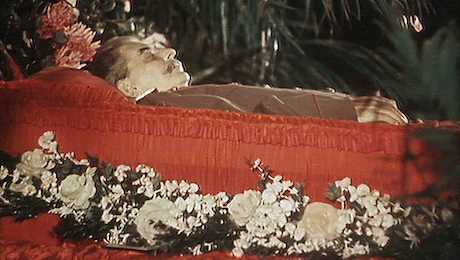
Ioseb Besarionis dze Jughashvili (better known to the world as Joseph Stalin) — Chair of the Ministers of the Soviet Union and Supreme Commander of the Red Army — totalitarian and killer of millions by famine, died on March 5, 1953.Happy Stalin’s Death Day!
Tsar Alexander II — Emperor of Russia, King of Congress Poland and Grand Duke of Finland — pacifist, emancipator of serfs, and generally less of a dick than many historical Russian leaders (a low bar, to be sure) — still was enough of a dick to his lower half blown off by a bomb by the “People’s Will” movement on March 13, 1881.
Iván IV Vasilyevich (better know to the world as Ivan the Terrible) — grand prince of Moscow and the first to declare himself Tsar of all Russia — general rage-a-holic and purge-a-holic, a-hole behind the massacre of Novogrod and the burning of Moscow by Tatars, and the murder of his own son, died on March 28, 1584.
Tsar Paul I— son of Catherine the Great and her husband Peter III (or perhaps by her side guy with a name so appropriate it’s almost Dickensian: Sergei Saltykov) — was killed by his own officers on March 24, 1801.
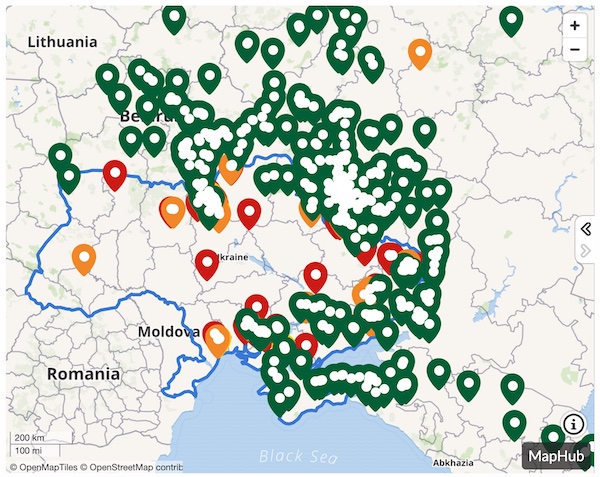
A screenshot of the Russia-Ukraine monitor map from 1:00 a.m. on March 4, 2022. Click to view the map on its webpage.
The Russia-Ukraine Monitor Map is a public resource for mapping, documenting, and verifying significant incidents that happen in the Russian invasion of Ukraine. Its goal, as stated on its webpage, is to “provide reliable information for policymakers, journalists as well as justice and accountability bodies about the evolving situations both on-the-ground and online.”
Created by Centre for Information Resilience and contributed to by Bellingcat, Mnemonic, Conflict Intelligence Team, and other members of the open source intelligence (OSINT) community, the purpose of the map is to provide reliable information. Its content is logged in a central database whose contents will be archived for future use by researchers, reporters as well as justice and accountability bodies.
Incidents or events are indicated on the map with colored “pin” icons. Each has been verified via image — photo, video, or satellite imagery — to confirm where and when it took place.
Green map pins indicate the movement and buildup of military assets. You’ll see many of these outside Ukraine, as they’re often visuals of supply convoys or trains bringing weaponry or soldiers.
Yellow map pins indicate “other footage” that don’t fit any of the other pin categories.
Orange map pins indicate evidence of gunfire, bombing, shelling, or explosion, but not necessarily civilian casualties, infrastructure damage, or military losses.
Red map pins indicate civilian casualties, infrastructure damage and military losses.
Click on a map pin to get more details about the incident at its location:
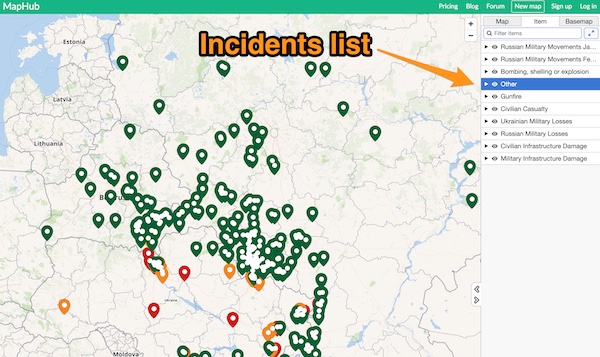
Another way to view incidents on the map is to use the list on the right side:
I know that the current situation in Ukraine has a lot of American firearms enthusiasts excited (and hey; guns are cool and fun to fire), but can we have a moment of honesty here? You’re less likely to fight neo-Soviets on U.S. soil and more likely to kill for something dumb.
In case you were wondering about the Florida man who shot — and killed — someone in a movie theater for texting (it happened here in Tampa, and he fired after the texter threw popcorn at him), here are some links:
My long-time friend Marichka Melnyk (I met her in 1989!) made me aware of this exchange between a Ukrainian woman and a Russian soldier, and her offering to him was so powerful and right-on that I had to share it here.
The video is above, and a translated transcript appears below:
Woman: Who are you?
Soldier: We have exercises here. Please go this way.
Woman: What kind of exercises? Are you Russian?
Soldier: Yes.
Woman: So what the fuck are you doing here?
Soldier: Right now, our discussion will lead to nothing.
Woman: You’re occupants, you’re fascists! What the fuck are you doing on our land with all these guns? Take these seeds [sunflower seeds — the sunflower is Ukraine’s national flower] so at least sunflowers will grow when you all lie down here.
Soldier: Right now, our discussion will lead nowhere [clearly, they’ve been given talking points]. Let’s not escalate this situation. Please.
Woman: What situation? Guys, guys. Put sunflower seeds in your pockets, please. You will lie down here with the seeds. You come to my land. Do you understand? You are occupiers. You are enemies.
Soldier: Yes.
Woman: And from this moment, you are cursed. I’m telling you.
Soldier: Now listen to me —
Woman: I’ve heard you.
Soldier: Let’s not escalate the situation. Please go this way.
Woman: How can it be further escalated? You fucking came here uninvited. Pieces of shit.
At the time, I was a high school student living in the Toronto suburb called Etobicoke (pronounced “Eh-TOE-bih-COE”), not far from my friend Peter Venuto. If the name of the suburb rings a bell, it’s because it’s the same suburb where Toronto’s most notorious mayor, Rob Ford, grew up.
Peter had started playing guitar a few months prior. He was a natural with the instrument, and his playing skill was growing in leaps and bounds. We started playing music together often — him on guitar, me on synthesizer.
With his growing interest in writing and playing music, he was getting less interested in his collection of comics and graphic novels. One day, while jamming at his house, he pointed at a box of comic books and graphic novels and said “take whatever you want”.
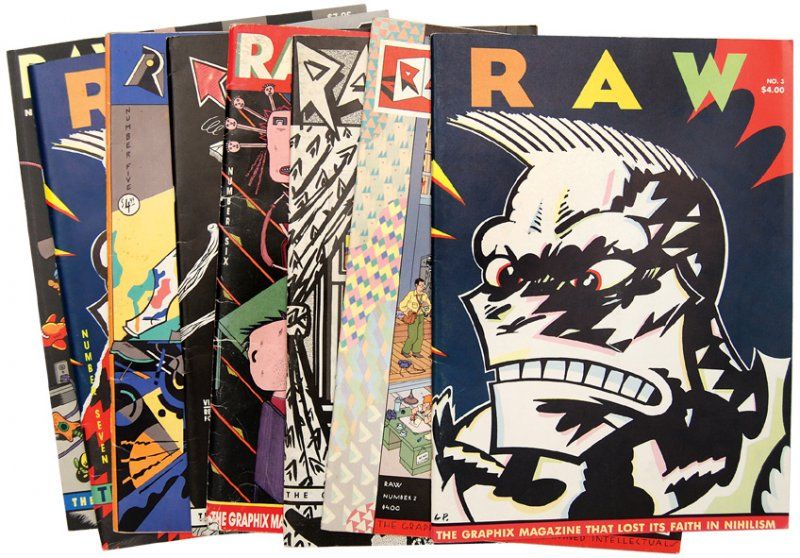
One of them was issue 3 of Raw. It captured my interest with its subtitle: “The Magazine That Lost Its Faith in Nihilism”.
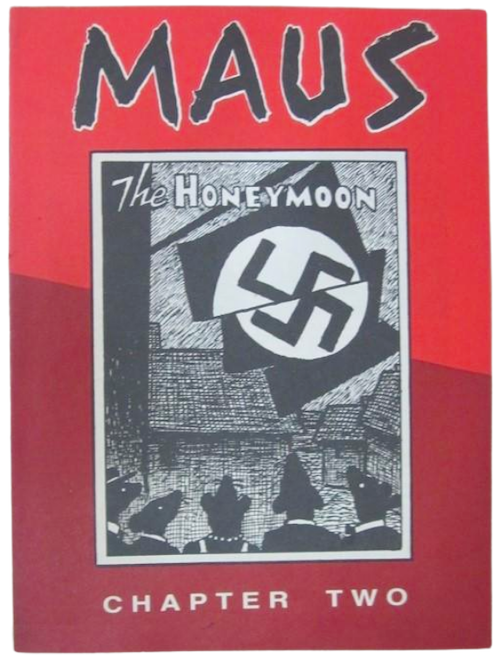
While the magazine had some great stuff (including an amazing article about Wonder Bread), the most interesting part was a smaller magazine within the magazine: chapter two of Maus, titled The Honeymoon.
While comic books and graphic novels were seen as more than kid-lit in Europe and Asia, they were still seen as juvenile in North America. This began to change in the mid-1980s, and some of the credit has to go to Art Spiegelman and Françoise Mouly, the creators of Raw.
Raw felt like a zine, but a zine that has somehow found some of the best artists in the genre (RAW alumni include folks like Lynda Barry, Charles Burns, Kaz, Ever Meulen, Alan Moore, Gary Panter, and Chris Ware), and published them in giant-size high-quality paper format instead of as photocopies stapled together.
Spiegelman included Maus in serial form in Raw. It would later get anthologized into a book, which in turn would go on to win the Pulitzer Prize in 1992.
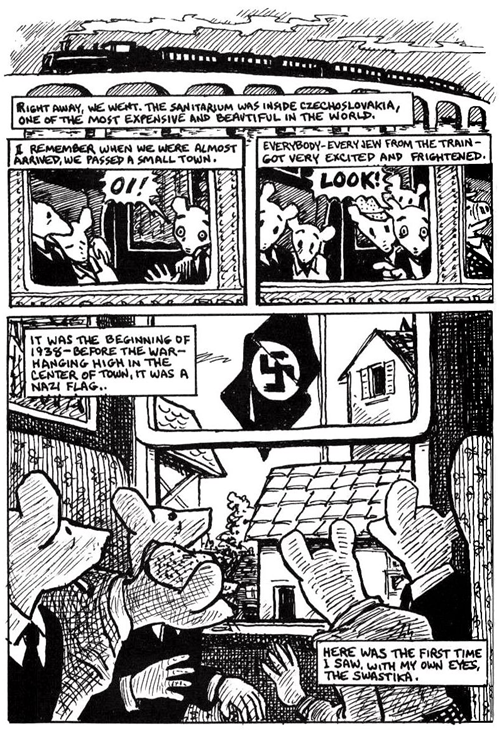
A page from Maus, Chapter Two: The Honeymoon.
Maus is a story depicting Spiegelman talking with his father Vladek, a Jewish Polish immigrant to the U.S., about his experiences during World War II. Most of the story is told from the point of view of Spiegelman’s father.
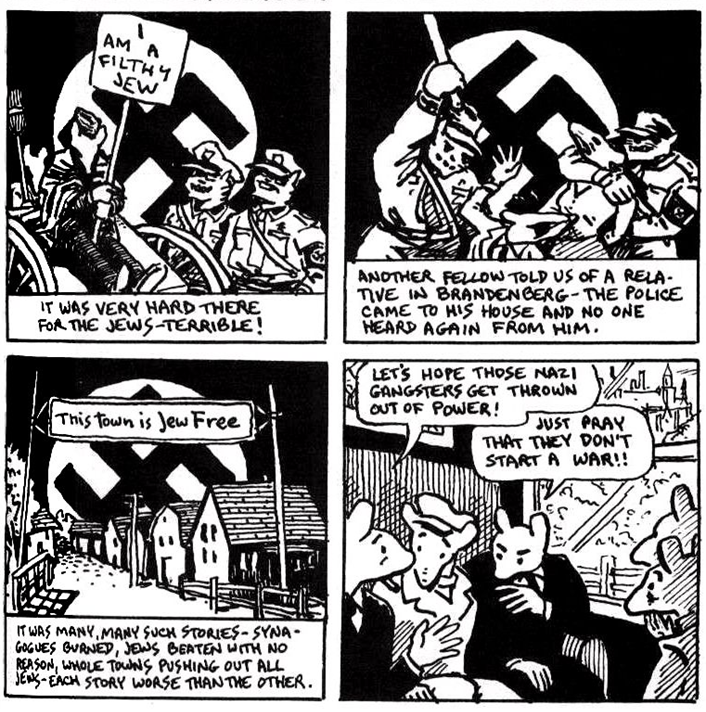
Spiegelman used anthropomorphics as a story-telling device, depicting Jews as mice, Germans as cats, and Poles as pigs. Later issues would feature Americans as dogs, the English as fish, the French as frogs, and the Swedish as deer.
A page from Maus, Chapter Two: The Honeymoon.
Maus was by far the best part of Raw issue 3. When it got turned into a book, I picked up the book, and somewhere in my mother’s house in Toronto, both the book and that issue of Raw are on a bookshelf in the basement. I’ve got to dig them up the next time I visit.
Maus is more than just a story with comic book animals, and it’s also more than a story about of the horrors of the Holocaust. It also tells a story of generational trauma brought on by institutionalized and nationalized cruelty — the kind that we’re regrettably test-marketing here in the U.S. today.
It also tells the story of a son and father trying to come to an understanding, challenged by the differences in their life experiences and the fact that the father grew up in “the old country” while the son grew up “here”. Being in the same situation myself, that resonated with me.

 Green map pins indicate the movement and buildup of military assets. You’ll see many of these outside Ukraine, as they’re often visuals of supply convoys or trains bringing weaponry or soldiers.
 Yellow map pins indicate “other footage” that don’t fit any of the other pin categories.
 Orange map pins indicate evidence of gunfire, bombing, shelling, or explosion, but not necessarily civilian casualties, infrastructure damage, or military losses.
 Red map pins indicate civilian casualties, infrastructure damage and military losses.