
Fredrick Marckini.
Here’s my first full set of notes from the Search Engine Strategies 2008 Toronto conference — they’re from Fredrick Marckini’s keynote presentation on Tuesday. These were flesh out from notes I typed during the keynote; anything in quotes is a direct quote.
Enjoy!
Eternal Life
“Search is really boring.”
“You think you came here to learn about search — you are here to learn about eternal life.” Thanks to search engines, what you put online can live forever.
Consider Reebok’s 2003 Superbowl ad in which Terry Tate was hired by fictitious company “Felcher and Sons” to boost office productivity:
In a pre-internet world, it would have only been seen by people who watching Superbowl 2003 and who weren’t running to the bathroom or getting a snack. Thanks to search engines and YouTube (which is in essence a search engine for video), it’s been viewed an additional 10 million times.
(And yes, the name “Felcher and Sons” was probably chosen deliberately. If you don’t get the term, I suggest a visit to Urban Dictionary, with the caveat that the definition ain’t pretty. Not one bit.)
All media and ads lead people to search, and not only on traditional search engines. Not everyone uses only Google and Yahoo! for search.
When it comes to search results, the third page. Having search results past the third page is like “posting a billboard in the woods”
Where People Click on Google Results Pages
“We are living in Google’s world.” Google gets 92% of the pay per click in the U.S. and Canada.
What percentage of users click on the pay per click sections vs. the “natural results” section on Google results pages? We did the research, and here’s what we found:

72% of all clicks were in the natural results section; the remaining 28% were in the paid. Therefore search marketing must include SEO. Without doing the work to boost your rank in the natural search results, you’re “kissing using only your bottom lip”.
Search Keywords: The Ones You’re Thinking Of Aren’t the Ones Your Customers are Using
Consider this: it’s a “Housewarmer” candle, a product of the Yankee Candle company:

Naturally, when the Yankee Candle company wanted to buy keywords for Google search results, they bought “housewarmer”, because that’s the product’s name, and that’s probably how they refer to these candles inside the company.
However, when they checked their logs, they found that the search term that people were actually using to find them was “jar candle”.
Your customers might be using different language than you are!
Other examples:
- What is “swirl marks” the number one search term for? Believe it or not, auto body shops. People doing this search were looking to have swirl marks removed from their cars.
- Institutions that provide loans were buying keywords like “lending”. From their perspective, that’s the business they were in. The problem was that their customer, when doing searches, were searching using terms like “borrowing”, which is how a loans transaction looks from their point of view.
- Places offering continuing education were buying the key phrase “prior learning” — in reference to college credit for life experience and on-the-job-training — and it was performing badly. Why? Because it’s jargon used within the field of continuing education but not by the general public.
The take-away: understand how your customers use language!
SEO-Savvy Sites

“Good SEO leaves behind clues.” Consider the Thingamajob job search site:
- Good use of keywords on the page
- It uses keywords in the
<title>tag - It used keywords in the URL
- It uses keywords in its headline tags (headlines are important — search engines work on the assumption that web documents are written in a hierarchical format)
- It uses keywords in the activated links
SEO is Not Dead
Some columnists say that SEO is dead. I don’t think so. I see SEO benefiting companies all the time.
In one particular case, I saw a travel company employ SEO — for a $900,000 investment, they experienced a 142% increase in traffic, which resulted in their going from $200 million in revenue when they started their SEO campaign to $500 million over a three-year period. In terms of profit, the client indicated that some months the generated as much $27 million in profit.
To borrow the Huey Lewis song line, “SEO is the heart of rock and roll, and the heart of rock and roll is still beating.” There is still good money to be made with good SEO fundamentals.
Offline Advertising and SEO
In Norway, a chain of car repair shops put out a massive TV ad campaign. Their competitor noticed that even though the TV ads weren’t for their company, they were still experiencing an increased number of visits to their site. The TV ads were driving people to search for car repair.
They decided to purchase 50 car repair-related keywords on Google so that when people searched for car repair, they’d show up in the pay per click section of the Google results page. The end result was that someone else’s TV ads were driving them straight to their online ads.
In the end, the competitor had to stop the Google AdWords campaign — not because of a cease-and-desist, but because they were overbooked for car repairs. Their Google AdWords campaign was a smashing success!
As for the company who ran the TV ads in the first place? They couldn’t be found on Google.
The question you should be asking yourself is: are your competitors using your offline ads to drive their online conversions? Research shows that 40% of people are driven online from offline sources when making a purchase. You need to connect offline ads to search!
Take Your Pay Per Click Campaigns Global Now
We had a client who’d maxed out their number of conversions available in the U.S., and they had anywhere from 3 to 20 competitors per keyword and a $632 cost-per-acquisition.
We did some research and found that in international markets, there were fewer competitors for the same keywords and lower costs per acquisition:
- South Africa: $428
- South America: $372
- Europe: $222
- Australia: $176
The take-away: Take pay per click campaigns global — that where you’re competitors aren’t!
Winning results with Google AdWords – Andrew Goodman
Universal Search

Image from Search Engine Land’s article, Google’s Universal Search Explained.
Click the image to see the original article.
These days, “all search is meta-search” — that is, searches of searches. Those different types of search at the top of the Google results page: images, maps, local, news, video — they’re like tabs leading you to specialized searches. Thinking about search results in terms of text only is no longer enough.
Google has recently introduced Universal Search, featuring results blended from all these tabs. This opens up opportunities to occupy the entire first results page, with “web” links, as well as image, video and news links!
Case study: We had a client whom I’ll call “Skeptical Bob” who worked for a shampoo company who thought he’d maxed out the potential of the keywords he’d bought. He didn’t think that a new SEO team could “move the bar higher”.
We did some thinking. Nobody says “nice shampoo”; they say “nice hair”. We improved his results by doing two things:
- Buying keywords related to hairstyles
- They had all sorts of video (including one with Winona Ryder) — we put them on YouTube
The end result: more and higher-ranked search results for his keywords!
Search-Leveraged Public Relations

The Wall Street Journal has a daily circulation of 1 million [According to the Wall Street Journal fact sheet, that figure is 2 million — Joey]. The New York Times also has a daily circulation of 1 million [Wikipedia reports the same figure — Joey].
While Google’s News search gets 10.3 million views a month, and Yahoo! News get 33.7 million views per month [which puts it on par with the daily circulation of the New York Times — Joey].
Online news has changed journalism. Reporters have changed their behavior and follow online sources.
Google News presents a good PR opportunity since there are fewer competing items in its results. Unlike regular search results pages, results in Google News are listed in reverse chronological order — that is, newest items first. The entire opportunity in the News tab is 30 days, after which news results eventually migrate into the regular search results.
I had a client in the laptop repair business who was wondering if he should go with PPC or natural SEO. I told him he couldn’t afford either, but suggested that he use a news release focusing on the keyword phrase “laptop repair”. The resulting news release had an activated link and got viewed 250,000 times in the first few weeks and got conversions. Even though not a single reporter wrote an article based on that news release, the exercise was not a failure, because he got search engine results and customers!
The take-away: news release outcomes are now expressed in terms of search engine results. Optimize your news releases for search!
The Long Tail
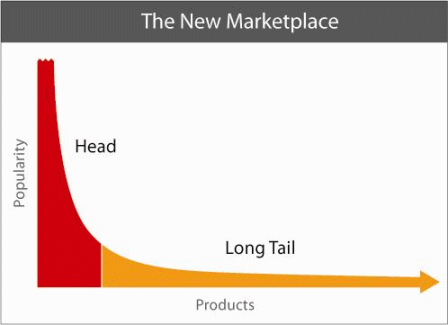
[In the interest of brevity, rather than explain the Long Tail here, I will refer you to the Wikipedia entry for the Long Tail and the Wired article on the Long Tail.]
On the left side of the Long Tail, you have the hits. As you go farther right, you get more niche-y. What nobody thinks about is that hits today become part of the long tail tomorrow, and that time multiplies the impact of the Long Tail.
[Shows a picture of the band Maroon 5 in concert] I was at this band’s concert. Looking around, I thought “I’m the oldest guy here!”
How did I get here? I don’t listen to radio, and I haven’t been to a record store in years. I’d never even heard the name of the band. In spite of all that, I bought 15 of their songs and bought two tickets to their show. I’d become a customer of a brand I’d never even heard of!
How’d that happen? Thanks to collaborative filtering. If you’ve ever looked through Amazon’s site, you’ve seen collaborative filtering. It’s the “Customers Who Bought This Item Also Bought” section in every product listing on their site.
If you do a search on Amazon.com for the term “prostate cancer”, the number one result is for Dr. Patrick Walsh’s Guide to Surviving Prostate Cancer. If you scroll down to the “Customers Who Bought This Item Also Bought” section, you’ll see a book titled You Can Beat Prostate Cancer, a book written by my uncle, Dr. Robert Marckini. The interesting thing about this book is that even though it’s self-published, it’s sold 20,000 copies!
The Future of Search
Algorithmic relevancy has hit a wall.
Vertical search is one possible answer. While Google will return a wide array of results for the search term “seal”, iTunes search will return results about Seal the musician, and an Animal Planet search will return results about seals, as in the animals.
Many things we don’t think of as search engine actually are search engines. Amazon is a search engine for books. iTunes Store is a search engine for music. Flickr is a search engine for pictures. Where people search is going to be as important as how.
Will social search matter? Social software applications such as Facebook, Flickr, MySpace, Last.fm, Digg, etc. all feature social search. Many blog entries have “Add us to your social bookmarks, please” links.
Yahoo! Answers is also a search engine of sorts. It features 90 million unique users who ask questions or post answers, and its answers are showing up in MSN search results and Google.
People are using search to inform their purchases. Shopping is a “visceral driver of commercial reccomndation systems”. Why do people use search for shopping?
- Compressed time. There are so many demands on our times today.
- We crave safety and security. People are “building cocoons and borders around their lives”.
- The “tyranny of overwhelming choice”: there’s so much to choose from.
This presents a natural opportunity for social media and a challenge for brands. Brands will have to participate in their community and “give back” to receive attention. In the past, the brands who won told the best stories about themselves. In the future, the brands who win will be the ones whose customers tell the best stories about them.
People are already doing this: on Flickr, people post photos of their stuff, and of things they’ve bought. There’s a phenomenon called “unboxing” in which people show, either with photos or video, them opening the packaging of their new “toys”. And unboxings get viewed: one guy [shown below] posted an unboxing video of his brand new Playstation 3, and it got over half a million views!
The phenomenon of customers posting fan pictures and video isn’t limited only to the U.S.. Fans are also taking video ads and remixing them with their own soundtracks.
One way to turn your customers into evangelists is to invite customers to photograph and video your products, and give them a place to share them. Sheraton has done this: they’ve invited people to post videos of their stays, and the result was that they exceeded their sales targets.
PVRs, once only for “early adopters”, hit a tipping point when PVR capabilities became a cable box feature. PVRs are also search engines in disguise: they’re search engines for broadcast TV. They’re an example of search behaviour being adopted to the offline world.
Another trend: the decoupling of content from place. Consider the iPod: it’s not a cellphone, it’s nothing short of a revolution. When the iPhone hit the market, Google saw a surge in search traffic originating from iPhones — queries from iPhones exceeded queries from all other smartphones combined. “Not bad for 2% of the market!” As more cellphones get iPhone-like browser capabilities, watch for them to become mobile search engines.
There’s an increasing decoupling of content from platform. You’re no longer tethered to TV set if you want to watch TV. The Slingbox is an internet streaming device that lets you view your cable, satellite or PVR programs from any computer hooked up to broadband internet.
I predict:
- In the next 3 to 5 years, fetaure films will be simulatenously released in theatres, on DVD and online.
- 80% of content digital by 2010.
“If it’s digital, then it’s searchable. Everyone will be a searcher from every device. That is your future”
The AEP model of engagement: Awareness leads to Engagement leads to Purchase. “The future of marketing is search-centric.”