Categories
Geek

The “Random Harlot Table” from the Original Dungeon Master’s Guide

The table below caused much snickering amongst my Dungeons and Dragons-playing peers in high school:

“Random Harlot” table from the original Dungeon Master’s Guide

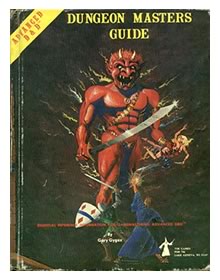
Original Dungeon Master’s GuideIs it a description of Jarvis Street south of Carlton at night, or perhaps a random sampling of H&M’s clientele? Actually, it’s the Random Harlot Encounter Table from the Dungeon Master’s Guide, First Edition, written by the late Gary Gygax. It’s part of the section on random encounters in cities and towns. One of the possible encounter types listed was “harlot”, and stickler for details that Gygax was, he wrote this sub-table which described the sort of sex trade worker one could stumble into in a Lord of the Rings mileu.

Here’s what it says:

Harlot encounters can be with brazen strumpets or haughty courtesans, thus making it difficult for the party to distinguish each encounter for what it is. (In fact, the encounter could be with a dancer only prostituting herself as it pleases her, an elderly madam, or even a pimp.) In addition to the offering of the usual fare, the harlot is 30% likely to know valuable information, 15% likely to make something up in order to gain a reward, and 20% likely to be, or with with, a thief. You may find it useful to use the sub-table below to see which sort of harlot encounter takes place:

00 – 10 Slovenly trull
11 – 25 Brazen strumpet
26 – 35 Cheap trollop
36 – 50 Typical streetwalker
51 – 65 Saucy tart
66 – 75 Wanton wench
76 – 85 Expensive doxy
86 – 90 Haughty courtesan
91 – 92 Aged madam
93 – 94 Wealthy procuress
95 – 98 Sly pimp
99 – 00 Rich panderer

An expensive doxy will resemble a gentlewoman, a haughty courtesan a noblewoman, the other harlots might be mistaken for goodwives and so forth.

All in all, Dungeons and Dragons prepared a lot of us for business in the high-tech world.

Needless to say, some of us didn’t quite get what this table was until we looked up “harlot”. You have to remember that this was the late 70s and early 80s, a decade before the World Wide Web, when you had to scour the woods and ravines for free porn. (For some reason, Toronto’s ravines were full of discarded porn magazines. That’s why Toronto guys my age are pretty good hikers.)

Categories
Geek

The “Dungeons and Dragons” Skit

In memory of Gary Gygax’s passing, here’s a classic video poking fun at Dungeons and Dragons that we used to watch all the time at OpenCola:

Categories
Geek

Gary Gygax: 0 HP

Gary Gygax, the first edition of the “Dungeon Master’s Guide”, D&D dice, D&D figureI’ll have you young whippersnappers know that I only played the first edition of AD&D, the One True Version of the game.

E. Gary Gygax, who as co-creator of the Dungeons and Dragons role-playing game, died this morning at the age of 69 at his home in Lake Geneva, Wisconsin. As a former dungeon master, I feel the urge to get some mead and pour 2d20 ounces on the ground outside the former Yonge Street location of Mr. Gameway’s Ark for my dead homie.

Requiescat in pace, Gary. You were a natural 20.

Categories
Geek It Happened to Me

On My Agenda Next Week…

BarCamp Austin!

BarCamp Austin III

More on this later.

Categories
Geek Toronto (a.k.a. Accordion City)

DemoCamp 17 Covered in the National Post

I am extremely pleased with the way DemoCamp 17 went. We had some great demos and Ignite presentations at the Toronto Board of Trade dining room, followed by one of the best post-DemoCamp after-parties at the Duke of Westminster. My thanks to all the attendees, the presenters, Jay Goldman for doing a lot of the heavy lifting and the very kind folks at the Toronto Board of Trade.

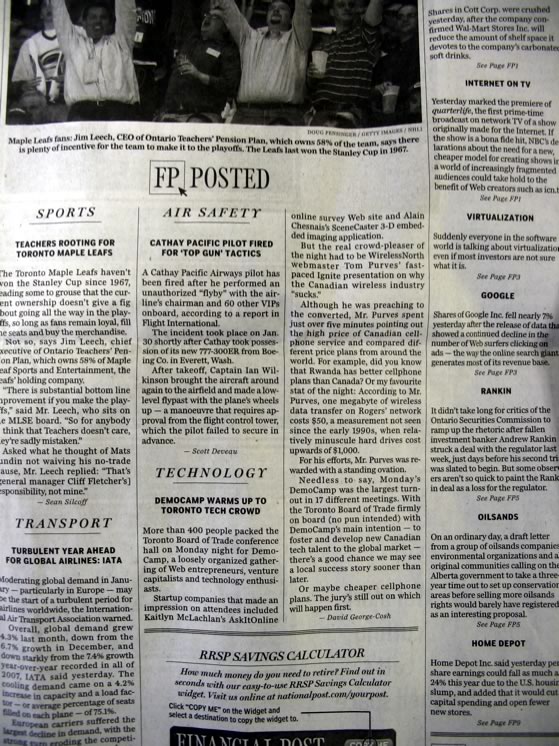
Pema Hegan of GigPark sent me a scan from today’s National Post, which appears below:

Article on DemoCamp 17 in the National Post.

I transcribed the article about DemoCamp:

DemoCamp Warms Up to Toronto Tech Crowd

More than 400 people packed the Toronto Board of Trade conference hall on Monday night for DemoCamp, a loosely organized gathering of Web entrepreneurs, venture capitalists and technology enthusiasts.

Startup companies that made an impression on attendees included Kaitlyn McLachlan’s AskItOnline online survey Web site and Alain Chesnais’s SceneCaster 3-D embedded imaging application.

But the real crowd-pleaser of the night had to be WirelessNorth webmaster Tom Purves’ fast-paced Ignite presentation on why the Canadian wireless industry “sucks.”

Although he was preaching to the converted, Mr. Purves spent just over five minutes pointing out the high price of Canadian cellphone service and compared different price plans from around the world. For example, did you know that Rwanda has better cellphone plans than Canada? Or my favourite stat of the night: According to Mr. Purves, one megabyte of wireless data transfer on Rogers’ network costs $50, a measurement not seen since the early 1990s, when relatively minuscule hard drives cost upward of $1000.

For his efforts, Mr. Purves was rewarded with a standing ovation.

Needless to say, Monday’s DemoCamp was the largest turnout in 17 different meetings. With the Toronto Board of Trade firmly on board (no pun intended) with DemoCamp’s main intention — to foster and develop new Canadian tech talent to the global market — there’s a good chance we may see a local success story sooner than later.

Or maybe cheaper cellphone plans. The jury’s still out on which will happen first.

David George-Cosh

Categories
Geek Toronto (a.k.a. Accordion City)

How ICT Toronto Sees the Local Tech Community

ICT Toronto is a City Hall initiative whose goals are, in their own words, to make Toronto a place that “will become, and be acknowledged globally, as one of the 5 most innovative, creative and productive locations in the world for ICT research, education, business, and investment by 2011”. They’ll be lucky if they manage to update their useless website — a single-pager with very little information and unchanged since April 2006 — by 2011.

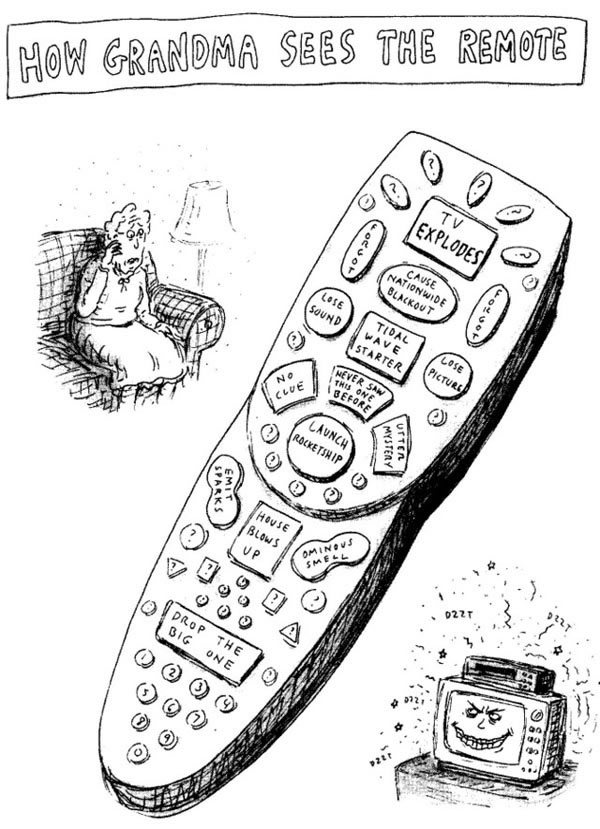
Their focus thus far has been attracting high-tech multinationals to build branch offices here and make us a place to “nearsource”. As far as the local tech community goes, ICT Toronto sees the local tech and startup community in the same way Grandma sees the TV remote:

Comic: “How Grandma Sees the Remote”

(I use the same comic for a slightly different purpose over at this article in Global Nerdy.)

Categories
Geek Toronto (a.k.a. Accordion City)

Responses to “Ideas to Steal from Silicon Valley and Seattle”

A couple of articles have already appeared in response to Ideas to Steal from Silicon Valley and Seattle:

Chris Ragobeer: An Open Letter to Toronto’s Technology Community

Chris RagobeerOver at The Toronto Marketing and Technology Blog, Chris Ragobeer wrote an article titled An Open Letter to Toronto’s Technology Community. In the article, Chris lists these things:

  • Things that Toronto already has that will help in turning the city into a high-tech hub.
  • Things Toronto needs to establish or acquire in order to turn the city into a high-tech hub.
  • Some suggested actions that the local high-tech community can take.

David Crow: Harnessing Hogtown’s Hominids for High-Tech Hijinks and Hubs

David CrowDavid Crow (who recently was voted Toronto’s best tech evangelist at BlogTO, running against some pretty stiff competition including Yours Truly) also responded to my article in a piece with an extremely alliterative title: Harnessing Hogtown’s Hominids for High-Tech Hijinks and Hubs. In the article, he makes these points:

  • Where is our “Fairchild” that creates our own “Fairchildren”? “Can you name big successful software companies that have started in Toronto? More importantly, can you name successful companies that have started because the founders were members of another “parent” company? Why has RIM or Nortel not created a strong spinoff culture?”
  • One possible source of “Fairchildren” might be people who’ve spent time in Silicon Valley and other hubs, who’ve either returned or migrated to Toronto to start companies here. They bring with them experience and connections and “might be a better hope for new wealth creation in Toronto in the high-tech sector.”
  • ICT Toronto is a joke. David’s feeling about City Hall’s attempt to bolster Toronto’s standing as a high-tech hub is similar to mine: “We have a fascination with self-congratulatory bullshit efforts!” Last year’s TechWeek was a non-event that registered on almost nobody’s radar, and I have my doubts about this year’s. Their goals are misguided, and they have no idea of what it means to be local technology company. They seem to be focused on on turning Toronto into a place to do “nearsourcing”, in which case they might as well come up with a marketing campaign like “Toronto: The Bangalore Next Door” and resign us to the fate of being a call center hub.