It’s because I always end up typing the wrong message in the wrong chat window. So far, I haven’t done anything as embarrassing as the ChaCha guide below, but I’m not going to tempt fate…
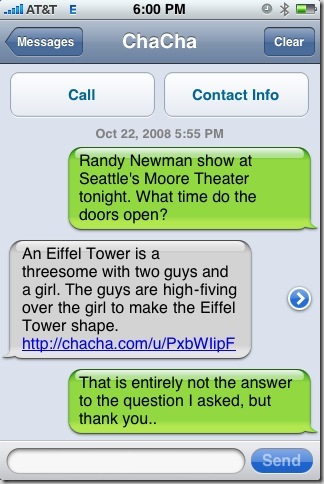
Screen capture courtesy of Miss Fipi Lele.
It’s because I always end up typing the wrong message in the wrong chat window. So far, I haven’t done anything as embarrassing as the ChaCha guide below, but I’m not going to tempt fate…
Screen capture courtesy of Miss Fipi Lele.
One nice thing about PDC: there are plenty of free snacks, some of which are healthy, some of which, well, not so much…
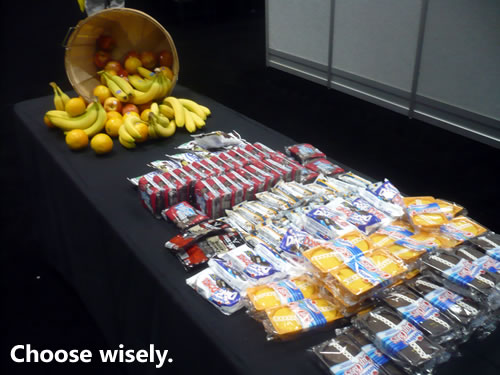
Choose wisely, my geeky friends.
Here’s Bo Burnham singing his nerd-folk/filk song, New Math:
In case you were wondering what the lyrics were, here they are:
What’s a pirate minus the ship? Just a creative homeless guy
And an anteater plus a large hungry mutant ant? An ironic way to die
And what’s domain, domain, range (x, x, y) — a kid with too much in his pants
and two balls minus one, six titles at the tour de france.Split a decision with long division,
Take the circumference of your circumcision
Live like your data and when you’re all “set”
Put it all together and whatever you get…Is new math
What’s a bag of chips divided by five? That’s a Nike worker’s meal
And Santa Claus mutliplied by i? Well, I guess that makes him real
And the square root of the NBA is Africa in a box
How do you trace a scatter plot? Give the pencil to Michael J. FoxTake the approximate moral proportion of the probable problem of a pro-life abortion
Live like your data, and when you’re all “set”
Put it all together and whatever you get…Is new math
And if you made a factor tree of the factors that caused my girl to leave me you’d have a tree
…full of Asian porn.
C-A-L-C-U-LATOR (see you later) mathematical minds make industrial smog
and whats the opposite of ln(x): Duraflame, the unnatural logSupport the farmers with a pro-tractor
Link Kennedy and Lincoln with a common factor (fact, or)
Live like your data…blah blahWord problems
If there’s a fat guy in a pastry shop with a twenty dollar bill and he’s ready to buy
In order to predict his volume change you need to know the value of pi (pie)
And theres a metal train that’s a mile long and at the very back end a lightning bolt struck her
How long ’til it reaches and kills the driver, provided that he’s a good conductor
And if ten percent of men are gay and twenty percent of men are Chinese
What are the odds that a man chosen at random spends his free time and mealtime while on his knees
And if Kim is half as old as Bobby who is two years older than twelve year old Tori
For how many more 30 day months will their threesomes be considered statutory rapeCause havin’ sex is like quadratic expansion: if it can’t be split then it’s time to stop
and havin’ sex is like doing fractions, it’s improper for the larger one to be on top
And havin’ sex is like math homework, I do it best when I’m alone in my bed
And squarin numbers’ are just like women, if they’re under thirteen just do them in your headAnd new math
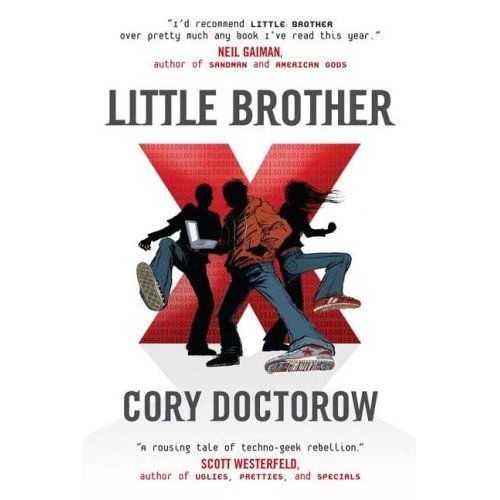
Last night, the Ginger Ninja and I attended Cory Doctorow’s reading of his new novel, Little Brother at the Merrill Collection (the collection of sci-fi books located in the upper floor of the library on College Street just east of Spadina). Little Brother is Cory’s first foray into writing a “young adult” book (memo to my friend Stacy Dillon: read this book!).
Here’s the publisher’s summary of Little Brother:
Marcus, a.k.a “w1n5t0n,” is only seventeen years old, but he figures he already knows how the system works–and how to work the system. Smart, fast, and wise to the ways of the networked world, he has no trouble outwitting his high school’s intrusive but clumsy surveillance systems.
But his whole world changes when he and his friends find themselves caught in the aftermath of a major terrorist attack on San Francisco. In the wrong place at the wrong time, Marcus and his crew are apprehended by the Department of Homeland Security and whisked away to a secret prison where they’re mercilessly interrogated for days.
When the DHS finally releases them, Marcus discovers that his city has become a police state where every citizen is treated like a potential terrorist. He knows that no one will believe his story, which leaves him only one option: to take down the DHS himself.
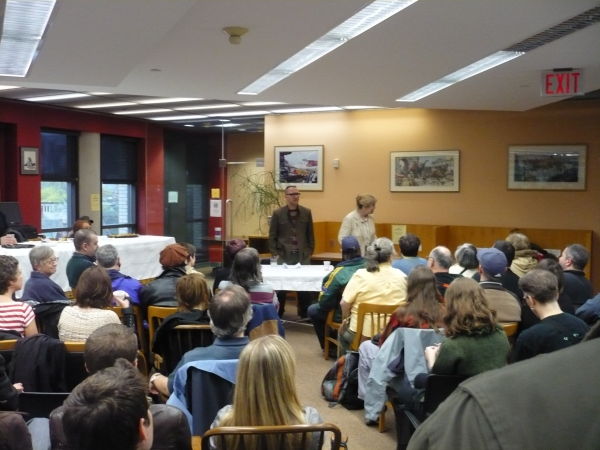
Cory being introduced to the crowd.
The room was packed to overflowing with Cory’s fans, largely a slice of Accordion City’s sizable nerd community, but a different branch from those you see at gatherings like DemoCamp. Cory’s family were also there: Alice and Poesy (who’s a very sweet, well-behaved baby) and the doting grandparents (whom I’ve mentally filed as the “Docto-‘rents”). I also saw some people I hadn’t seen in a good long while, including OpenCola alumni Chris Smith, Michael Skeet and Karl Schroeder, who writes sci-fi that’s harder than Chinese math.
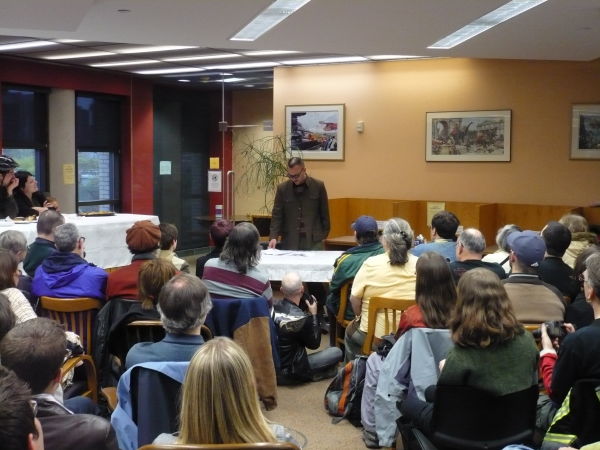
In order to let some latecomers straggle in and not miss the reading, Cory opened the session by taking a couple of questions from the audience.
One member of the audience asked Cory for his opinion of the proposal that the SFWA — that’s the Science Fiction and Fantasy Writers of America — open their membership to comic book and graphic novel writers. Apparently this has sparked some controversy among science fiction and fantasy writers, who don’t want their roster muddied by funny-pages people. In response to this, Cory said that he supported the SFWA opening their doors to comic book people, stating “If science fiction writers and comic book writers have nothing to say to each other, then someone should tell Neil Gaiman.”
Another person asked about Cory’s being a Canadian writing about the Department of Homeland Security, whose methods and approaches are basically an American problem. Cory answered that a number of Americans have taken up the same challenge, and that being a Canadian gives you a little distance from the situation, which in turn can give a better perspective. He used a couple of comparisons: first, how being a bit of an outsider in high school can give you a better view into the social machinery of the popular kids’ cliques (a feeling that I’m sure everyone in this crowd was familiar with), and second, “It’s like we’re Animal House and they’re Dean Wormer.”
“Would you consider Little Brother a sequel to 1984?” asked someone else in the audience, to which Cory replied, “Don’t think of it as a sequel to 1984, think of it as 1984 fan fiction.”
Cory read chapter 12 of Little Brother. A lot of his descriptions of San Francisco’s Mission district come directly from experience; when he and I worked together down there, we ate at a lot of the little Mexican restaurants that fit those he described in the book, right down to the description of brain burritos and our never quite getting up the gumption to order them, even after watching the dinner scene near the end of Hannibal. (And I could swear that he wrote the make-out session near the Mission church by following me and my then-girlfriend back in 2001.)
The chapter was good solid present-day cyperpunk, and in addition of bringing back memories of San Francisco, it also brought back memories of being young, going to concerts and ditching my alcohol and running from the cops after they busted a bush party. As a forty-year-old, I enjoyed this snippet of the story, and I’m sure that teenagers — whom Cory says read not only for pleasure but also to figure out the world — will get a lot out of it.
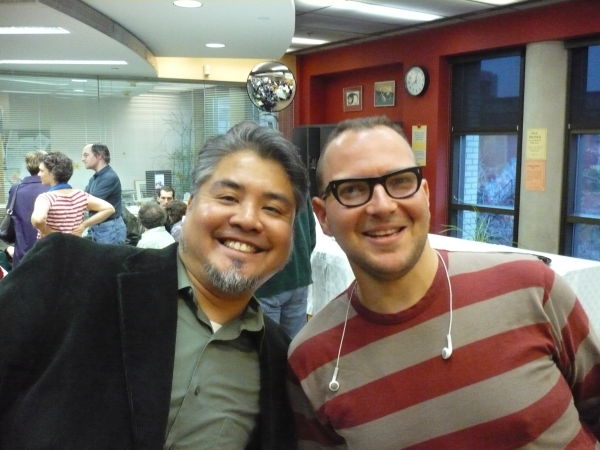
Posing with Cory after he signed my book.
It was good to see Cory and his family at the gathering — it’s a shame that he, Alice and Poesy live so far away! I’ll have to visit them in Merrie Olde Englande sometime soon.

My tech blog, Global Nerdy, is largely focused on computer technology and programming, but it also covers nerd culture, of which Star Wars is a significant part. Right now, I’ve got some Star Wars fun on its front page:
Grand Theft Childhood is a new book written by Dr. Lawrence Kutner and Dr. Cheryl Olson, a husband-and-wife team who co-founded the Harvard Medical School Center for Mental Health and Media. In the video above, Drs. Kutner and Olson talk with X-Play’s Adam Sessler about some of the findings from the study documented in their book.
Some notes:
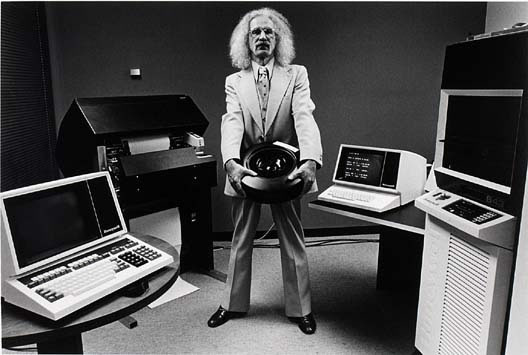
 It’s official: Aaron Brazell, the Director of Technology for b5media (where I hold the title of Nerd Wrangler), is leaving to pursue other projects. When he joined the company, it was a startup literally operating out of a garage and running on shared hosting. We’re now a blog network of over 300 blogs with a total of 10 million unique pageviews per month. I’ve worked with him for a mere three weeks — and one of those was spent at the South by Southwest Interactive conference — but he’s a solid guy, and his skills are evident in his work and the high regard in which he is held.
Here’s an excerpt from his “farewell” post in his blog, Technosailor:
It’s been a great ride, but now it’s time to look forward and explore new territory. Recently, through my interactions with so many wonderful people in the DC technology community, the PodCamp community, the larger social media, business and technology communities, my appetite for something new and challenging has been overwhelming. I’ve had several conversations with Jeremy Wright, our CEO, over the past months exploring this stuff and he has been amazingly supportive, as has the rest of the b5media team.
An exact date has not been set, as I want to make sure a replacement is found and brought up to speed, however it will probably be within the next couple of months.

With Aaron’s departure comes a job opening for a new Director of Technology. Could it be you?
Here are some points on the position:
Here’s what Jeremy Wright, b5’s CEO, has to say:
End of the day, we hire smart people who like to have fun and really want to build great stuff that tens of millions of people are going to see. The challenges for this year are significant, but so is the opportunity. In fact, by this time next year, this individual will be leading a team of 15-20 folk building some of the most widely used tools in the blogging world.
If you’ve got questions about the job or b5, feel free to email me, but I also strongly recommend that you also email Jeremy (after all, he’s the CEO). We’re looking to fill this position as quickly as possible — if you think you’re our Director of Technology, let us know!