Looking at a “Gang Signs” chart, I asked myself “Why should gangstas have all the fun?” The end result: the “Geek Signs” chart, pictured below. Enjoy!

Click the image to see the original version.
Looking at a “Gang Signs” chart, I asked myself “Why should gangstas have all the fun?” The end result: the “Geek Signs” chart, pictured below. Enjoy!
Click the image to see the original version.

Can you believe it’s been 16 years since this movie? Weird.
In the article Further Thoughts on “Toronto the Naughty”, I described local nightlife activist and Newmindspace co-founder Kevin Bracken as “single”. My buddy Pete Forde said “no, he’s not single; he’s in a relationship,” to which “yes, he’s single; he’s not married.”
It’s interesting how bits of your language change as you move from one phase of life to another; I recall using the term “single” in the same sense that Pete used it. I’m reminded of an observation in Clay Shirky’s book, Here Comes Everybody: The Power of Organizing Without Organizations: Only people who have already met their spouse say that cites are dead.

A 1998 Honda CR-V.
In the article Gas Pains, I mentioned that I typically spend the equivalent of US$75 on gas every 6 to 8 weeks. At least four people wrote in via email to say something along the lines of “You have a car?”
This isn’t the first time that someone’s been surprised at my car ownership status. A former co-worker of mine at Tucows who used to butt heads with me regularly over developer relations once expressed surprise at my owning a car by saying “You have a car? But…but you’re an anarchist!”
(“Bon vivant”, sure. On certain days, you might be right to go with “libertine”. But “anarchist?” Hardly.)
I drive a 1998 Honda CR-V that barely has any scratches or mileage. The car’s 10 years old and has less than 100,000 kilometres (around 60,000 miles) on the odometer. It’s not used for commuting to work, occasionally used for going out on the town and on weekends for shopping trips and over to my sister’s house for our weekly family dinner. It’s good for the environment, but more importantly, it’s good for my health (as I bike to work as well as for small grocery runs) and for my wallet.
But yes, I do have a car.
I run Google’s AdSense ads on both this blog and Global Nerdy. AdSense uses Google’s search engine tech to scan this blog and present ads related to the text of my articles. The idea is that people are more likely to click on ads that a related to whatever they’re reading. The rules don’t allow me to disclose what I make in a very specific way, but I am allowed to say that it covers my wardrobe budget or allows me to take the Ginger Ninja out to a very nice restaurant reasonably often.
There are some downsides. Being software, it has no idea of contextual subtlety and will display ads that send a message or opinion opposite to my own. The Gas Pains article mentions George W. Bush in a number of places, and since John McCain is strongly connected to George Bush as far as Google’s search engine is concerned, guess what ads appeared:

Screenshot courtesy of Charles Starrett.
Ah, the vagaries of computer-based recommendations. I’ll have to set aside some time to go into my AdSense settings block Republican ads (despite my being based in Canada, about 60% of my readers are from the U.S., so I’d rather show ads for my preferred candidate, Obama, who seems to be the choice of a number of prominent techies). I may not be eligible to vote, but I am eligible to influence.
Thanks to Charles Starrett for pointing that one out!

An IonCleanse poster hanging in the storefront of a chiropractic office near my home in High Park.
I’ve received a number of responses, via email, comments and in person, to my IonCleanse article. A number of people believe it’s real. I still think it smacks of quackery. I should check up with Pete and see if he’s raised enough money to take the IonCleanse challenge.

Siouxsie Sioux.
Yet another sign I’m getting old: an alt-rock icon from my teen years turned 51 today — Susan Janet Ballion, better known to the world as Siouxsie Sioux (pronounced “Suzie Sue”). She and her band, Siouxsie the Banshees, were a mainstay of my music collection, and if you were a regular at Clark Hall Pub (the engineering pub at Crazy Go Nuts University) during my 1989 – 1994 DJ run, you’d probably hear one of the singles during my alt-rock sets. Somewhere in my parents’ basement is a near-complete collection of Siouxsie and the Banshees vinyl LPs; I’ll have to dig them up sometime.
In her honour, here are some Siouxsie and the Banshees videos for your enjoyment. Happy birthday, Siouxsie!
Here’s Hong Kong Garden by Siouxie and the Banshees, from 1978:
And now, some Siouxsie and the Banshees numbers from my teen years, the eighties. I’ll start with Christine from 1980:
Here’s Cities in Dust, from 1985:
Here’s their 1983 cover of Dear Prudence, which made it to a number of my mix tapes:
I’d be remiss if I didn’t show you the video for the one Siouxsie and the Banshees number that featured an accordion (or at least a very well-synthesized accordion): Peek-a-Boo, from 1988…
And finally, here’s Kiss Them for Me, from 1991, the Lollapalooza era:
This article also appears in Global Nerdy.
If you’re a reader of the usual sites with links that nerds like, you’ve probably seen the video or read the writeup of Clay Shirky’s presentation at Web 2.0 on “Gin, Television, and Social Surplus”.
In his presentation, he describes a conversation with a TV producer, in which he talked about the effort that people put into the “Pluto” entry in Wikipedia. The producer, hearing this story, rolled her eyes and asked “Where do they find the time?”
Clay suggests that the producer believed that “free time”, which he refers to as “cognitive surplus” or “social surplus”, was TV’s by divine right. He posits that the mental energy once devoted to television watching and other equally passive ways of filling one’s spare time is being better spent — on the internet.
(I’ve always found that saying someone has “too much time on their hands” is an intellectually dishonest way of dismissing someone: see my entry Too Much Spare Time? and Cory Doctorow’s essay, Too Much Time on His Hands.)
If you haven’t seen the video of Clay’s presentation, here it is — it’s 16 minutes of your free time well spent:
The TV producer reminded me of a record executive whom I encountered at my first job out of school. It’s an interesting story about programming work and technology in the mid-90’s, the music industry and how predictions about technology can be way, way off.

A screenshot from the 1991 version of the Mackerel Stack, a HyperCard stack the promoted Mackerel’s design work.
My first job fresh from getting my computer science degree at Crazy Go Nuts University was developing multimedia applications in Director at a little company called Mackerel Interactive Multimedia.
The year was 1995, when Myst still defined the cutting edge of multimedia, CD-ROMs and sound cards were still fairly novel peripherals and the only other opportunities for a wet-behind-the ears developer seemed to be at a bank or insurance company, neither of which seemed to be appealing. While the pay wasn’t great — I used to call us the “hos of technology” and did a Full Metal Jacket-esque routine that ended with me shouting “Me so geeky! Clicky-clicky! Me hack for long time!” — the place wasn’t soul-killing like a bank or insurance company might have been. I could wear whatever I wanted, I could dress up my office space however I pleased, the hours were flexible and the co-workers were great: a hip and cool set of young people, with a near 50:50 gender balance. It seemed like Douglas Coupland’s Microserfs, which had just been published at that time, right down to the ill-advised office romances (one of which was mine).
While the dream at the company was to write the next Myst, we paid the bills by writing multimedia apps for clients — typically interactive advertising or educational pieces that would eventually be distributed on CDs or even multiple floppies.
The company went under after a disastrous merger in 1997. Its story was covered by Cory Doctorow wrote an article for Wired about the Mackerel’s demise; unfortunately, it never got published in the magazine. The Mackerel story is told from a different angle by co-founders Dave Groff and Kevin Steele at the Smackerel site, which is subtitled A Biased History of Interactive Media.

One of the bands represented by the record exec’s company. You can try to guess who they are, and you should be able to figure out the record company as well.
One day during the summer of 1996, one of the founders came into the area where the developers hung out and told us that we’d landed a contract with an independent record label belonging to a major record company.
“Isn’t that a contradiction in terms?” I asked.
Apparently it wasn’t. The indy label turned out to be merely a new branch of the major record company. It would sign up-and-coming underground and alternative acts and use the major label for distribution. If the major label was pin-striped and buttoned-down, the indy label was its edgier nephew, clad in faux Hot Topic-esque cred. In spite of their trying-too-hard-to-be-cool aspects, we thought they’d make an interesting client.
The record company exec was a woman who was about five years past their twenty-something demographic. She gave off more of a business school vibe than a rock vibe. She peppered her speech with business-school-isms like “target audience” and “units sold”. She used the word “product” several times and didn’t use the word “music” or even “album” once. Everything she knew about music didn’t come from being a fan; it came from what she’d read in her market research reports.
“That’s why they don’t call it show art,” one of us quipped.
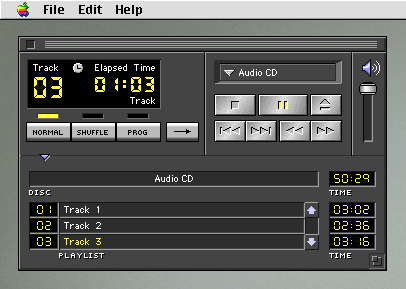
The CD player application from System 7, the version of Mac OS from 1996.
One of the goals of this initial meeting was to brainstorm some ideas for interactive apps that we could build for them. I had been working on an idea that I was rather proud of: CD player apps customized for specific albums. For any CD other than the one for it was customized, it would show a mostly plain interface, plus some promos for the album. However, if you used the player to play the album for which it was customized, it would “come alive” with lyrics, liner notes, album art and so on. It was an attempt to bring back what was lost in the move from LPs to CDs.
“Nice try, kid,” said the exec with great disdain. “We did some market research and we’ve determined that no one will ever listen to music on their computer. People see them as machines for getting work done. We’re aiming for the rec room, the den, the living room and the bedroom, not the home office. You computer guys are aiming for home office.”
“You sure about that?” our production manager asked. “We all use the CD players on our machines. For some of us, our computers are in our bedrooms and living rooms, and they’re also our primary stereos now.”
“That may be true for you,” she replied, “but you guys are the exception. Computers are great, but they’re office equipment. You don’t keep a typewriter or photocopier in your living room, so why would you have a computer there? And that’s where people listen to their music. Office equipment and entertainment: apples and oranges. Trust me – I’ve been in the music industry for a while – no one’s going to listen to music on their computer.”
I listened as a few other people had their ideas shot down in similar fashion. It was a matter of her knowing the music industry better than we did.
At some point during the increasingly futile brainstorming session, I remembered something that I’d brought back from the Macromedia User Conference. I reached into my laptop bag and fished out a floppy disc.

“Here, check this out,” I said, slotting the diskette into my laptop. “It’s something called Shockwave, which lets you embed multimedia applications inside web pages.”
“We don’t think there will be much interest in the world wide web outside of technical people. The pictures are tiny, you’re stuck with default fonts, and your customers have to go buy a modem. Too much tech hassle, too little payoff.”
“You should give this a look,” I insisted. “The company that makes the tool we use to write multimedia software is using MPEG layer 3 [the term “MP3″ hadn’t made common parlance yet] compression to squeeze music files into less space. There’s a small multimedia program on this floppy, and a whole three-minute song. It would normally take about 8 floppies to hold this song.”
I put the disk in my laptop and launched the Shockwave application, which started a tune playing.
“Sounds like crap,” she said. “And who’s the band? The Spin Doctors? They’re so over.”
“Ignore the band,” I said, trying to remain patient. “Just think of the possibilities. This three-minute single is only a megabyte in size. It fits on a floppy, which you can hand out, or you’d be able to download it in a reasonable amount of time. The download will be even faster on the new 56K modems.”

“Blah, blah, blah,” she said, making that opening-and-closing hand gesture signifying pointless chatter. “It only means something to you because you’re a techie. I’ve seen the market research, and I will tell you now: people are not going to be getting their entertainment from computers or the internet. It’s going to come from set-top boxes and MiniDisc recharging stations at their record stores.”
At this point, I decided that discretion was the better part of valour. “Well, you seem to have all the market research, so maybe the best thing would be for you to come up with ideas for an interactive application, and then we can hammer out the details with you in a later meeting.”
“I think that would be a good idea,” she said. She rose from her seat to leave the room, shaking her head.
“I don’t know about you,” I said to the others after confirming that she was out of earshot, “but I think the music industry needs to be destroyed.”
[This article also appears in Global Nerdy.]

I took this shot of Darren Rowse at the b5 Ranch outside Austin, Texas in March 2008.
The photo is from this entry in my personal blog, The Adventures of Accordion Guy in the 21st Century.
My fellow b5er Darren Rowse, of ProBlogger and Digital Photography School fame, was featured in a Chicago Tribune article titled Blogging Paying off for a Few, which takes a look at how some people have been making a living through blogging.
Here’s the part of the article featuring Darren:
In Melbourne, Australia, Darren Rowse has been generating a six-figure income since 2005 from ProBlogger.net and several photography blogs. His blogging career started as a hobby four years ago, when, as a minister, he blogged about starting a new church, he said. That blog led to another; soon Rowse had 20 different blogs, but most didn’t generate enough interest so he shut them down.
When Rowse launched ProBlogger.net to offer advice to other bloggers in 2004, he hit on a need in the marketplace, he said. ProBlogger’s revenue comes from advertising, affiliate marketing, sponsorships and job boards, he said.
“In the early days, I had to be quite proactive,” he said. “As it grew, I found advertising agencies would come to me.”
His experience spurred him to co-found b5media, a Toronto-based network of more than 350 blogs in 15 areas of interest that draws more than 10 million visitors a month. The collective power of b5media attracts advertisers, and the company pays writers to produce blogs for the network, Rowse said.
To be successful, the blogger must be knowledgeable about the topic. It also helps if you’re passionate about it, he said. “Can you see yourself blogging about this topic every day? Quite often, people do it only for the money and can’t sustain it,” Rowse said.

That’s right, Wiener Water Soup. Here’s the recipe, in its glorious entirety:
- 1 pkg. wieners
- 3 c. water
Combine wieners and water in a two quart saucepan. Bring to a boil until wieners are cooked. Throw the wieners in the garbage. Serve soup. Serves 3.
Jason Kottke summed it up nicely: “Cooks.com lets anyone submit recipes.” He found it via Serious Eats, who in turn found it via Dancing at Gunpoint and Copyranter.
I think the recipe meets Gordon Ramsay’s criteria for good food, being both simple and rustic.

Click the photo to see it on its Flickr page.
(This recipe reminds me of Limp Bizkit’s third album, whose title suggested that they knew their fans very, very well: Chocolate Starfish and the Hot Dog Flavored Water.)

Image from BrianKaneOnline.
In July 2000, the city average retail price across the United States for unleaded regular gasoline was US$1.59 per gallon.
Around that time, George W. Bush was the Governor of Texas and the presumptive Republican candidate for that year’s presidential election. Here’s an excerpt from an article in the New York Times:
Gov. George W. Bush of Texas said today that if he was president, he would bring down gasoline prices through sheer force of personality, by creating enough political good will with oil-producing nations that they would increase their supply of crude.
…
Implicit in his comments was a criticism of the Clinton administration as failing to take advantage of the good will that the United States built with Kuwait and Saudi Arabia during the Persian Gulf war in 1991. Also implicit was that as the son of the president who built the coalition that drove the Iraqis out of Kuwait, Mr. Bush would be able to establish ties on a personal level that would persuade oil-producing nations that they owed the United States something in return.
…
Asked why the Clinton administration had not been able to use the power of personal persuasion, Mr. Bush said: ”The fundamental question is, ‘Will I be a successful president when it comes to foreign policy?’ ”
(You should read the rest of the article, as it’s quite funny/sad in retrospect.)
What’s the average price for a gallon of regular unleaded in America today? $3.80.

I felt that pain a couple of weekends ago in Boston. The Ginger Ninja and I had all sorts of commitments that required us to travel all over Massachusetts, so we rented an intermediate-sized car. When we arrived, all cars in that size class were taken, so the rental company gave us a Ford Explorer (the 2008 model is pictured above) at the same rate. As per standard procedure, we filled the gas tank before returning it; being a gas-guzzling beast, it cost a whopping US$75…for a weekend’s worth of driving. That’s my typical gasoline spending over 6 to 8 weeks!
It doesn’t look as though Dubya’s “sheer force of personality” is going to help lower gas prices, judging by this recent Associated Press story:
Saudi Arabia’s leaders made clear Friday they see no reason to increase oil production until customers demand it, apparently rebuffing President Bush amid soaring U.S. gasoline prices.
It was Bush’s second personal appeal this year to King Abdullah, head of the monarchy that rules this desert kingdom that is a longtime prime U.S. ally and home to the world’s largest oil reserves. But Saudi officials stuck to their position that they will only pump more oil into the system when asked to by buyers, something they say is not happening now, the president’s national security adviser told reporters.
I’ll close this article with a comic about personal appeals to King Abdullah (and a subtle Obama reference, to boot):

[Thanks to BrianKaneOnline.]