…I’m reminded of that line (it’s from this episode of The Simpsons) every time I see photo ops of Hillary Clinton pretending to enjoy beer or whiskey:
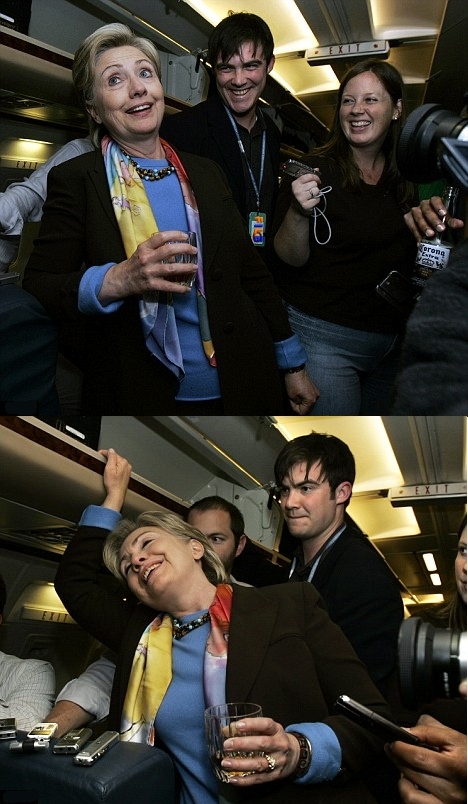
“Shhhwiiiing loooow, shweeeet chaaaaa-reeeeee-otttt…”
…I’m reminded of that line (it’s from this episode of The Simpsons) every time I see photo ops of Hillary Clinton pretending to enjoy beer or whiskey:
“Shhhwiiiing loooow, shweeeet chaaaaa-reeeeee-otttt…”
If I were George, I’d be telling them that if they really wanted to apologize, they SHOULDN’T run the apology:
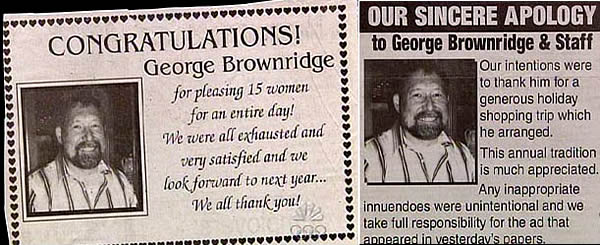
Photo courtesy of Miss Fipi Lele.

To borrow an expression from a commenter on The Seattle Weekly: “Critical Massholes – Saving the planet, one sociopathic gesture at a time.”
As a daily cycle commuter and supporter of Accordion City’s bike plan (I’d really like to see them pull it out of its currently stalled state), I believe in the promotion of cycling as a safe, environmentally-friendly, fiscally responsible and community-building way of transportation. I used to participate in the monthly Critical Mass bike ride in the mistaken belief that it was a way of promoting bikes, but after a year of riding and playing accordion with them, I grew disillusioned with the whole thing. It seemed less like a way to promote cycling and more as an excuse to annoy people who had the gall to travel in a car and not live “I’m so individual, just like the rest of the clique who look and live just like me” twenty-something hipster lifestyle and to live out those unresolved “rebelling against your parents” issues.
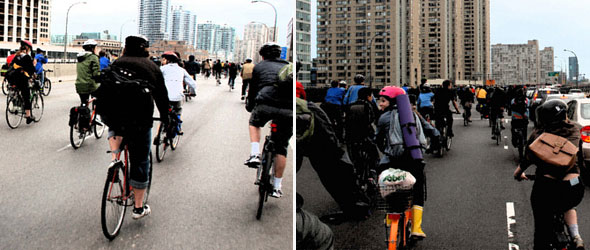
Photo by torontopile.
Click the photo to see torontopile’s Flickr photostream.
Last Friday, yet another Critical Mass bike ride took place here in Toronto, and they’ve upped the ante on their pointless gestures. This time, they — in the words of a participant — “shut down the Gardiner” Expressway, the major east-west highway running along Accordion City’s southern end. The story is covered from different perspectives in different places:
this was my first (and likely last) critical mass ride. i really like their principle of “we’re not blocking traffic, we are traffic”. that being said, i have always felt that as a cyclist wanting to be treated like a vehicle in traffic, we must also respect the rules of the road (ex. stopping at red lights and stop signs, passing on the left, etc.). while i think that it is a relatively minor issue disrupting traffic on the downtown roads for a couple of hours on the last friday of every month (the group is very polite to pedestrians and motorists temporarily disrupted by the ride), i can’t help but wonder if what happened on may 30 was a bit too much. even as i joined the group riding up the jarvis entrance to the gardiner expressway, my gut told me it was a bad idea. with a few other riders in tow, i exited at spadina while the rest of the group continued on to dunn ave. where the boys in blue awaited. quite the experience to say the least and i have certainly enjoyed reading the various opinions about this event online this morning. oh, and i am looking forward to riding the gardiner again tomorrow in the ride for heart!

If the goal of Critical Mass is to participate in some kind of “us-vs-them” war between bicycles and cars and to fulfill some fantasy about fighting against “the pigs”, then Friday’s event was a success. If the goal was cycling advocacy and winning hearts and minds, I’d have to brand it a failure. I can’t imagine someone whose commute home on the Gardiner — which is already slow at rush hour at the best of times — was stretched out even longer thinking “Gee, those Critical Mass guys have sold me; I’m biking to work from now on!”
I don’t think Critical Mass is about cycling advocacy anymore. I think goes even deeper than punishing people for using cars and trucks. I think it’s about a few key people within the group punishing people for not being just like them. You know, just like the conservatives they despise do.
I will continue cycling, but I want nothing to do with the Critical Massholes.

Feel free to use this button on your site or blog!
[This article was also posted on Global Nerdy.]

I have a tit-for-tat arrangement with the folks behind the upcoming Search Engine Strategies 2008 Toronto conference (which runs from June 16th through 18th): they’ll give me a media pass for the conference in exchange for my blogging (both on this blog and on Global Nerdy) from the conference as well as interviewing some of the conference presenters. I’ve been meaning to learn more about search engine optimization and getting one-on-one time with a presenter is pretty difficult, so I think I’m getting the better part of the bargain.
 My first interview is with Jane Motz Hayes, who is an Information Designer at WebFeat, a multimedia company that provides services for online marketing, employee learning and hosting/data management/content management services. She’ll be on a panel called Accessibility, Usability & SEO. Here’s the abstract for the session:
Which user experience elements have you been neglecting? Is your site working, accessible, intuitive, and persuasive? Is it compliant with government accessibility regulations? Do you have a regimen for user testing? Building a user-friendly and accessible site generally coincides with SEO strategy, but not always. If you make changes to the site, will there be positive or negative repercussions on search engine traffic?
The panel takes place on day 2 of the conference, Wednesday, June 18th at 2:30 p.m.. If you’d like to catch this panel as well as the rest of the conference, go here and register for Search Engine Strategies 2008 Toronto.
I had the chance to have an email conversation with Jane recently. Since her panel discussion is going to be about accessibility, usability and SEO, I thought that would be a good jumping-off point for the interview. I asked her some questions, and she sent back some answers, and they appear below. Enjoy!
Being findable by search engines and being easy to use by human beings seem like two very things — one’s about machines and the other’s about people. So what’s the connection between SEO and usability?
 SEO and Usability are both about humans. You can’t have one without the other. Humans use search engines to seek and find information according to the nature of their query — encapsulated as a keyword search. To say that SEO is only about machines omits the human factor, which is kind of the point.
At WebFeat, we think about how to optimize a website for search during the definition and planning phase and we treat search crawlers like an audience (or persona) whose information needs can be satisfied in the pages of the website. By treating search crawlers as an end user, we design all of the pages to be findable on search engine results pages. In the real world it doesn’t make sense to build a store and then not advertise its location or put up a sign informing customers what the shop is, why its useful to them, or whether to push or pull the door to come in. The same applies to the online space. If you aren’t ranking on the first search engine results page for your brand / name, then you’re less usable to humans. Usability is inherent to SEO.
Usability is usually the domain of conscientious designers and developers, and if you’re lucky, your company’s usability consultant or specialist. Meanwhile, SEO is usually managed by sales, marketing and the occasional developer with “suit” tendencies. With such different groups with different agendas, how do people get both SEO and usability to align?
Usability is indeed an SEO issue, and vice versa. At WebFeat, we align the two by interconnecting user experience goals at the onset — and ensuring that every stakeholder understands and agrees that there is improved performance to be gained. When the common ground is increasing sales and improving customer relationships, the case for Usability and SEO alignment is made simple. Findability is a priority for website use – and the natural fit is a user-friendly interface and useful content that is accessible, findable and visible to search engines.
It was Dan Saffer who wrote that user experience is everyone’s responsibility, and web teams all have a stake in ensuring usable, findable websites. In the end, it comes down to better performance as the common agenda and focus.
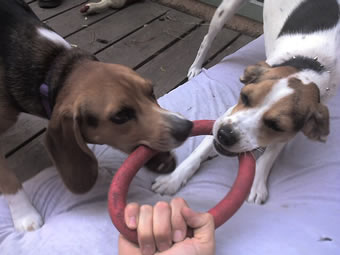
There’s often a tension between designs that are “cool” and designs that are usable, as well as a tension between optimizing for SEO and making a beautiful site. Surely when dealing with a three-way tug-of-war between usability, SEO and beauty, not everyone wins. How do you deal with these differing agendas?
We see this tension all the time, and more often than not, it is the person sitting in my seat on the team, that must mediate the tug-of-war and broker a peaceful solution. But managing opinions and outcomes becomes easier when you advocate hard for the end user — taking this position tends to neutralize territorial agendas and lessen the risk of offending anyone. Indeed there are studies that show that users deem aesthetically pleasing websites as more credible than those with poor information design, and other studies show the ROI of usability. There are even more studies that show the attempts to measure the ROI of SEO. One can appeal to research to provide guidance, but in the end, looking at the users’ requirements of the website, the client goals, and of course the budget and timeline, will help drive out the design, and how much user research and how many SEO tactics you can tackle.
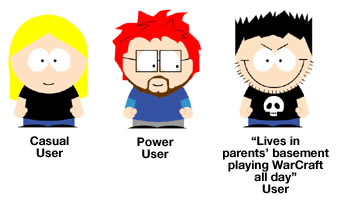
I’ve been to a couple of get-togethers where UI types go out for drinks (yes, there seem to be a lot of them) and one thing I always hear them talking about is “personas” — fictious example users that participate in different scenarios that help guide their designs (such as “Bobby is not really a technical person and uses the site rarely…” and “Carol is a power user who uses the service several times a day…”). If usability and SEO are related, perhaps there’s a persona for a search engine. What would that persona be like?
This is a good question. Personas are often criticized for making broad assumptions and for being tied too closely to real customer data. But I think, as a user research tool, they can be very powerful when implemented properly. That being said – what’s the persona of a search engine? A search engine – let’s call her Jane Doe – is a task-oriented girl who browses the web looking for things she deems important (her mind is always changing and she’s not oft to disclose why she’s changed it) and she likes to keep a record of everything. Once her browsing is complete, Jane stores all of her findings neatly in her apartment as she waits to be asked for something in particular. If you ask her nicely (using the “right” keywords), Jane will think about it for a minute and then provide you with exactly what you need in the order of her choosing. If you don’t ask properly, Jane will give you nothing of use at all. Such is the same with search engines. They crawl the web, indexing documents, then processing queries (based on keyword searches) and provide results based on the algorithm of the search engine. Search engine results pages are prioritized according to the algorithmic determinants of the individual engine. It is part of their charm — they can be great and they can suck. It all depends on who they’re talking to.
In many projects I’ve worked on, usability got short shift, being an afterthought if it was even considered at all. I can see SEO being an easier “sell” to management, as it’s easier to make the connection between it and readers, conversions and money. What do you think of using SEO as a “trojan horse” to sneak some usability work into projects?
Search Engine Optimization is often easier to sell because clients can “see it” and also make a direct connection to ROI — user-centered design is more difficult to conceptualize and quantify a value. But I feel like the tide is turning, as more and more clients understand the value of Usability in informing their website strategy. More than ever, clients understand that usable websites are a measure of brand reputation and credibility – especially those selling products or services online.
That being said, price-sensitive clients may not have the budget for both User Research and SEO so defining KPIs and keyword research is important. KPIs help drive the user experience and well-researched keywords can create a basis for off-page SEO tactics like copy writing and information architecture — which all contribute to a positive user experience. One way to insure proper search visibility is to build off-page SEO best practices into your development process so that you don’t end up with something that can’t be crawled or indexed in natural search When budget becomes available, essential on-page tactics like copy optimization and link-building can occur.
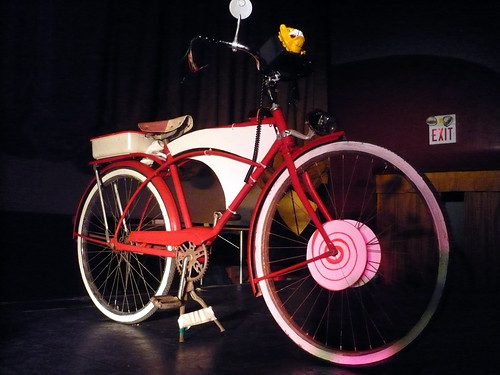
The bike! Click the photo to see it on its Flickr page.
Last night, the Ginger Ninja and I caught the 9:30 presentation of The Pee-Wee Herman Picture Show, a showing of the cult classic Pee-Wee’s Big Adventure, dramatically augmented by a simultaneous live performance of the movie by local community activists and indie rock stars from the Hidden Cameras, Apostle of Hustle, Broken Social Scene, Kids on TV, Republic of Safety and The Phonemes.
Why did such a production take place? Aside from the fact that it’s a fun and new way to see an old film, it’s also a great way to kick off Bike Month, when we here in Accordion City promote the bicycle as a fuel- and cost-efficient, fitness-building, environment- and community-friendly way of getting around. It’s also a better way to convince people to bike than having some patchouli-reeking unwashed hemp-clad underemployed hippie chaining himself to an SUV and reading bad poetry and manifestos about bicycles, which is what a lot of bike awareness rallies feel like.
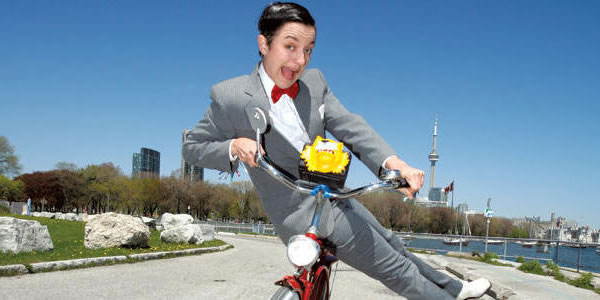
Lex Vaughan made an excellent Pee-Wee.
Photo from Eye Weekly.
Local artist Lex Vaughan (of the art duo “Bucky and Fluff”) played the titular role, with Dave Meslin acting as a Pee-Wee stunt and mirror double. Both Vaughan and Meslin used thier playing the same person to great effect, especially in the scenes where Pee-Wee made a quick change of outfit and where Pee-Wee primps in front of a mirror. The other actors played several roles — not just as people in the movie, but also as props and scenery. One of the best bits was when a dozen people played the role of Pee-Wee’s breakfast-making machine.
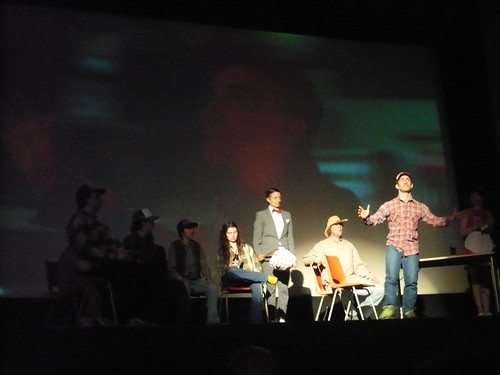
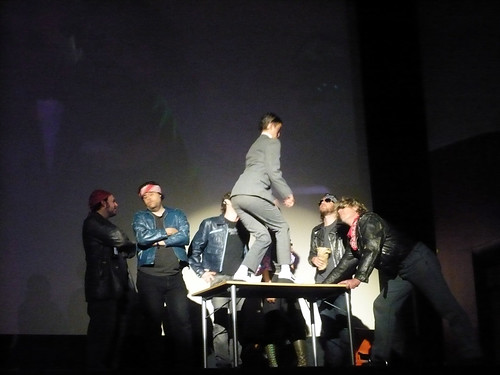
I took photos throughout the performance, and you can see them in my Flickr photoset, titled The Pee-Wee Herman Picture Show. I’ve got some samples below — click them to see them on their Flickr pages:
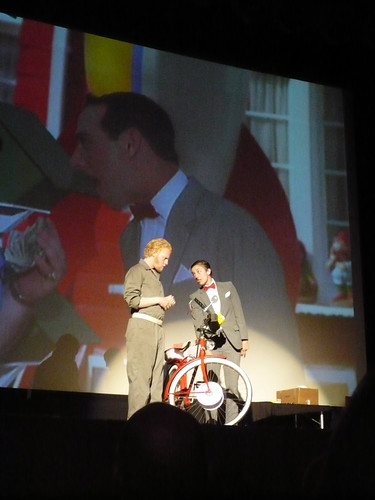
Francis tries to buy the bike.
Click the photo to see it on its Flickr page.
“But that means the Large Marge I was riding with was…A GHOST!”
Click the photo to see it on its Flickr page.
“Tequila!”
Click the photo to see it on its Flickr page.
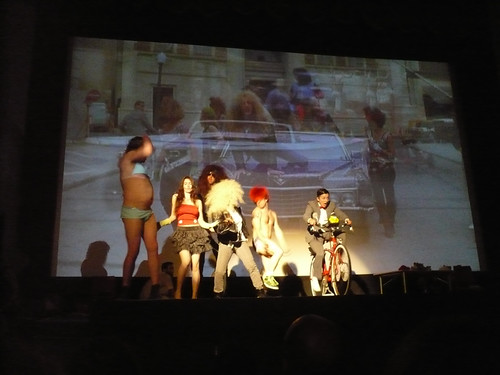
Crashing the Twisted Sister video shoot.
Click the photo to see it on its Flickr page.
For more about The Pee-Wee Herman Picture Show and the people behind it, check out this article from local weekly paper Eye Weekly: Toronto Cyclists’ Big Adventure.
I’d normally post this on Global Nerdy (and I did), but I figured that the appeal of the Guitar Hero series of games was broad enough to merit my posting this here.
Take a look at this promo ad that walks you through the gameplay of Guitar Hero: On Tour, the version for the Nintendo DS handheld game system.
My question is: is it…
I like the attachable fret buttons-and-pick idea; I’m less sure about yelling “Rock out!” into the microphone to activate Star Power, and not at all thrilled about the silly “put out the fire on your guitar by blowing into the microphone” concept.
What do you think?