The SAT (Scholastic Aptitude Test) is an American standardized test
used as part of the criteria for admission to colleges and
universities. There’s a new one for 2005 and MSN has a sample test made
up of 8 math questions — how would you fare?
I got a perfect score using only a piece of scrap paper to keep track of the addends and subtrahend in question 6.
“Hey, Joey,” said my coworker Kim, “wanna come to the Beer Festival?”
And hence this morning’s slightly pasty mouth. Last night was the opening night of the annual Toronto Festival of Beer, which takes place all weekend at Historic Fort York.
Beer companies both large and small showcase their beers their at very
reasonable prices: $1 for a 4-ounce sample or “half-order”, $2 for 8
ounces or a “full”.
Here’s a little tidbit of useful information: when you first enter the
Festival, you’re given a glass that you keep for the stay and use for
the beer you’re served. Always order the half-order.
The beer servers are quite generous and alway overpour the 4-ounce
servings, but the laws of physics prevent them from pouring anything
more than the full glass.
It was a lovely evening of booze-soaked merriment, and I managed to get a few snapshots which I posted. You can view them in photo album or slideshow form.
Here are a couple of samples:
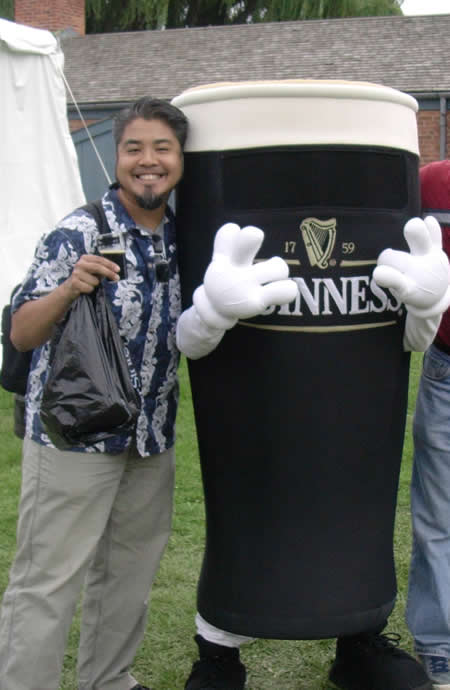
“Thank you, Giant Beer!” My coworker Greg and I make friends with an anthropomorphic Guinness.
“Hey, baby, what shay you and meeeee go shomeplashe quiet?” Darryl finds his one true love.
Super Freak was my first “signature song” when I started DJing at Clark Hall Pub at Crazy Go Nuts University: when you heard Rick singing “She’s a very kinky giiiiirl…”, you knew that I was manning the booth.
Rebecca MacKinnon and Jay Rosen. Rebecca is a media fellow at Harvard’s Joan Shorenstein Center on the Press, Politics and Public Policy; prior to that, she was CNN’s Tokyo Bureau Chief. Jay Rosen is the faculty chair of NYU’s school of Journalism, a former fellow at the Shorenstein Center, was one of the Democratic National Convention bloggers and will be blogging the upcoming Republican National Convention.
After hearing about how Hoder and I came to Canada, Jay quipped “Isn’t history so rude, the way it just interferes with lives like that?”.
In commenting on my write-ups of the PJNet conference on public journalism and blogging
(which he complimented — thanks!), he asked if my reporting style was influenced by my training as a computer programmer. I told him that I couldn’t imagine it not being influenced by it, as I’m the sort of
person who likes his information well-organized.
We also talked about the excellent but short-lived television show Max Headroom, which Jay, Jeff and I loved. Jeff said that he gave it a great review (I’m not sure if it was in TV Guide or People — he worked at both in the 1980s).
Jeff Jarvis and “Hoder” Derakshan. Jeff is the president and creative director of Advance.net (which oversees the internet strategy of Advance Internet and Conde Nast’s CondeNet). Prior to that, he created Entertainment Weekly and was a TV critic for TV Guide and People. Hoder, often known as “The Iranian Weblogger”, contributes in his own way to the reformation of Iran through his English and Persian blogs, both titled Editor: Myself. Hoder’s so influential that someone’s written a Wikipedia entry on him!
We also talked about software and hardware usability and the conceptual gaps between programmers and the people who use their software, self-expression and cultural gaps, beer, journalists’ perception of
blogging, getting Rebecca set up with a Blogware blog, Tucows and Asia.
The big topic of discussion was what I like to think of as “Changing the World”, through weblogs. It was inspired by Hoder’s blogging; he’s almost single-handedly responsible for starting a blogging revolution
in Iran. The hope is to foster the exchange of ideas, international understanding and free speech through blogging. We came up with these requirements (which I’ve cribbed from this entry on Jeff’s blog):
Promotion. Hoder says it is important to get prominent people, like journalists, blogging in these countries to bring attention to it. He wants to set up an award for Iranian blogs — not for the best blog but for the best post, which is appropriate to the medium. We talked about the need to create a blog news service that would translate and reblog notable posts from around the world: Hey, big news guys, here are the stories you’re missing but here’s a link to where you can get them. And hey, powerful politicians, here is what the people are reporting in your country. And hey, readers around the world, here’s a new perspective on a country you’re not seeing in thepaper or on TV — either because it’s not coverered or it’s covered from a high altitude and not from a human level.
Tools. We need to get tools and instruction translated into Arabic and other local languages. They need to be the appropriate tools — so, for example, bloggers can post via email when they can’t get Web access. For blogging to take off in a country, it has to be done in the native language. Efforts are underway.
Hosting. If rich folks want to help the cause of freespeech and understanding, providing free and anonymous hosting that’s not under the control of repressive governments will help.
Detours around censorship. The web technical community needs to invent new ways to get around government censors, who regularly block access to specific blogs and to blog domains (e.g., Blogspot and Typepad). Hoder’s site is now blocked in Iran, which lost him a lot of traffic that matters, but he also found that more people are now subscribing to his RSS feed instead. Separate RSS feed services, cacheing of blogs, clever redirects, and other means need to be created to keep free speech free.
It has happened in Iran. It is happening in Iraq.
Rebecca says it’s exploding in China (though I wish that news service existed so we could get an idea of what people are saying there). Where else should it be happening? Afghanistan. Turkey. Egypt. Saudi Arabia. Indonesia. Central Asia……
Thanks for dinner, Jeff, and it was great dining and talking with all of you!
…to work as Shabbos Goy for
his household. The inquisitive robot, ShaBot, decides
that he is Jewish, and is therefore unable to fulfill his duties as
servant. ShaBot spends his days asking questions about Judaism, trying
to find logic in a religion that sometimes DOES NOT COMPUTE.
ShaBot 6000 is unlike any other Jewish themed cartoon.
In fact, the only other Jewish cartoon worth mentioning is Yaakov Kirschen’s Dry
Bones, a venerable comic strip which has been in syndication since
the 1970’s! Whereas Dry Bones is mostly about Israel and Middle Eastern
politics, ShaBot 6000 is more about Jewish faith. ShaBot 6000 looks
at the lighter side of kashrut, parshat
ha-shavuah, Talmud, interfaith and more, often challenging Jewish principles that most
would never dare question. ShaBot 6000 is a comic strip for
the 21st century modern Jew!
Trust me — it’s pretty amusing. I may be a goy, but since five I know from funny!