My career has been shaped by what I like to call “hobbies that have spiralled out of control”. The first was computer programming, which I took up in the eighties. Accordion playing came in the nineties. In the “naughties”, after submitting suggestion after suggestion to Cory Doctorow to post in Boing Boing, he said “Joey, why don’t you start your own blog?”
I opened an account at Blogger and, when prompted for a name, I went with the stupidest thing I could think of — The Adventures of Accordion Guy in the 21st Century. “I’ll give it a real name later,” I thought.
Nearly seven years later, this blog has become my third hobby to spiral out of control. It’s paid off in ways I would never have imagined, and it’s gained a readership I wouldn’t have imagined either. StatCounter says that this year alone, it’s amassed 1.98 million pageviews. At the current rate, I’ll hit 2 million sometime next week:
While nowhere near as popular as Accordion Guy, my tech blog, Global Nerdy, isn’t doing too badly either. It should hit half a million pageviews by the end of the year:
I’d like to say “thank you!” to all of you readers, whether you’re a long-time reader or if this is your first visit either of these blogs. These numbers don’t happen without you.
I’d also like to say “watch these blogs!” because things look like they’re going to get really interesting.
The building next door to my workplace — 176 Spadina Avenue — is being demolished (presumably to be replaced by a newer, shinier building). It’s too close to the surrounding buildings to use a wrecking ball (which would’ve been cool) or explosives (which would’ve been even cooler) to take it down. Instead, they brought in demolition shears. They’re essentially giant pliers that are used to pull the building apart. The shears dismantle the building as if it were a pig roast, while an excavator scoops away the building chunks like so much pulled pork.
The demolition drew a crowd, which included Yours Truly. I took some photos, which you can see in this Flickr set or in the slideshow below.
I pointed a friend of mine who works in finance — I’ll call him “Senor Gumbo” — to my earlier post in which I explained “longing” and “shorting” to see if I’d explained it properly. He said that I’d nailed it, but he also said that I should more clearly explain what happens if you bet the wrong way when longing or shorting.
At first I thought that I didn’t need to do that, since that should be obvious. After thinking about it some more, I was reminded of something my buddy George likes to say every now and again: “there’s power in stating the obvious”.
So now, via the magic of dry-erase markers and boards, I present: Winning and Losing When Longing and Shorting.
Winning and Losing When Longing
A quick recap: longing is the intutively obvious way to play the stock market. You buy shares that you believe will increase in value over time and eventually sell them for more than you paid for them.
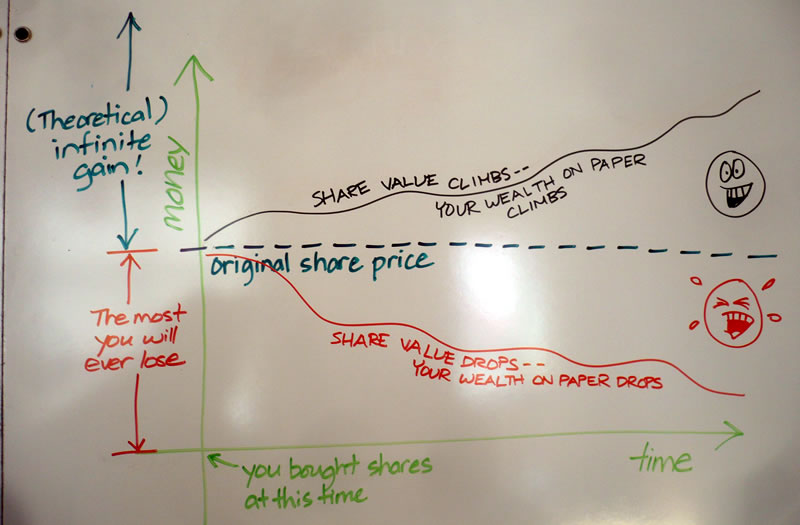
The dry-erase board chart below shows two generalized outcomes of longing:
You bet correctly and their price went up (the black line on the graph)
You bet incorrectly and their price went down (the red line on the graph)
If you bet correctly, the trend in your stock price will look something like the black line, which shows its value generally increasing over time (in order to keep things simple, neither trend shows wild fluctuations). The dashed line in the graph represents the price you paid for the shares, the black line shows the price of shares over time, and the money you gained at any point in time is represented by the distance between between those two lines.
In theory, the price of the shares can go up forever, which means that when longing your profits can go up forever (in theory; if you know of a stock like this that exists in reality, could you kindly email me once you’re done reading?). There is no limit to how much profit a stock can provide…in theory.
If you bet incorrectly, the trend in your stock price will look something like the red line. Once again, the dashed line in the graph represents the price you paid for the shares. The red line shows the price of shares over time. The money you lose at any point in time is represented by the distance between those two lines.
There is a practical maximum to the money you lose when longing. Since the lowest possible stock value is zero — that’s when the company goes under — the most you can lose when longing a stock is what you initially paid for the shares.
Winning and Losing When Shorting
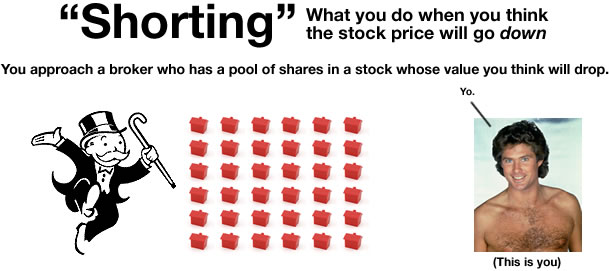
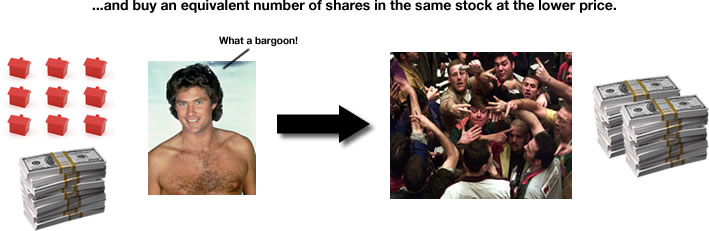
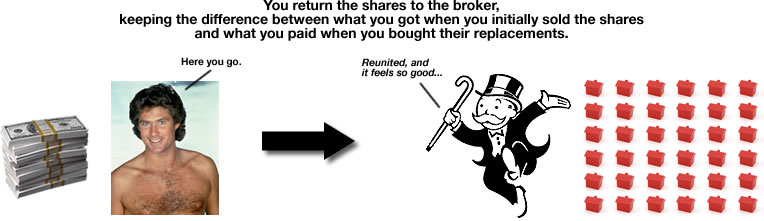
As I mentioned in that earlier post, shorting seems like something from the Bizarro World, where everything is backwards. When you short a stock, you’re trying to make money by betting that its value will drop. You do this by borrowing shares in a stock from a broker and then immediately selling them. When their price drops, you buy an equivalent number of shares in the same stock and give them to the broker. You keep the difference between the price you sold the borrowed shares for and what you paid to buy the replacement shares.
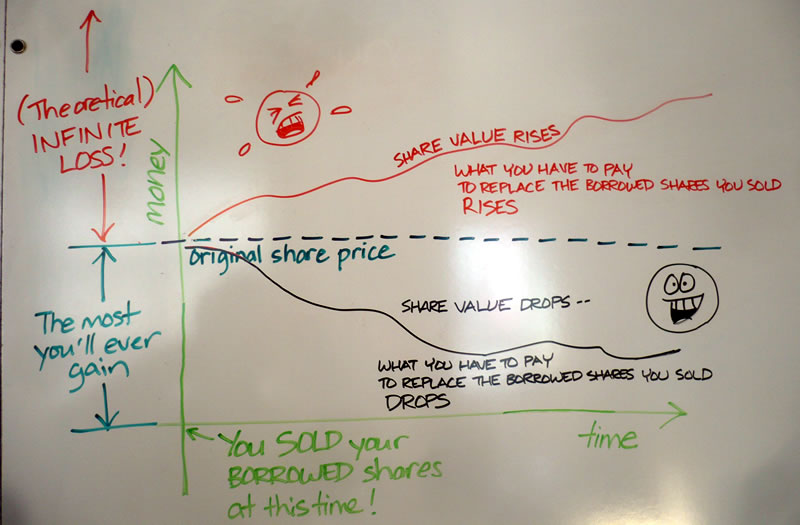
The dry-erase board chart below shows two generalized outcomes of shorting:
You bet correctly and their price went down (the black line on the graph)
You bet incorrectly and their price went up (the red line on the graph)
Again, the black line on the graph shows the stock price trend if things are going your way; the difference is that when shorting, a drop in share prices is good. It means it costs less to “buy back” the shares you sold than it did to sell them, which means you make a profit.
Unlike longing, there is a practical maximum to how much money you can make by shorting. You hit this maximum when the share price drops to zero, meaning that the company has gone under, which in turn means you don’t have to return the stock to the broker. You keep all the money you made when you sold those borrowed shares (minus fees, including what the broker charged you for borrowing those shares, of course).
The red line shows the stock price trend if things are not going your way. It’s bad when the stock price is higher than when you sold those borrowed shares; it means that the cost of replacing them is higher than what you made when you sold them, meaning that you owe the broker money.
Here’s where the theoretical infinity of the stock value will nail you: if there is no (theoretical) limit to the price of shares, there is no (theoretical) limit to what you can lose by shorting. With longing, you can’t lose more on a share than what you initially paid for it; with shorting, you can lose way more than the share’s original value.
I hope that makes things clearer. If you’ve got questions or something to say, please feel free to put them in the comments. If I can’t answer your questions, I can always ask Senor Gumbo.
McDonald’s often caters to the culture of the country it’s in, which is why I’ll occasionally check out Mickey D’s when I’m travelling in Asia or Europe. There’s India’s Chicken Maharaja Mac, Israel’s McShawarma and McSpaghetti in the Philippines, which serves spaghetti the way God intended: with cut-up hot dogs in the sauce.
Oftentimes, it turns out to be junk, but it’s interesting junk, such as this Thai Green Curry Burger:
It’s quite telling that almost every article on the recent restrictions on short selling (or “shorting”) stocks includes a couple of paragraphs explaining what short selling is. The shortest explanation — “It’s making money by betting that a stock will go down” — is counterintuitive. The English idiom “to sell something/someone short” adds to the confusion, because it means “to underestimate the value of something/someone”, which is essentially the opposite of short selling.
In this article, I’m going to explain the basics of short selling and give you enough background material for you to read articles about the current state of the financial world without getting complete confused. And yes, I’ll make it fun.
Stock Market Jargon, Applied to Dating
Believe it or not, this is not a vodka ad, but an actual candid shot from a gala I attended.
About five years ago, I attended a gala and at one point had the accordion-assisted privilege of enjoying some cocktails with some very pretty ladies, an event I chronicled in this entry.
An excerpt:
At one point in the evening, I was having some Campari-and-sodas with a group of charming young women, all of whom were wearing The Little Black Dress. The one who was sitting beside me cupped her hand, turned to me and whispered “See that guy? My friend Lisa* longs him.”
(* Not her real name.)
I interpreted “longs” as “longs for”. However, later on in the conversation, some guy took a seat beside Lisa and started hitting on her with the grace of a rhino on NyQuil.
“Ugh,” said She Who Sat Beside Me. “She really shorts him. I think we’re all shorting him.”
That’s when it clicked. The girls all worked in the financial industry together; in fact, it seemed that most of the attendees at the gala were in finance or had at least written their CFA exam.
They’d adopted the terms longing and shorting for dating. If they liked someone, they “longed” him; if they didn’t, they “shorted” him.
The blog entry caught the attention of Globe and Mail editor Carol Toller and ended up being a short piece in the Our Town section in January 2004. This appearance gave it considerably more exposure, and for the next little while, I was approached by a number of friends and readers who suggested that I write an article explaining longing and shorting. I thought it was a good idea, and it sat in my “things to blog about” list for the next five years.
With the recent events on Wall Street, most notably the current ban on short selling shares of specific financial institutions, I thought that now might be a good time to take that article off the “to do” list and make it real.
“Longing”
This is the form of investing that makes intuitive sense. In longing, a.k.a. “buying long” or “going long”, you buy shares in a stock that you think will go up in value. At some later time, you sell them for more than you paid for them, and thus you make a profit.
Once more, with feeling:
You buy some shares at a low price
You wait for their price to increase
You sell the shares at a higher price
The concept is so simple that I’m pretty sure that you already knew what longing was, even if you were unaware of the term.
It’s usually after this explanation of longing that people ask “Then how can you possibly make money on a stock that loses value? You’d have to be on the Bizarro World!”
To which I’d answer: “Exactly.”
Introducing Bizarro World!
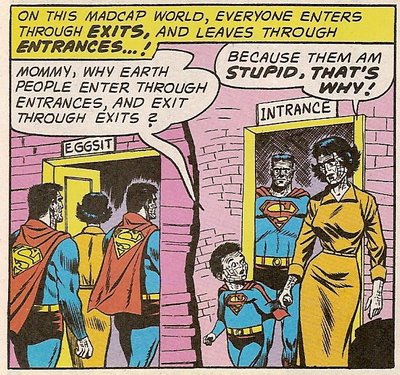
Superman comics in the 1950s and 1960s were full of some painfully, stool-softeningly dumb ideas. One of them was the Bizarro World, the home of imperfect duplicates of Superman and Lois Lane, where everything is backwards.
On the Bizarro World, you enter through the exit and exit through the entrance:
You demonstrate affection by throwing tantrums on Bizarro World:
You win Bizarro World races by coming in last place:
On one Superman comic, Bizarro bonds are shown to be selling like hotcakes because they’re guaranteed to go down in value.
Since everything is (somewhat inconsistently) backwards in the Bizarro World, you, as a Bizarro investor might try to “go long” in reverse order:
You sell the shares at a higher price
You wait for their price to decrease
You buy some shares at a low price
Believe it or not, that’s how shorting works.
Shorts Illustrated
Since the Bizarro World doesn’t exist, we’ll have to accept a couple of real world constraints.
The first is finding a way to sell shares you don’t own. In “regular” shorting (a.k.a. “covered” shorting), you borrow the shares from a broker who would typically have a lot of them and is willing to lend them out for a fee. (There is a way to sell shares you don’t own without first borrowing some. It’s called naked shorting and it’s the “extreme sports” of short selling.)
The second is to make sure that enough people in the market think that in the long term, the share value of the stock will go up. The broker keeps a pool of those stocks because s/he thinks that in the long term, they will appreciate. S/he’s happy to lend them out to short sellers who are planning to make money on the occasional dip in value, but believes that its price’s trend over time is upward.
Short Selling and the Death of Satire: This article from July in funny-sad in hindsight. The author laments the planned crackdowns on short selling back then, saying that the “delicate flowers” that the measure is supposed to protect are big strong places like…Lehman Brothers!