This guy’s sphincter control is nothing short of mind-boggling. On my best Taco Bell day, I could do two candles at most. In case you were wondering, the Tagalog word for “fart” is utot (ooo-TOT).

There’s a graphic about the record-breaking Powerball jackpot that’s going around the internet. Given how bad at many people are at math, I can’t tell whether it was originally intended as a joke or not. It reads:
Powerball 1.3 Billion
÷ U.S. Pop 300 Million
Everyone receives 4.33 mil
Poverty solved!
It sounds nice and inspiring, but it isn’t true. Some people will say it’s because redistribution of wealth doesn’t work and will only make things worse, and we can argue that point another time. I’m arguing that it isn’t true because the math is wrong. Here’s why:
- The Powerball jackpot is 1.3 billion dollars. A billion is 1,000 times a million, and 1.3 billion is 1,300 times a million.
- The U.S. population is slightly over 300 million, which is another way of saying 300 times a million.
- Dividing 1,300 million (the Powerball prize money) among 300 million people (the U.S. population) is exactly the same as dividing 1,300 by 300, which is the same as dividing 13 by 3: $4.33.
It won’t fix poverty, but it will buy every American a Grande-sized Starbucks drink or the Sausage McMuffin with Egg meal at McDonald’s. It’s not the American Dream; it’s more of an American snack.
Update: The “British billion” explanation
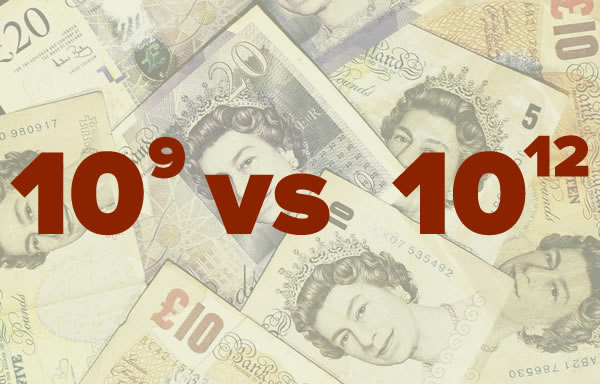
A number of people have read my article and suggested that perhaps the poster used the wrong form of “billion”, because there are two:
- The modern form, where a billion is 1,000,000,000 — written as 1 followed by 9 zeroes, and also expressed as 109 or “ten to the ninth power”.
- The archaic British form, where a billion is a million million, or 1,000,000,000,000 — written as 1 followed by 12 zeroes, and also expressed as 1012 or “ten to the twelfth power”. It’s why some people in the UK still use the form “thousand million” to refer to what we in North America call a billion.
Even if the Powerball jackpot was 1.3 British billion dollars, simple order-of-magnitude estimation shows that you won’t give everyone in the US a million bucks. Divvying that amount (on the order of 1012) among the US population (300 million, which is on the order of 108) can at most yield an amount of 104, or $10,000. If you run the actual numbers, it gives each American $4,333. That won’t lift America out of poverty, but it could give each and every American a new laptop, tablet, and smartphone.

With a $900 million jackpot for Powerball — that’s a U.S. lottery game playable in 44 states as well as the District of Columbia, Puerto Rico, and the U.S. Virgin Islands — I found myself waiting in line to pay for my drink behind an assortment of ticket buyers at my local shoddily-constructed convenience store. Tickets are $2 each, and I saw the people ahead of me dropping $10, $20, $50, and in one case, a whopping $68. You may scoff at these sums, but these people couldn’t: they weren’t spending “walking around” money, but what was probably grocery money.
A couple ahead of me were arguing about whether or not blowing $40 on Powerball tickets was a good idea. “You got a chance of like, what? One in a million? Or two million?” she said, but he wouldn’t be swayed.
“Yeah, it’s one in a million,” he retorted, “but what if I’m that one?“
Mathematically, “but what if I’m that one?” is a nonsensical response, but it appeals to that part of our brains that also gloms onto other nonsense like “things happen for a reason,” “juice cleanses remove the toxins from your body”, “vaccines cause autism”, and “hey, let’s go to Olive Garden!” For a lot of people, those ideas just make a sort of intuitive sense.
If you know someone who’s about to blow money that they can’t afford to lose on Powerball, point them to the Los Angeles Times’ Powerball simulator. It lets you enter your six lucky numbers (or let the computer create a random “quick pick”), pick an amount of money you want to spend on tickets, and simulates a lottery while tracking what you spent, and how far ahead or behind you are. In the screenshot below, you can see that my idea of spending a simulated $200,000 on Powerball rather than pretending to invest it in index funds isn’t working out very well:
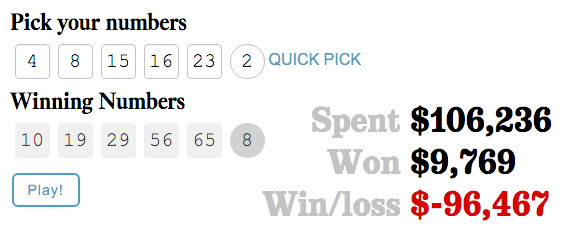
Give it a try and truly experience what slim odds are like. The odds of winning $1 million are slightly better than one in 12 million, while the odds of winning that $800 million jackpot are one in almost 300 million.
Here’s your end-of-week nostalgia fix: DJ 8-Bit Mullet’s chiptune-tastic Bad Dudes: Mega Mash, which takes the soundtrack from the 1988 arcade game Bad Dudes vs. Dragon Ninja and mashes it up with a number of retro musical biscuits, including:
- White Horse by Laid Back
- Magic Man by Heart
- LL Cool J’s Phenomenon
- Michael Jackson’s Bad
- Short Dick Man by Gilette
- White Lines by Grandmaster Flash & the Furious Five
- “plus a little bit of Nate Dogg, Lady Gaga, Heart, Ace of Base, Daft Punk, and samples from the movie The Wizard.”
It doesn’t matter whether or not you wasted your youth at dances, clubs, and arcades like I did — Bad Dudes: Mega Mash is pure 8-bit awesome. I’ve been beating my head against a particularly frustrating bug in an AppleTV game when I did decided to put it on the background — and I fixed it 15 minutes later. I think it made me smarter! Thanks, DJ 8-bit Mullet!
Scenes from Bad Dudes vs. Dragon Ninja
Bad Dudes is every 1980’s action B-movie reduced to its purest form and turned into a videogame. You’re an Arnie-like character trying to rescue a Ronald Reagan-like character from ninjas. I’m pretty sure I pumped a lot of quarters into this game back in the day, which presents its challenge very plainly and clearly:

With the intro out of the way, you’re unleashed on the mean streets of some random unnamed American city that’s crawling with ninjas…
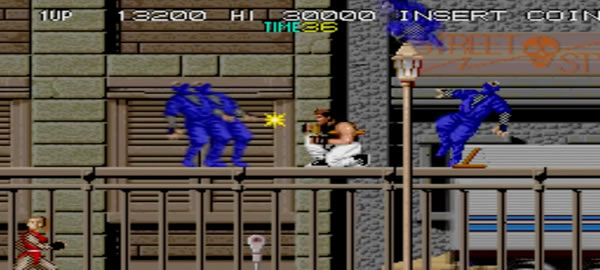
…and from there, you proceed to kick ass on the freeway…

…the sewers…
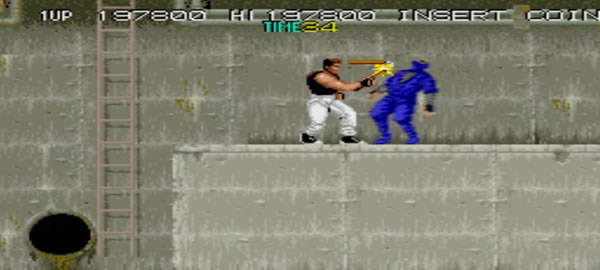
…the woods…
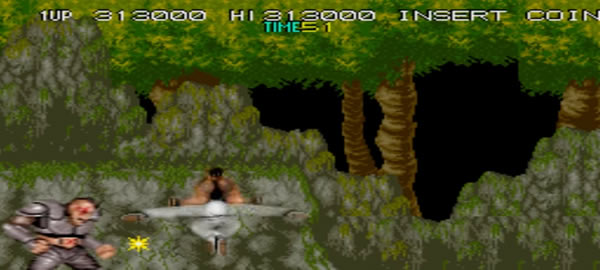
…and in the end, the fabulously-costumed Final Boss on a helicopter!

During a particularly dull stretch of the summer of 1992, I pumped a ridiculous number of quarters into Bad Dudes vs. Dragon Ninja, dispatched the Final Boss, and finally rescued President Ronnie. This was my reward:
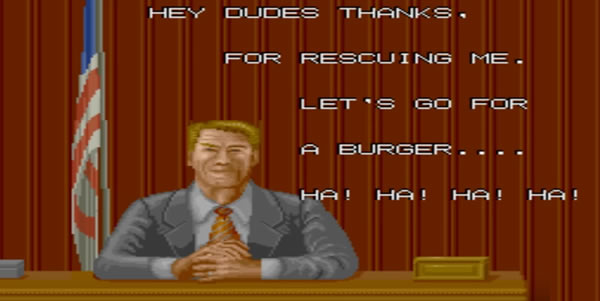
Hey, if the Japanese can be sold on the idea that KFC is a traditional Christmas dish in the U.S., why can’t they believe that the Stateside reward for a daring rescue is two all-beef patties, special sauce, lettuce, cheese, pickles, onions on a sesame-seed bun?
For those of you who can’t get enough videogame gameplay in your diet, here’s a playthrough of the arcade game:

Cartoon by Tom Toles for the Washington Post. Click to see the source.

I’m sure they’re a very nice, very good vet, but in my (ahem) circle, we bring up the term “circle of life” whenever eating meat or watching some nature documentary where one animal beats the crap out of and then eats another animal.
It also reminds me of this very sad scene from The Lion King:
Categories
This software EFFING sucks

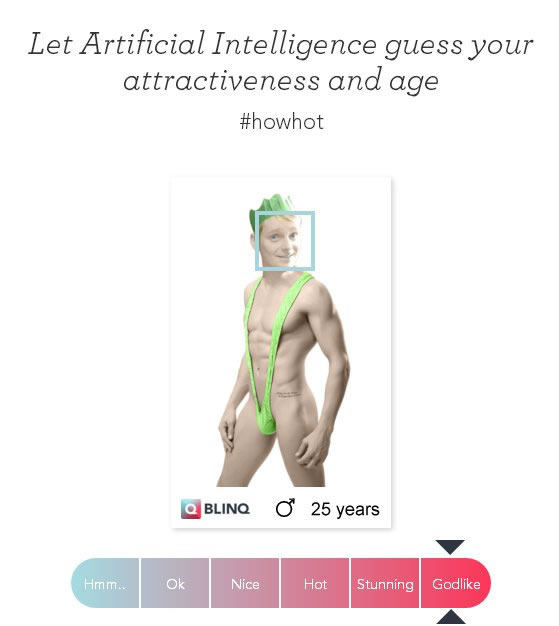
The Swiss dating site Blinq has teamed up with ETH Zurich, a University, to build a web application and mobile app that tell you how attractive you are, based on the preferences of Blinq’s users. Apparently, the Swiss are as cuckoo as their clocks, because the app revealed to me that they have NO GODDAMN TASTE WHATSOEVER.
Here’s how a recent photo, taken in St. Pete the day after Christmas, got rated:
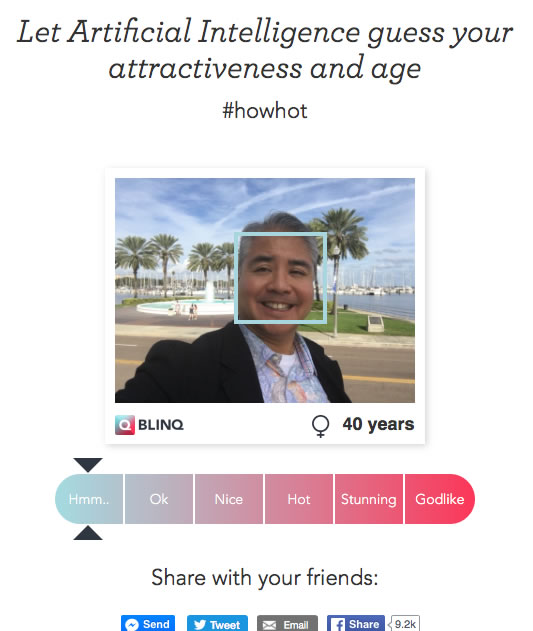
“Hmm…”? Let’s try another one. How about the selfie I sent to my wife from the wifi-equipped flight to India in October?

Just “Ok”? That, my friend, is a frickin’ book jacket-worthy author photo. At least it thinks I look young.
On a lark, I tried this photo from the day after Thanksgiving, featuring a “Cleopatra”-style headdress at one of the Busch Gardens gift shops:
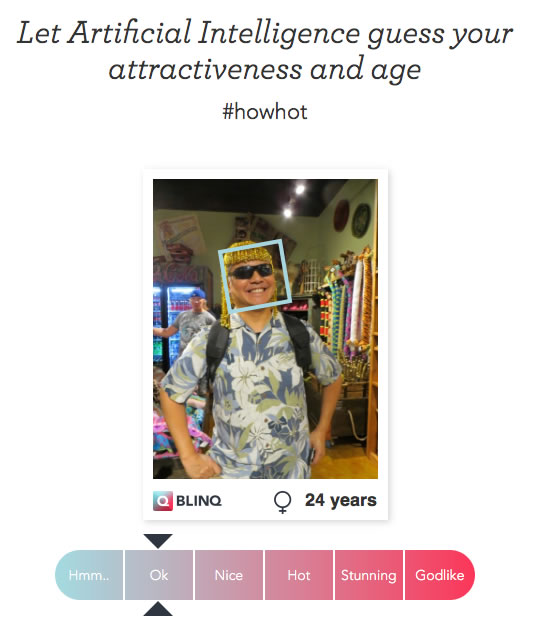
Geez. And it thinks that the 1980s-era Stevie Wonder look makes me seem even younger.
I decided to challenge the algorithm with a photo of me demonstrating a duct tape hack for my CPAP mask (I was traveling and had forgotten the straps for the mask at home). Here’s the result:

This one, it liked. Apparently the Swiss are into the Hannibal Lecter/“Dennis Hopper huffing nitrous in Blue Velvet“ (warning: swearing aplenty) look.
Then I found out about how other, less conventional images scored with the software. Here’s Guy Fieri:

Really?
Then there’s how it rated the image below:
And finally, this image of “Lumpy”, Chewbacca’s son from the oh-so-seventies, oh-so-terrible Star Wars Holiday Special:
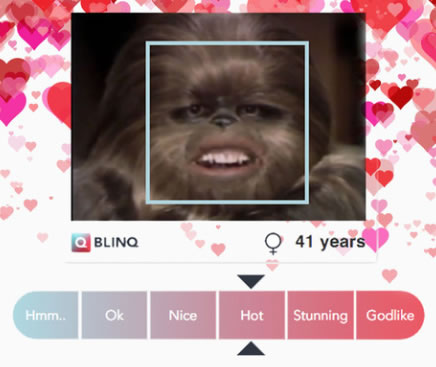
GOD DAMMIT.