Dan, when you read the Onion article Housemates Reject Third-Roomate Debt-Relief Plan, do you burn with shame?
I can think of 6500 reasons why you should.
Dan, when you read the Onion article Housemates Reject Third-Roomate Debt-Relief Plan, do you burn with shame?
I can think of 6500 reasons why you should.
It’s been such a busy time that the third anniversary of The Adventures of Accordion Guy in the 21st Century — Wednesday, November 10th — completely slipped past me!
I’m glad to report that 3 years and 3,338 articles later (3,339
including this one), it’s still fun. Like the accordion, the blog has
paid off in ways I never could’ve imagined. When I started back in
2001, I thought it would just be a creative outlet and something to
pass the time as my job responsibilities as OpenCola were being
whittled down (in the end, all I was responsible for was building the
installer and the “About” box for our software). Instead, it expanded
my social circle, gained me a little internet notoriety and a handful
of newspaper and TV appearances, landed me a job, saved my bacon from a girl who wasn’t who she said she was and played a part in my meeting my fiancee. Hooray for unexpected uses of technology; as William Gibson once wrote: “The street finds its own uses for things.”
Or in my case, “The street musician finds his own uses for things.”
Cory writes in BoingBoing about a proposed internet levy for Canadians.
The money will go to copyright holders, but paying the levy confers no
additional rights to you. Where I come from, that’s called a rip-off.
Here’s the article (quoted in its entirety, thanks to BoingBoing’s Creative Commons Licence):
on this last week. Heritage Canada is now recommending an Internet
“levy” that will go to a collecting society, on a grounds that
everything on the Internet is copyrighted by someone, and the
collecting society will gather money for them in exchange for your use
of their material.
The problem here isn’t really the levy — blanket license fees,
including levies, are actually not a bad way of solving some copyright
problems — but what you get in exchange for it. The levy here would
cover all Internet users, including institutions that have the right to
re-use work without permission or payment (like schools and libraries),
and it won’t confer any substantial rights upon you.
That means that even if you pay the levy for the use of copyrighted
works on the Internet, you won’t get the right to share music, or
download movies, or use screenshots in your PowerPoint presentation.
When a radio station pays a blanket license fee, it gets the right to
play all the music ever recorded. When you pay your levy, you’ll get
virtually no rights at all — except the right to get your ass sued off
if someone decides that you’re being naughty.
The standing committee on Canadian Heritage, which presented
this recommendation along with several other potentially disastrous
ideas, heard lots of learned, substantive testimony on why this is bad
for Canada. It roundly ignored it all. The report that Heritage
delivered is a one-sided smear against the Internet and a naked grab
for a few giant copyright holders at the expense of new entrants to the
market and the general public. The people responsible for this should
be removed from their duties — it’s inexcusable.
If Canada is going to extract a levy from Canadians, then
Canadians should get soemthing in return: unlimited access to
noncommercial, educational, and archival use of copyrighted works on
the Internet. A levy without something in return is just an exercise in
picking your pocket — and you shouldn’t stand for it. Sign the petition today.
The best answer to copyright reform has always been to maintain
balance, the lawyers say. Society wants to maintain creative
incentives, so laws are passed to protect creators; but society must
also have access to those works to share in their knowledge.
“The danger of WIPO is that it threatens that balance,” Mr. Geist said, “and replaces social rights with absolute rights.”
There’s also the potential for the recommendations to have a direct economic impact.
“The committee ignored solid evidence that the levy on blank CDs
[meant to compensate artists for pirated content] would double as a
result of the national treatment requirements of the WIPO treaties,”
Mr. Knopf said. “This could quickly cost Canadians more than
$100-million annually.
“We could end up with the worst of all dystopian worlds,” he
added. “You could pay the levy on a CD and get sued anyway” over the
disc’s content.
The article also links to a Globe and Mail piece titled Ottawa’s copyright plans wrongheaded, experts say.

Remember how I wrote about how Factory Direct Computer Outlet was selling refurbished 10 gig iPods for CDN$279? From now until November 17th, once you factor in a CDN$40 rebate, they’re now going for CDN$199 (according to xe.com, that’s US$166.17).
Over at Big Story, another famous war poem: Wilfrid Owen’s Dulce et Decorum Est. It’s a good reminder that remembering the courage and sacrifice of our veterans and fetishizing war are two completely different things.
(For those of you whose Latin isn’t so hot — or didn’t learn this poem in high school: the title of the poem is derived from the adage dulce et decorum est pro patria mori, which is also the finale of the poem. It means “How sweet and decorous it is to die for one’s country”.)

A Canadian Remembrance Day poppy pin.
Here in Canada, today is Remembrance Day, while in the U.S., it’s Veterans Day. In honour of this day, here’s John McRae’s poem, In Flanders Fields — the poem that is traditionally read here in Canada — in McCrae’s own handwriting:
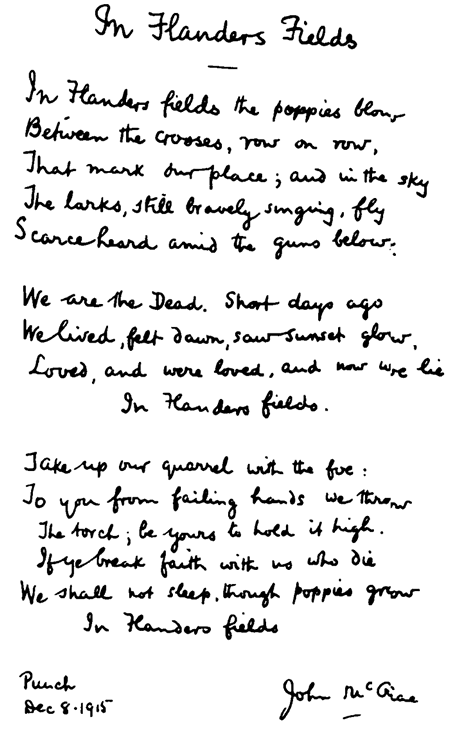
Here’s a page with more information about In Flanders Fields.

Today, November 10, 2004, is the first anniversary of ther release of Outkast’s biggest single, Hey Ya!, in the UK. While the clever pop magazine Pop Justice hails the song as one of the greatest singles of 2003, they’ve had enough. They’ve posted a page titled ENOUGH IS ENOUGH and are asking all you Beyonces and Lucy Lius and babydolls to get off the floor. They’re asking people to stop dancing to Hey Ya.
I think they will meet with very little success. The song’s riff (build
on top on an infection G – C – D – Em progression) is so catchy that
people will dance and sing to even my (necessarily pared down)
accordion rendition.