Here’s the text with link annotations for the Zoomer blabber…
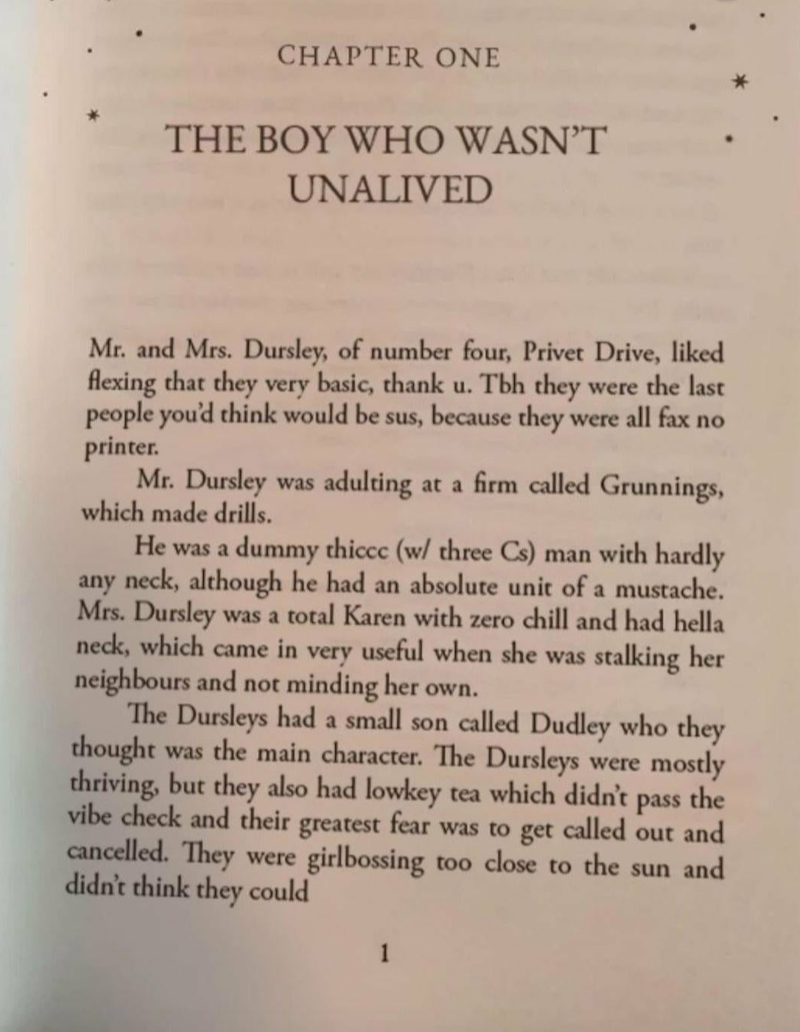
Mr. and Mrs. Dursley, of number four, Privet Drive, liked flexing that they very basic, thank u. Tbh they were the last people you’d think would be sus, but they were all fax no printer.
Mr. Dursley was adulting at a firm called Grunnings, which made drills.
He was a dummy thiccc (w/ three Cs) man with hardly any neck, although he had an absolute unit of a mustache. Mrs. Dursley was a total Karen with zero chill and had hella neck, which came in very useful when she was stalking her neighbours and not minding her own.
Don’t drag Gen Z kids for using the word “unalive.” As un-erudite as it sounds, it has a clever origin: it was coined to get around automated social media filters that block words like kill,death, and similar terms, yet doesn’t its meaning is easily grasped by people who’ve never encountered the word before.
With Kevin McCarthy failing to win the vote to become Speaker of the House for the 11th time, he’s probably looking for fresh advice. Has he tried ChatGPT?
If he hasn’t, that’s okay — I asked on his behalf:
Here’s the text of my question and ChatGPT’s answer:
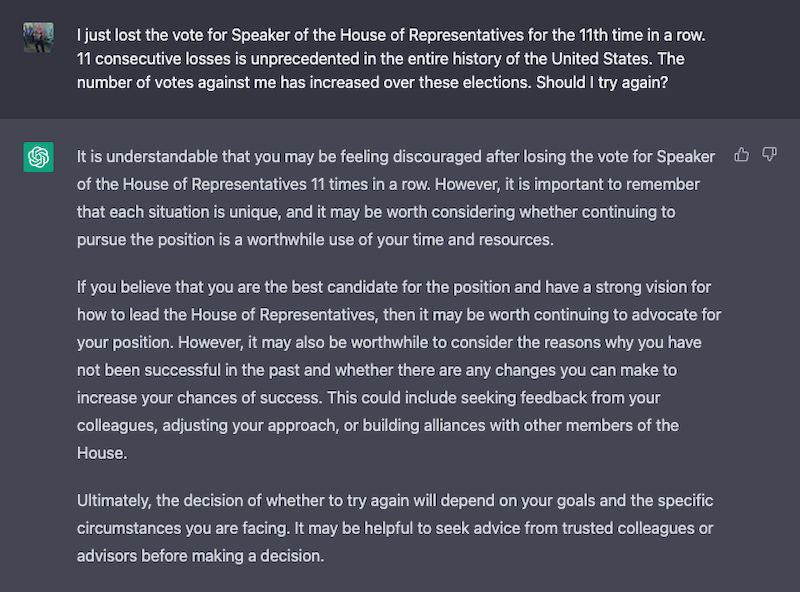
Me: I just lost the vote for Speaker of the House of Representatives for the 11th time in a row. 11 consecutive losses is unprecedented in the entire history of the United States. The number of votes against me has increased over these elections. Should I try again?
ChatGPT: It is understandable that you may be feeling discouraged after losing the vote for Speaker of the House of Representatives 11 times in a row. However, it is important to remember that each situation is unique, and it may be worth considering whether continuing to pursue the position is a worthwhile use of your time and resources.
If you believe that you are the best candidate for the position and have a strong vision for how to lead the House of Representatives, then it may be worth continuing to advocate for your position. However, it may also be worthwhile to consider the reasons why you have not been successful in the past and whether there are any changes you can make to increase your chances of success. This could include seeking feedback from your colleagues, adjusting your approach, or building alliances with other members of the House.
Ultimately, the decision of whether to try again will depend on your goals and the specific circumstances you are facing. It may be helpful to seek advice from trusted colleagues or advisors before making a decision.
An operational Jetstar has dual jetpods on either side of the tail section. The Elvis jet’s engines were removed a while back. (Creative Commons photo by Thomas R Machnitzki; here’s the source.)
Avid planespotters will note that it doesn’t have any engines. They were removed a long time ago, and it means that this plane can’t fly. Whoever buys it will have to disassemble it for shipping. This sale isn’t for someone who wants to travel in a classic private plane, but an enterprising individual or group who wants to start (or add to) an aviation museum or an Elvis museum.
Elvis has left the plane.
From the auction page for the plane:
For decades, Lockheed’s JetStar was the executive jet of choice for countless A-listers, recognized dignitaries and star-studded celebrities, and this 1962 Lockheed 1329 JetStar is no exception, as it was once owned by the king of rock ‘n’ roll: Elvis Presley. Presley acquired it from OMNI Aircraft Sales Inc. on December 22, 1976 for the princely sum of $840,000.
…
When Elvis took ownership of this particular JetStar, registered with the FAA as N-20TF, the entertainer was no stranger to luxurious aviation acquisition. He had already amassed a modest fleet, which included a custom Convair 880 named the “Lisa Marie” that went by the call sign of Hound Dog 1, along with a second JetStar identified by its call sign of Hound Dog 2.
The interior is done up in red velvet with gold-tone metal accents. I am not surprised.
With a busy touring schedule, these crafts were needed to transport the singer, his TCB band, backup groups, Col. Tom Parker and the ever-present Memphis Mafia to venues, concerts and appearances all around the country. Elvis kept several pilots on retainer that were ready to fly him to adoring fans at a moment’s notice.
This JetStar is one of several private jets owned by Elvis Presley, with two currently on display at Graceland. Inside, the cabin features wood paneling and red velvet upholstery with gold-finish hardware. There’s seating for nine by way of six plush chairs that swivel and recline, along with a couch. An onboard entertainment system is tucked away in a media cabinet, featuring a television, RCA VCR player and audio cassette player, and headphone ports with audio controls are located at every seat. A galley contains storage and a meal-prep area complete with a Kenmore microwave and beverage dispenser. At the rear is a lavatory along with additional storage and cubby areas.
In the spring of 1977, the jet was sold, later ending up with a Saudi Arabian company. The JetStar was then moved to Roswell International Air Center (ROW) in Roswell, New Mexico, where it’s been stored for decades and resides to this day. The aircraft will require disassembly to be shipped, and coordinating assistance is available. Documentation joining the jet includes a copy of the Aircraft Security Agreement document signed by Elvis Presley, a copy of the Aircraft Bill of Sale and Official FAA Blue Ribbon documents. While the P&W engines and many cockpit components have been removed and no engines or replacement parts will be included with the sale of Elvis’ jet, it serves as an incredible restoration opportunity and a chance to create a unique Elvis exhibit for all the world to enjoy.
Gotta love that 1970s wood paneling!
The auction site lists these highlights about the jet:
Purchased by Elvis Presley on December 22, 1976 for $840,000
1 of several private jets owned by Elvis Presley, with two currently on display at Graceland
1 of 202 production JetStar airplanes produced by Lockheed
Includes a copy of the Aircraft Security Agreement document signed by Elvis Presley
Includes a copy of the Aircraft Bill of Sale documentation
Official FAA Blue Ribbon Documents included
Aircraft Serial No. 5016
FAA Registration No. N-20TF
Red exterior with silver accents
Custom interior upholstery featuring red velvet and gold-finish hardware
Onboard Kenmore microwave
Onboard television with RCA VCR player
Onboard cassette player
Wood cabin paneling and trim including window shades
Six passenger chairs with swivel and recline functionality
Onboard lavatory with vanity
Interior cabin seating for up to nine occupants
The P&W engines and many cockpit components have been removed
No engines or replacement parts are included with the sale
Stored for decades and currently residing at Roswell International Air Center (ROW)
The aircraft will require disassembly to be shipped (coordinating assistance available)
An incredible restoration opportunity to create an Elvis exhibit for the world to enjoy
Railroad workers are unionized and their contract is set to expire on Dec. 9, which has prompted speculation about a possible railroad strike that could disrupt travel and cripple supply chains.
President Joe Biden and Labor Secretary Marty Walsh helped broker a tentative deal earlier this year, but four out of 12 rail unions voted against it, mostly because the proposed contract included just one single paid sick day. In their current contract, the workers have zero sick days.
…
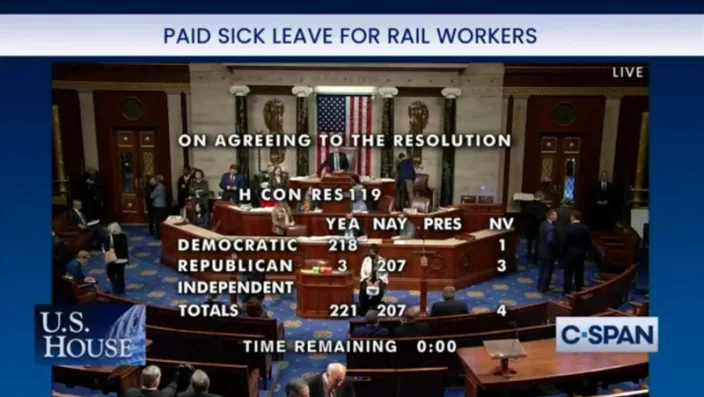
On Wednesday, the House of Representatives voted on a bill to adopt the tentative contract, which passed 290-137. Many Democrats were also furious about the sick time issue, so the House also voted on Resolution 119, which would add seven days of paid sick leave to the contract. A whopping 207 Republicans voted against it. The resolution still passed with 221 votes, from 218 Democrats and a measly three Republicans.
Find out more
The Guardian: US House approves bill to block rail strike and mandate paid sick leave. “The US president, who built a reputation on being pro-labor and put himself at loggerheads with the unions after asking Congress to avert a strike, had warned of the catastrophic impact of a rail stoppage that could begin as early as 9 December and could cost the US economy about $2bn a day by some estimates, with chaos hitting freight and passenger traffic.
On Tuesday, the House speaker, Nancy Pelosi, and Senate majority leader, Chuck Schumer, indicated they would attempt to push through a bill to impose the settlement, albeit expressing reluctance.
Workers expressed dismay at the stance of Biden and his administration.
On Wednesday, the House passed the bill to block the strike and, separately, voted 221-207 to give seven days of paid sick leave to railroad employees, a plan that faces an uncertain fate in the evenly split Senate. Democrats and some Republicans have expressed outrage over the lack of paid short-term sick leave for railroad workers.”
New York magazine’s Intelligencer column: Why America’s Railroads Refuse to Give Their Workers Paid Leave.“Unlike nearly 80 percent of U.S. laborers, railroad employees are not currently guaranteed a single paid sick day. Rather, if such workers wish to recuperate from an illness or make time to see a doctor about a nagging complaint, they need to use vacation time, which must be requested days in advance. In other words, if a worker wants to take time off to recover from the flu, they need to notify their employer of this days before actually catching the virus. Given that workers’ contracts do not include paid psychic benefits, this is a tall order.”
US Bureau of Labor Statistics: Paid sick leave was available to 79 percent of civilian workers in March 2021. “Paid sick leave was available to 79 percent of civilian workers in March 2021. Among wage categories, access to paid sick leave ranged from 95 percent of workers whose average hourly wage placed them in the top 10 percent of civilian workers, to 35 percent of those in the bottom 10 percent of all civilian workers.”
More Perfect Union: Rail Strike by the Numbers: Railroad Profits are Soaring at Workers’ Expense. “In 2001, leading American freight carriers CSX, KC Southern, Norfolk Southern and Union Pacific earned average operating margins of about 15%. That means that after accounting for all the costs associated with running a railroad (including money spent on compensation & benefits), for every $100 of revenue, investors were left with $15 of profit. Twenty years later that number has skyrocketed to over $41.”
With Thanksgiving having come and gone in the U.S., we’re now in the holiday shopping season, which starts with Small Business Saturday!
Small Business Saturday is an annual event whose purpose to encourage people to support their local small businesses. Instead of going to a “big box” store or chain, we’re asked to support local businesses, either by going to their local brick-and-mortar shop or shopping online. This event takes place every November and represents a significant opportunity to increase sales for small businesses during the holiday shopping season.
I live in Tampa’s Seminole Heights neighborhood, where we’re fortunate to have a number of small businesses that do provide goods, services, and those less tangible “neighborhood-y” things that chains and big box stores can’t or won’t.
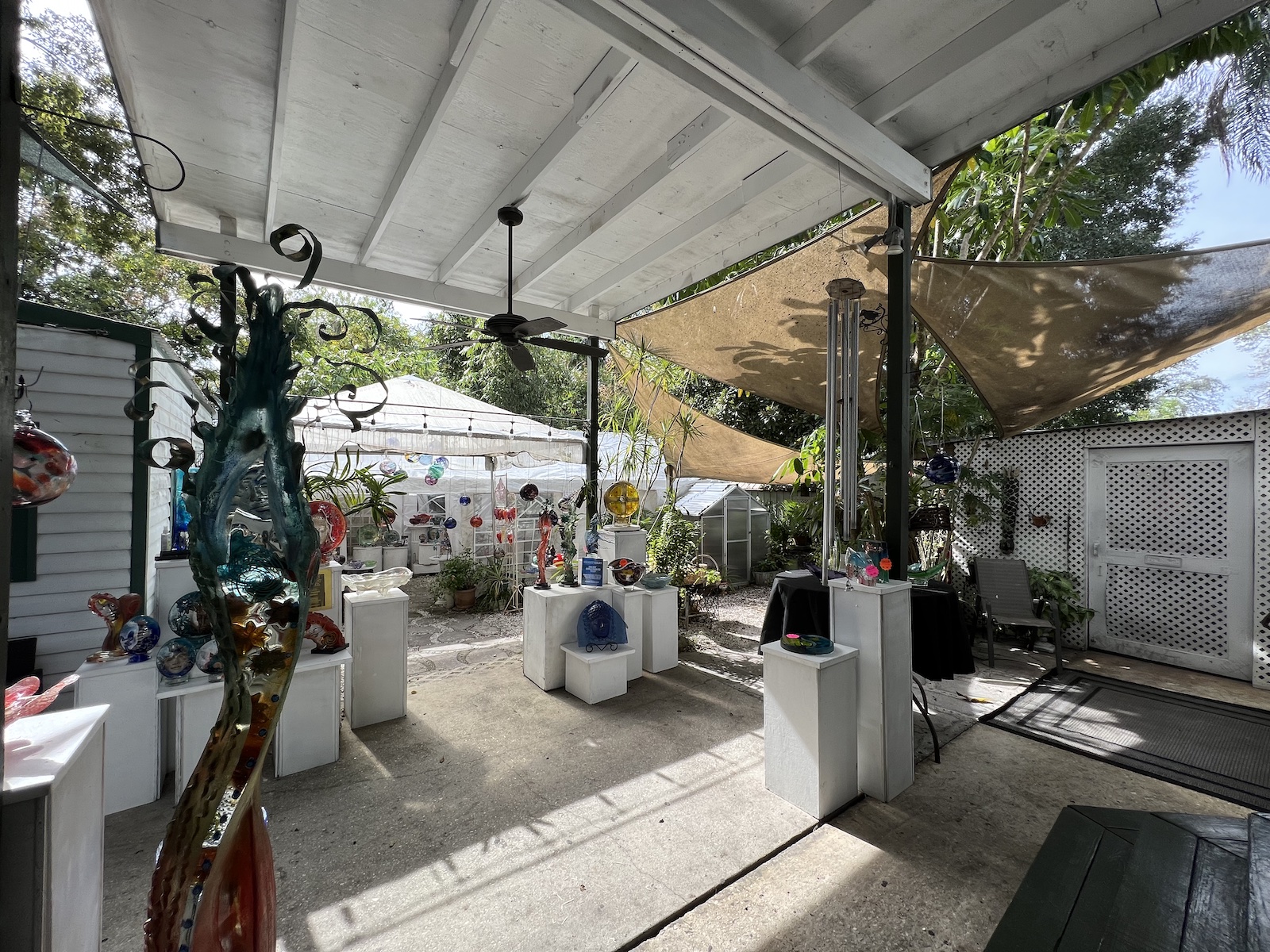
The day is young, but we’ve already picked up some goodies at Gott Glass, the local glass-blowing studio and shop.
If you’re in the area, check them out! The shop is a lovely mix of indoor and outdoor, Susan Gott and her staff are nice, and they do glass-blowing demos and even have classes (which I plan on signing up for).