My move from Toronto to Florida — a little over six years ago now — forced me to really apply a rule I try to follow: If you’ve been hanging onto something and never use it, let it go. Sell it, give it to someone who really needs it, or toss it. I’ve had to use this rule more since moving from Toronto to Tampa, as the move required me to take only what I could fit in my old car, and because I didn’t want to treat my mother’s basement in Toronto like a free storage place forever.
In spite of this rule, I’ve hung on to one piece of clothing that I’ve had since the very last days 1999 and that I almost never wear. It’s a grey zippered sweatshirt, a photo of which you’ll see later on in this article. There’s nothing terribly bad about it; I like the color, but the cut’s all wrong, it’s a little too big, it has ridiculous snap-straps all over (in the photo, you can see one of them around the neck). While it’s perfectly serviceable, I don’t like it enough to keep it under normal circumstances. It would’ve ended up at the drop-off of a Goodwill or some other charity ages ago. Still, I keep it, and I only get it dry-cleaned by professionals. Why? Because it’s a special gift from my dad.
Late December, 1999
In 1999, my former high school classmate André Fenton was doing neuroscience research at the Czech Academy of Sciences and decided that he wanted to ring in the year 2000 by throwing a big New Year’s Eve party in the nicest place that he could rent somewhere near Prague.
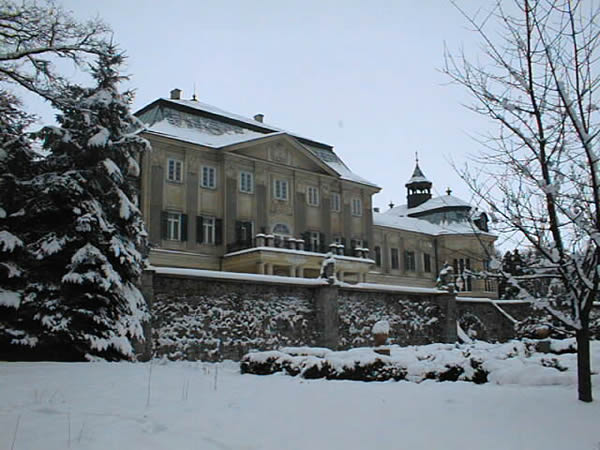
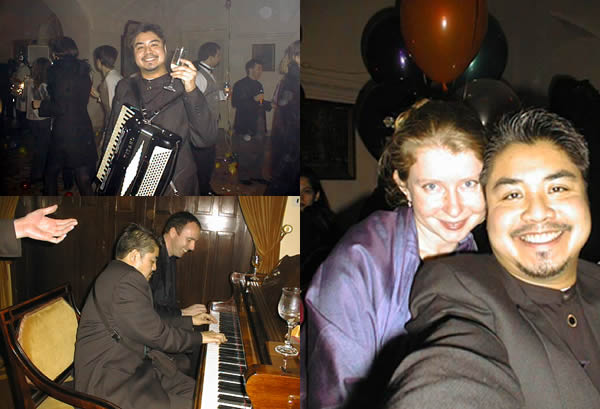
He found a great place — Zamek Roztěž(although these days, it’s marketed as Casa Serena Chateau and Gold Resort). It’s a “hunting castle” originally built in the late 1600s in the village of Roztěž, located in the Kutna Hora district, about 80 kilometers (50 miles) east of Prague. I was invited to the party, and while there, had a grand old time:
Upon hearing that I would be staying at a castle somewhere in the central European woods in the dead of winter, Dad decided to surprise me by buying me something to keep me warm. That thing was the zippered sweatshirt, and he gave it to me just as he dropped me off at the airport to catch my flight to Amsterdam, and then Prague.
“I got this for you. I don’t want you to be cold when you’re in that castle.”
I thanked him for the sweatshirt, gave him a big hug, wished him a happy new year in advance, and told him that I’d send photos that I’d take with my still-newish digital camera (1024 by 768 pixels in super-fine mode!) to mom via email (he never had an email address).
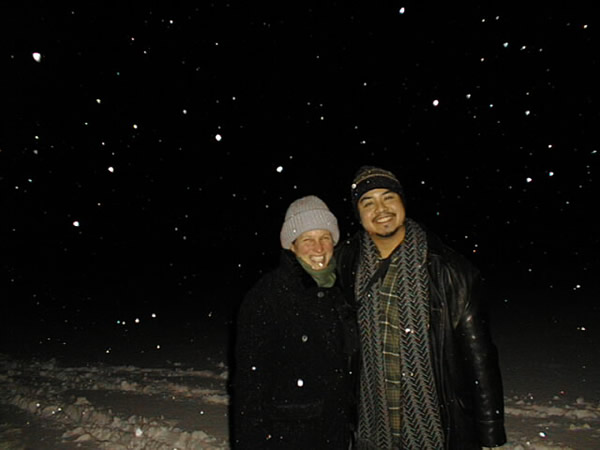
It’s not really what I would’ve bought, but it’s big and warm, I thought, and it served me well on the flight, in the castle (which wasn’t all that cold — they’d been doing a fair bit of renovating), and especially well on a hike around the castle grounds with some lovely company on the night of January 1st, 2000:
Twenty years later
Because I am a big ol’ sentimental softie, not only have I kept this sweatshirt that I don’t really like all these years, but I take it with me whenever I travel far to someplace cold, as a sort of comforting tradition. I wore it walking through the streets of Prague, while shivering on the slopes at Whistler while trying to figure out how snowboarding worked. I wore it when I was conducting mobile technology assessments in the bitter cold of Athabasca’s oil sands. As I drove through the snow-covered hills of West Virginia on those chilly days of March 2014 as I moved to Tampa to be with Anitra, I had it on. I bring it with me on our trips to Toronto in winter. I last wore it during the handful of days that Tampa gets close to freezing, when the office’s heating just wasn’t keeping up. It keeps me warm, not only in the physical sense, but also in the way that it reminds me of his kindness and generosity.
Me, in the “Dad sweatshirt”.
Dad died at the end of February 2006. But thanks to this sweatshirt that I normally wouldn’t be all that crazy about, I have a little bit of him that I can take with me when I’m cold and far from home. That’s why I’ll never part with it.
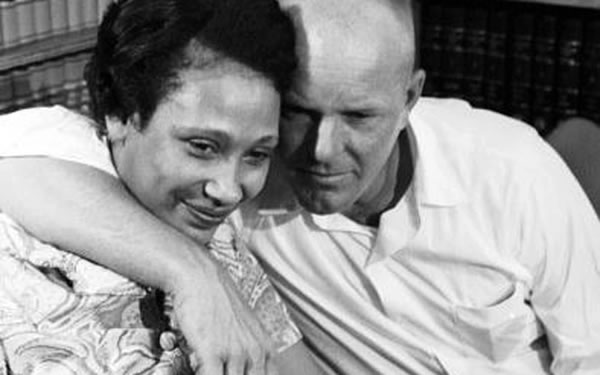
On this day in 1967, the United States Supreme Court issued their ruling on the case of Loving v. Virginia, which struck down laws banning interracial marriage across the U.S..
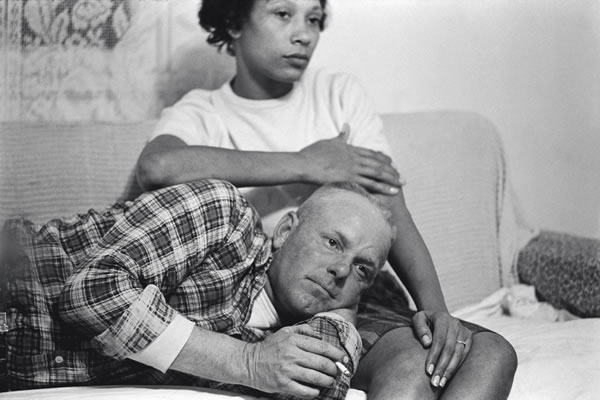
The case involved Mildred Loving, a woman of color, who was married to Richard Loving, who was white. In 1958, they were sentenced to a year in prison for marrying each other, in violation of Virginia’s Racial Integrity Act of 1924, which made it a crime for people classified as white to marry people classified as colored. In court, they had to plead guilty to “cohabiting as man and wife, against the peace and dignity of the Commonwealth.”
The case also involved the state of Virginia, whose original state song lyrics included the line “There’s where I labored so hard for old Massa,” and the signature line of the chorus, “There’s where this old darkey’s heart am long’d to go.”
On this day in 1967, the Supreme Court unanimously ruled that the Racial Integrity Act and similar laws were unconstitutional, and this ruling was also used as a precedent in Obergefell v. Hodges, the case that made same-sex marriage legal countrywide.
For some readers, 53 years ago may seem like pre-history, but think of it this way: Both presidential candidates were of legal voting age at the time. Actually, that does make it sound like pre-history. My point is that there are a lot of people alive today who were alive at that time (myself included, by a few months).
Today, we call June 12 Loving Day. While it’s victory for everyone, it’s especially so for me and Anitra, since it means we’re not committing a crime simply by being married.
Thank you, Mildred and Richard Loving, and Happy Loving Day, everyone!
There’s an alt-right group who believe that a second Civil War — which they call the “boogaloo” — is coming, and they’re raring to take their part in it. The name “boogaloo” comes from the 1984 film Breakin’ 2: Electric Boogaloo, which was a sequel to Breakin’. The term “boogaloo” has since been contorted into similar-sounding shibboleths: “big igloo,” and quite notably, “big luau.” It’s the “big luau” expression that led to their adopting the aloha shirt as a signifier, along with camo pants, MAGA caps, and other clothing that’s meant to signify to their buddies that “I too am a fascist.”
That’s the point of this article…
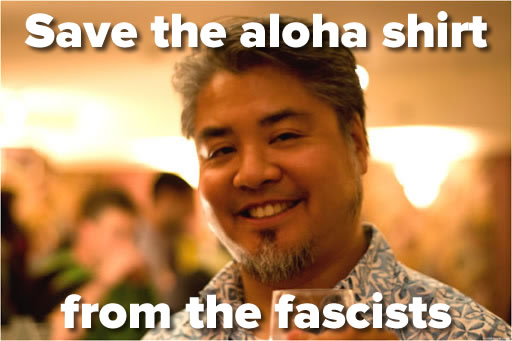
These alt-right assholes are trying to claim the Aloha shirt as part of their symbology, and I intend to do everything in my power to stop them. It’s bad enough that they’ve associated themselves with the tiki torch, but this Pacific Islander will not stand idly by as they attempt to co-opt my sartorial specialty.
Aloha shirt history
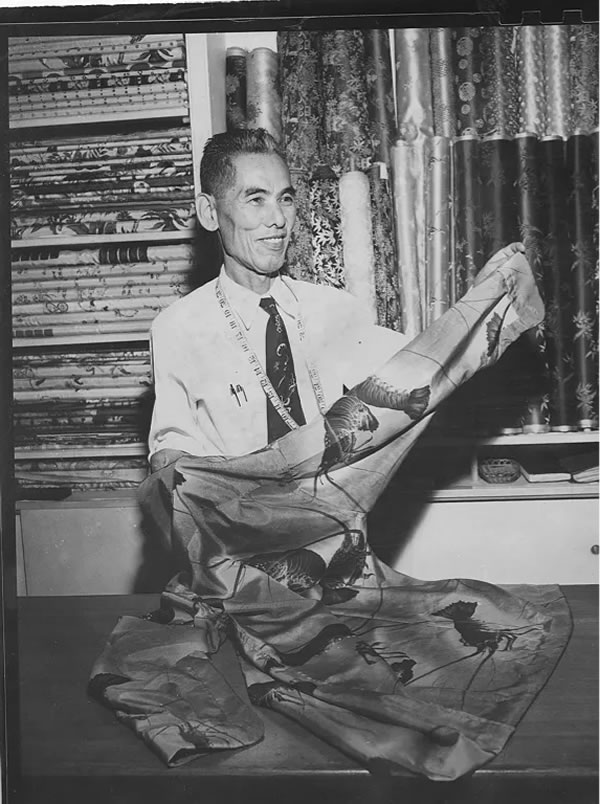
Quite unsurprisingly, Aloha shirts are the creation of an Asian expats in Hawaii. One account credits its creation with the “Musa-Shiya The Shirtmaker” store…
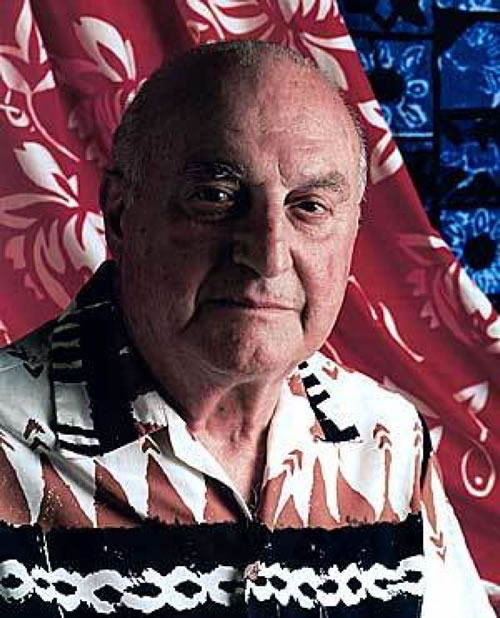
…under the proprietorship of Koichiro Miyamoto, pictured below:
Another story says that Ellery Chun, a Chinese merchant who ran King-Smith Clothiers and Dry Goods in Waikiki. He is believed to have been the first to mass-produce pret-a-porter aloha shirts.
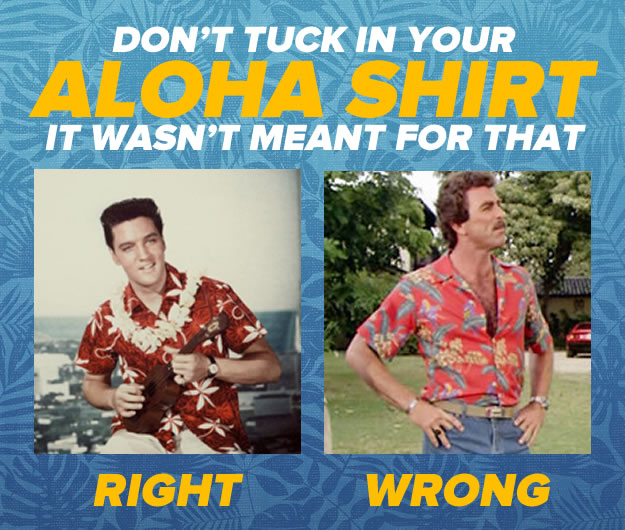
Because aloha shirts have straight lower hems, you’re supposed to wear them untucked, following the example of local Filipinos, who often wear dress shirts untucked (I do).
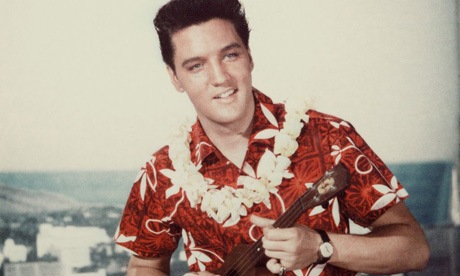
If there’s one person who should be credited with the popularity of the aloha shirt (the term “Hawaiian shirt” is technically incorrect), it’s textile manufacturer Alfred Shaheen. While he didn’t create the aloha shirt — they’d been made in Hawaii since the 1930s, and with the rise of air travel in the 1950s, tourists started them bringing them home from their vacations in the islands. Shaheen took these shirts, which were originally cheaply-made, and elevated them with better tailoring, materials, and patterns. The red aloha shirt that Elvis wore on the cover of the Blue Hawaii soundtrack album is a Shaheen design:
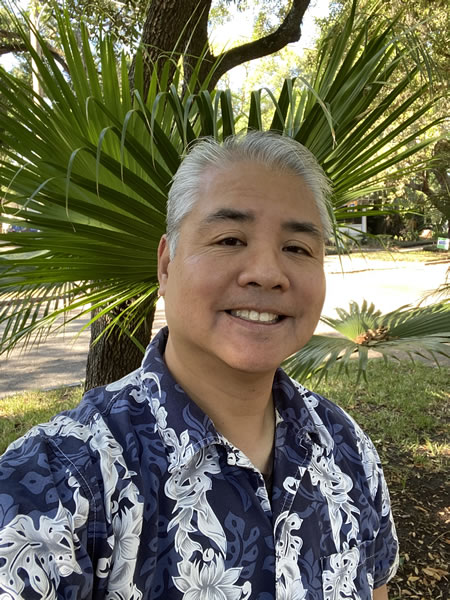
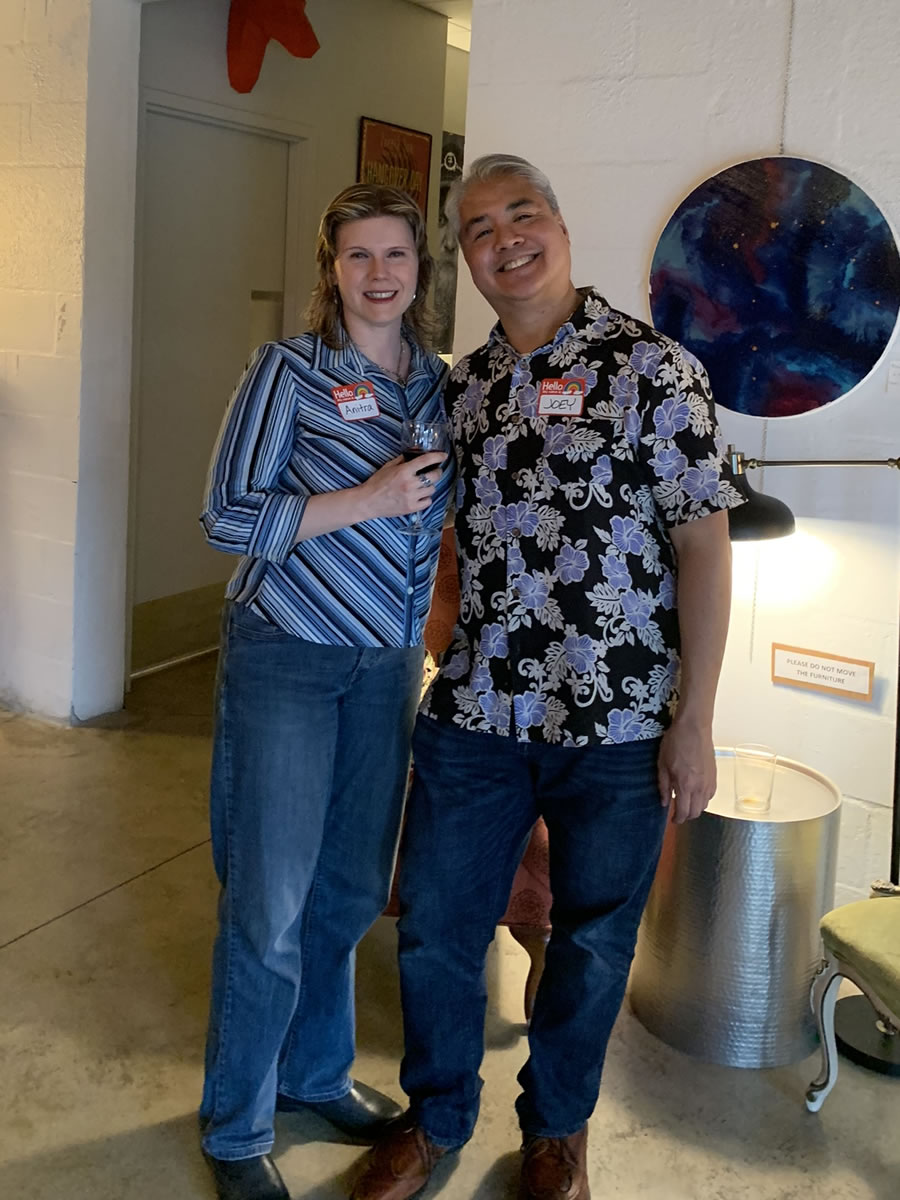
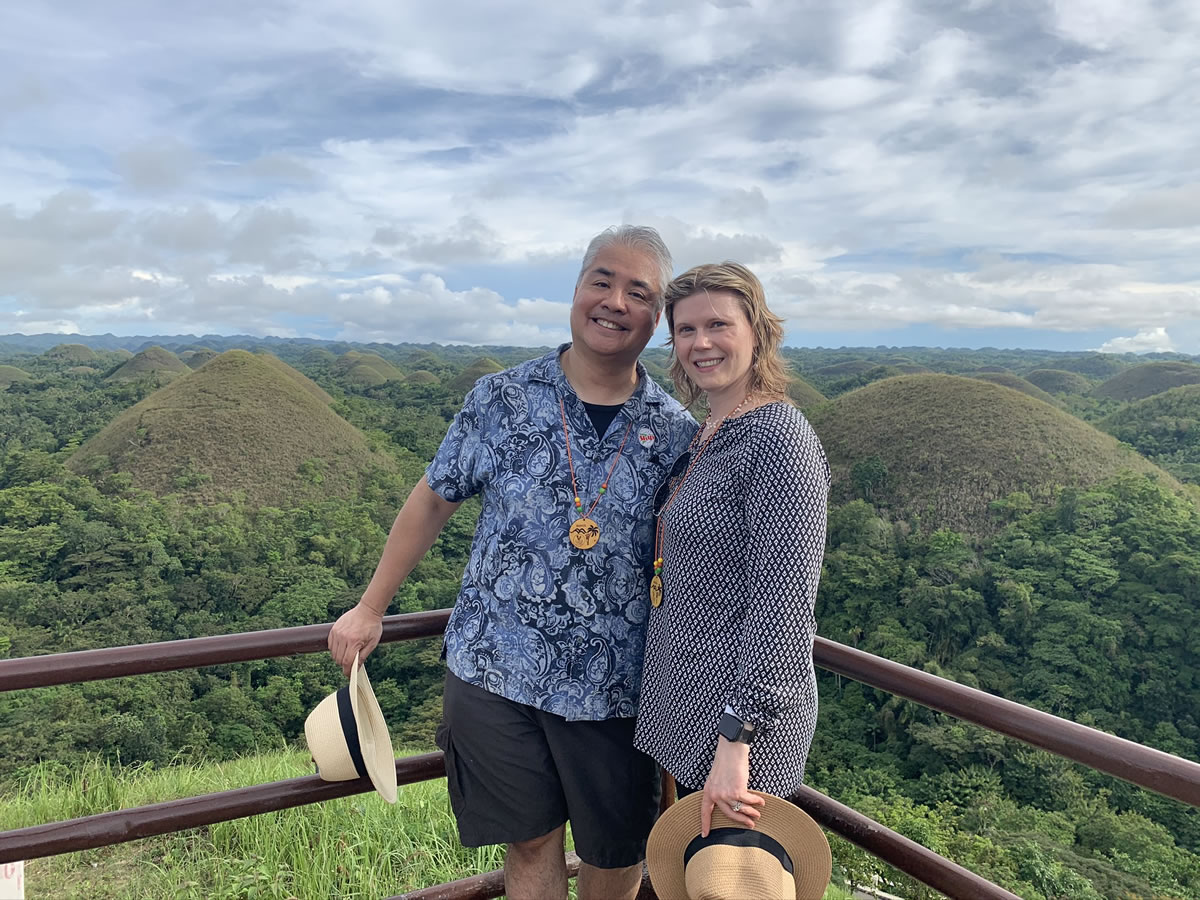
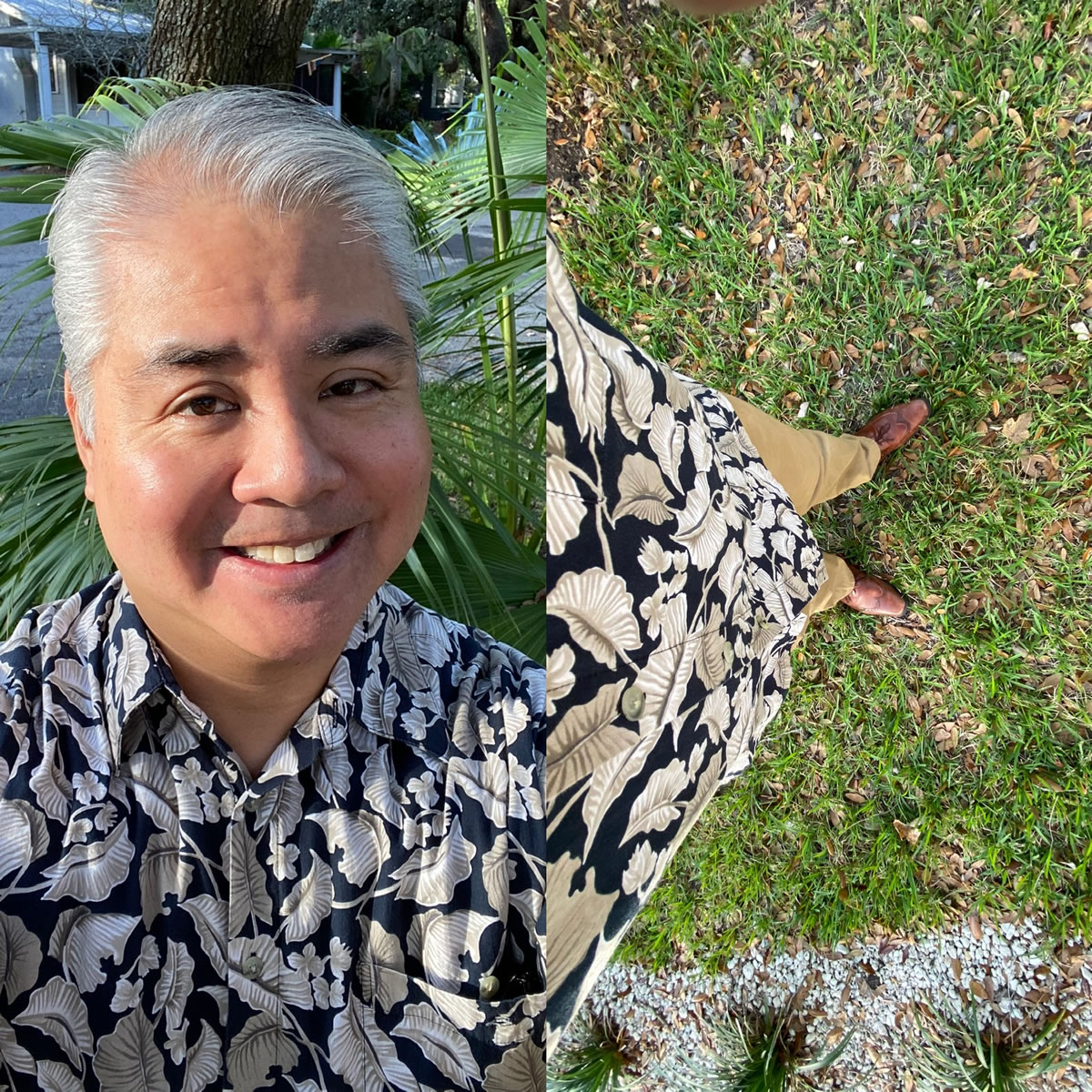
Those of you who’ve known me a while know that I maintain a fine collection of aloha shirts, and I’m often mistaken for Hawaiian. You have no idea how many times I’ve been greeted with “Mahalo!” It’s the perfect clothing for my general vibe, and it’s even more appropriate now that I live in Tampa’s sub-tropical climes:
…the inherent jolliness of a Hawaiian shirt gives heavily armed boogaloo boys a veneer of absurdity when they appear in public that can deflate criticism. “It’s tough to talk about the danger of guys showing up to rallies in Hawaiian shirts without sounding a little bit ridiculous,” said Howard Graves, senior research analyst at the Southern Poverty Law Center in Montgomery, Ala.
Not only do we want them known by their proper name — aloha shirts, and not “Hawaiian shirts” as mainlanders call them — but in particular, they should not have been taken over by a violent political fringe group.
And yet, as a result of memes in social media, aloha shirts have been adopted as a kind of uniform for white nationalist groups. Folks who get the relaxed vibe of aloha shirts call that inappropriate. No aloha to those violent Hawaiian-shirt wearers.
Until we get that official voice, it’s up to us — those of us who wear aloha shirts out of love for the style, the signifier of being “the life of the party” or a person of good cheer, to celebrate a love or heritage of the Pacific islands, or any combination of all those — to defend our beloved items of clothing and keep the boogers from ruining them. Join me in this fight!
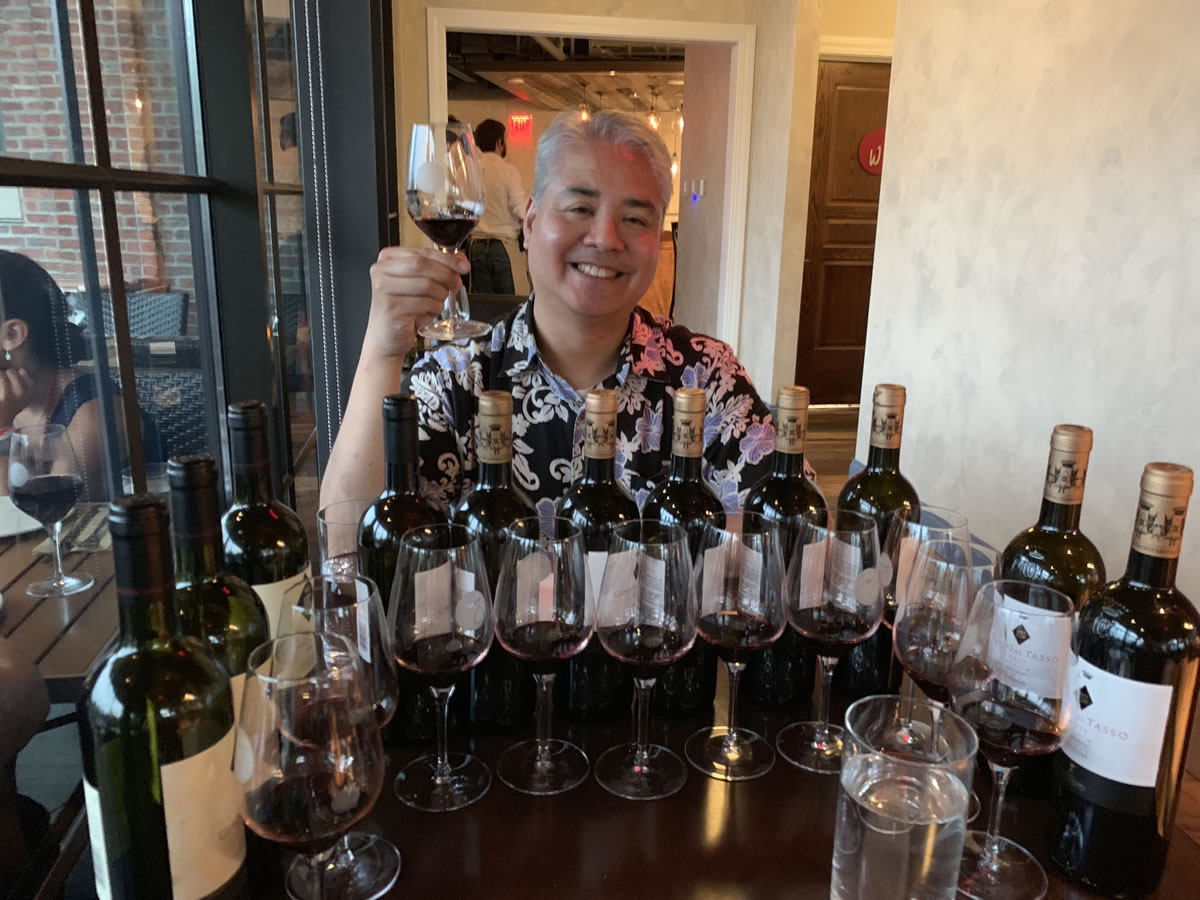
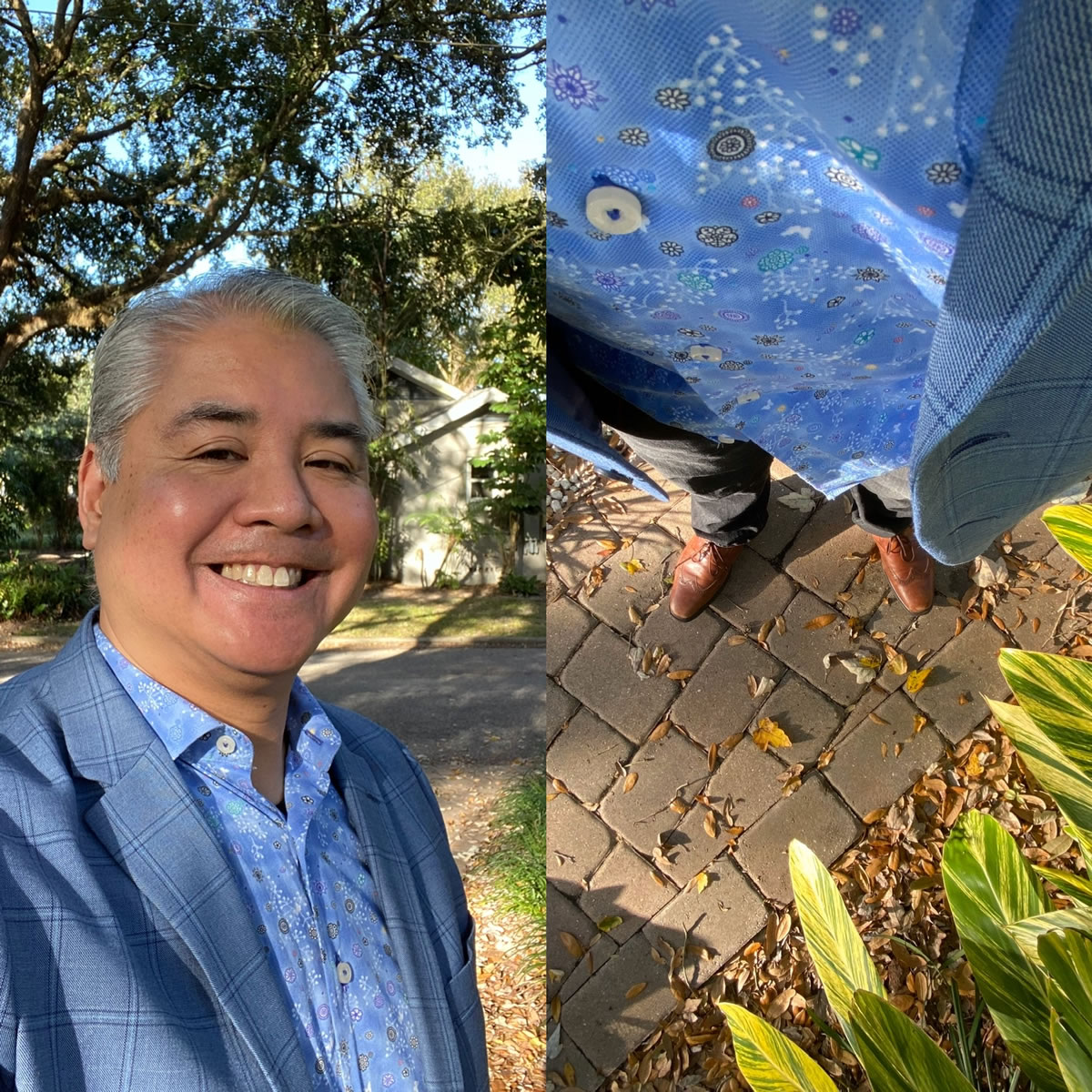
I’ll close with a gallery of Yours Truly in some of my favorite aloha and aloha-style shirts.
On Friday, I stopped by Produce Wagon, the fruit and veg stand that operates in our neighbourhood, just a few blocks away from the house on Tuesdays and Fridays. It’s always nice to see Patti and Fabiola, and was even better to find out that they’ve added an extra hour to their schedule — they’re now open at 13th and Crawford on Tuesdays and Fridays, from 9 a.m. to noon!
The vegetables I bought ended up in this morning’s scramble (pictured above), and will play a part in tonight’s dinner, which will be ma po tofu.
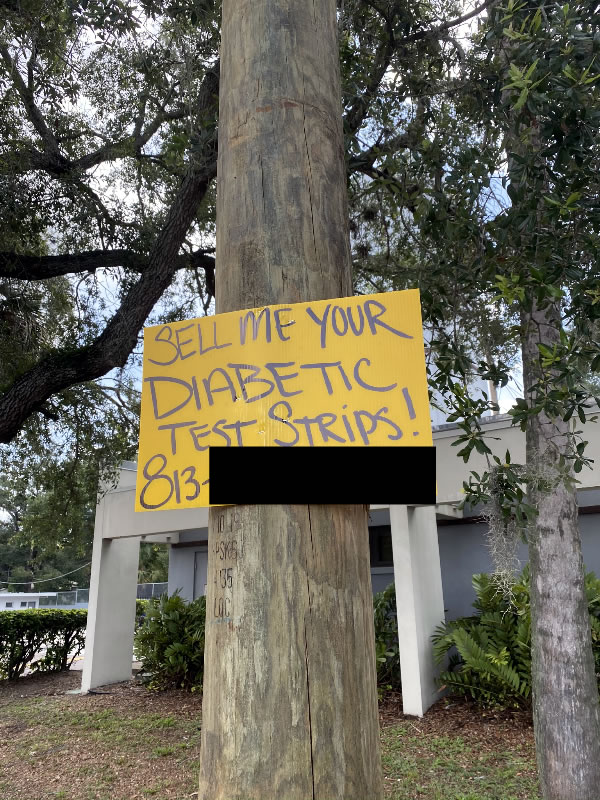
This one’s got all the major themes: Diabetes, unequal distribution, the profit motive, and “Oh jeez, I’m on my own; I’d better improvise something or I’m totally screwed.”
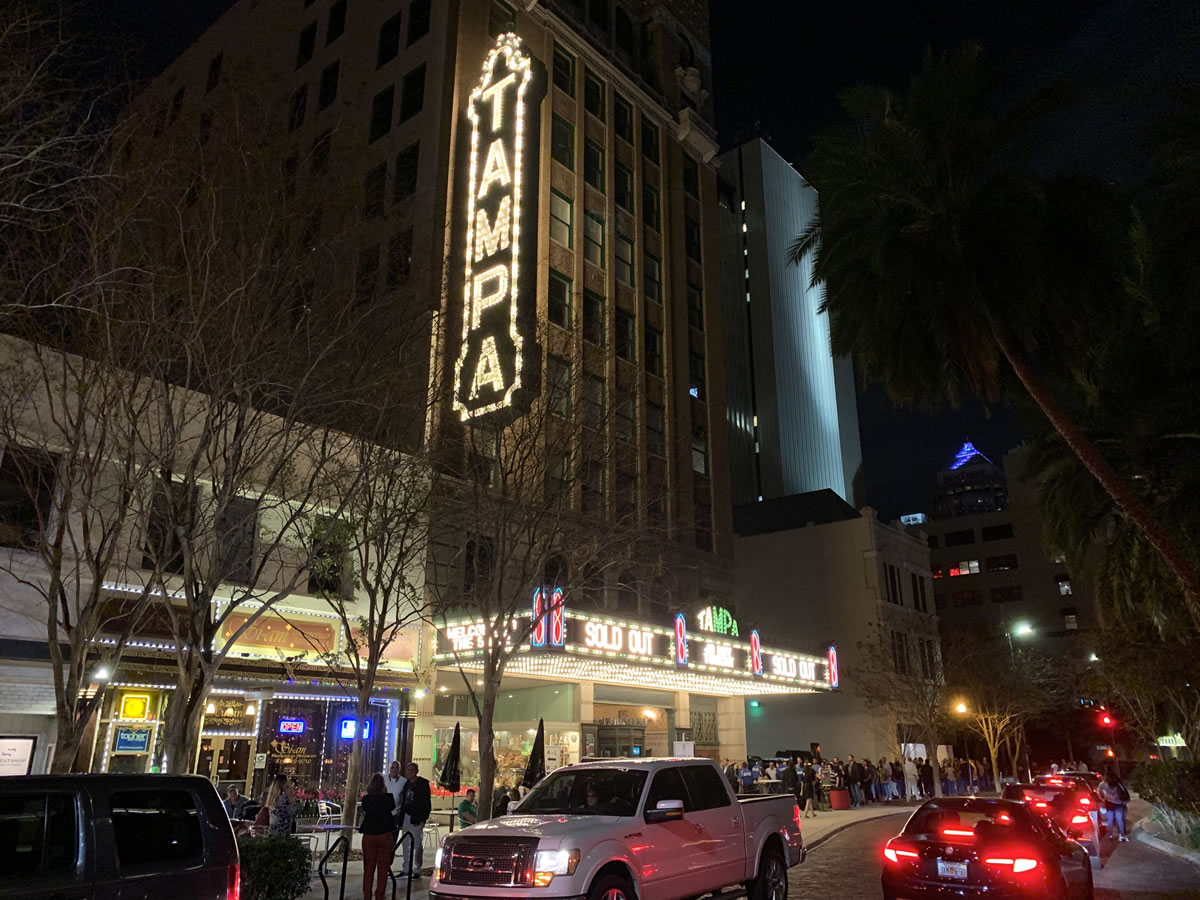
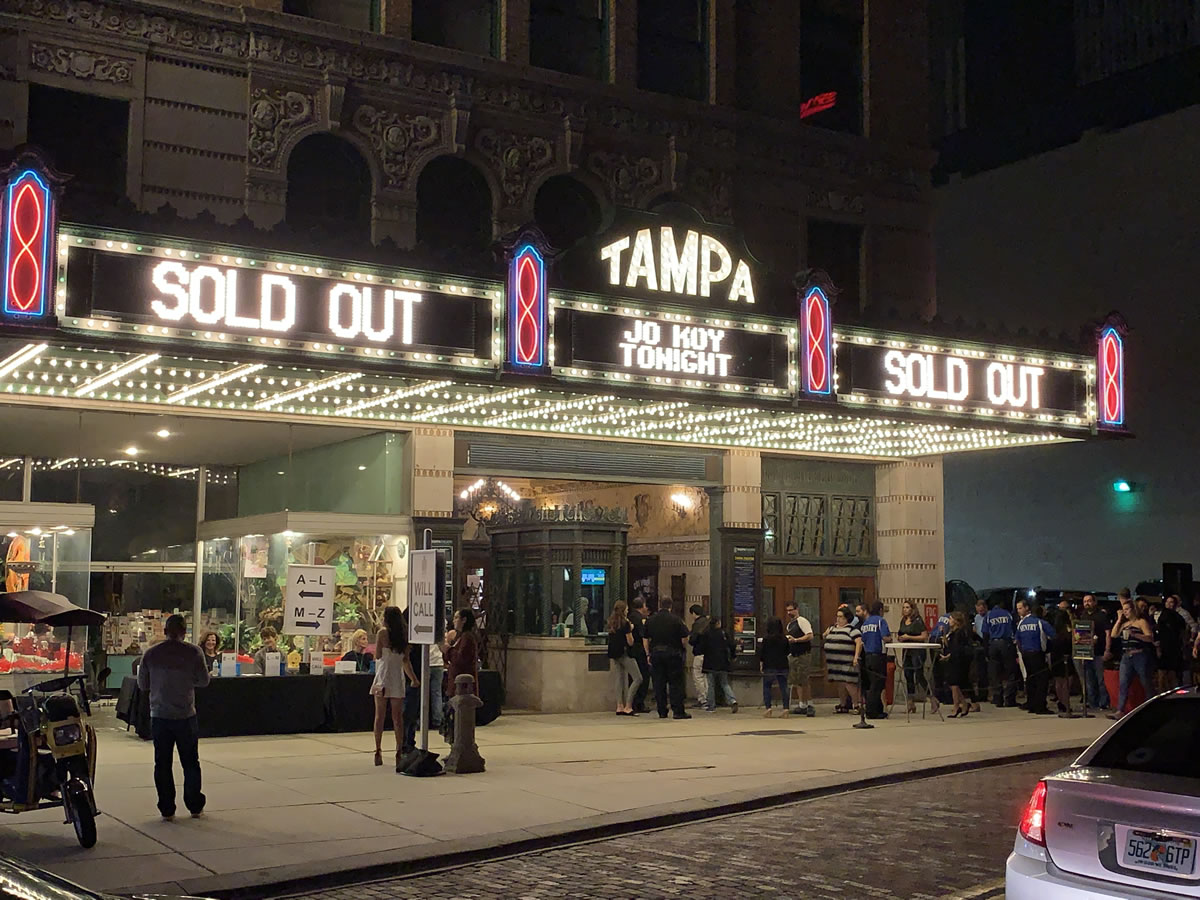
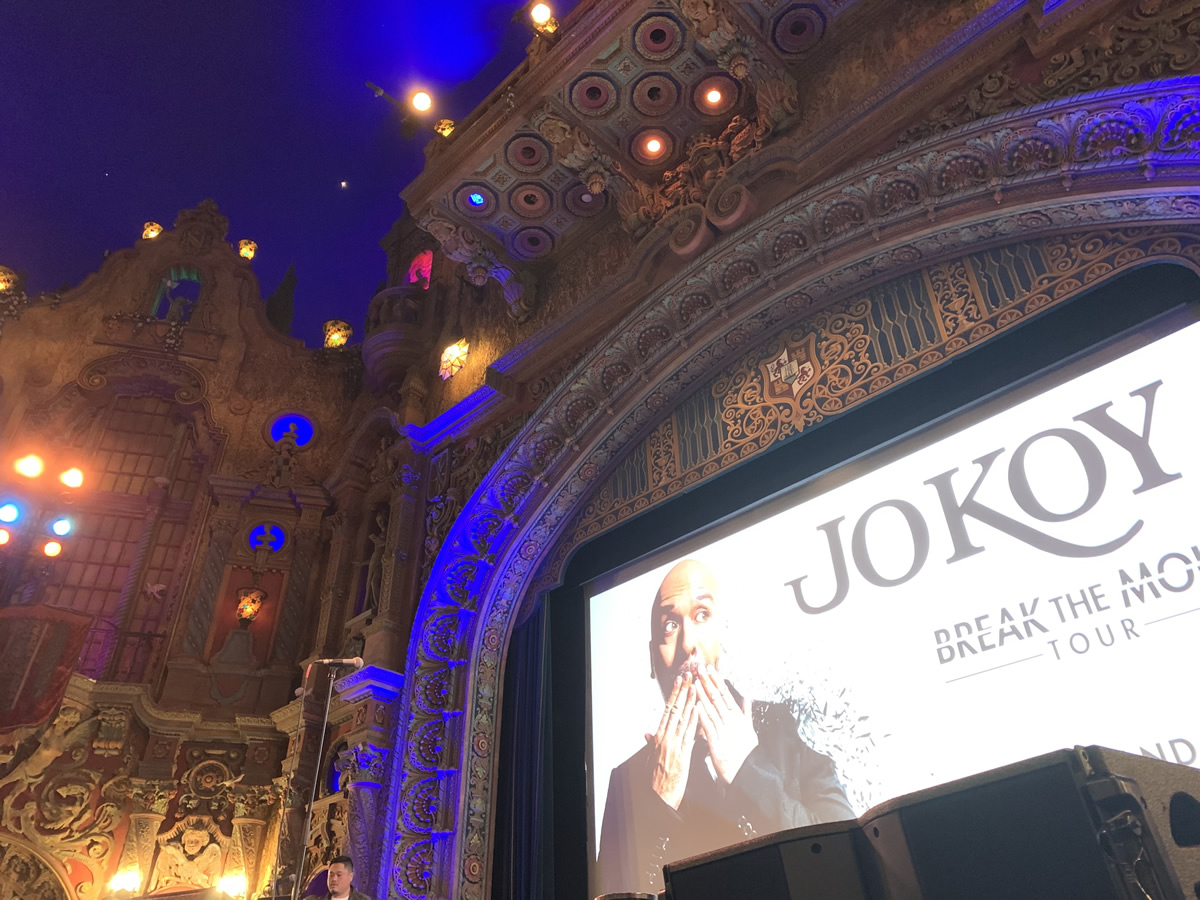
Here’s a post I started back in February 2019 and didn’t finish — until now! Jo Koy returns to Tampa at the end of February, and I wanted to publish this before then.
There aren’t many theaters like this one left. It first opened in 1926, and was the first commercial building with air conditioning. It had its heyday during the golden age of movies but fell into disrepair during the era of suburban flight in the 1960s. The city rescued the theatre in the early ’70s, with Hillsborough County’s arts council taking over the theatre’s program and selecting its films and events. This effort became the model for saving endangered theaters nationwide.
Click the photo to see it at full size.
Click the photo to see it at full size.
Click the photo to see it at full size.
Click the photo to see it at full size.
Click the photo to see it at full size.
We had VIP tickets, which entitled us to a quick selfie session with Joseph Glenn Herbert (that’s his actual name; “Jo Koy” is derived from “Jokoy”, which is one of many possible Filipino nicknames for “Joseph”) himself:
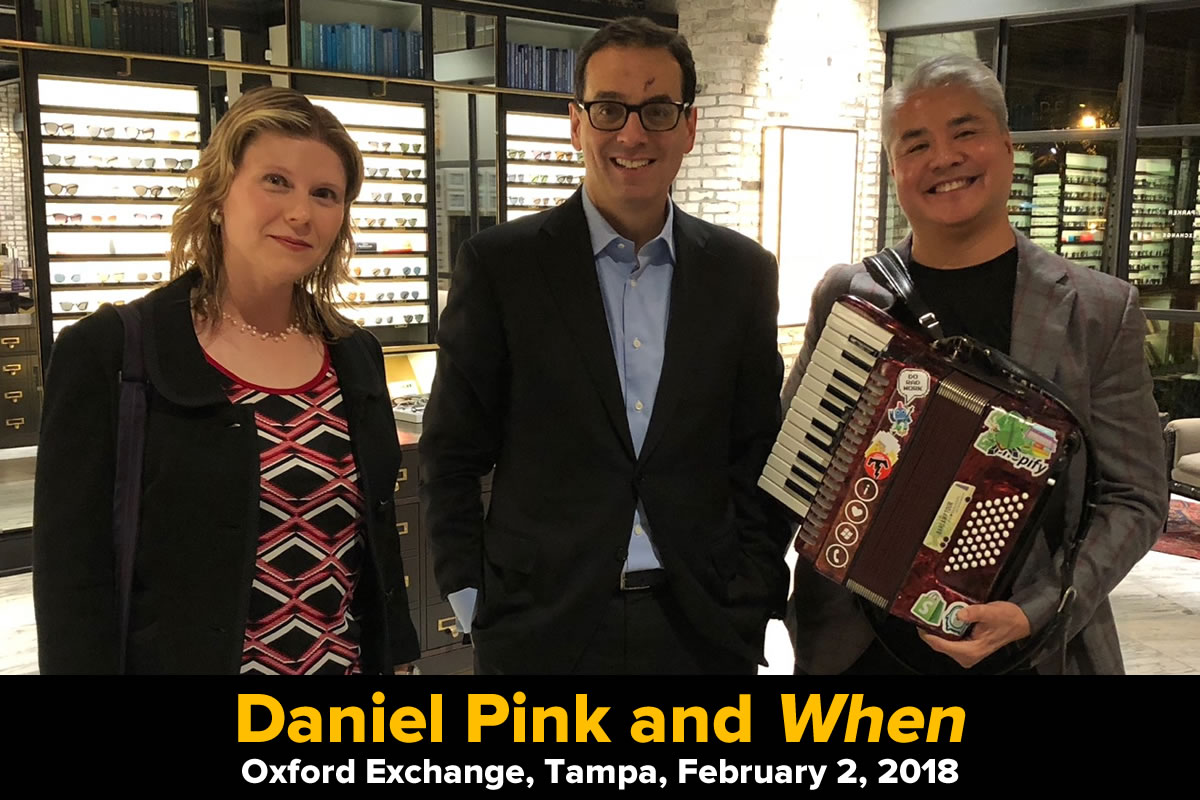
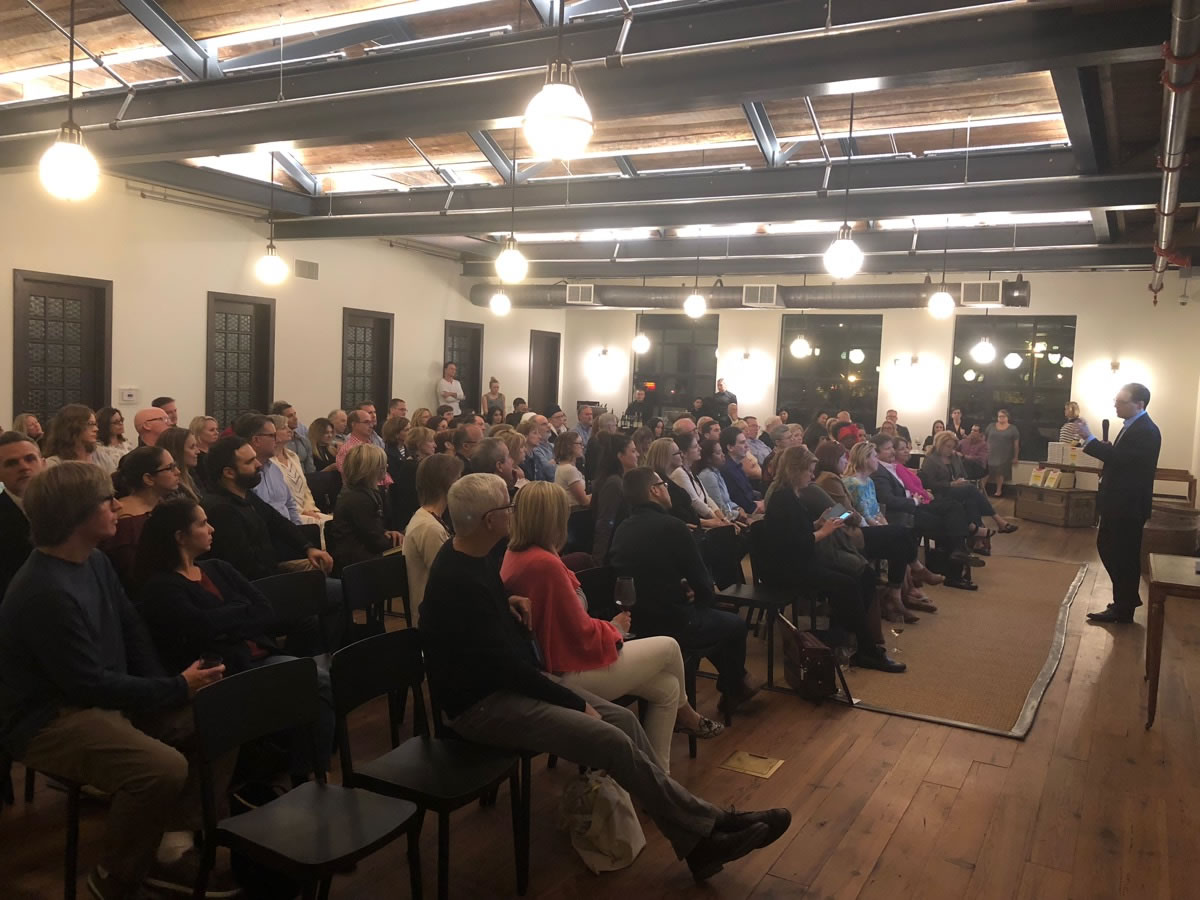
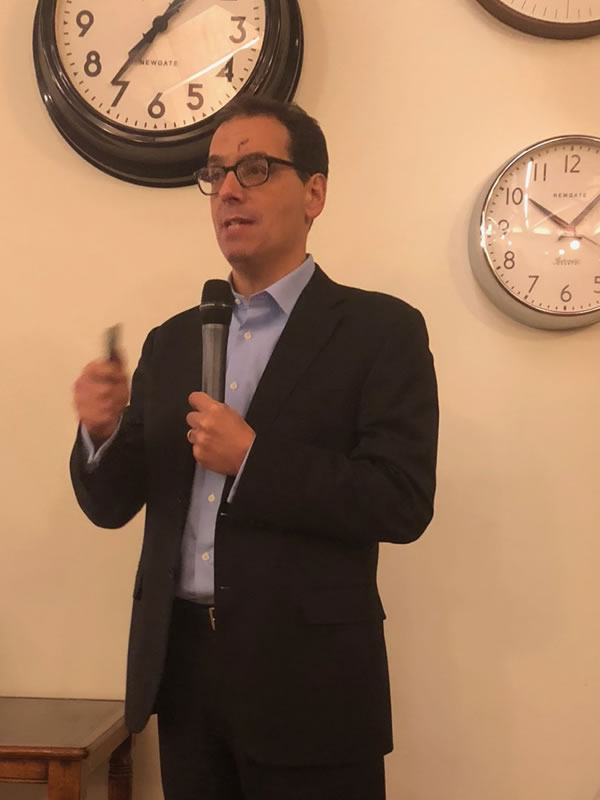
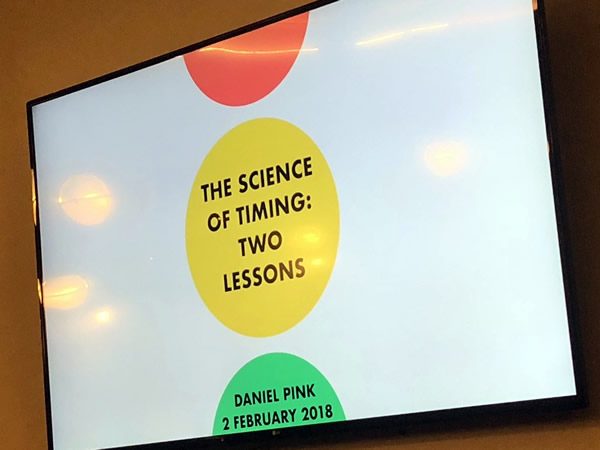
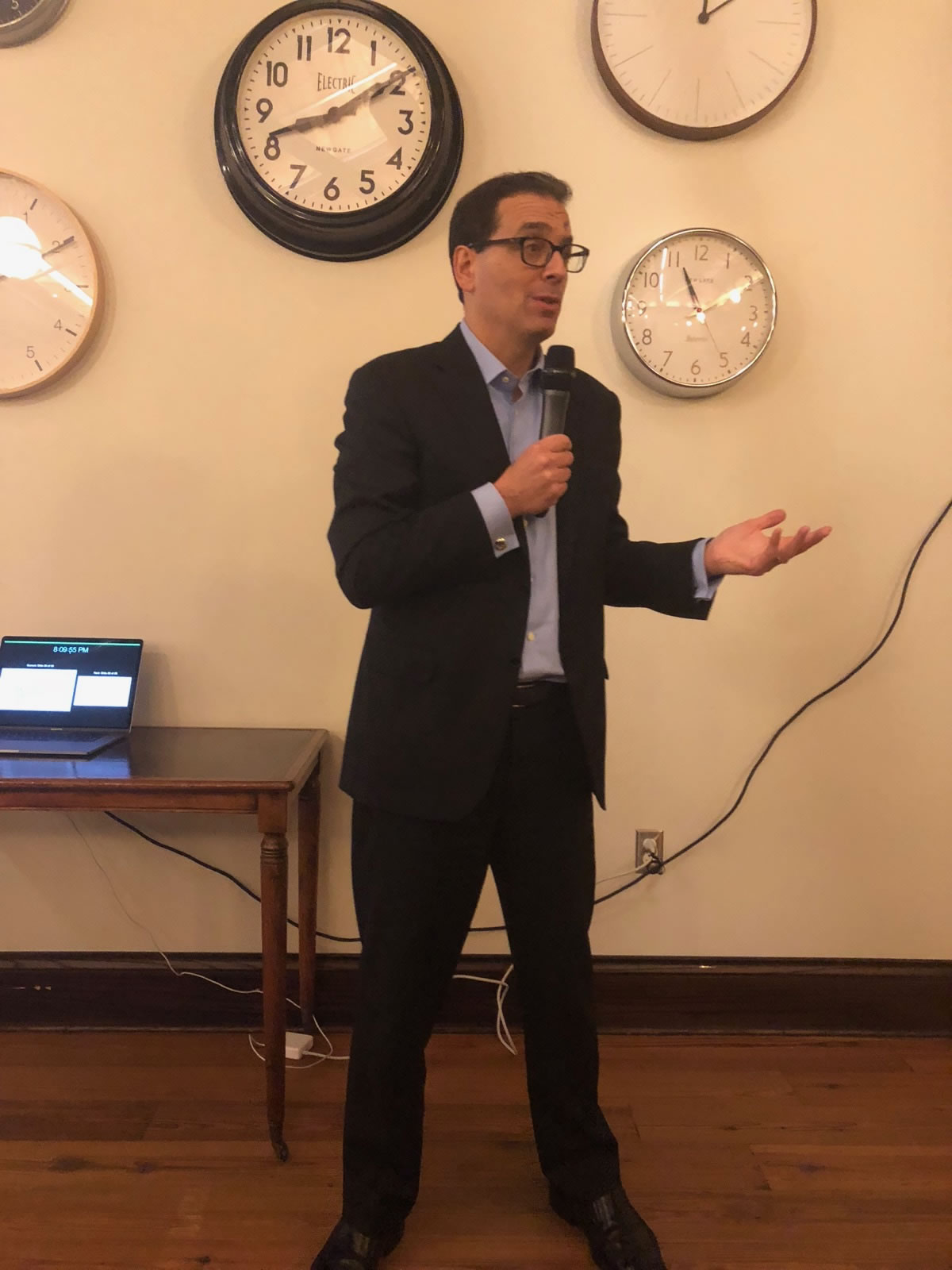
On Friday, February 2nd at Oxford Exchange — a fantastic combination of bookstore, shop, restaurant, coworking space, design studio, and event venue in downtown Tampa — author Daniel Pink gave a presentation as part of the promotional tour for his new book, When: The Scientific Secrets of Perfect Timing.
The presentation took place upstairs, in Oxford Exchange’s Commerce Club, a space with many beautiful rooms, including a large conference space where the Friday breakfast salon series of talks called Café con Tampa takes place. If you live in Tampa Bay and want to hear and meet the area’s big thinkers and movers and shakers, you should attend.
Pink opened his talk by dealing with the elephant in the room: the scar on his forehead, which gave him a very Harry Potter-like appearance. He said that he wished that there was an interesting story behind the scar, but it was simply the product of slipping in the shower. The bad news was that the result was ten stitches in his forehead. The good news — and the reason why would soon become clear — was that it happened in the morning.
“We lead lives that are series of episodes,” Pink said at the start of his talk. “Episodes by their nature have beginnings, endings, and midpoints. Each of these has a different effect on our behavior.”
His talk, like his new book, was about the oft-overlooked importance of when we do things. Among the questions he would answer, either at the talk or in his book, were:
When should you exercise — early in the day, or late?
Why should you never go to the hospital or schedule an important doctor’s appointment in the afternoon?
Why does beginning your career in a recession depress your wages 20 years later?
Why do both human beings and great apes experience a slump in midlife?
Why is singing in a choir good for you?
When during the year is your spouse most likely to file for divorce? “One of them is next month,” quipped Pink. “Check your email.”
“When we talk about units of time — things like seconds, and minutes, and weeks — you realize that most of them are completely made up,” he said. “They’re not natural in any sense; they’re things that human beings have created to corral time. But there are unit of time that are natural, like the day…and that has a big effect on us.”
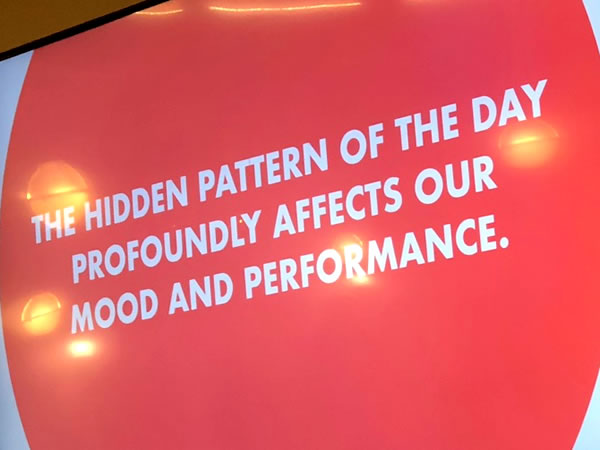
With that, he introduced his thesis: that during the day, we experience a pattern that in turn affects the way we feel and how we perform.
Click the photo to see it at full size.
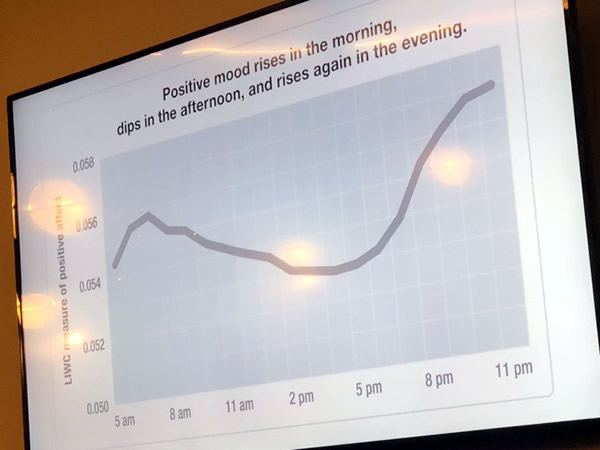
He talked about a Cornell study using software called LIWC — Linguistic Inquiry and Word Count — to analyze 500 million tweets (“None of them written by the President,” he joked) for emotional content. The researchers of the study wanted to find out how emotional content varied through the day. This kind of study is called sentiment analysis, and in performing it on a large corpus of tweets, they found a pattern:
In the early part of the day, they saw that “positive mood” has a peak.
In the middle of the day, around the early afternoon, that general mood entered a trough.
And finally, as the afternoon wore on, positive mood rose again, in a recovery.
Click the photo to see it at full size.
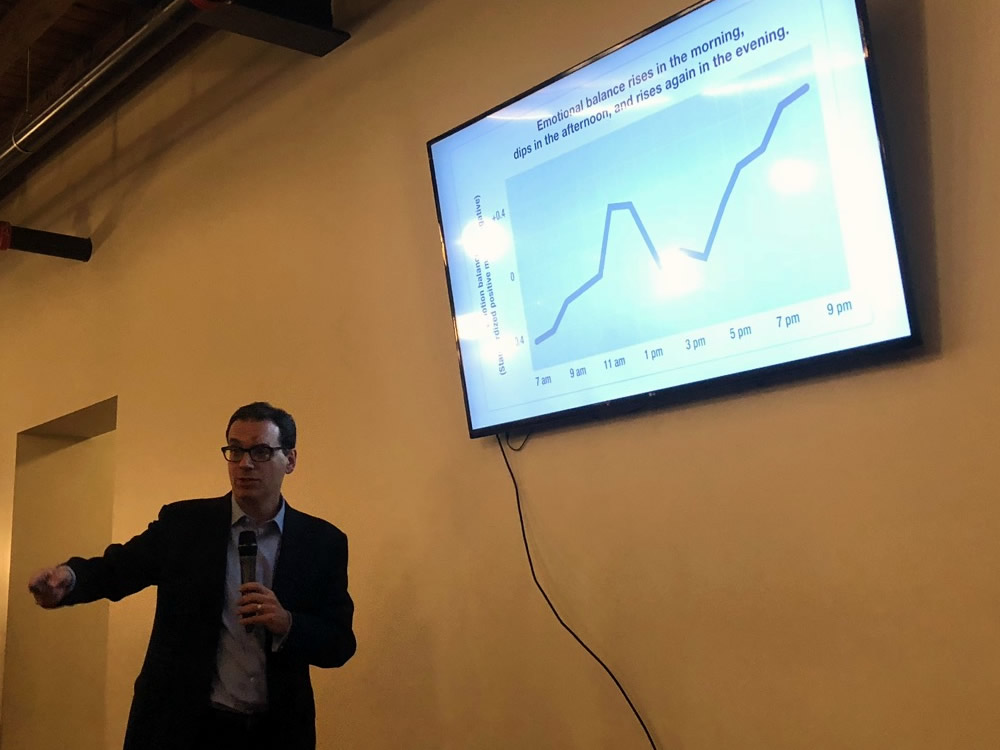
He then pointed to Princeton researcher Daniel Kahneman’s“Day Reconstruction Method”, in which he gave people diaries to track what they were doing and how they were feeling for every hour they were awake. Its purpose was to determine what activities made people feel better or worse (commuting was the daily activity that makes people feel the worst), but it also gave them a look into whether time of day affected “net good mood” — and according to their data, it does. “Net good mood”, it turns out, experiences a peak in the morning, a trough in the afternoon, and recovery in the evening.
This peak-trough-recovery pattern occurs in many places, and while the pattern is hidden to many people, its effects are decidedly not.
Click the photo to see it at full size.
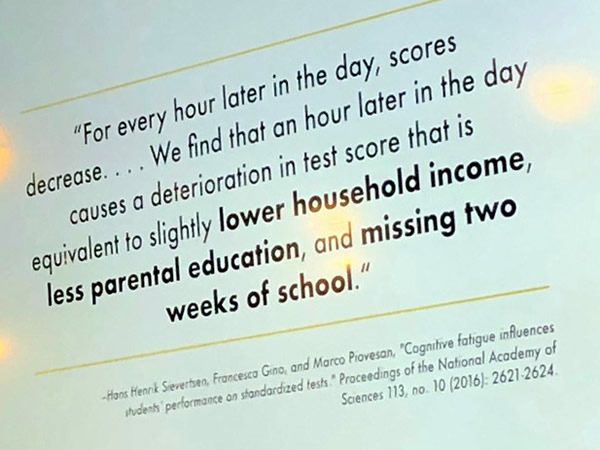
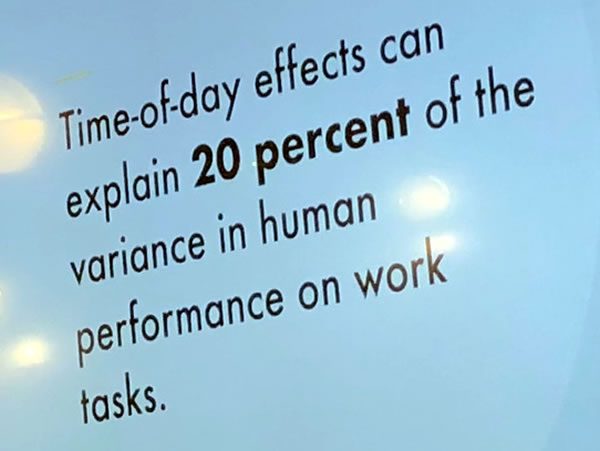
He then went to a different topic: standardized testing in Denmark. Danish students take these tests on computers, but the students outnumbering computers, they had to schedule students to take the tests at different times of the day. When they mapped performance against time of day, they found something interesting, which they summarized as follows: a general trend that the later a student took the test, the worse they performed. In fact, the effect was pronounced enough that it was written up like so:
“For every hour later in the day, scores decrease… We find that an hour later in the day causes a deterioration in test score that is equivalent to slightly lower household income, less parental education, and missing two weeks of school.”
Given that policy and decisions about a student’s future can hinge on a standardized test, the edge or setback created by when the test is taken could make a big difference.
Click the photo to see it at full size.
He cited some scary medical peak-trough patterns:
Anesthesia errors: 4 times more likely at 3 p.m. than 9 a.m.
Hand-washing in hospitals: Drops as the day goes on.
In colonoscopies, they find half as many polyps in afternoon exams as in morning exams.
Doctors are more likely to prescribe unnecessary antibiotics in the afternoon than in the morning.
“We’re very intentional about what we do — anyone here have a to-do list? We’re intentional about who we do things with — that’s why we have HR departments. We’re intentional about how we do things. But when it comes to when, we’re kind of loosey-goosey about it.”
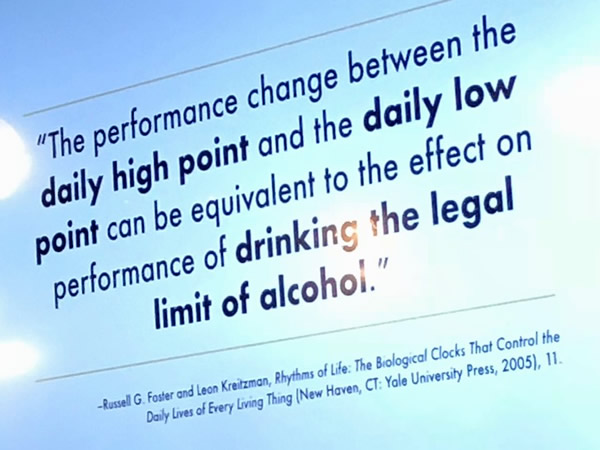
This is a shame, because the difference in our performance between the time of day when we’re at our peak and when we’re at our worst can be just like getting legally drunk.
Click the photo to see it at full size.
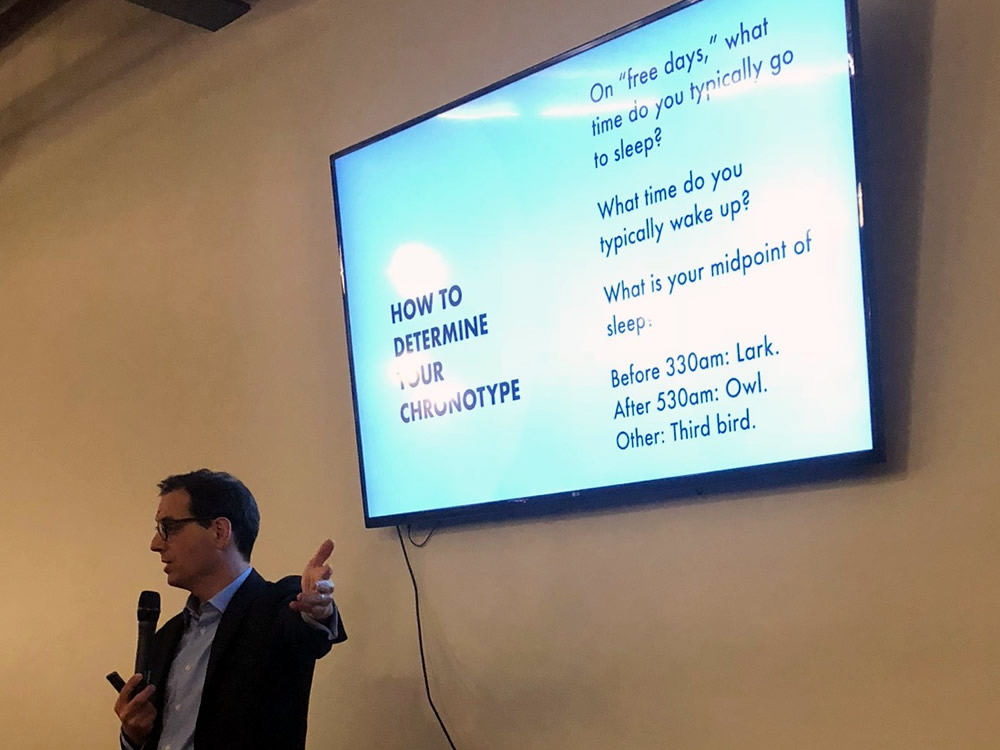
One way to help mitigate the effects of time of day on how we perform is to determine your chronotype, which is a fancy way of whether you’re a morning person, or a night owl. It’s simple to do: make a note of the time you go to sleep on “free days” (that is, a day when you don’t have to go to work the next morning) and when you wake up, and calculate the midpoint between those two times.
If the midpoint is before 3:30 a.m., you’re a Lark or morning person. 15% of people are Larks, and a disproportionate educators are Larks.
If it’s after 5:30 a.m., you’re an Owl or night person. 20% of people are Owls.
It it’s between 3:30 a.m. and 5:30 a.m., you’re a Third Bird — something in-between.
If you’re a Lark or Third Bird, you follow the pattern of peaking in the morning, trough in the early afternoon, and a late afternoon recovery. Owls go through the pattern, but in reverse: they have the recovery in the morning, a trough in the late afternoon, and a peak in the evening.
Click the photo to see it at full size.
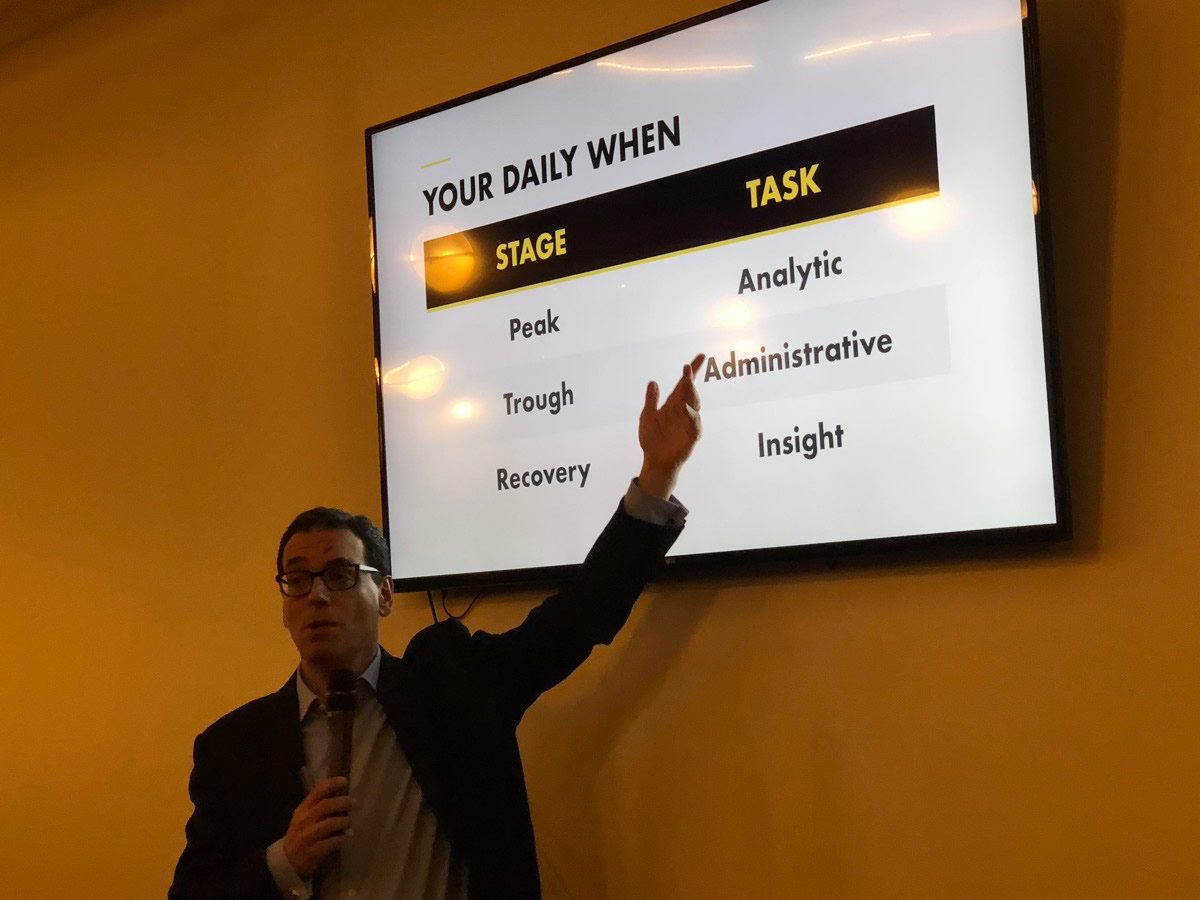
Whether you’re a Lark, Owl, or Third Bird, you should adjust what you do to match the peak-trough-recovery pattern:
During the peak, you should do analytic work.
When in the trough, do rote, mechanical work: administrative tasks and other things that can be done “on autopilot”.
The recovery period is one where your analytical powers are improved, and your mind is more flexible, which is great for insight tasks.
To prove the bit about the recovery phase and insight tasks, Pink presented the audience with a couple of brain-teasers which the majority of people get wrong. I’d seen the first one before — it’s “The Linda Problem”:
Linda is 31 years old, single, outspoken, and very bright. She majored in philosophy. As a student, she was deeply concerned with issues of discrimination and social justice, and also participated in anti-nuclear demonstrations.
Which is more probable?:
a) Linda is a bank teller.
b) Linda is a bank teller and is active in the feminist movement.
(The answer is a; case b is a subset of case a, and therefore can’t be more probable.)
He then presented another one, which I’d never heard before:
Ernesto is a dealer in antique coins. One day, someone brings in a beautiful bronze coin. The coin has an emperor’s head on one side and the date 544 BC stamped on the other. Ernesto examines the coin, and instead of buying it, calls the police instead. Why?
I find that I do my most clever, creative programming in the evening, because that’s my recovery period, and as this audio recording from that part of Pink’s talk will show you, it’s my insight time:
It’s not every day that you get to impress one of your favorite authors.
Click the photo to see it at full size.
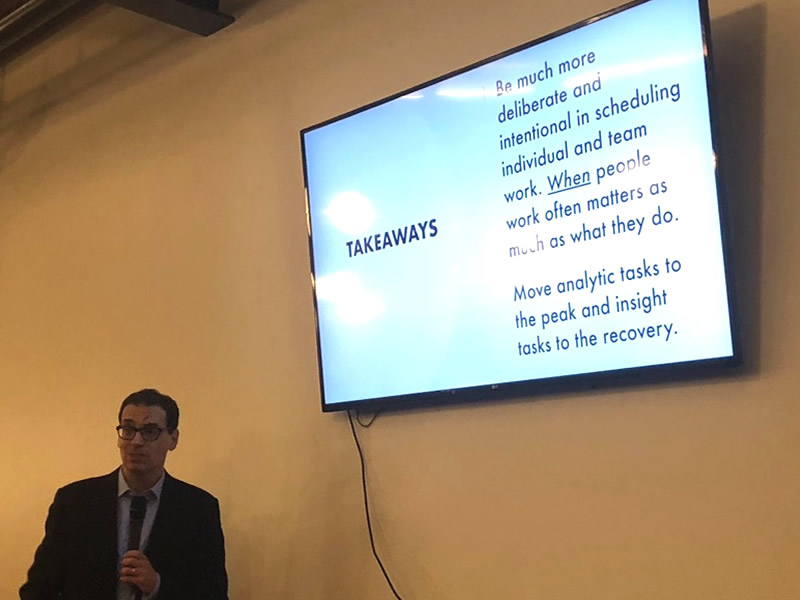
Since attending the talk, I’ve been giving more thought to the way I arrange my day. I’m taking Pink’s advice to change my schedule so that I’m taking on tasks that require analysis and vigilance during the morning, “turnkey” work in the early afternoon, and saving my creative and learning tasks for the late afternoon and evening, when the elevated mood but lower vigilance lend themselves well to that sort of thing.
Click the photo to see it at full size.
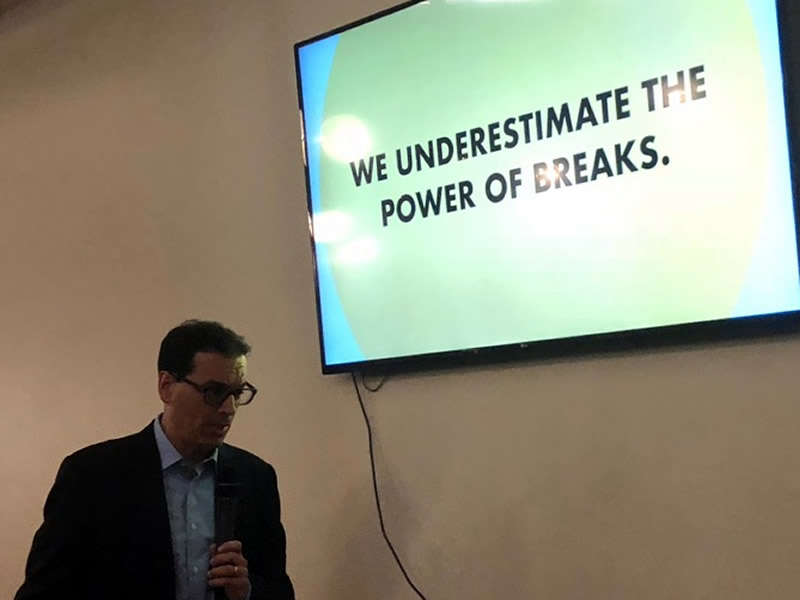
I’m also going to put more thought into when and how I take my breaks, as we tend to underestimate their restorative power.
Click the photo to see it at full size.
Click the photo to see it at full size.
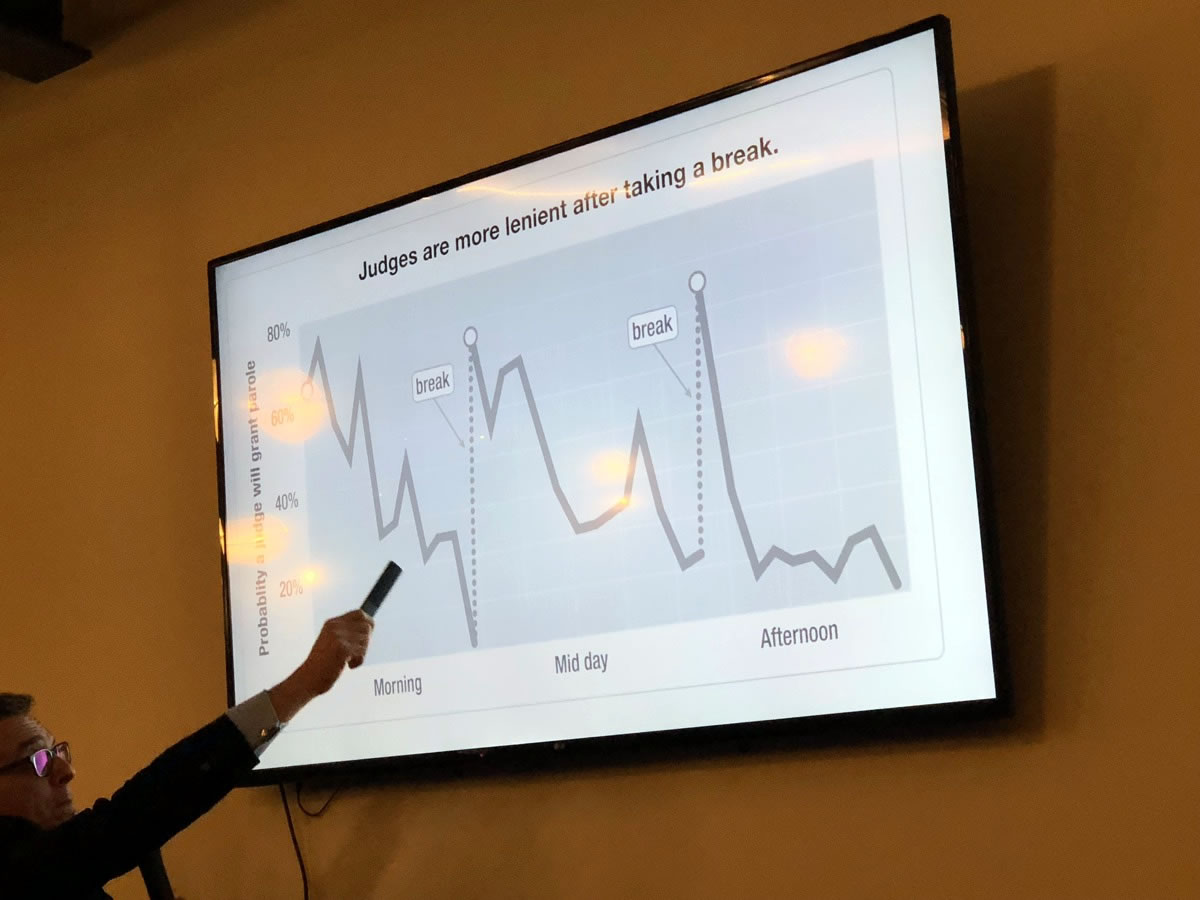
He showed a graph based on a study of Israeli parole boards, which showed that judges were more lenient after taking a break, and grew less lenient as time wore on.
Click the photo to see it at full size.
According to Pink, the science of breaks is where the science of sleep was 15 years ago. Back then, the value of sleep was being introduced in popular culture, and the same is now happening for taking a break. The data shows that we should take more breaks, and we should take certain kinds of breaks. The idea of “powering through” and not taking a break is as bad as sleeping less to get more done.
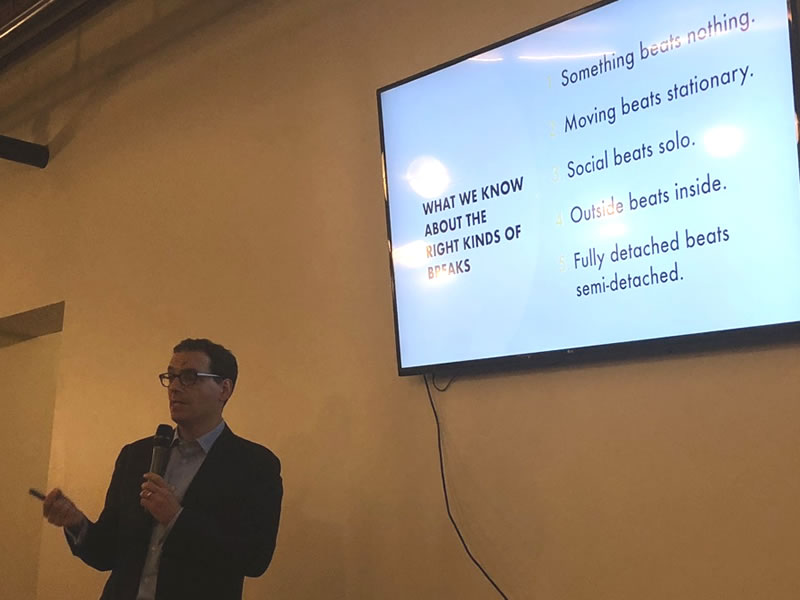
Here’s what’s known about taking the right kind of breaks:
Something beats nothing. Even a micro-break of a minute or two is better than no break at all.
A break where you’re moving around is better than one where you’re stationary.
Social beats solo. Breaks taken with people of our choice are more restorative.
Outside beats inside. Nature has powerful restorative effects.
Fully-detached — not talking about work — beats semi-detached.
Taking breaks — and especially the right kinds of breaks — can help mitigate the effects of the trough.
Click the photo to see it at full size.
Pink then went into the Q&A session, where we learned a few things:
The idea that amateurs take breaks and professionals don’t is completely backwards — it’s the other way around.
During adolescence, our chronotype shifts towards “Owl”, which is why many high schools are now wisely scheduling the school day to start later.
A couple with twin boys — one who’s a Lark, and one’s an Owl — were concerned about their Owl son’s performance on the upcoming SAT. Pink suggested that they could mitigate the morning’s effects on the Owl son by encouraging him to take a walk before the test, preferably with a friend.
Having a brainstorming session? Don’t hold it in the early afternoon.
There’s also something called the “Fresh Start Effect” — we’re more likely to stick with a change in behavior on “fresh start” days like a Monday, or the first day of the month or year, or on the day after your birthday rather than two days before your birthday.
When people make decisions, they generally have a default decision. When being pitched to, this default decision is “no”. People are more likely to overcome the default during the peak, and immediately after a break.
“This book has changed my behavior more than any other book I’ve written,” Pink said. “I became much more intentional about my own schedule… I take breaks in a way I wouldn’t have before — I always make a break list now.”
On when to work: If you goals are to lose weight, boost your mood, or establish a habit, exercise in the morning. Exercise in the evening is better for avoiding injury, if you want it to be more enjoyable and less effortful, or if you want to break records (a large number of which are broken between 4 and 7 p.m.).
Click the photo to see it at full size.
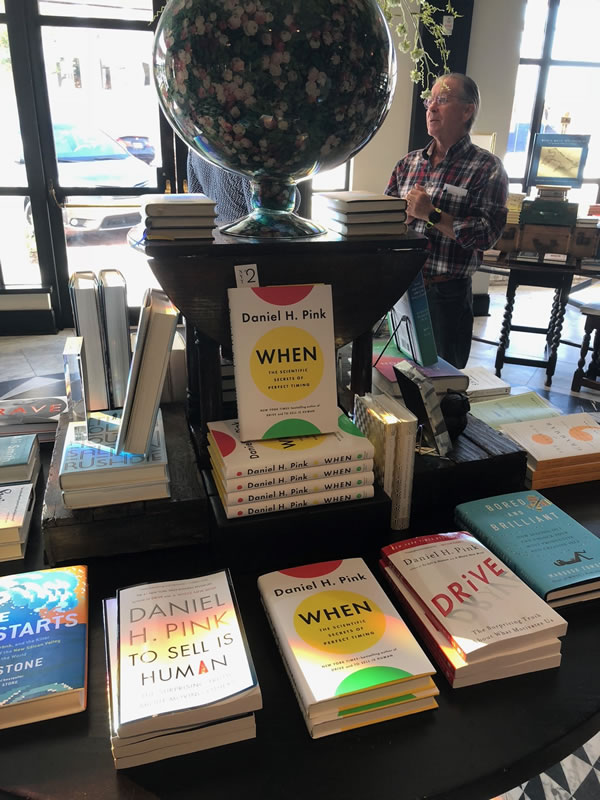
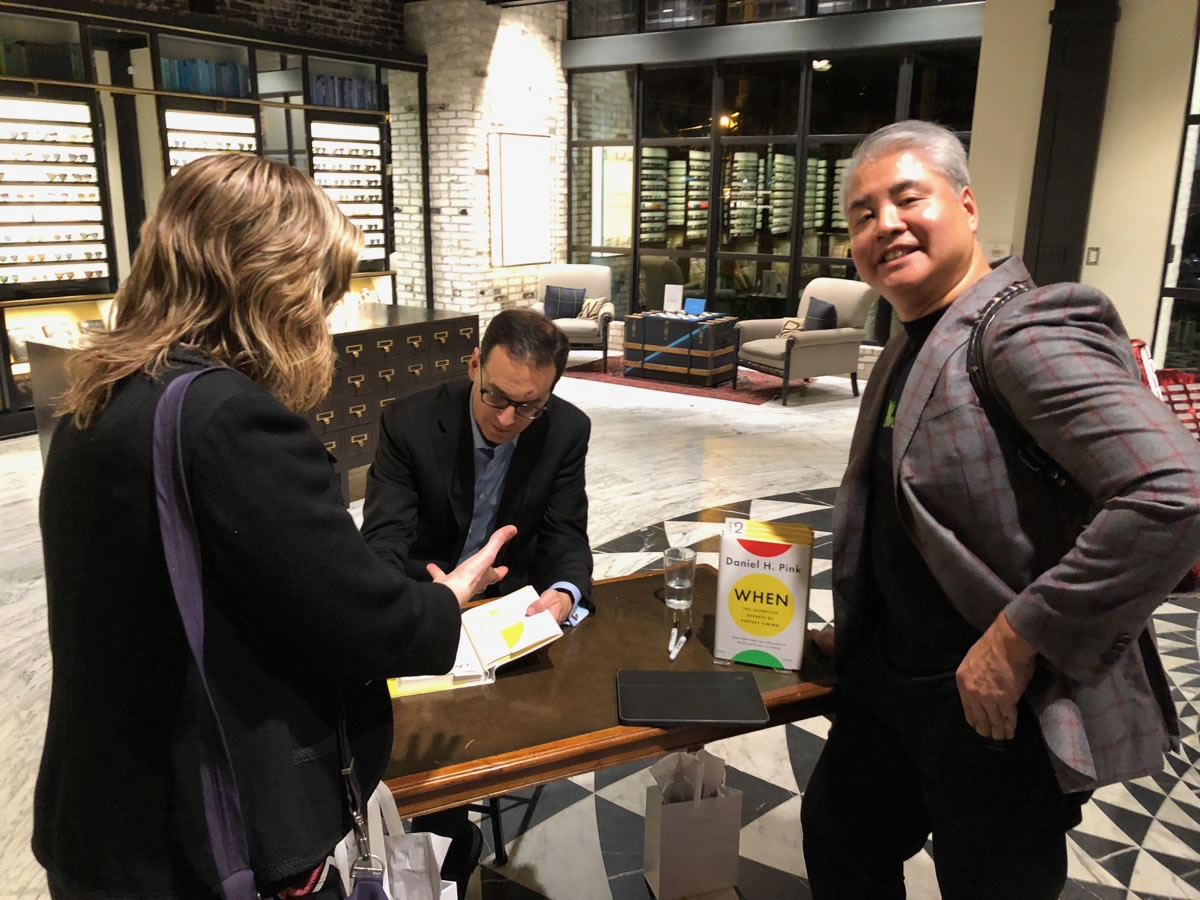
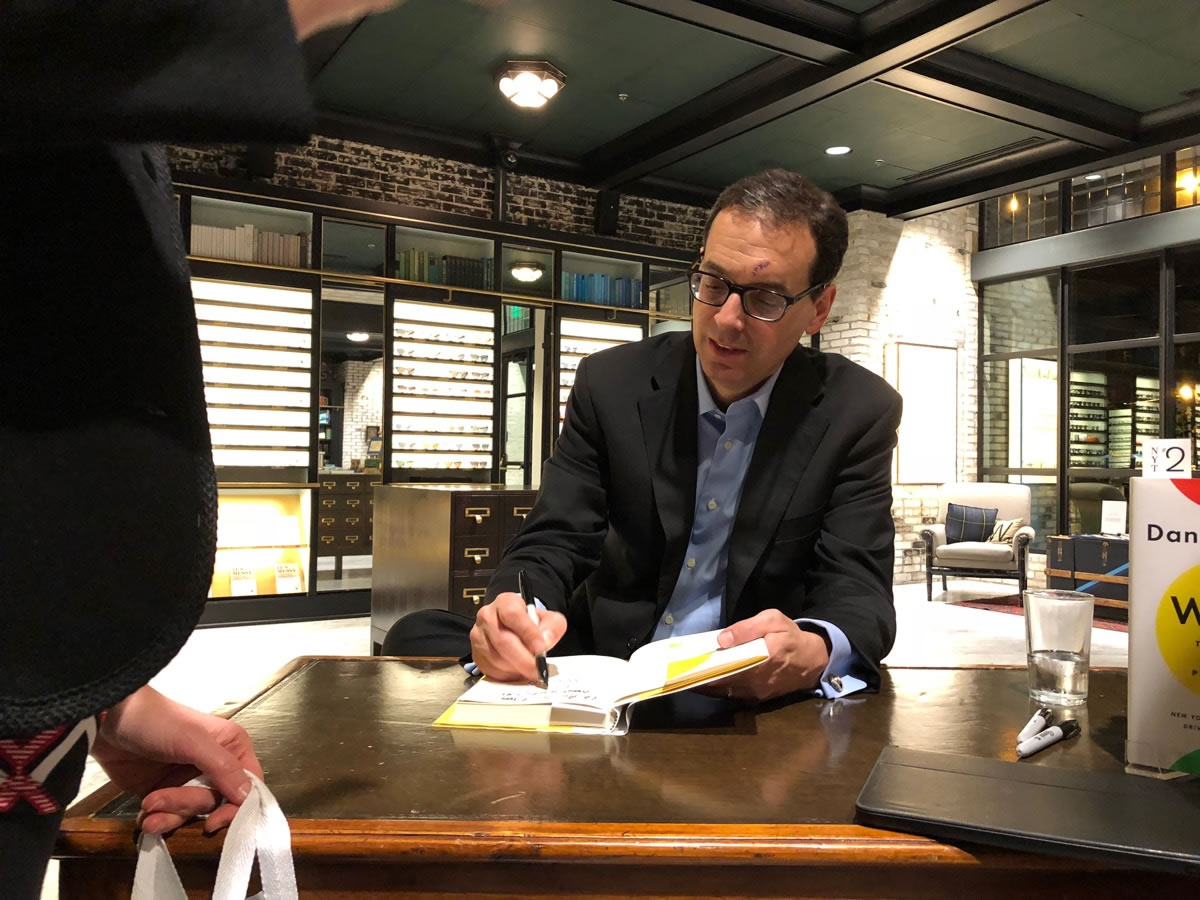
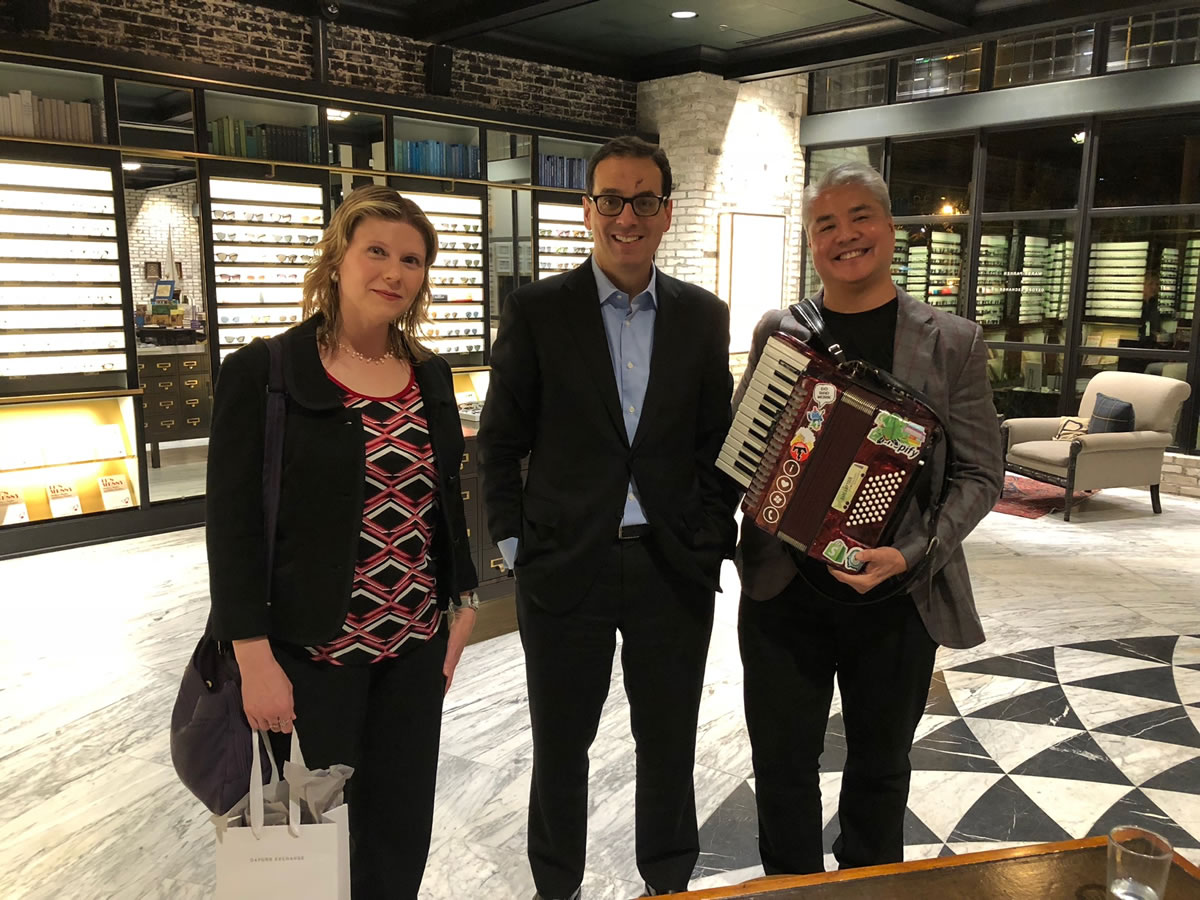
We then went downstairs to Oxford Exchange’s bookstore section to get our copy autographed…
Click the photo to see it at full size.
…during which time Anitra asked Pink for recommendations for books that he found interesting. He wrote these on a post-it:
My coworker Justin Downey was unfamiliar with Pink’s work, but came along based on my recommendation and greatly enjoyed the talk. I think we have a new fan!