…which means that the waking-up experience on Monday morning’s gonna feel like this:

Bonus reading: Infoplease’s page on Daylight Saving Time.
…which means that the waking-up experience on Monday morning’s gonna feel like this:
Bonus reading: Infoplease’s page on Daylight Saving Time.

The Web 2.0 or Star Wars Character? test determines how well you can tell the difference between Web 2.0 company names and the names of characters from the Star Wars universe.
Here’s a flickr photo titled The Need for Answers that’s been garnering a fair bit of attention lately:
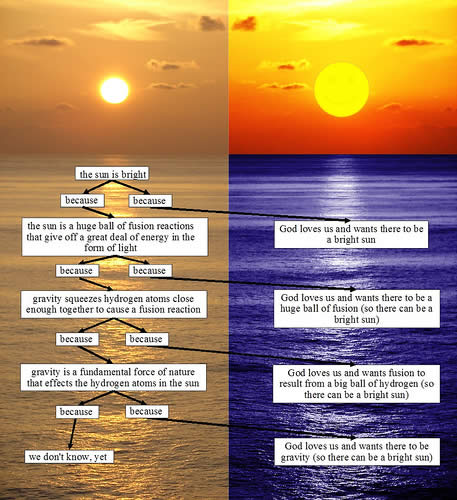
The problem with this image is that it makes the classic mistake of mistaking science for religion or philosophy — essentially a sort of equally-bad inverse of the Creationist mindset. Science is for answering the “how” questions, while religion and philosophy are for tackling the “why”. The photo oversimplifies the nature of faith in that typical hip not-quite-done-rebelling-against-my-parents way that’s popular these days. The same people who often don’t quite buy into the notion of a creator will often talk about karma as if it were Newton’s Third Law for Morals.The silliness goes both ways, as well, if the study that reports that atheists are the least-trusted group in the US is accurate.
I personally believe that science and religion are not mutually incompatible, and as Wil Wheaton put in the comments for the photo, there’s a big grey area right down the middle that’s missing. Perhaps that’s why Einstein quipped that “science without religion is blind, and religion without science is lame,” and why he also observed: “There are only two ways to live your life. One is as though nothing is a miracle. The other is as though everything is a miracle” (Reverend Victoria Weinstein does a much better job of covering this in a recent sermon).
Food for thought. Feel free to comment…
Maybe it’s the return to regular bicycling or Dad’s recent passing or maybe just part of closing in on 40, but I’ve been giving a little more thought to the “what does it all mean” questions. Here are some scribblings I’ve been filing in the “Drafts” folder of my blog. Feel free to comment.
The thing I love most about America is its “can-do” spirit.
I remember my former housemate Paul telling me about a book he’d been reading about Charles Babbage’s experiences in trying to turn his ideas for programmable mechanical computing machines — engines, as he called them — into actual working devices. Babbage often lamented that a Briton, when presented with a revolutionary engineering idea, will come up with all sorts of reasons as to why it won’t, can’t or shouldn’t work. On the other hand, he said that an American would probably try to brainstorm three or four different ways that the idea could be turned into reality.
Cory made a similar observation a couple of years ago during a reading at a local library.
“America’s simultabeous best and worst quality,” he said, “is
that it’s the only industrialized country where ambition isn’t frowned upon. If
you were to end washed up Robinson Crusoe-style on the East River and
declare to the natives that you wanted to start a media empire that
would grow to crush Rupert Murdoch’s and in the end do the thinking for
most people in the developed world, the natives would gladly direct you
to nearest investment banker.”
“If you tried that in Europe,” he continued, “the natives would think you were a complete lunatic. The way to win them over would be to tell them that you
wanted to start a modest little publishing house that printed quaint
little stories that would garner a small but elite readership of the
type of people who hung out in the pub where Tolkien and C.S. Lewis
gave each other wedgies.”
A colleague of mine who’d recently come here from Europe remarked that he was working on adopting “a more American attitude” to big business, by which he meant being more gung-ho and competitive.
“Mix it with that European attention to detail and you’ve got a winner,” I told him.
One of our group that helps put together DemoCamp, Albert Lai, recently blogged about the attitudinal difference between Accordion City and Silicon Valley. While I do have some gripes about the Valley (it’s mostly burbclaves, office parks and strip malls, and you could accurately rechristen the area as “Aspergerpalooza”), Albert points out that our version “thinking big” is peanuts compared to their “thinking big”: we thinking “let’s become a moderately big player in our field”; they think “let’s be number one”. I’m with Albert — one of my few complaints about Canada, my adopted home, is this “go for the bronze” attitude.
My morbid fascination with Archie comics continues…

 It’s been made public, so I can talk about it here now: marketing guru Ken Schafer — whose blog One Degree is an invaluable resource for Canadian internet marketers — is joining Tucows. Ken’s well-known in tech circles and has probably forgotten more about marketing than I will ever learn, so I’m pleased to see that he’ll be taking on the position of Vice President of Marketing.
Like many people who are in with the local tech crowd, Ken’s a DemoCamp attendee, so I plan to congratulate him in person at tomorrow’s gathering and welcome him to the herd. Good to have you on the team, Ken!
 Don’t forget that the “Ask Tucows” Chat
— in which you can chat online with me and other people who work at
Tucows — takes place today at 1:00 p.m. Eastern (10:00 a.m.
Pacific, 18:00 UTC). A number of people within the company have signed up to join in the
conversation, so it looks as though most departments within the company
will be represented.
The chat is an IRC chat and will take place on the #asktucows channel on the IRC server irc.freenode.net. If you already have an IRC client installed on your machine, all you need do is click here to join in.
If you don’t have an IRC client installed on your machine, you’ve got a couple of options:
Once again, the chat starts at 1:00 p.m. Eastern (18:00 UTC) and will run for about an hour. See you there!