 In the What’s Online section of today’s New York Times, the theme is Suburbia’s March to Oblivion and one of the topics is Obay. The article links to my first post on Obay as well as Torontoist’s article.
Category: Uncategorized
Categories
“Obay” Explained

It’s official: according to this story at Canada.com — Mystery Ad Gains Momentum: Whodunit? — the ads for “Obay”, which have been popping up all over Ontario are the first wave of a viral advertising campaign for Ontario Colleges.
Here’s an excerpt from the article:
Though Scientology and anti-pharmaceutical lobbyists have been widely named as suspects in the Obay whodunit, detective work by Canadian blogs Accordion Guy and Torontoist have pegged Ontario Colleges as the likeliest source of the ads – which despite being clustered in eastern Canada, have gained national attention online.
Questioned about their involvement with the campaign, Ontario Colleges spokesman Rob Savage was cautiously vague (“at this point, we don’t have any information we can give you”), but told Canwest News Service he would follow up before the end of the month about the “long-term marketing stuff” being undertaken by the organization.
They’re being quite generous: Torontoist really did the detective work. I merely reported that someone on a mailing list to which I subscribe mentioned a connection between the Obay ads and Ontario Colleges; the people at Torontoist investigated much further.

For those of you not familiar with the Canadian use of the words “university” and “college”, here’s a quick explanation:
- University refers to a post-high-school institution that generally can grant many levels of degrees — bachelor’s degrees, master’s degrees, doctorate degrees and so on.
- College refers to a post-high-school institution that generally can grant bachelor’s degrees, as well as certificates and diplomas.
Universities are perceived as more prestigious than colleges; in some circles, college is seen as where you go if you just university is out of your grasp, whether intellectual, financial or status-wise. The Obay ads, now that it’s known who’s behind them, are probably a campaign that promotes Ontario Colleges by poking fun at parental pressure to go to university and to show that a college program is a viable choice.

The thing I found most interesting about the Obay ad campaign is that the ads are a sort of Rorschach Test — the psychological test in which you’re shown inkblots and you’re asked to look at them and describe what you see. For the people who commented on my original article as well as for commenters in other places on the net, the Obay ads seemed to reveal their “hot buttons”. Various commenters saw the ads as:
- A commentary on the some parents’ use of drugs to make their teenagers more compliant
- A Church of Scientology campaign against psychology and psychiatry
- A call to arms against mindless conformity
- Culture jamming by media-savvy pranksters
- Yet another example of the “billboard child-raising nonsense” and “the absolutely flawed ideas of the left and the simply retarded ideas of the hopelessly stupid”
- Yet another example of the hippie “I have unresolved feelings of rebelling against my parents” metality
- Actual ads for real behaviour-altering drugs for your kids
- Just stupid

Since these ads are all over Toronto and since about one in three people in the Toronto area has a Facebook account, it’s no surprise that there are three “Obay” Facebook groups:
Colleges Ontario will host a media launch next Monday that, according to Torontoist, will reveal “the news behind Obay and its side effects on Ontario’s Post-secondary Education.” Torontoist will cover that story.
On a related note, here’s a parody ad from This magazine, a publication with a very progressive slant, courtesy of Torontoist:


Click the photo to see it on its original page.
Categories
Bookstaircase
When the Ginger Ninja and I finally purchase that house, I’d love to rig one of the rooms to have the “bookstaircase” shown in the photo below. The photo is taken from this article in the Apartment Therapy website:

Click the photo to see the original article.
Categories
Accidental Malice
This photo was taken at Stevens Creek Boulevard in Cupertino, California:

Photo courtesy of Miss Fipi Lele.
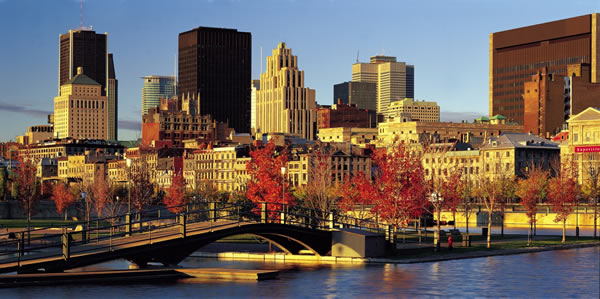
Montreal!
I fell in love with Montreal in my late teens. It’s quite unlike most cities in North America — you can practically feel the place’s history, and everything from its architecture to the “feel” of its streets just seems different. It’s like having a little bit of Europe, but closer by and cheaper to get to. If you’re from North America and looking for a different vacation destination and on a budget, I recommend Montreal.
Today’s Montreal Gazette features an article titled Silicon Island?, which takes a look at their high-tech community’s grassroots movement:
Inspired by the collaborative nature of the Internet, local geeks with bright ideas started meeting at informal, community-organized events called BarCamps. The global movement that began in the Silicon Valley was the grassroots retort to stuffy, invitation-only tech conferences. In a BarCamp, computer whizzes show the first drafts of their garage projects to anyone who will listen.
This type of networking results in lasting connections that can pay off. Now when [George Favvas of Montreal-based SmartHippo.com] needs someone with a particular skill, he puts the word out on his blog, his Facebook profile or on his LinkedIn page, a social network for business contacts. Other bloggers write about it. Someone who knows just the guy gets wind of it, and Favvas has a candidate in a few hours.
This way of doing things has been so fruitful that it’s being seen as a model for other sectors of the technology industry, like telecommunications and life sciences.
“The young entrepreneurs today are different from the IT entrepreneurs of the ’80s and ’90s,” said René Barsalo, the director of strategy and liaison for the Society for Arts and Technology, which has become the preferred venue for local tech gatherings.
“They are very good at organizing themselves. … It’s sad to see more established companies not seeing this as a core of business,” he said.
There’s also a gathering called YULbiz, a monthly get-together for local business bloggers (YUL is the airport code for Montreal’s Pierre Trudeau airport). Montreal StartUp encourages successful entrepreneurs to become angel investors. Guy Kawasaki’s Garage Technology Ventures has a branch office in Montreal.
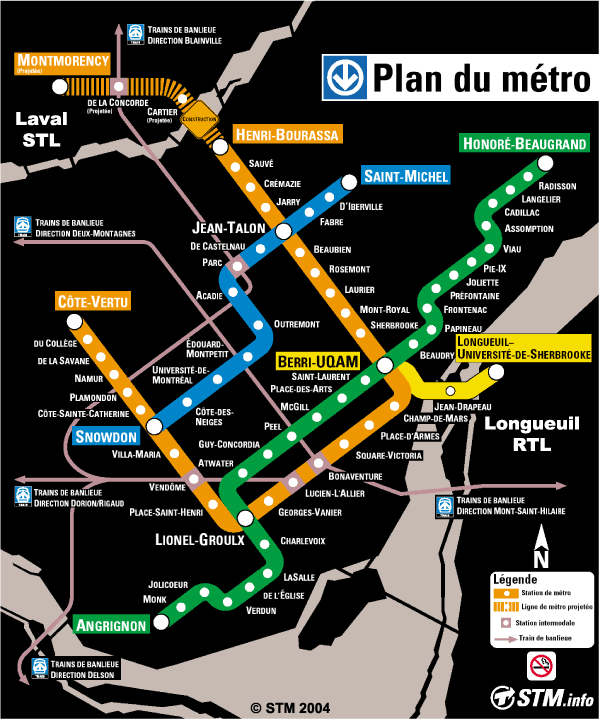
Map of Montreal’s subway.
As with Toronto, the chicken-and-egg problem also plagued Montreal. As the article puts it: “Do risk-takers attract smart money, or does the availability of money encourage risk-takers? Ideally, both factors are at work, in a mutually reaffirming symbiosis.” The seed money is now coming in, and things are looking up:
With its pool of tech talent, the emergence of seed money, and a budding network of mentors, “Montreal has the right mix of elements and we’ll see it really flourish next year,” [Austin Hill] said.
The next step is to get people from different tech and business sectors talking to each other. René Barsalo, the director of strategy and liaison for the Society for Arts and Technology (“the preferred venue for local tech gatherings”) says that in his ideal world, a presentation by a 3D animator would have engineers, musicians, medical technicians and furniture designers in the audience.
The article closes with a line that people in the Toronto tech community will find familiar: “The grassroots is moving up quite nicely, but a top-down movement isn’t happening at all.”
Seattle Taps Its Inner Silicon Valley
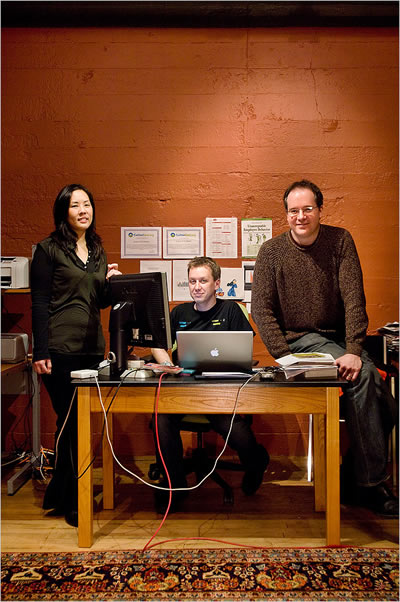
Jenny Lam, Hillel Cooperman and Walter Smith of the software company Jackson Fish Market.
Seattle Taps Its Inner Silicon Valley is a recent New York Times article that opens with a pretty dramatic statement that I hope we’ll someday say about this weblog’s home city, Toronto: “Many communities dream of becoming the next Silicon Valley. [Seattle] is actually doing it.”
The city has its share of big players: Microsoft has its headquarters the nearby suburb of Redmond as well as satellite offices in Seattle proper, Amazon is based there, Google has a research lab there and Nintendo’s American headquarters is also in the area. However, the real topic of interest — from both the article’s point of view as well as mine — is the city’s startup ecosystem. “More young companies are moving in downtown,” says the article, “near the art galleries and bookstores around Pioneer Square. Still others are spreading into the surrounding suburbs.” A number of these startups fall into interestingly-named categories:
- The “Baby Bills”, startups formed by ex-Microsofties. The name comes (obviously) from Microsoft co-founder Bill gates and (less obviously for those of you who might be too young to remember) the “Baby Bells” that emerged from the breakup of AT&T.
- The “Baby Jeffs”, startups created by former Amazon employees, named after Amazon’s Jeff Bezos.
- The “Baby Sergeys”, startups run by former Googlers, named after Google’s Sergey Brin.
Silicon Valley got its start as the “Fairchildren” left Fairchild to form their own companies, whose employees moved between them or formed their own spin-off companies, creating the atmosphere of cross-pollination that turned the area into a high-tech Mecca. The same thing seems to be happening in Seattle, according to Walter Smith of Seattle software company Jackson Fish Market: “Seattle is like an adolescent version of Silicon Valley,” he says.
Just as Silicon Valley has Stanford, Seattle has University of Washington, which the article says is fostering the area’s entrepreneurial spirit in the same way. Another similarity is the area’s old industry: aerospace, which provided an earlier boom in the Seattle area, just as it did in the Valley. Now the entrepreneurs and venture capital are moving in, and there are social networks, support businesses and a business culture that views failure as a badge of honour, not shame.
How Green Was My Valley

Scenes from the Valley’s El Camino Real (left) and Seattle’s Pioneer Square (right).
The New York Times article on Seattle inspired this response on Seattle-based Redfin’s corporate blog: How Green Was My Valley. Where the Times chose to focus on the similarities between the Valley and Seattle, How Green Was My Valley takes the opposite tack and focuses on the differences. some of which are:
- Seattle has become unrecognizably wealthier in the past decade, yet is oddly unhappy about it. While Seattle has people who get nostalgic for the city’s good old days, the amnesiac Valley — most of whose denizens only came there for the tech gold rush — have neither the history there, nor any real connection to the place.
- People live in Seattle because they love Seattle — the lifestyle and schools, the mountains and the lakes. Contrast this with the blog article’s author’s story about his first roomate: “My first roommate spent four years building a company in San Francisco without ever buying furniture. When his startup went bust, he packed for the trip home to Toronto the same day.”
- The high cost of living keeps the Valley in a sort of post-adolescent collegiate state. A two-bedroom house in “Shallow Alto” (that was our nickname for it during the OpenCola days) will set you back $1.5 million, which prevents people from buying a suitable place for starting a family. “In Silicon Valley,” goes the author, “Seattle’s 28 year-old family man is still working his tail off for a hit.”
- Stanford is the Valley’s “Hogwarts”. “…without Stanford the Valley would grow old and die,” says the author. “Native Seattleites hardly notice Seattle’s Stanfordlessness; Valley expats never get over it.”
- Here’s something that reminded me of Paulina Borsook’s book Cyberselfish: In Seattle, “High-tech entrepreneurs are expected to be pillars of the business community…not, as Silicon Valley’s establishment likes to think of itself, pirates of the Caribbean.” Techies get involved in non-tech community organizations like the Rotary Club and seem to have a mindset connected to “a set of civic virtues bigger than any one company”.
- Seattle has a sense of “helping out” that’s much harder to find in the Valley: “And it has nurtured a rookie CEO like me. A Seattle journalist e-mailed me while I was still loading the tiny U-Haul that brought me here. A VC who should have eaten my gizzard for breakfast invited me to his lake house for dinner. A startup CEO who offered money-raising advice over lunch diverted us from Quiznos to Carmines.”
- The new-for-new’s sake ethos of the Valley isn’t so pervasive in Seattle. While techies in the Valley chase fashionable ideas, techies in Seattle have the freedom to work on less cool projects that work. Redfin itself is in the “uncool” business of real estate.
- There’s a sense of dedication and loyalty in Seattle. While many of Google’s engineer’s are “plotting their next startup on the company dime,” “ten years on at Microsoft, engineers deep in Redmond’s rain forests are still writing the next version of Office.”
- And finally, one similarity: both the Valley and Seattle have the weather as their selling point, for completely opposite reasons. Says Zillow’s Rich Barton of Seattle: “You work hard here because it’s gray. Then you go hiking or fishing or skiing.”
Toronto’s Challenge

A whole mess of Toronto tech people. Can you identify them all?
Along with Leila Boujnane, David Crow, Jay Goldman and Greg Wilson, I help put together the DemoCamp gatherings here in Toronto. As part of this group, as well as a Toronto-based techie and a long-time resident of this city (since 1975!), I have an interest in making Toronto a great place to work, live and play, in both my geek and non-geek modes.
As I’ve written before, I think that Toronto is an underappreciated gem of a city and that a lot of the elements required to make Toronto a high-tech startup hub are in place. We’ve got:
- A vibrant city,
- with a strong creative class,
- a healthy number of techies with a strong entrepreneurial bent,
- interesting neighbourhoods with lots of character,
- youth and liberalism,
- a local culture with strong social networks,
- a number of good universities in the area,
- and the Accordion Guy!
Okay, maybe the last item in that list isn’t absolutely necessary, but it couldn’t hurt.
There are a number of hurdles that we need to clear, not the least of which are the timidity of local investors and the sense among a lot of people here that “making it” means getting a job in a big company, not starting your own. Perhaps it’s a symptom of the national character; after all, Canada was founded by people loyal to the British Empire, people who said “Hey! We like being a colony! Taxation without representation? Fine by us! So King George talks to trees…who doesn’t?!”
I’m glad that there are a lot of people in Toronto who are thinking about this sort of thing, and I look forward to talking with them, making plans and putting them into action. Over the next little while, I’m going to talk about what it would take to build up Toronto as a high-tech hub and a livable city. Watch this space!
Earlier Articles on Toronto as a Startup Hub
In case you missed them, here are some links to older articles of mine about what it would take to turn Toronto into a startup hub:
- How to be Silicon Valley: My take on Paul Graham’s article, How to be Silicon Valley.
- On “How to be Silicon Valley”, Part 1: Comments on How to be Silicon Valley
- On “How to be Silicon Valley”, Part 2: Even more comments on How to be Silicon Valley.
- On “How to be Silicon Valley”, Part 3: In which Toronto high tech finds common ground with Toronto fashion.
- Silicon Valley Fight Club (or “How to be Silicon Valley, Part 4”): A private fight club made up of developers and engineers in Silicon Valley, and what it says about life there.
- On Becoming Silicon Valley, Part 5: Toronto developer David Janes’ take on How to Become Silicon Valley.
- On Becoming Silicon Valley, Part 6: My comments on Guy Kawasaki’s article, How to Kick Silicon Valley’s Butt.
The hair! The awkward VJ delivery! The public-access TV production values! Night Ranger! It’s all here in the two Google Video clips below, featuring three hours’ total of MTV from 1983, back when it was a channel that showed music videos…
[via]