While waiting for our flight to Toronto, I went to the bathroom in Tampa’s airport, where I saw this attachment in the stalls:
It’s The Pouch, an acrylic bag or item holder that’s been making increasing appearances in public bathroom stalls over the past decade.
But the Pouches at Tampa airport are unlike others I’ve seen. They differ in one key way, with this sticker:
That’s right — it’s a “do not jam your baby into the Pouch for hands-free pooping” sticker!
I have this question: Was there an incident that led to the sticker, or are they anticipating that someone might try to use it as a baby-holder?
(To be fair: the “Pouch” name and logo, along with the fact that kangaroos actually carry their young in their pouches, might lead people to think that’s it’s supposed to be baby storage.)
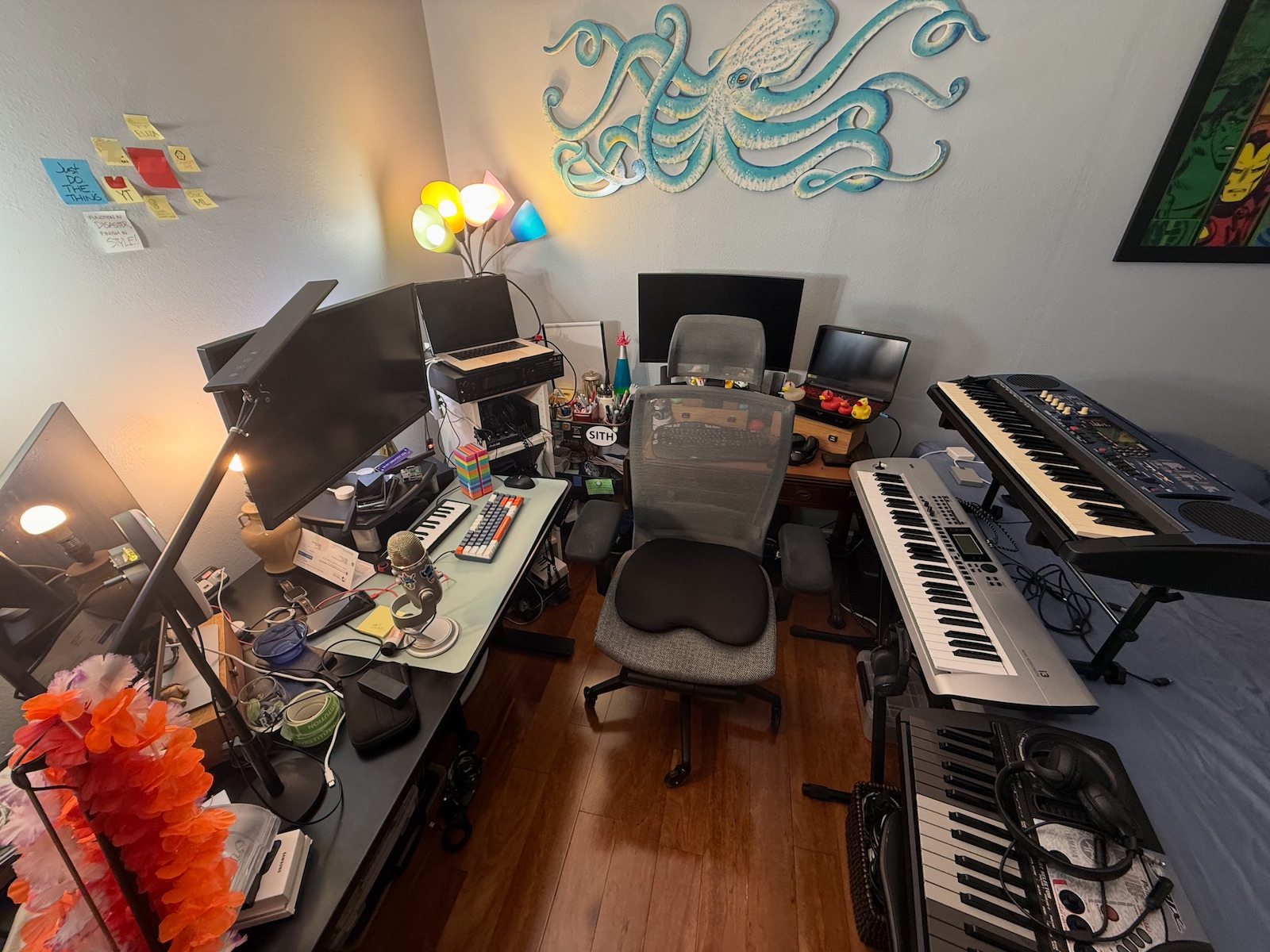
My Yamaha DJX II (top rack) and DJX (bottom rack). Keyboards don’t get any more “nineties” than this!
Over the past few weeks, I’ve tripled the number of keyboards in my office (the electronic music kind of keyboards, not the typing kind). As a result, I’ve probably more than tripled the amount of music I’ve played as well.
Before I took up the accordion, I played the synth. I’ll continue to play the squeezebox, but it’s also nice to get back to my roots.
A day after I bought it, I did a little “DAWless jam” (that’s the term the kids use these days for “playing a physical instrument without the aid of computer software”) on the DJX. I started recording, picked a beat, and jammed for a couple of minutes.
Afterward, I gave the recording a listen and thought, “this needs to be on a 1990s cyberpunk-style video.” So I took the track, grabbed some cyberpunk clips from Canva and Pixabay, and assembled this video in Camtasia:
All told, I recorded the jam in under ten minutes, and put the video together over a couple of hours on Saturday afternoon.
The DJX II jam
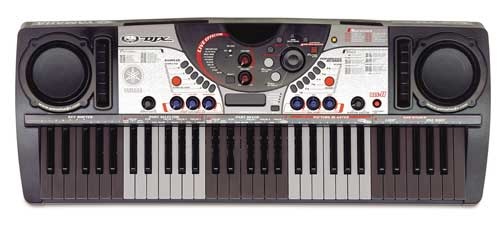
The other keyboard I regret not buying back then was the Yamaha DJX II, the follow-up dance music keyboard to the DJX, released in 2000. In more than a few ways, the DJX is a better keyboard than its successor, but damn, the DJX II is a better rhythm machine than the original.
Rare as the DJX is, the DJX II is even more so. I found the DJX through good ol’ manual Googling. I found the DJX II only because I’d cobbled together a little Python script to comb through Craigslist’s “musical instruments” pages in cities all over the U.S. for a DJX II. As I wrote in an article I wrote earlier, it worked.
On Saturday, I recorded another DAWless jam, this time on the DJX II, and here’s the result. No video this time — just the audio of me pretending to be the backup band for Morcheeba or Lamb or Tricky:
What do I plan to do with all these jams?
Among other things, I make technology videos, which I post on the Global Nerdy YouTube channel. While I think I have a pretty good narrating voice (I’ve been told time and again that I should be on the radio), a video still benefits from having a good soundtrack. I already do the writing, presenting, and graphics — why not also do the music?
My videos already incorporate my music, and there’ll be more — both videos and music — soon!
It’s similar to the electronic “band in a box” keyboards you can buy at Costco or your preferred “big box” store, but with one very important difference: it was made specifically for hip-hop and electronic dance music. Even though it was released in 1998, it still sounds fresh and fun.
I wrote about the DJX in this article, which I ended with:
Aside from making music with the DJX, I’m also keeping an eye out for its even more rare little brother, the DJX 2…
I enjoyed the DJX so much that I decided to try to find its successor, the DJX II, which was released in 2000. Rare and precious as the DJX is, the DJX II is even more so. If you enter the term DJX into a Google Shopping search, you’ll see a couple of DJX keyboards, and a few more DJX IIB devices, which were DJX IIs with the keyboard replaced by a CD scratch wheel…
…but you’re not likely to see any results for the DJX II keyboard with its distinctive alternating dark grey/light grey “white keys.”
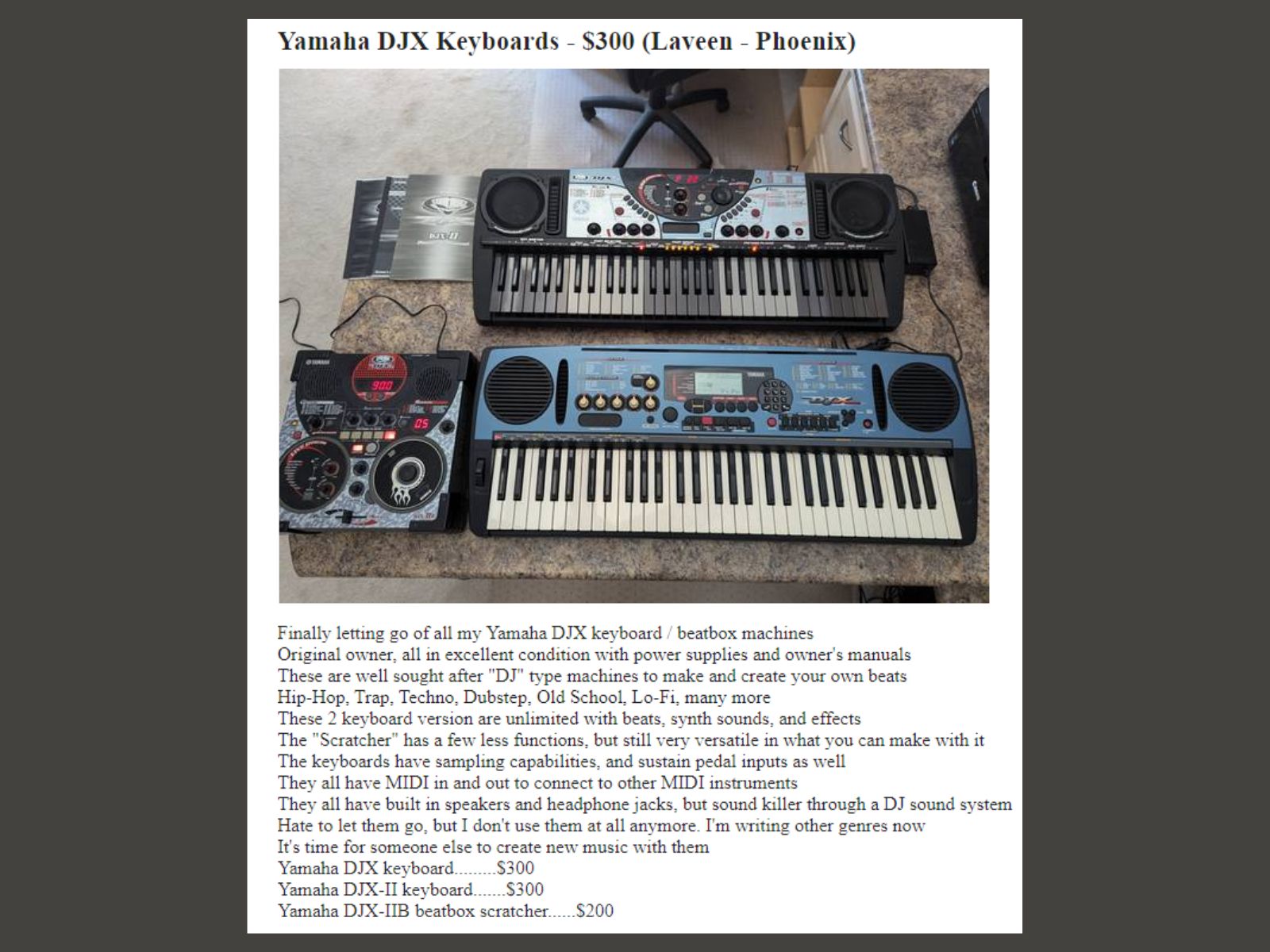
After a couple of days’ of typing in search terms on Google, I did what I always end up doing: I wrote a Python script to automate the process for me. In addition to checking Google, it also scoured a number of Craigslist sites, and that’s how I found this listing:
I contacted the seller, who’s a really nice guy, but didn’t want to deal with shipping and electronic payments. He wanted to sell to someone who could pick it up in person and confirm for themselves that it was in perfect working order, and pay in cash. Personally, I can’t blame him.
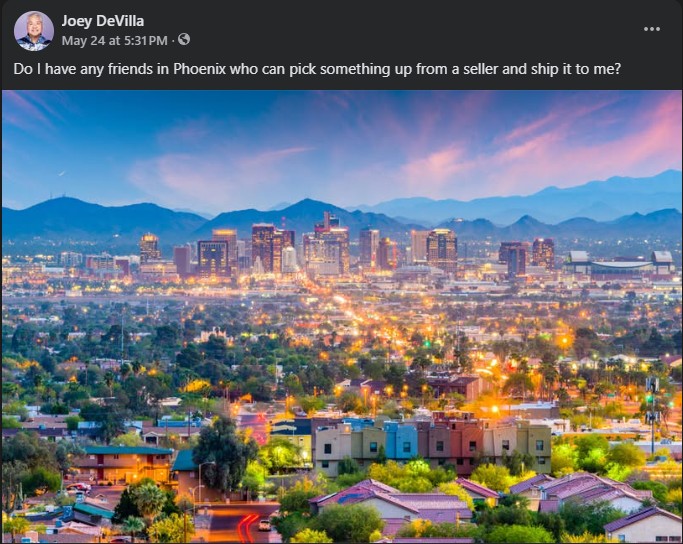
I thought about hiring someone from Taskrabbit to pick it up and ship it to me, but I decided to go on my social media accounts and ask…
Fortunately, like Cassian Andor…
My friend Meghan, who moved to Phoenix not too long ago, stepped up. I sent money for the keyboard, shipping, and her time, and on Friday, it arrived in a very big, very well-padded box.
I’m now the proud owner of a Yamaha DJX and DJX II:
…and my office is looking increasingly like Fatboy Slim’s supervillain lair:
For the curious
If you’re wondering why I’m so excited to own a 25-year-old keyboard, here’s a couple of looks at its features. This one’s from four years ago…
…while this one was posted just last month:
When the DJX II was released, Yamaha made the then-unusual move of creating a promotional video:
My neighborhood, Seminole Heights, has at least a half-dozen Little Free Libraries that I’m aware of. I always check to see if there’s something interesting or amusing in them, and I’m rarely disappointed.
We had a long-overdue game of Dungeons and Dragons at our place on Saturday, and we did it old school/new school, or as I like to say, we took the “Flintstones/Jetsons approach.”
If you think D&D’s just a silly game, I need to remind you that it’s part of the foundation of nerd culture, and as a result, it’s baked into the DNA of the technology industry. Reid Hoffman, who made a little website you might have heard of — LinkedIn — insists that Dungeons and Dragons made him the business success that he is today, and that it’s a valuable tool for learning about making your way in the business world.
He’s even devoted a couple of episodes of his podcast, Masters of Scale, to the topic. Here’s the latest one:
If Hoffman’s endorsement doesn’t impress you, how about Vin Diesel’s?
Or Joe Manganiello?
Or the cast of Daredevil?
Old school
The “old school” part was that we played the 1980s edition of D&D: Advanced Dungeons and Dragons, First Edition, written by E. Gary Gygax himself! This was the version of D&D depicted in Stranger Things…
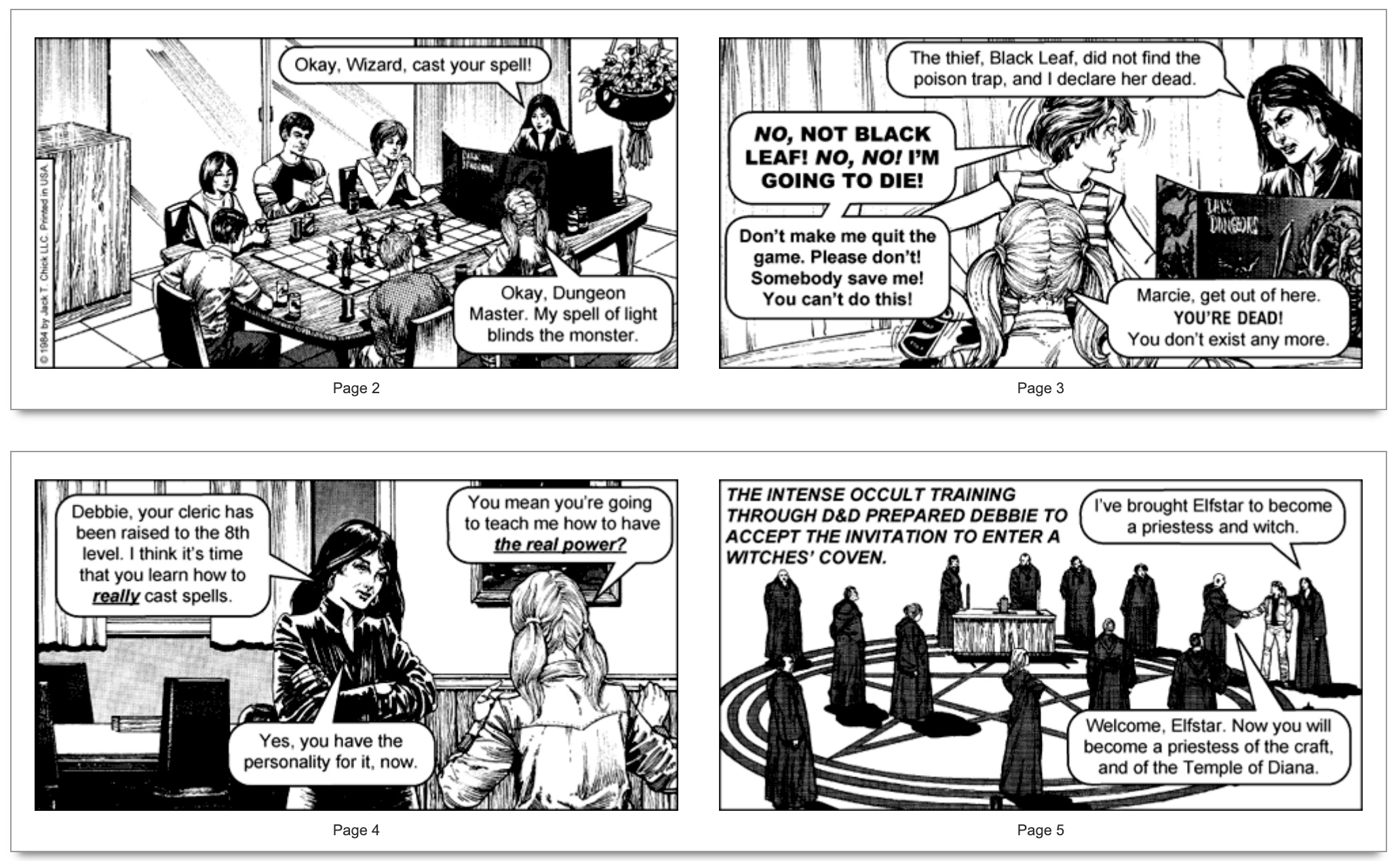
…and yes, it’s the version that was part of the “Satanic Panic” and one of my favorite Jack Chick tracts, Dark Dungeons…
The first edition rules are quaint by today’s standards, but they’re still recognizable by people who play using the current version — the 2024 revision of the Fifth Edition rules. After all, the rules and dice are there to provide a basic structure; the game is really about the shared storytelling experience.
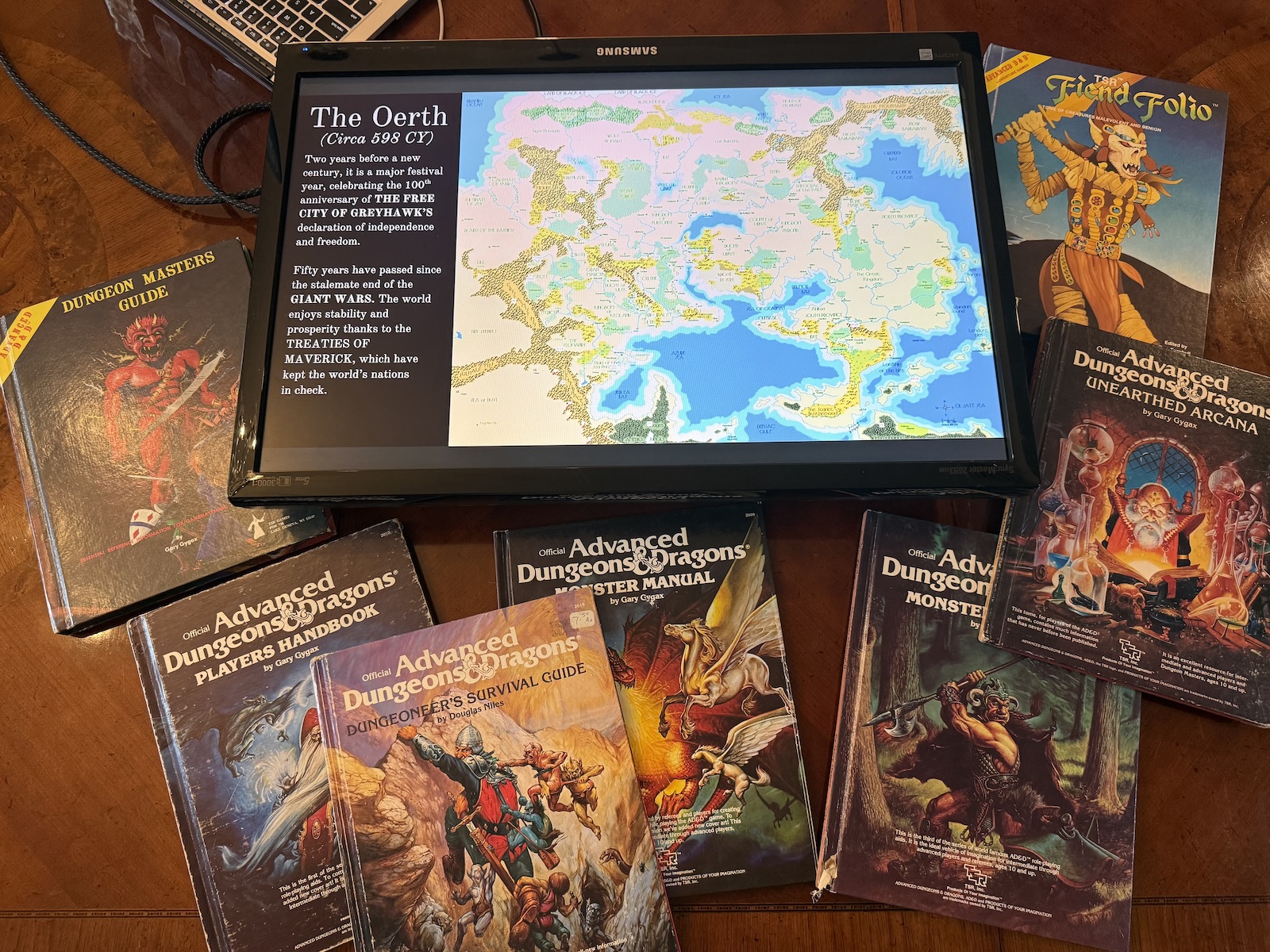
o my nearly-complete set D&D books from the ’80s (I’m missing Deities and Demigods), and brought them to Tampa from Toronto. I even have two copies of the original edition Dungeon Master’s Guide.
We had one last old school element for our game: Cheetos and Mountain Dew:
In case you don’t get the reference, it’s from this video…
…whose dialogue is a snippet from this skit (which also pokes fun at the Satanic Panic) by the Dead Alewives:
New school
The game monitor
You can play Dungeons and Dragons without any visual aids; it is storytelling, after all. But sometimes, it’s nice to be able to provide players with a sense of where they are, and where other characters in the game are.
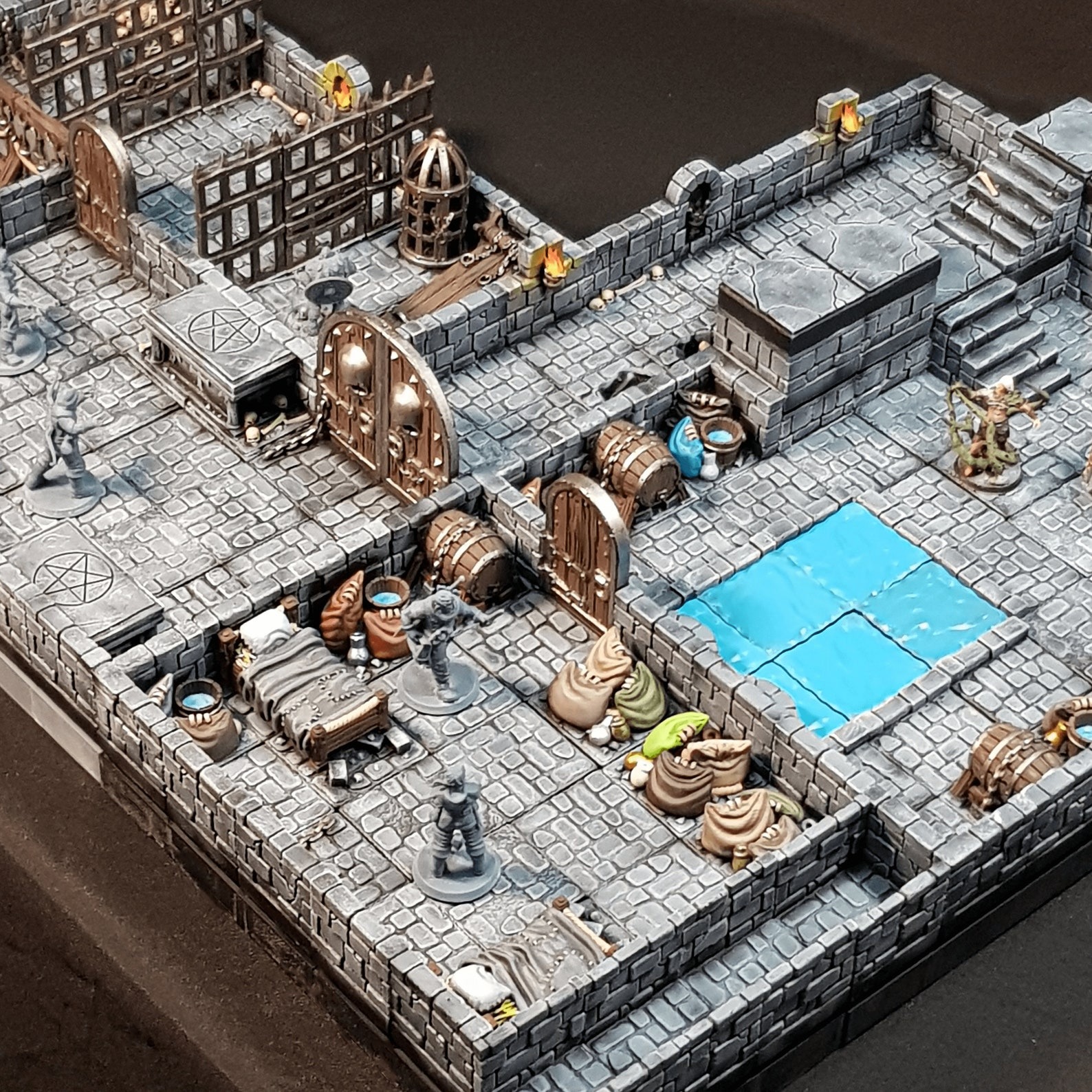
Many games are conducted with maps and miniatures, starting with simpler setups like this one…
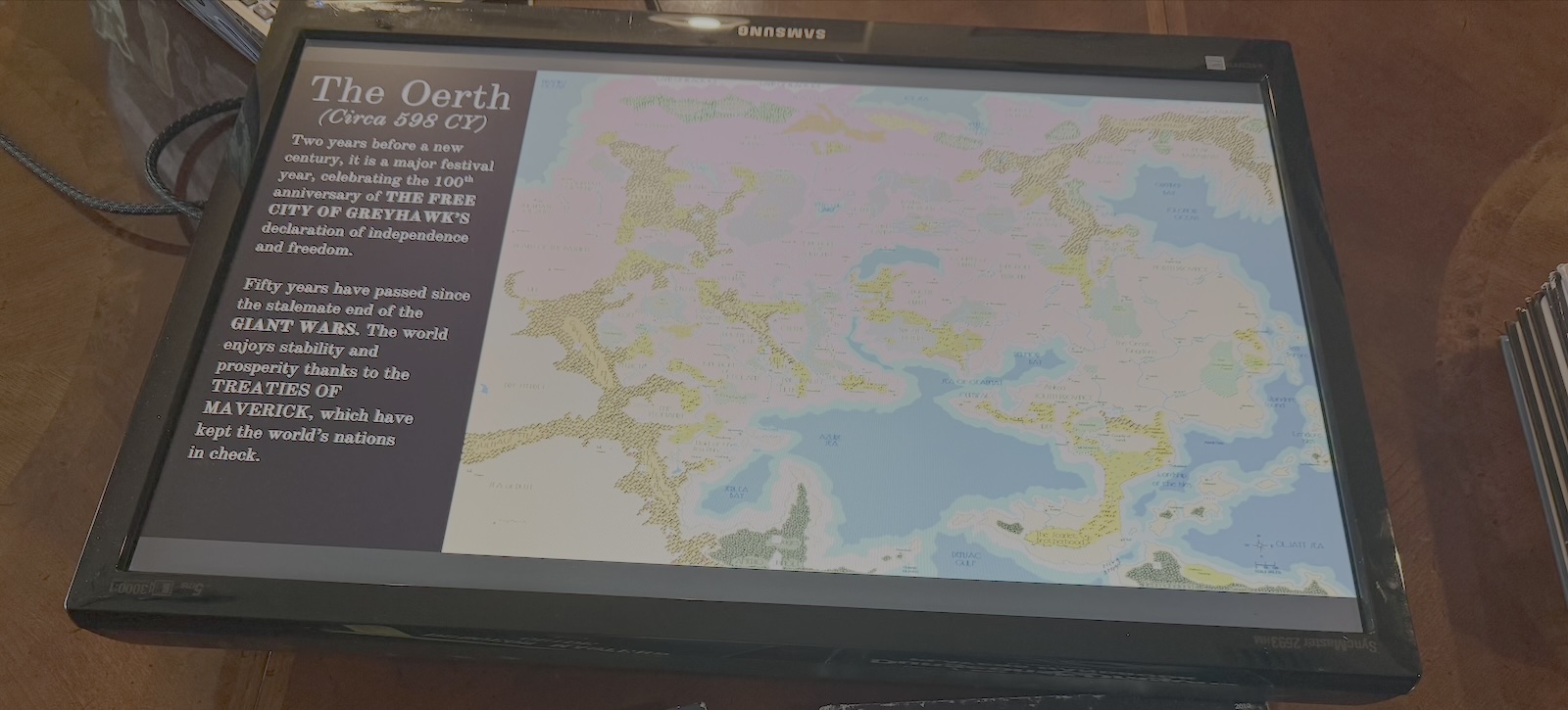
I wanted something that could display maps, but also provide visuals, and even play mood- and scene-setting music and video:
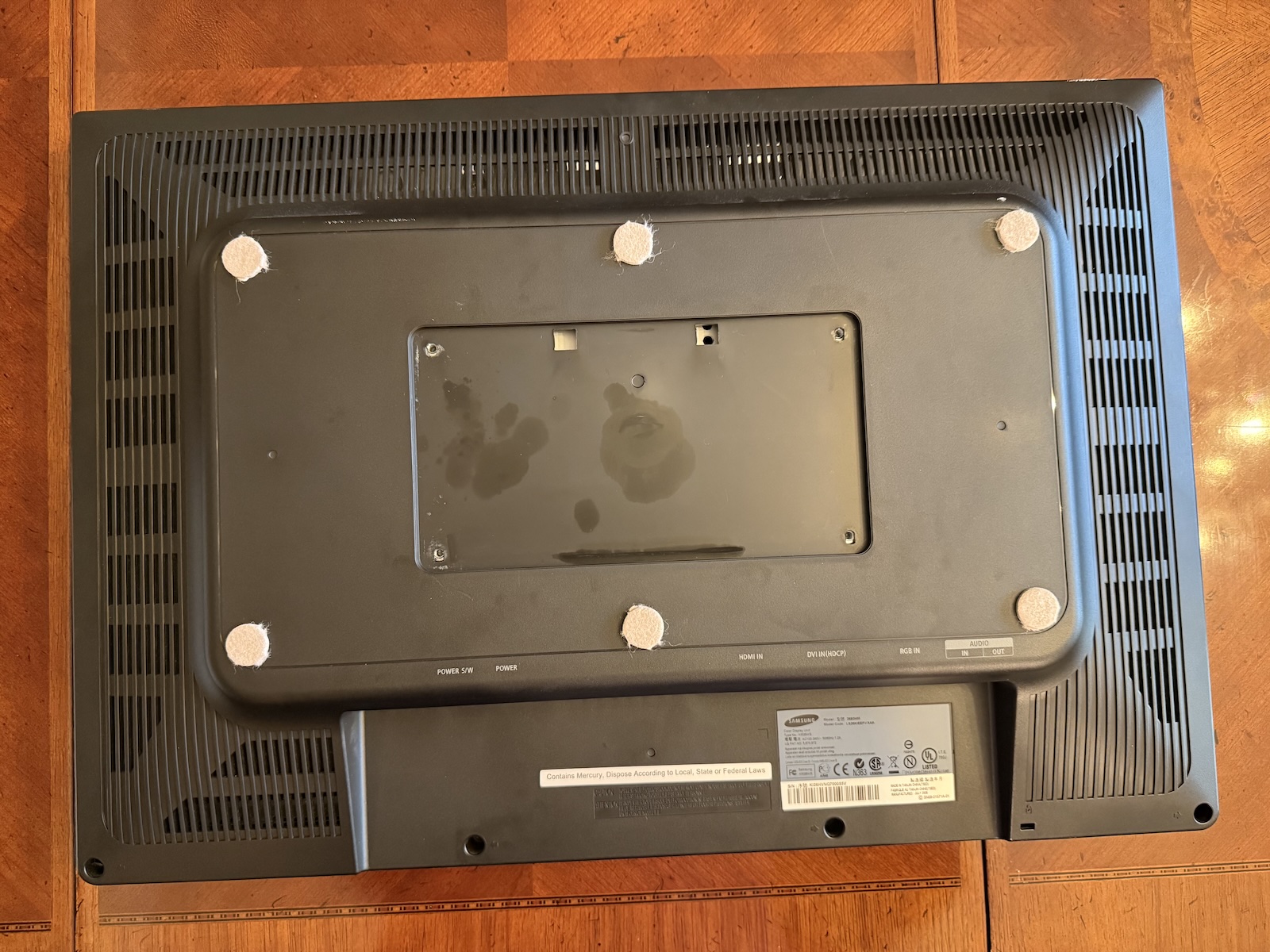
I used a monitor that I’ve owned since 2008 that I’d been saving for hobby audiovisual projects. I removed it from its stand so that it could lay flat, and I put some stick-on felt pads on its back so it wouldn’t scratch up the table:
There’s just enough room on the back of the monitor for me to attach a Raspberry Pi and turn it into a dedicated “smart tabletop,” but for the time being, I simply connected it to a laptop.
Here’s the monitor on our dining table to give you a sense of size and scale:
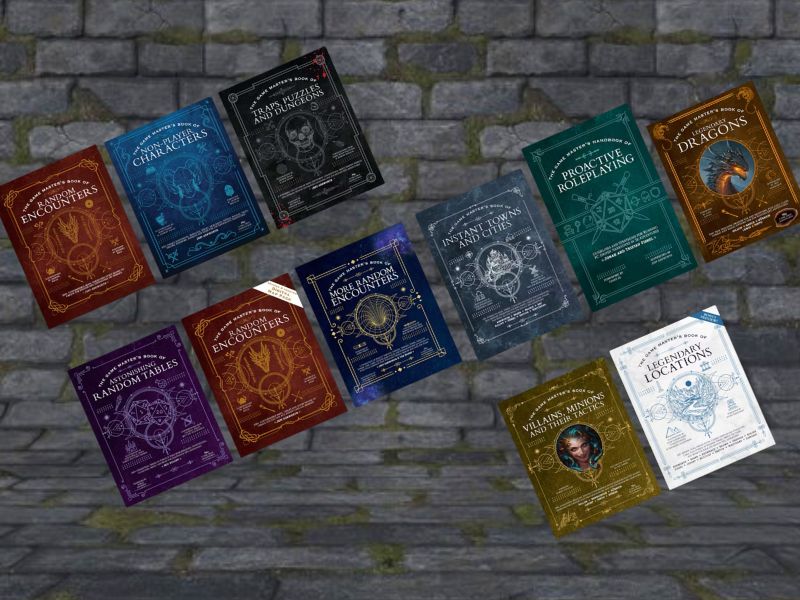
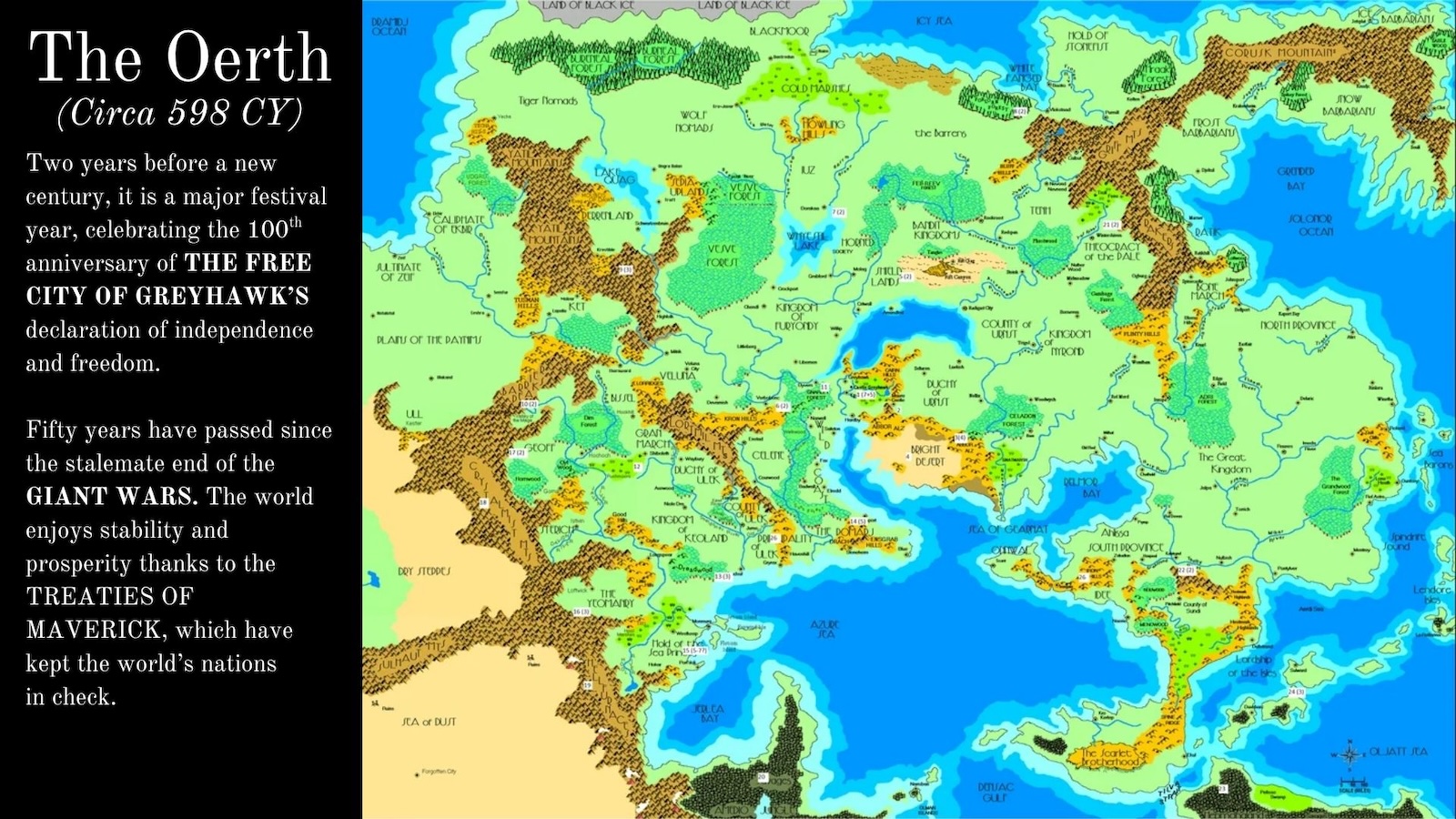
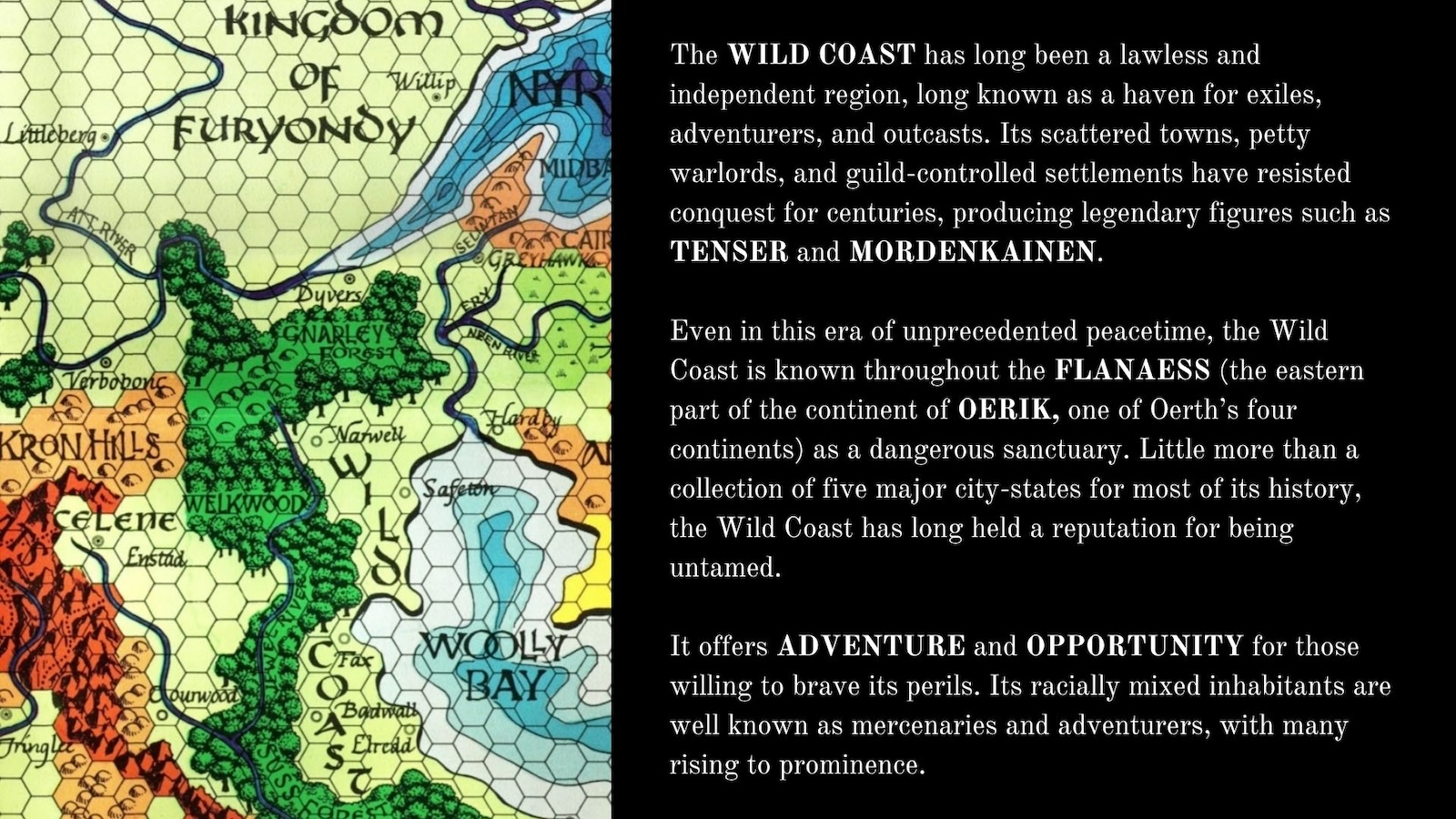
I created a whole set of maps, some taken from online sources, and some taken from the “Game Master’s Guide” series of books (on sale for $15 at Humble Bundle at the time of writing):
And I assembled them into a Canva project. During the game, I used Canva’s presentation mode to present an introduction to the gaming session:
This “slide” was actually video. It didn’t show more than the “Chaper 1” title and a camera panning across a foggy forest:
I originally thought about using a city from the old The Keep on the Borderlands “module” — a pre-scripted adventure that you can buy — but decided that in the age of AI and other technological wonders, I could do better.
First, I decided to take inspiration from the decade when I started playing D&D, the 1980s and adapt characters and ideas from that era.
The map generator
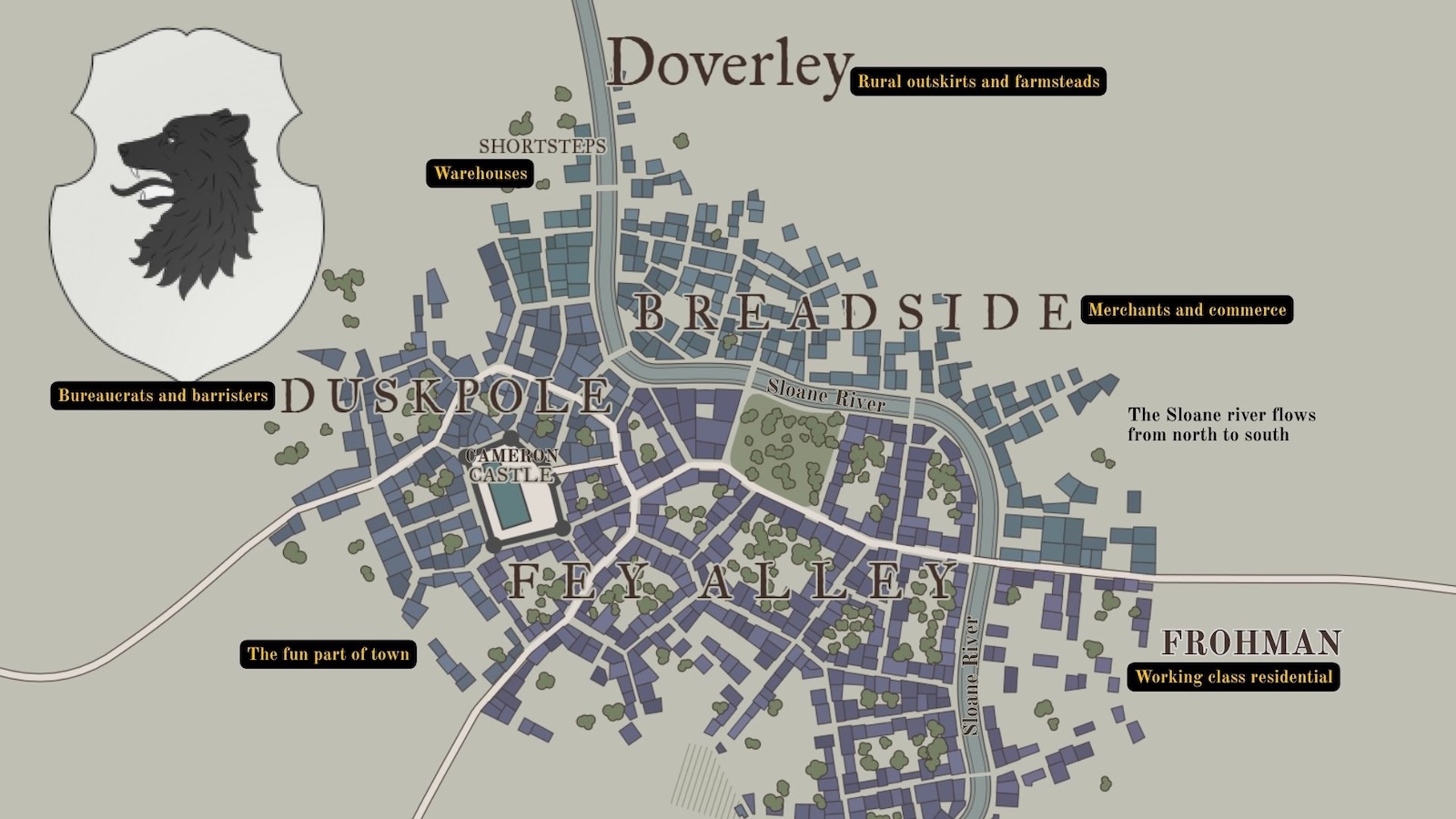
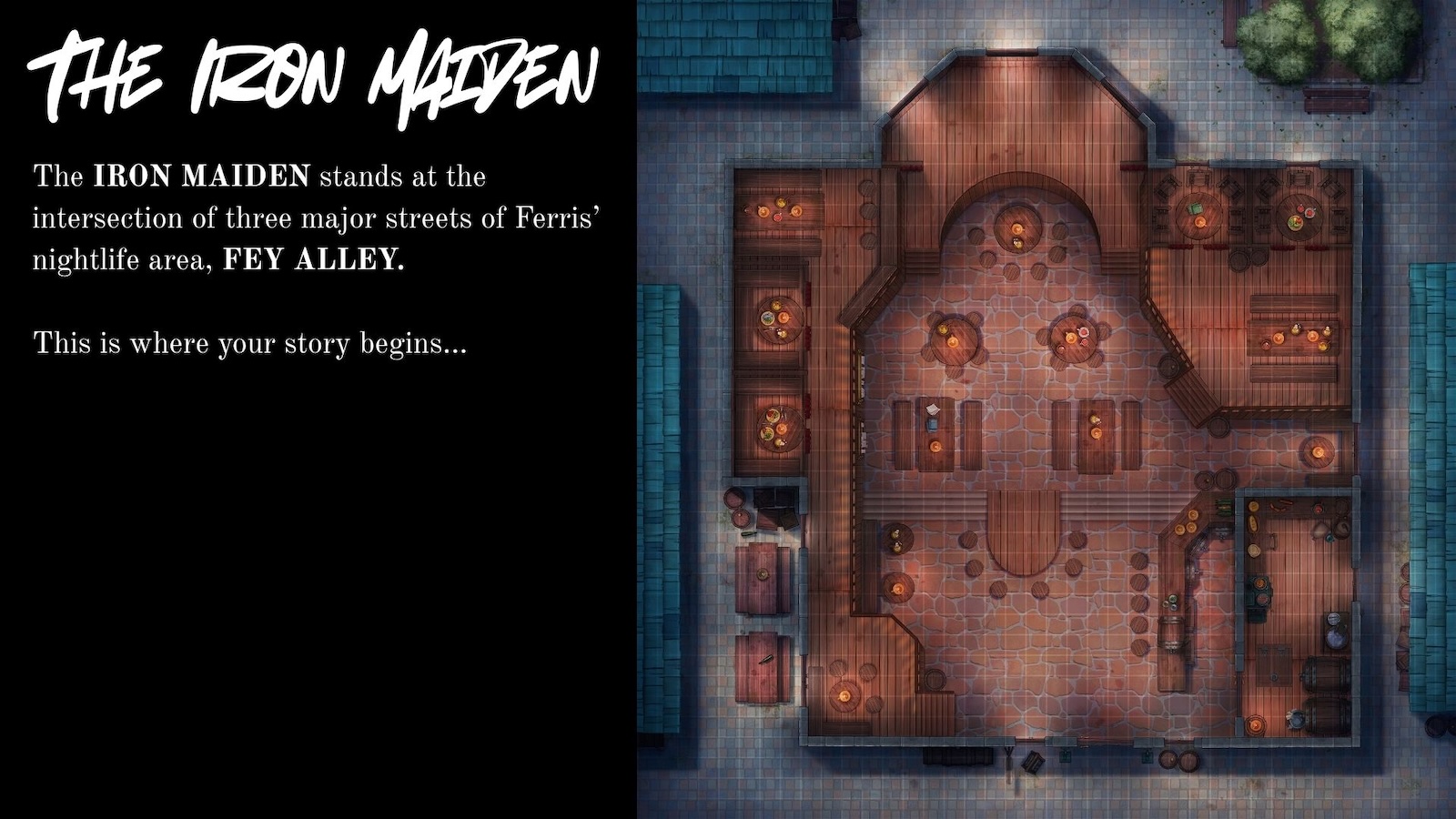
With that in mind, I created a starting point: the city of Ferris (as in Bueller). I went to the Medieval Fantasy City Generator site, where I was going to have it generate a city for me, but I was rather fond of one of their examples, so I simply used the example and added some additional text and labels to it:
My “dice”
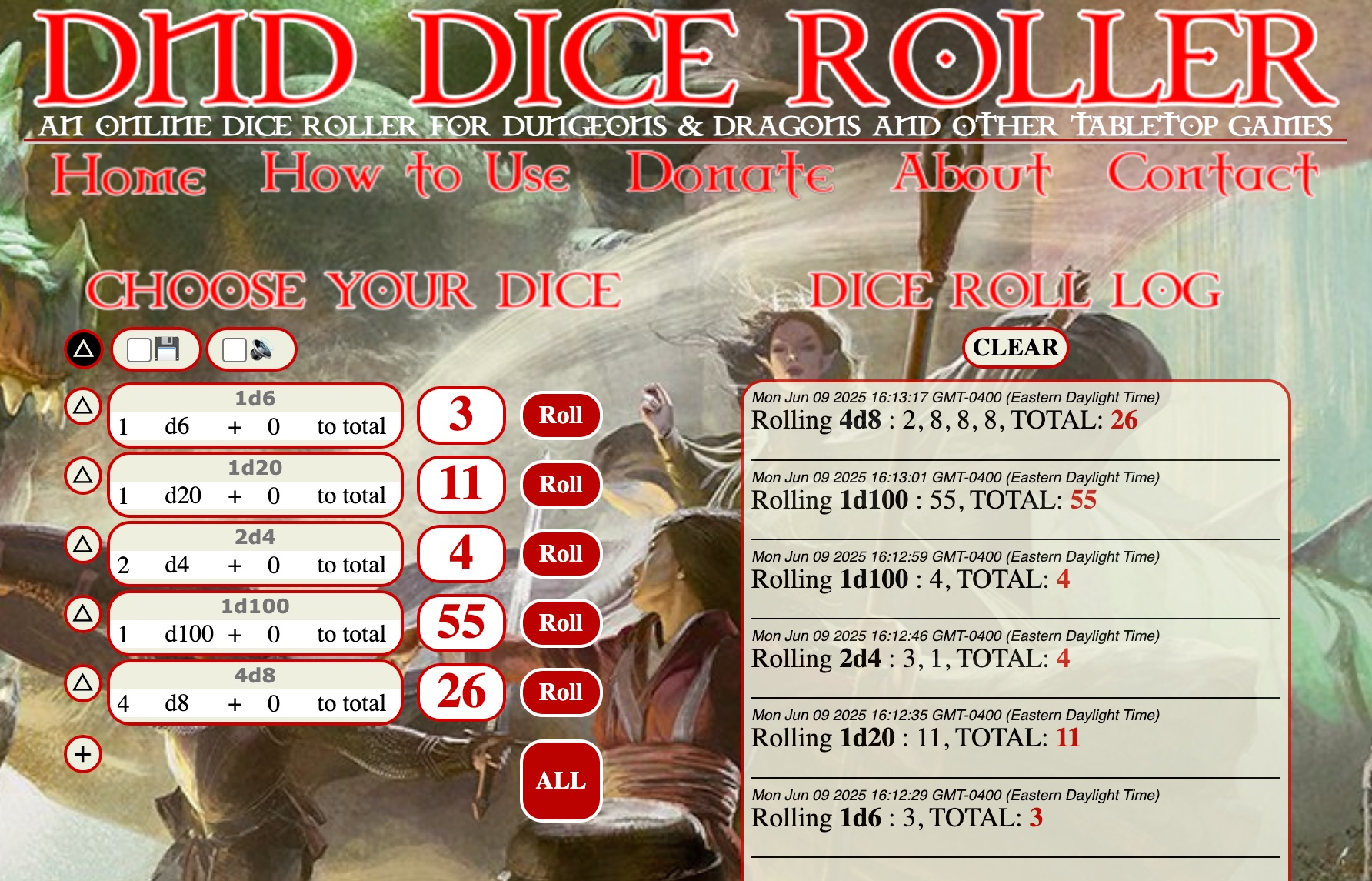
I don’t own any dice (Anitra does, but I don’t), so I used the DnD Dice Roller, which is very useful for DMs, since it keeps a log of all your rolls.
(Also, using it makes it very easy to do surreptitious die rolls that the players don’t know about!)
Claude and Canva
I then opened Claude, uploaded the map, and entered this prompt:
I’d like to use the city depicted in the attached map as the initial setting for the adventure. Can you come up with descriptions of the areas in the map that fit my “D&D 1980s homage” setting?
Claude, being a very good AI, processed the map and starting generating descriptions of each area. Here’s a sample:
FEY ALLEY (Central District)
The heart of the city’s entertainment and nightlife scene. This is where The Iron Maiden is located, along with other music venues, theaters, and upscale taverns. The district pulses with energy day and night – think neon-lit (magical crystal) signs, street performers, and the constant sound of music. The architecture mixes elegant older buildings with newer, flashier establishments. During the day it’s respectable; at night it transforms into the city’s party central where adventurers, artists, and risk-takers gather.
Key Features:
The Iron Maiden tavern and music venue
Several smaller clubs and performance halls
Magical “neon” lighting powered by enchanted crystals
Street art and graffiti that occasionally moves or changes
The Vinyl Vault – a shop selling recorded music on enchanted crystals
DUSKPOLE (Western District)
The city’s administrative and political quarter, housing government buildings, courts, and official residences. Named for the ornate streetlamps that create dramatic lighting at sunset. This district has a more formal, uptight atmosphere – lots of bureaucrats, lawyers, and minor nobles trying to look important. The buildings are impressive but conservative, representing established power.
Key Features:
City Hall and administrative offices
The Hall of Justice (courts and legal proceedings)
Government archives and records offices
Exclusive gentlemen’s clubs for the political elite
The Establishment – an ultra-conservative tavern that [one of my key NPCs] would never set foot in
I would start my players in a tavern in Fey Alley (Ferris’ entertainment district) called The Iron Maiden, which would be the D&D version of a club you’d go to see up-and-coming rock acts.
Here’s a portion of the prompt I used to flesh out TYhe Iron Maiden:
I need an opening scenario for my first-level party where they’re making their first steps as adventurers. I want to start with them at a tavern (of course) called The Iron Maiden, trying to see if there are any opportunities for adventure. I want them to be approached by someone recruiting for [Redacted].
This tavern should be the World of Greyhawk’s equivalent to the kind of bar where you’d see a combination of up-and-coming bands and general mayhem. Think of the club where the band Dragon Sound plays in the film Miami Connection.
For the main staff of the Iron Maiden, I need 3 characters, modeled after Jack, Chrissy, and Janet from Three’s Company. Jack is the bartender, and Chrissy and Janet are the waitstaff.
Here are the screens I used for The Iron Maiden:
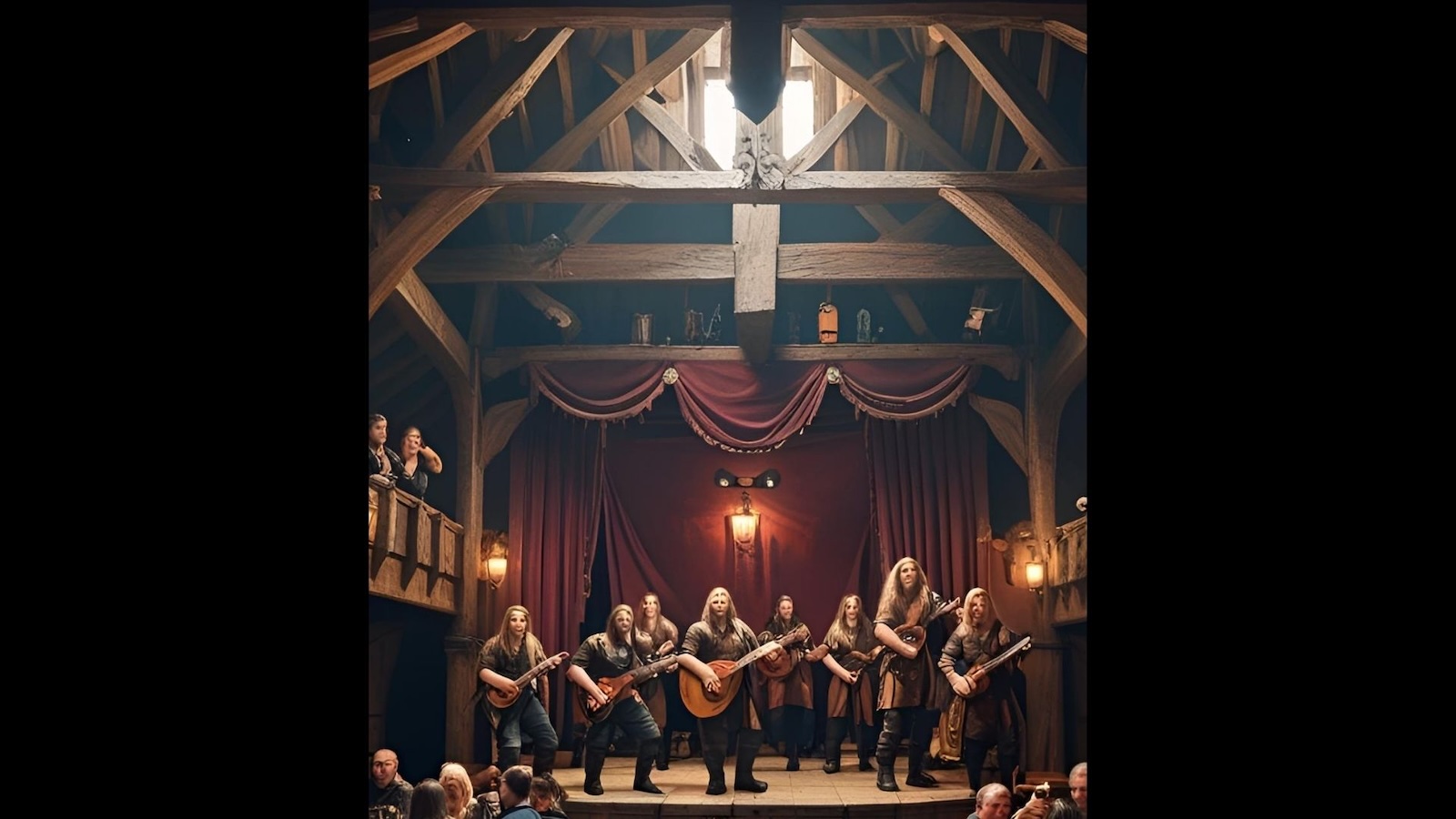
I used Canva’s AI feature to generate this image of a band playing a heavy metal-like style of music that’s new to the D&D world:
I used a combination of Claude (for fleshing out the character backstories and generating stas) and Canva AI (for generating images) to create characters such as the dealmaker…
…this mysterious individual…
…and an incredibly capable, if dysfunctional band of adventures modeled after Fleetwood Mac:
Here’s a portion of what Claude gave me in response to my prompts:
Mick is the steady foundation that keeps the group together despite their personal chaos. As the group’s founder and leader, he’s learned to navigate everyone’s explosive personalities while maintaining their professional reputation. He’s the diplomat, the mediator, and often the only thing preventing the group from imploding…
Stevie is the group’s mystical heart and soul. Her elven heritage gives her an otherworldly perspective, while her dual-class abilities make her incredibly versatile. She’s intuitive, mysterious, and has a tendency toward dramatic pronouncements that sometimes prove prophetic…
And no 1980s-themed adventure is complete with one Mr. William Broad, an up-and-coming bard…and maybe more:
I gave Claude plenty of prompt info, and I got a nice little backstory in return:
Born Wilhelm Broad in the Free City of Greyhawk, he was the son of a minor noble who expected him to follow a traditional path. Instead, he was drawn to the taverns and street corners where real music lived. He adopted the stage name “Billy Idle” after a particularly scathing review called his political ballads “the idle complaints of a spoiled brat.”
Billy spent years traveling the Flanaess, learning songs and stories from every culture. He’s performed in the courts of Furyondy, the taverns of Dyvers, and the underground clubs of the Free City. Along the way, he’s accumulated contacts, debts, favors, and a reputation as someone who knows everyone and everything.
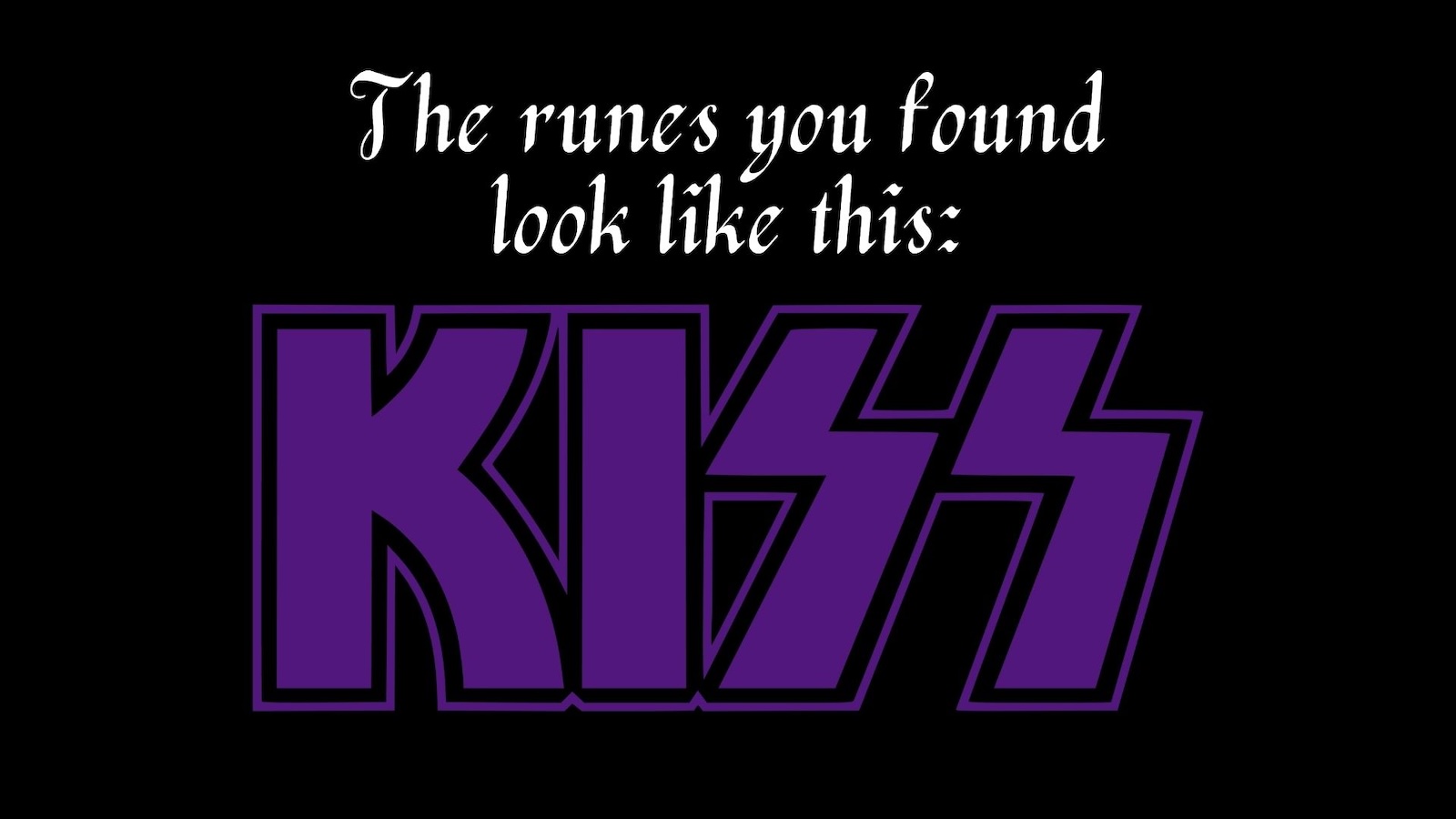
The players’ first hint about the campaign’s “Big Bad” were these runic markings:
Thanks to a couple of evenings’ worth of work with Claude, Canva, and the kind of imagination that thinks that walking around with an accordion is a good idea, I came up with all sorts of scenarios and encounters, all designed to push the story forward.
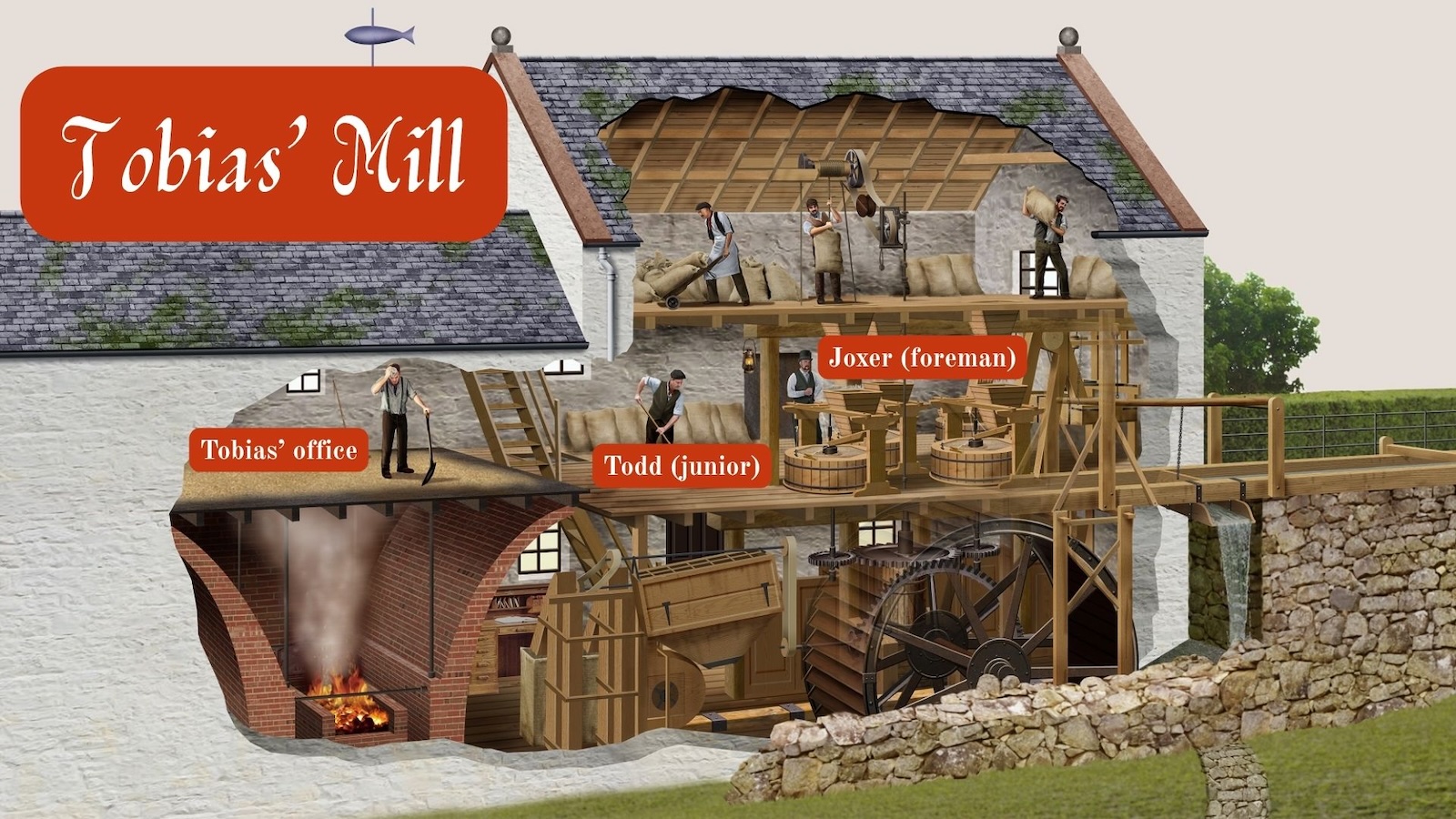
The players were sent to investigate a mill that was suddenly producing poisoned flour…
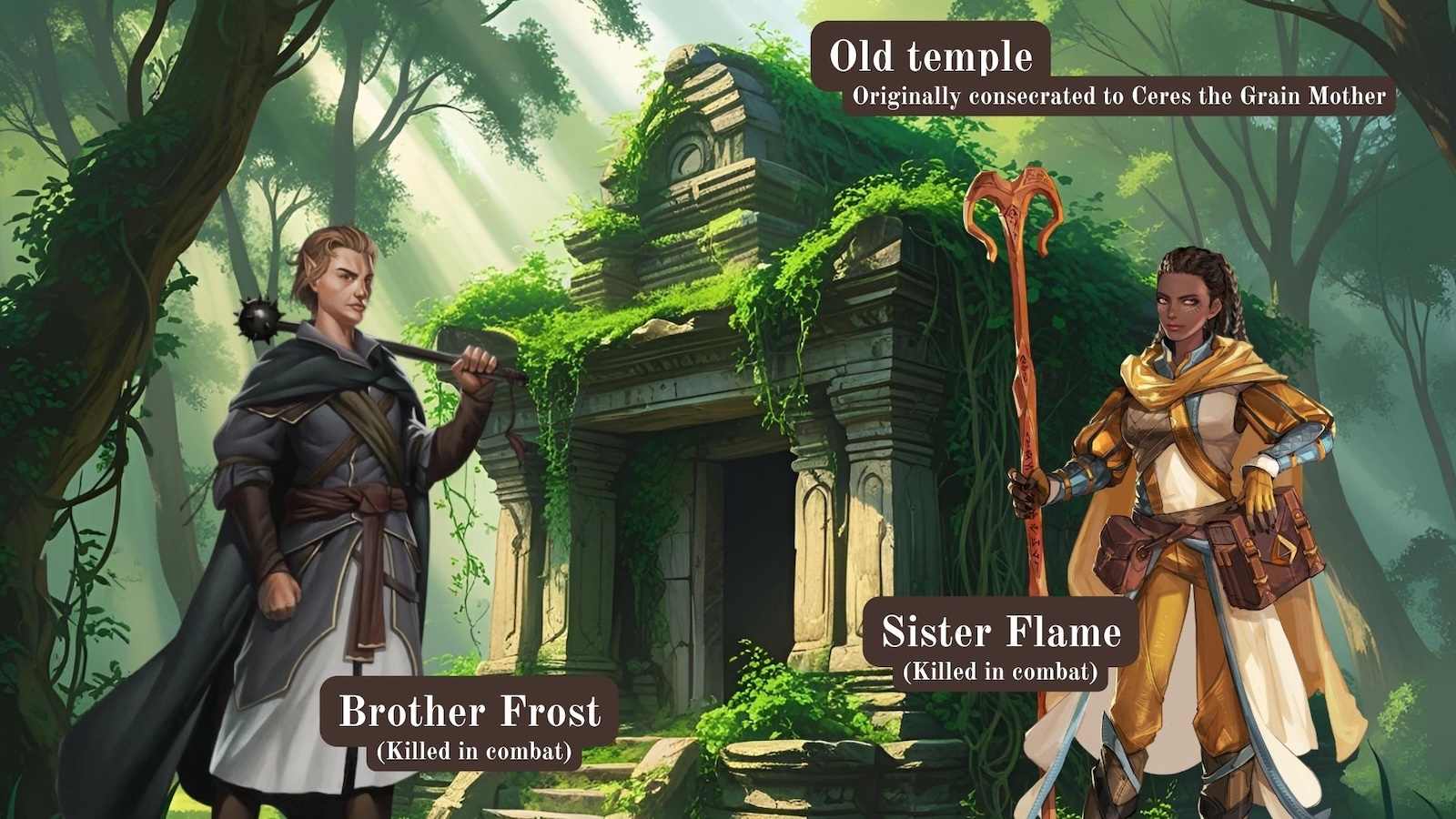
…which led them to an abandoned temple, where two religious cultists were casting a spell that could adulterate all food and kill vegetation and small animals in a three hundred yard radius:
When the players did something I didn’t expect and I needed to create a new setting in a hurry, I gave Claude some quick prompts and got what I needed.
For instance, when they decided to leave The Iron Maiden and find a more down-to-earth working-class pub, I fed Claude a prompt which included the following information.
Claude and I had been having an ongoing “conversation” about the city of Ferris, so it had enough context for the following prompt to work:
I need a working class-type pub located in Frohman right by the river.
Give it an appropriate name.
Use the cast of Cheers as a template for the people there. I need stats, too.
Also keep in mind that [redacted, because the players haven’t hit that point in the story yet]…
This is only a part of the description I got back, and all in about a half-minute of prompt typing and another half-minute of generation:
The Setting
The Rust & Ruin sits on Hammer Street, just three blocks east of the main bridge crossing the River Sloane. It’s perfectly positioned to catch workers heading home from the docks, warehouses, and workshops that line the river’s eastern bank. The building faces west, so workers can watch the sunset over the river through the windows while enjoying their after-work drink.
The Building
A solid, two-story stone and timber structure that’s clearly built to last rather than impress. The walls show honest wear from decades of use, and the slate roof bears patches from various repairs. The pub sign hangs from a wrought-iron bracket: a painted shield showing a hammer crossed with a tankard, both showing realistic rust and wear that somehow looks dignified rather than shabby.
Street Presence
Unlike the entertainment venues in Fey Alley, The Rust & Ruin doesn’t try to attract attention. The windows glow warmly at night, voices and laughter spill out onto the street, and the smell of hearty food draws in the hungry. A simple wooden bench sits outside for those who want to rest weary bones or enjoy a pipe in the evening air.
Practical Details:
Hitching posts for delivery wagons and work animals
Boot scraper by the door (and it gets used)
Rain barrel to wash dusty hands before entering
Simple but sturdy construction throughout
Afterward…
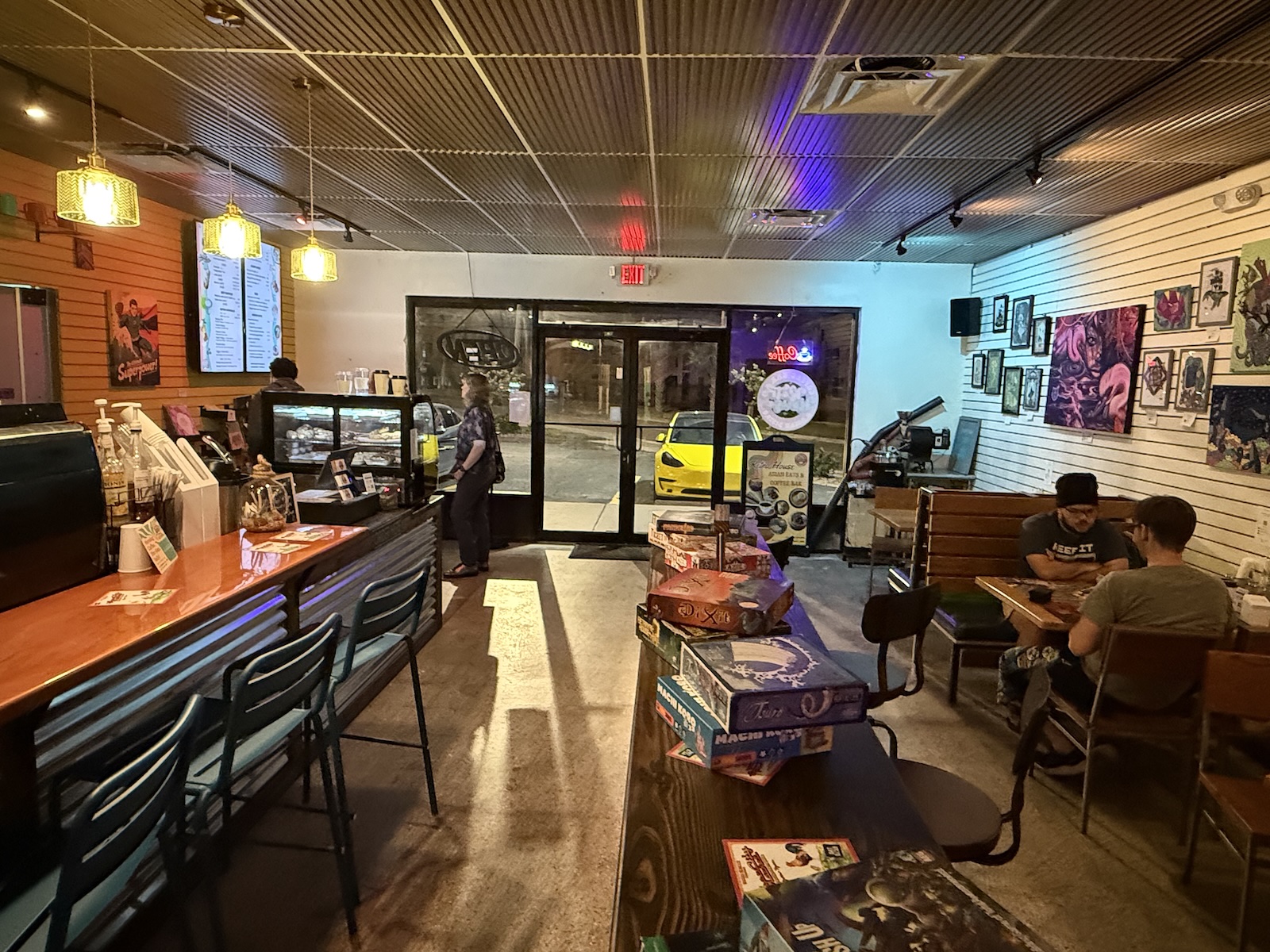
Our session lasted from 1:00 to 7:00 p.m., after which we went out to dinner at Retro House (very appropriate, since it was a retro-themed D&D campaign) for Chinese food…
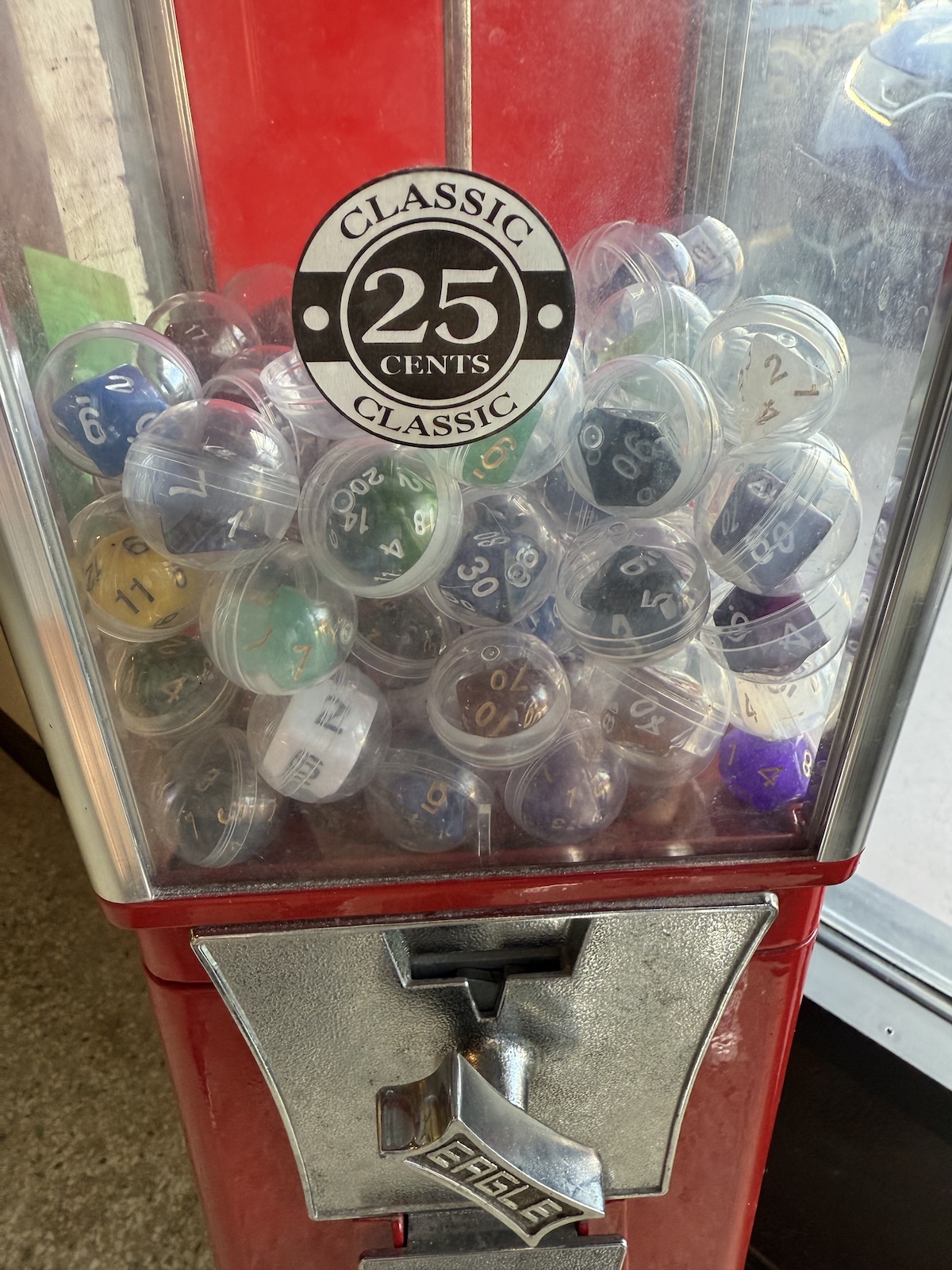
Retro House has a board game night every Wednesday, and that’s probably why they had this thing near their front door:
…a gumball machine that dispenses dice for a quarter! Anitra and I came back the next day with a large handful of quarters and got a nice haul.
And afterward…
It was Saturday night, so why go home when you can go to the Spookeasy Lounge…
…have a beer, and then go down to The Catacombs for some classic goth, alt-rock, and Prince tunes, and as one does in a place called “The Catacombs” when you’ve been Dungeon Mastering all afternoon…
All in all, a fun day for me (and hopefully the players, too!).
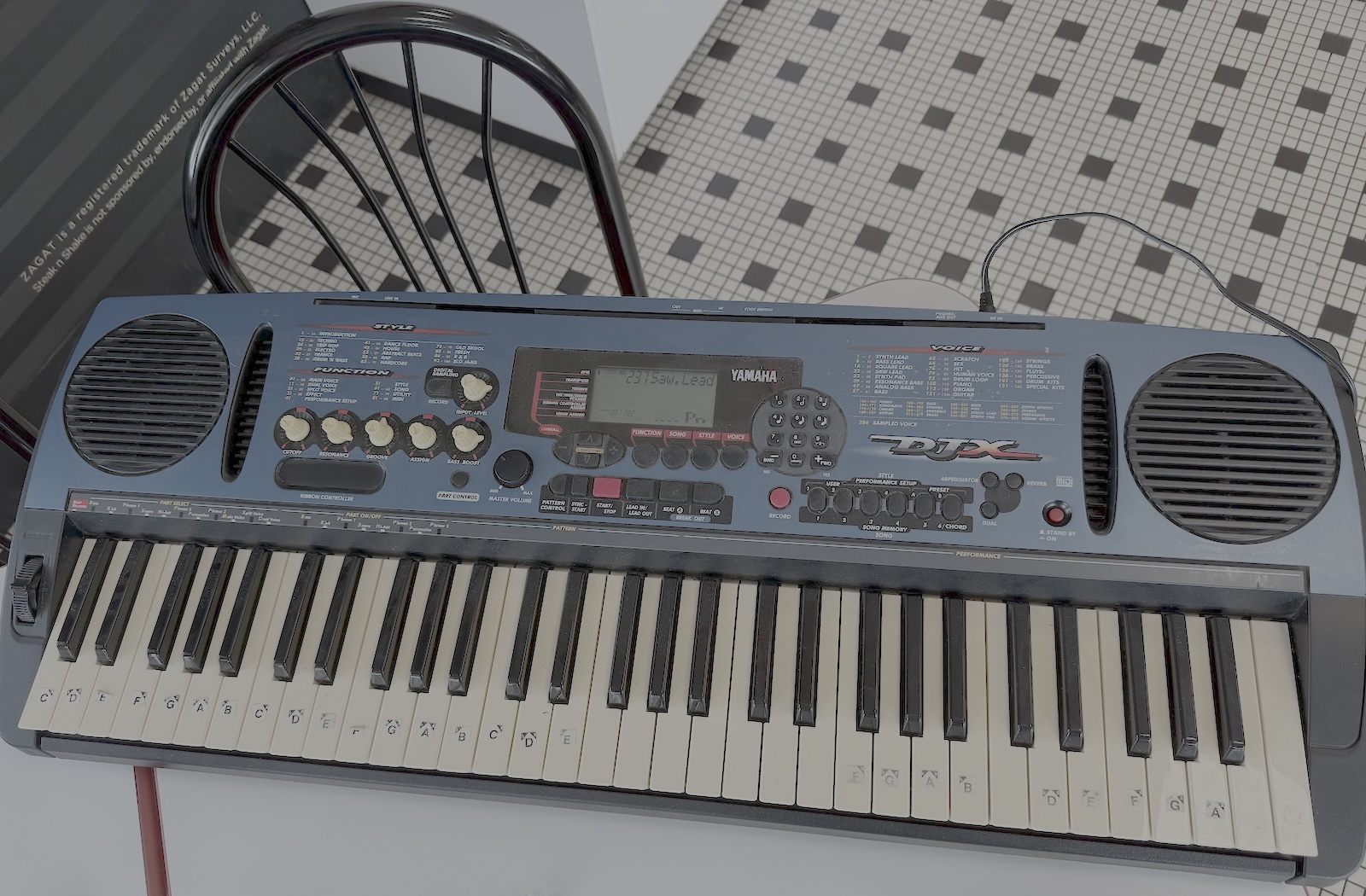
On Monday, I took time out of my day to drive a little out of my way to Valrico during rush hour to meet a stranger at a Steak ’n Shake to purchase a long-discontinued, hard-to-find keyboard: the Yamaha DJX.
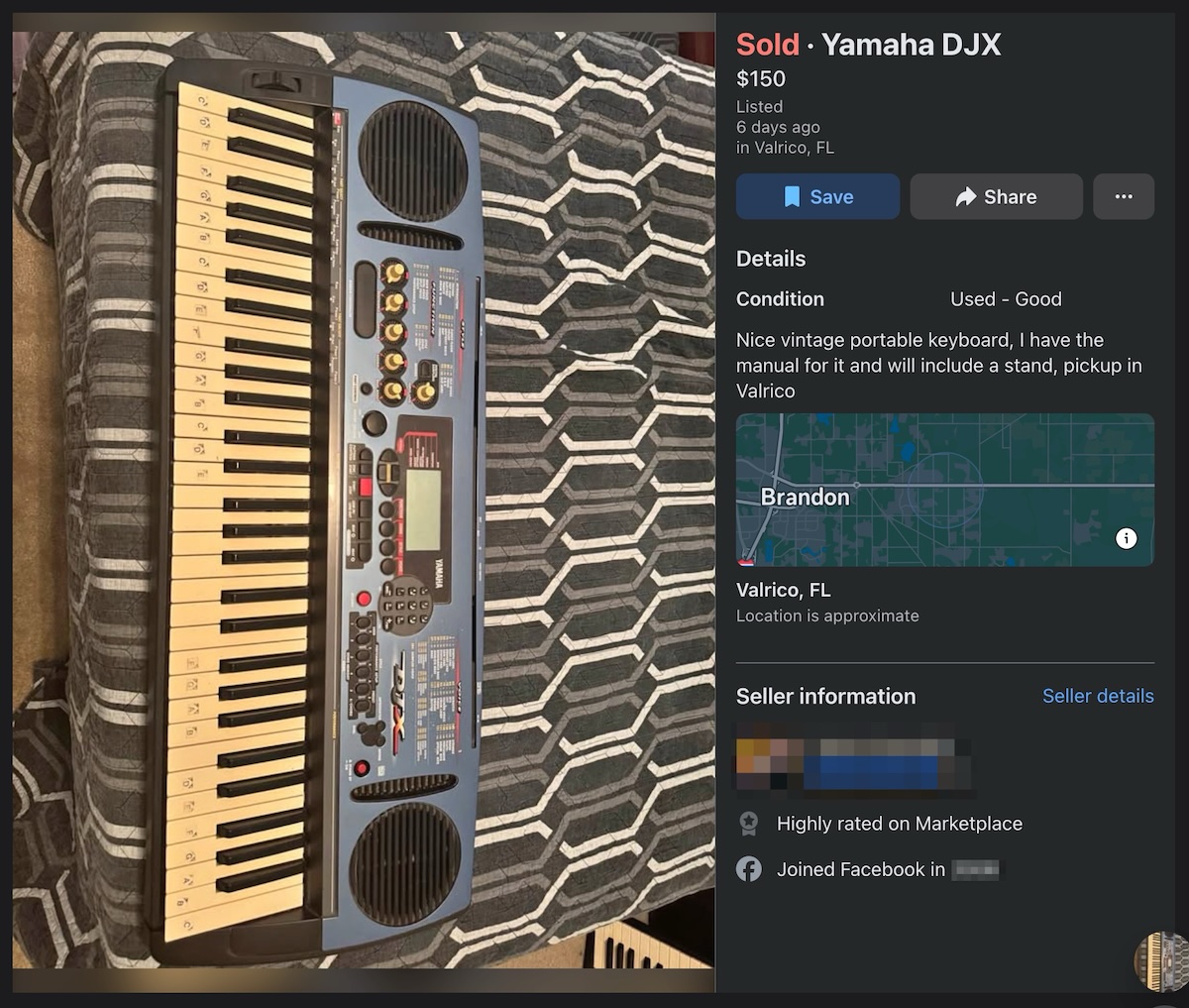
I like to peruse the Tampa Bay Facebook Marketplace for deals, and I’ve always wanted a DJX, so when I saw this ad…
The Facebook ad for the DJX.
…I had to contact the seller right away. They’re rare, and they generally sell for at least $100 more than the seller was asking.
Fortunately, this seller lived within a reasonable driving distance, and was more than happy to let me test the keyboard first. We met at a public location — the Steak ’n Shake in Valrico — which had a convenient outlet at one of its booths.
After “paying the rent” by buying a chocolate shake, we set the DJX on the table:
Aside from a few minor blemishes and scratches and a lot of dust buildup, it looked pretty good. Remember, this is a machine that’s been out of production for a quarter-century.
I fired it up, and I started playing. I pressed every key and fiddled with every button and knob and the pitch-bend and ribbon controllers. The volume control was a little noisy, but that’s something that can be fixed relatively easily. I auditioned a good number of its “patches” (synth slang for “instrument sounds”) and beats, and it sounded great.
Satisfied, I gave the seller $150 in cash and they left. I stayed at the Steak ’n Shake a little longer, to finish my shake and play with the DJX a little longer. There were pop tunes playing on the restaurant’s sound system, and I found myself playing along. There were only a couple of other people there, and they were looking in my direction trying to figure out what was going on.
I’ve since peeled the beginner stickers off the keyboard and given the DJX an initial cleaning — and I’ve also had a blast playing it! I expect to use it to create background music for my videos on the Global Nerdy YouTube channel, and hopefully for some live performances.
…a self-contained electronic or digital musical instrument for the production of live, loop-based electronic music with a high degree of user control facilitating improvisation.
Grooveboxes are generally used for creating electronic dance music, which rely heavily on a drumbeat. They’re also aimed at DJs, producers, and people who generally arrange music rather than play it. Because of this, most grooveboxes follow the design of drum machines.
Here’s a tutorial video that shows the basics of making a tune on a groovebox:
The device that defined the groovebox category was the Roland MC-303 Groovebox, which was released in 1996, right in the middle of the decade where all forms of dance music exploded:
Modern grooveboxes look like this:
As I mentioned earlier, grooveboxes are designed for people who are more arrangers who make music in the studio rather than actual players who make music live.
The DJX series of keyboards is a rarity in that they come with an actual piano-style keyboard that you can play on top of the beat. I regret not getting the DJX when it first came out, and had recently started keeping an eye out for a reasonably-priced used unit.
I’m going to record some videos showing what mine sounds like, but in the meantime, you can check out these videos, which show the styles that come built into the DJX. It’s an EDM/hip-hop machine!
What’s next?
I’ve given it a preliminary cleaning — including removing the beginner stickers from the keyboard and removing the glue residue with the ever-reliable Goo Gone — and it looks so much better. I need to give it a deeper cleaning (opening it up and vacuuming the dust bunnies from its internals) this weekend.
After the preliminary cleaning.
Aside from making music with the DJX, I’m also keeping an eye out for its even more rare little brother, the DJX 2…
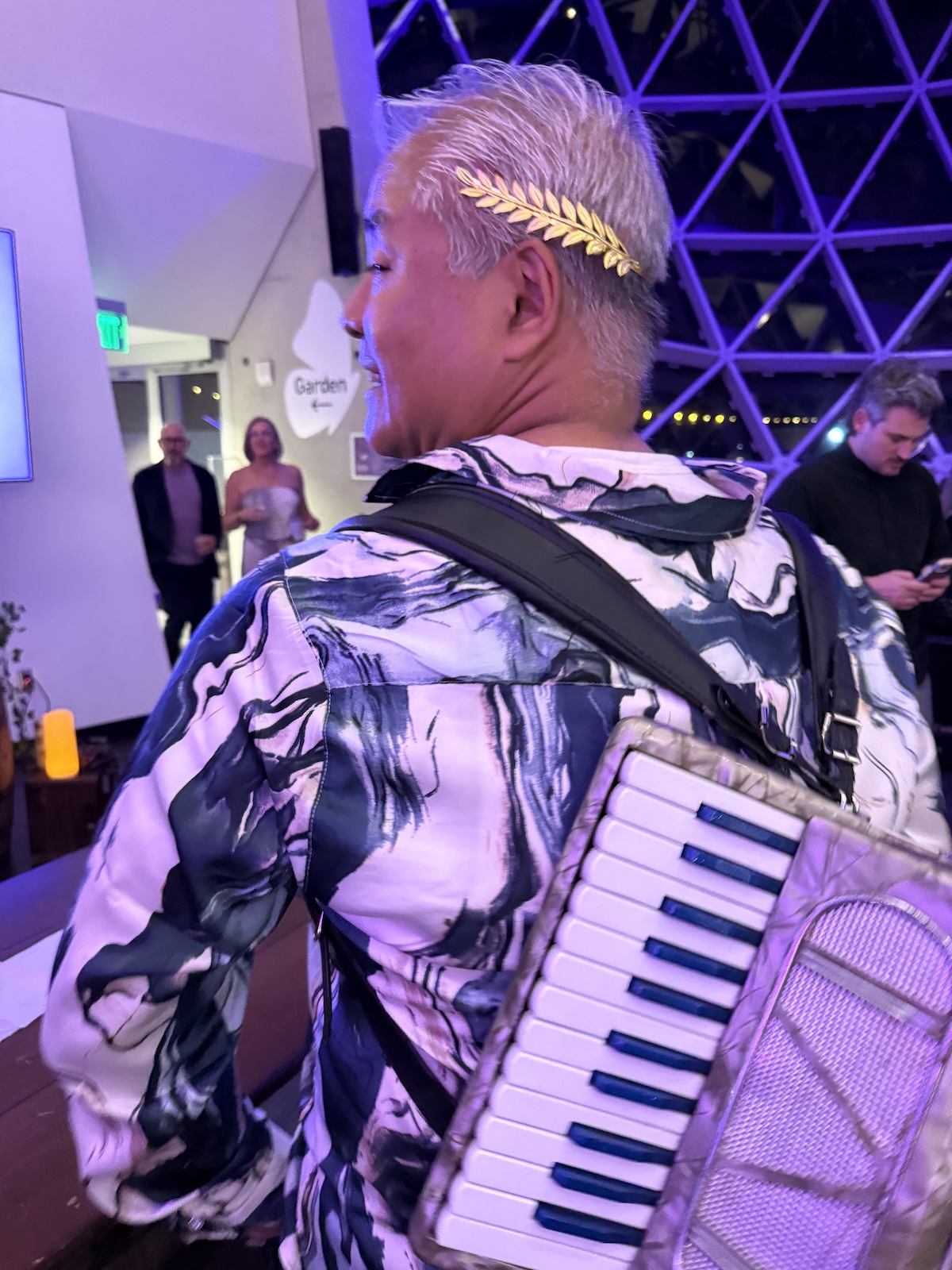
My favorite souvenir from Greece was also the cheapest: the gold-tone laurel wreath pictured above. They sell these at every cheesy tourist souvenir shop in Greece for a handful of Euro, but I’m going to get dozens of evenings of fun out of it.
Case in point: I wore it to the recent Vinos de Dali party at the Salvador Dali Museum a couple of weeks back, got lots of compliments and started more than a handful of conversations:
I think that Apollo, patron god of musical performance, would have approved.