
Category: Accordion, Instrument of the Gods
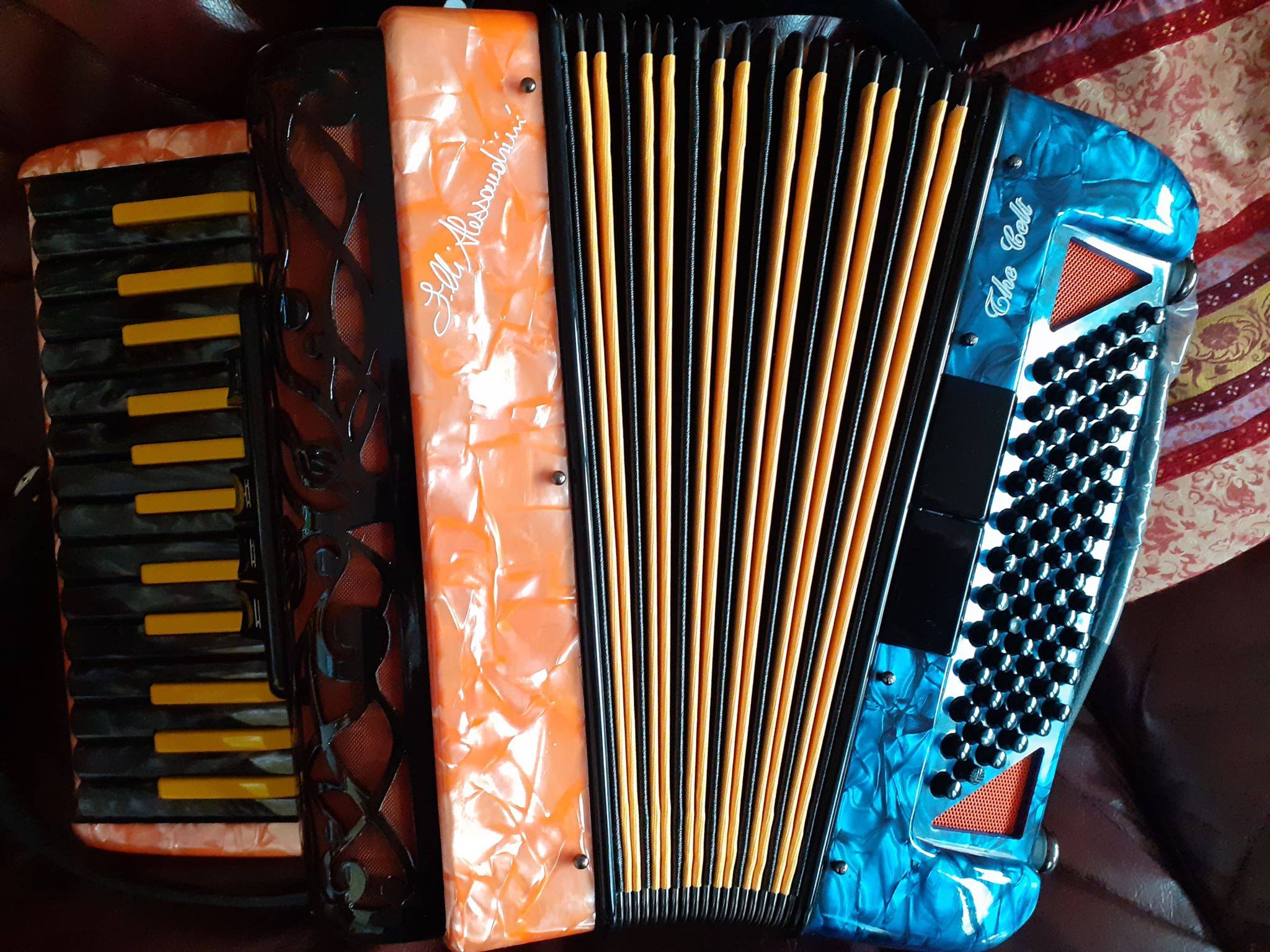
 The Squeezebox Shop (Scotland) posted this photo, and not only is it unconventional looking, but it’s in my favorite colors as well!
Not only is this a straightforward accordion, but it’s also rigged up with MIDI, so you can hook it up to synths, samplers, lighting boards, and anything else MIDI-equipped.


While reorganizing my files, I found these photos of me with the accordion in various situations and decided to post them here, just for fun.
The one above is from the karaoke competition at the 2015 edition of the GIANT Conference, a great UX conference in Charleston. I’m doing Young MC’s Bust a Move, and won an Apple TV as a result. I still have it, too!
The photo below is from a party held at Social Game Universe’s offices on Toronto’s King Street West when I found a unicorn mask and decided to try it on:

Here’s a couple of pictures from a 2004 meetup with technology journalists Amber Mac and Leo Laporte:


For a brief, shining moment, I was in an earlier version Lindi Ortega’s band:

These photos are from two DEF CON conferences, DEF CON 8 and DEF CON 9:


These final photos are from Year One of the accordion — the year when I first took the accordion out into the world, yielding some surprising results:


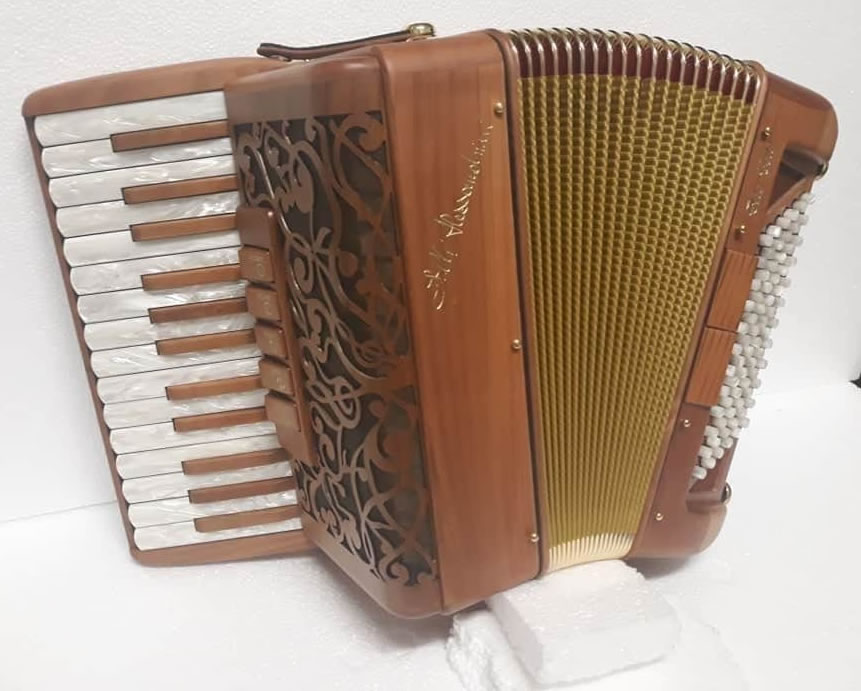
Every once in a while, someone asks me how expensive accordions can get, and what you get for shelling out a lot of money. Pictured above is an example: The Celt, an accordion with Irish Tuning (I have no idea what that means) made by Fratelli Alessandrini (“Alessandrini Brothers”).
Unlike less expensive accordions — the kind I own, perhaps save the one that my friend Sean Galbraith gave to me — the Alessandrini Celt doesn’t have any plastic parts. The mechanical bits are metal, of course, but that’s a straight-up wood body, wood keys, wood switches, and wood grille.
Not only is it a visually beautiful instrument, but it also sounds beautiful. Here’s a demo video by The Squeezebox Shop in Scotland:
If you’re on Facebook, you can also check out this video of Ross Little enjoying his newly-purchased Celt in the great outdoors.

And now, the price. For an accordion made with these materials and this kind of craftsmanship in small production runs, you can buy at The Squeezebox Shop for… £4,495.00. At today’s rates, that’s about $5,750 US.
I might wait until my LLC’s making a little more money before picking up one of these.
Recommended reading
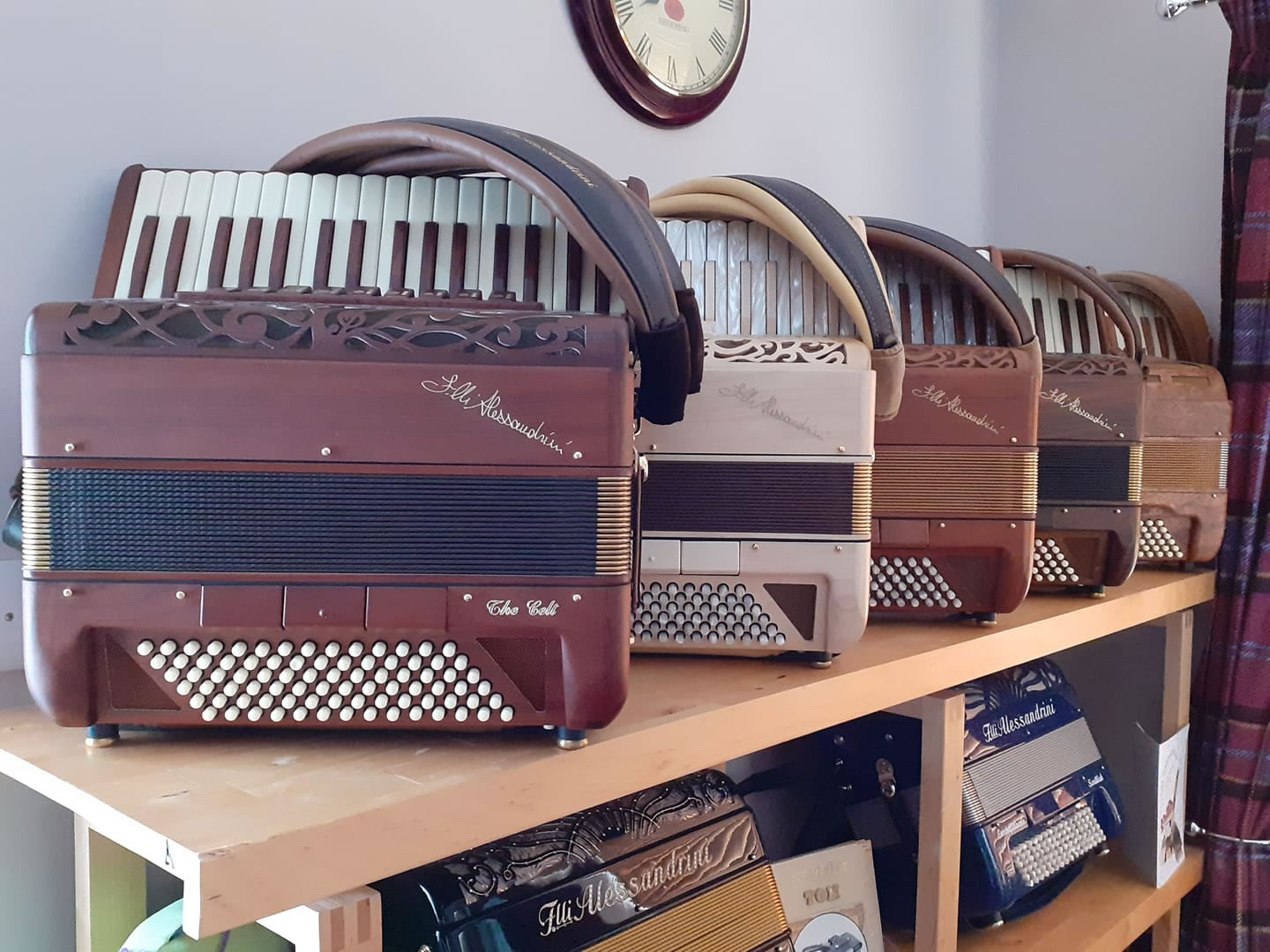
The Squeezebox Shop has a regularly updated Facebook page for all your accordion fetishizing needs.
Also, for those of you new to this blog: How I became the Accordion Guy.

I’ve had many great first weeks on the job, but this first week on the job had a particularly unfair advantage: I was working at b5media, and the timing was such that my first week on the job was the same week the company went to the South by Southwest Interactive Festival 2008 — that’s the one where Airbnb launched and got only two bookings.
I arrived on Day 1 of the festival and was going to spend a long time in the registration line, when some friends — Min Jung Kim and Rannie Turingan — who were on the “How to Kick Ass at Your First SxSW” panel heard I’d arrived. They somehow used their panel host powers to fast-track me through registration, bring me up to their panel (which was full of big names), and then play accordion for the audience.
That’s what the photo above shows. The best part? I’m literally upstaging Tim Ferriss.
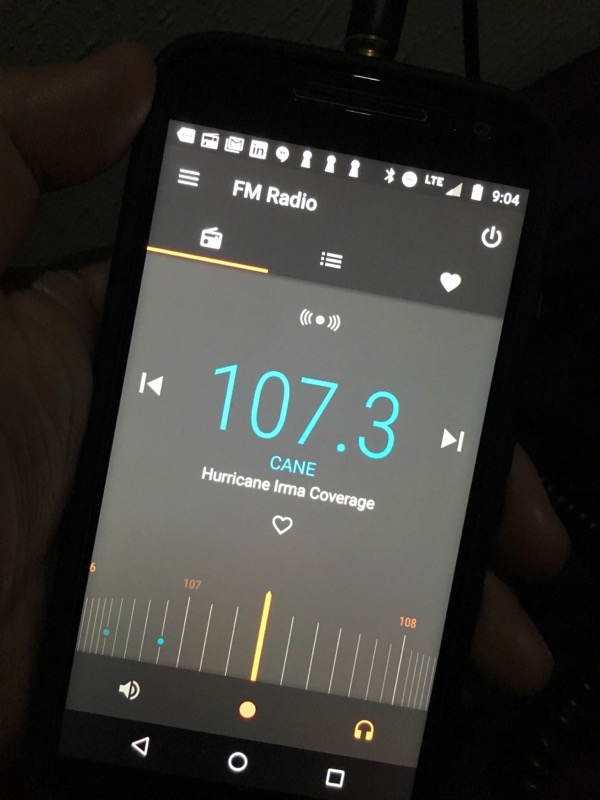
When Hurricane Irma closed in on the Tampa Bay area Sunday evening, the power went out at around 7:30, and soon afterward, cellular service became spotty and then disappeared entirely. However, we weren’t cut off from information about Irma because we fell back on a 1930s technology, FM radio, which is built into every smartphone, and accessible on many Android phones (including mine).

In the age of the smartphone, you might think your Android or iPhone can replace a radio receiver as a lifeline during a disaster. After all, while a radio receiver is audio-only and one-way, your smartphone can both send and receive text, audio, picture, video, and location information — but only if the cellular towers nearby are up and running. If the nearby tower is damaged, loses power, or gets overloaded, you’ll be cut off and left with the dreaded “No Service” indicator on your phone.
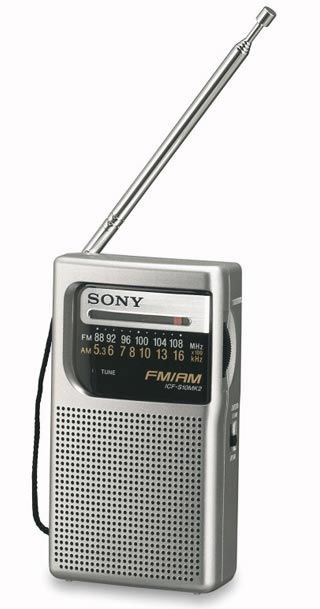
Consult just about any disaster preparation guide for a checklist of “must-haves”, and one of the items on that checklist will be a battery-powered radio. When phone and internet service fails, you can fall back on radio as long as you have batteries. (Better still, if you have a radio with a hand-crank generator, you don’t even need batteries.)
We have a nearly century-long tradition of radio stations providing vital information during disasters of all kinds. In the case of Irma, they did one better and teamed up with TV newsrooms. During the storm, many radio stations in the Tampa area teamed up with TV stations to provide continuous coverage of and information about the storm, such as where it was, how quickly and in which direction it was moving, and what to do. It was a valuable resource for many people, and it may have even saved a few lives.

You may think that you don’t own a portable FM radio, but chances are that you do. It’s just hidden away in your smartphone.
Just about every mobile phone maker — even the big ones who manufacture their own processor and graphics chips, such as Apple and Samsung — gets their cellular modem chipsets from a single manufacturer: Qualcomm. In fact, Qualcomm pretty much has a monopoly on these chipsets, which in addition to sending and receiving cellular signals, have an FM receiver baked in. You wouldn’t know it in the U.S., as fewer than half the smartphones have the FM receiver enabled, and they’re all Androids.

My Android phone is a Moto G4, and in addition to having an enabled FM receiver, it also comes “out of the box” with the FM Radio app, which simply provides a user interface for the FM radio capability. When the power went out in our part of Tampa on Sunday at around 7:30 p.m. and the cell service disappeared shortly after, I fired up the FM Radio app and we had updates on the storm’s progress all night long. In fact, I also used the phone’s FM radio and all day the next day — and there was still battery power to spare and the end. That’s because FM radio uses considerably less power than just about any smartphone function (and it uses no data at all!).
My iPhone doesn’t expose its FM radio capability, and it was useless as a source of updates until the cellular connectivity improved the next day, well after the storm had passed. I can’t say for certain, but I’ll just blame Apple designer Jony Ive, who’s never met a much-loved traditional feature that he didn’t like to remove. I get the feeling that FM radio is too distastefully old school to include as an iPhone capability, even though it’s already there.
While I experienced the usefulness of FM radio in smartphones during an emergency firsthand for the first time during Irma, it’s been clear to broadcasters and public safety officials — FEMA (the Federal Emergency Management Agency) included (see the video above) — that there are great benefits to unleashing this capability. The National Association of Broadcasters (NAB) has been lobbying to require the FM radio capability to be enabled in smartphones, and even Ajit Pai, chairman of the Federal Communications Commission (FCC) has been advocating for this (but he won’t go beyond advocacy). At an NAB event in February, he said:
“It seems odd that every day we hear about a new smartphone app that lets you do something innovative, yet these modern-day mobile miracles don’t enable a key function offered by a 1982 Sony Walkman.”
In Mexico, where there’s a strong radio culture (and a rise in non-commercial and community radio over the past decade), the Federal Telecommunications Institute (CIRT) approved a new rule in April requiring all smartphone manufacturers to enable the FM receiver. CIRT’s rationale was that in emergencies and disasters, having the FM capability would make it possible for people to get alerts and vital information when cellular networks failed. Mexico is the first country to pass such a law, and it’s hoped that other countries will follow suit.
Find out more

The go-to place for the movement to make the FM radio capability that’s already in our phones, waiting to be unleashed, is FreeRadioOnMyPhone.org. It has the latest info on the movement to enable FM radio on smartphones, including:
- How to get FM radio working on your Android phone
- How to contact Apple to ask them to enable FM radio listening on their phones
- How to contact the FCC and ask them to require FM radio be made available on phones
- The latest new about the movement
You may also find these articles of interest:
- Inside Radio: Emergencies Push FCC To Lobby For Smartphone FM
- Wired: Your phone has an FM chip. So why can’t you listen to the radio?
- NPR: The Hidden FM Radio Inside Your Pocket, And Why You Can’t Use It
- eMarketer: New Rules in Mexico Unlock FM Radio on Smartphones
- Recode: Trump’s FCC chief wants it to be easier to listen to free FM radio on your smartphone
- The Atlantic: Is that an FM radio in your pocket?
And finally, an article that needs to be pointed out because it’s dead wrong (and unsurprisingly, published by 2010-era Business Insider, from the time they were almost stealing content): Mandatory FM Radio: A Dumb Idea For Smart Phones, in which its clueless author says that it’s just a move to prop up the dying terrestrial radio industry.
As with other articles in this series, I’m including an appropriate music video:
Click here to see all articles tagged with “Hurricane Irma Report”.