Quebec’s Charter of Values, when viewed on the surface, seems to be about separating church and state, with rules such as the one preventing government employees from wearing “ostentatious” religious symbols at work. However, if you look at its supporters, it seems to be more about preserving the pur laine (literally, “pure wool”, the closest English analogue is “dyed in the wool”) aspect of French-Canadian culture: that is, people who are descended from the original settlers of New France, or at least those who can fake it convincingly.
According to the Quebec Charter FAQ, a satire Tumblr, Quebec’s Charter of Values will unify the people of Quebec by doing the following:

From the Quebec Charter of Values Tumblr. Click to see the source.
We’ve seen hints of it in the case where a kid in Quebec with a turban was forbidden from playing soccer, and this “wonderfully enlightened” statement made by retired professor Claire Simard at a recent rally in support of the Charter:
“I would rather die than be treated by a woman wearing a full-face veil in an ER.”
By the way, Professor Simard — did you know what people wear in ERs? Face and hair coverings like this:

I know, I know, it’s about “trying to create a secular society”, right?
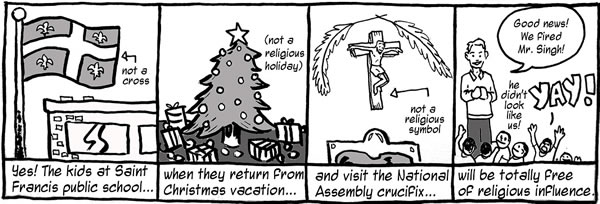
From the Quebec Charter of Values Tumblr. Click to see the source.
No, it’s not. It’s just not-so-secret code for “fit in or else”, or “separatism’s back, in 21st-Century form”. It may be coincidence that the French word for “charter” — charte — is pronounced roughly the same as the English slang word “shart”, but it’s very fitting.
Thanks to Ahmad Nassri, through whom I found out about the Quebec Charter of Values Tumblr.


 BarCamp is an “unconference”, which means that it’s a gathering that looks like a conference to the casual observer, but actually turns some of the basics of a conference upside-down. For starters, there’s no agenda until the morning of BarCamp. At the very start of the day, the agenda is blank, and it’s up to attendees who want to do a presentation to fill it. By filling in a spot on the agenda, you claim a room and a time slot. Non-presenting attendees can look at the schedule and choose which sessions they want to attend, and they are encourage to actively participate in the session, with questions, comments and points of information. Many presenters come in with a prepared topic and presentation, but impromptu ondes are welcome, and some of the best BarCamp presentations I’ve seen have been off-the-cuff, freewheeling discussions fuelled by the presenter’s knowledge and passion. As the BarCamp Tampa folks say on their site, “the day is what you make it, by choosing presentations to attend and deciding whether or not to present a topic.”
 BarCamp topics are all over the map, but they’re usually of interest to people with an interest in technology, the internet, and community. If you’re a designers, developer, marketer, copy writers, SEO specialist, sysadmins or run a business with a web presence, you’re likely to find something of interest to you.
 I’ll let the site do the talking here: “Barcamp is a community event, both in participation and in funding. It is made possible by the time and money donated by the crew of people running the event, the attendees and companies that support us. Thank you to all of you! Each year we have some fantastic companies that sponsor by donating time, money, facilities and supplies for the day. We’re also very lucky to get great support from attendees making donations in order to attend. We hope that everyone takes the time to check out the companies and people that support us!”