My guess is that the folks at Ponies “R” Us originally had a sign that simply said “Rides $4 each”, and that the customers kept saying things like “I don’t have the time to do complex math, Einstein! Just tell me how much for five rides!”
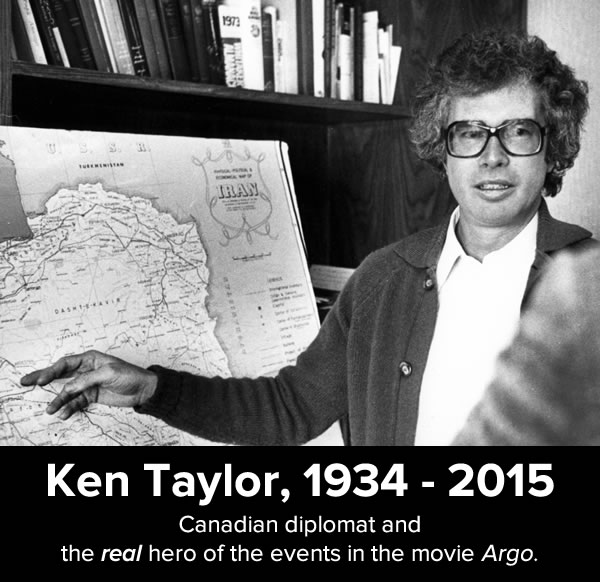
One of the events of the Iranian Revolution of 1979 was the storming of the US embassy in Iran by students and the taking of the people within as hostages. Six Americans managed to escape in the confusion and managed to stay hidden for four days until they made their way to the Canadian embassy. There, they met Ken Taylor, then the Canadian ambassador to Iran, who worked out a way to safely exfiltrate them from Iran, an event that would later be known as “The Canadian Caper”.
Taylor and Canadian immigration officer John Sheardown, at great personal risk, took the six Americans into their private residences and came up with a plan to sneak them out of the country with Canadian passports, which also contained forged Iranian visas created by the CIA. They also received assistance from CIA disguise and exfiltration expert Tony Mendez, who came up with the cover story of filming a science fiction film, which the Canadians criticized as too “Hollywood”, “cowboy”, and over-the-top. “Whether they were purported to be petroleum engineers, nutritionists, agronomists — instead of film-makers — probably didn’t much matter,” Taylor said. This became the basis of Ben Affleck’s 2012 film Argo (in which Taylor’s and Canada’s roles were criminally downplayed).
Taylor ran the operation expertly, sending his embassy’s staff on fake errands to establish erratic patterns to fool Iranian operatives and to observe airport procedures, and coordinating the operation with Canadian and American leaders and intelligence. Even his staff were sharp: one of them caught a mistake made by the CIA in the fake visas they provided: they didn’t account for the fact that the Iranian year begins on the first day of spring, but an eagle-eyed member of Taylor’s team caught the mistake and fixed it before it became a problem.
On Sunday, January 27, 1980, the Americans boarded Swissair flight 363 bound for Zurich with their Canadian passports and flew to safety. I remember seeing stories of the Canadian flag flying across the US, along with “Thank You” billboards.
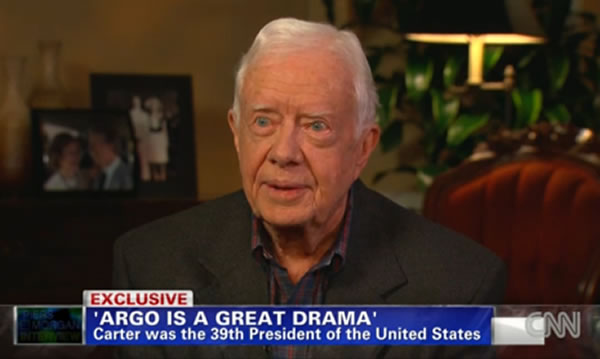
90% of the contributions to the ideas and the consummation of the plan was Canadian. And the movie gives almost full credit to the American CIA. And with that exception, the movie is very good. But Ben Affleck’s character in the film was… only in Tehran a day and a half. And the main hero, in my opinion, was Ken Taylor, who was the Canadian ambassador who orchestrated the entire process.
Taylor died yesterday. He was diagnosed with colon concern August, but his son told CBC news that he “took full advantage of the time he had left.”
US Ambassador to Canada Bruce Heyman posted these on Twitter:
Deepest condolences to family of Canadian former Ambassador Ken Taylor, who died today.
If you’d like to know more about the true story of the events of the Canadian Caper, toss aside that copy of Argo and watch Our Man in Tehran instead. Not only does it tell the true story of how the Canadians rescued the Americans, but a lot of things about the situation leading the Iranian Revolution.
Here’s the trailer for Our Man in Tehran:
…and here’s the full film, which someone’s posted on YouTube, for however long it stays up there:
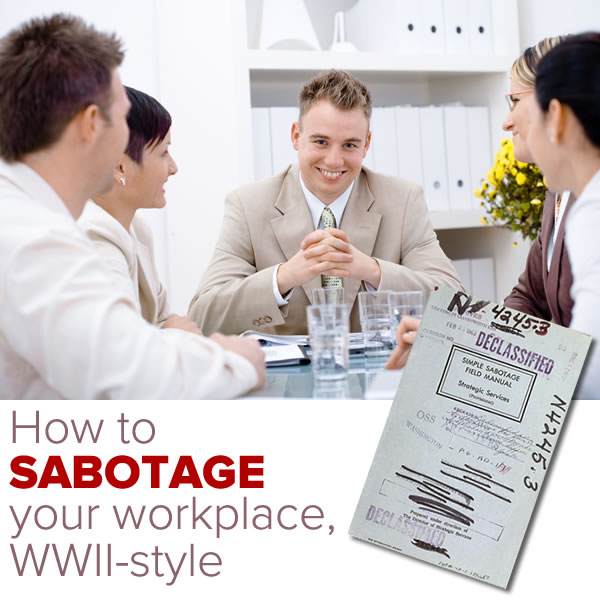
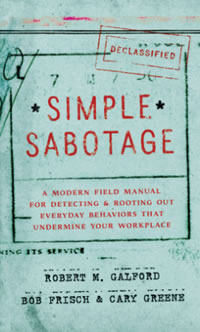
In 1944, back during World War II, the OSS, short for the Office of Strategic Services — the organization that would eventually be replaced by the CIA — published the Simple Sabotage Field Manual, a “Sabotage for Dummies” guide filled with handy tips for resistance members in Europe.
In its 32 pages, it lists a number of acts that could be carried out by ordinary people who want to mess with the Nazis and who aren’t even part of the resistance. The tips listed in the book have the goals of both hindering the Nazis’ ability to wage war and minimizing the risk to the saboteur, who would most likely be a civilian.
You’re not likely to see the acts of physical sabotage listed in this book in your day-to-day life, but you probably see people using the book’s suggestions for organizational sabotage every day at work. What a 1944 book listed as tactics to sabotage an organization are normal behavior for many managers in 2015:
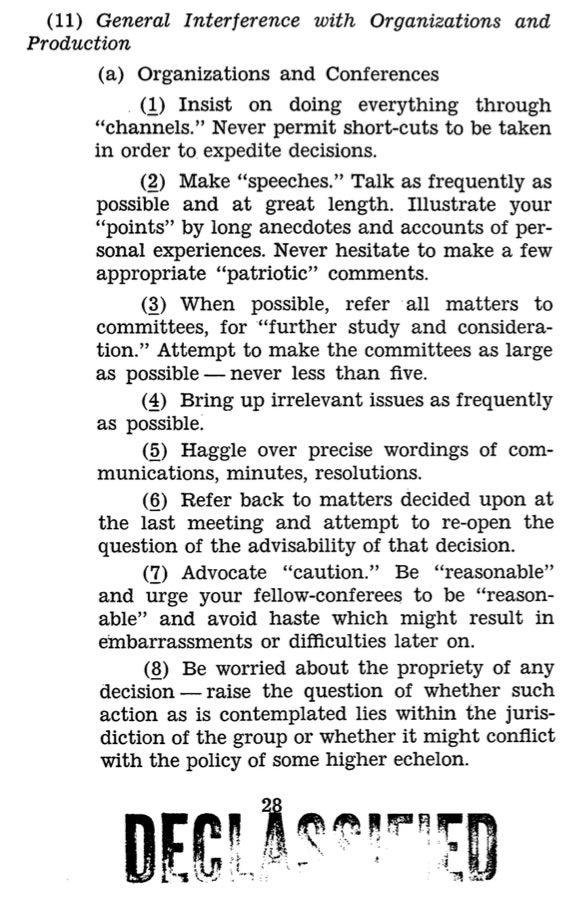
Page 28 of the OSS’ Simple Sabotage Field Manual. Click the image to see it at full size.
Here’s the text from that page:
(1) Insist on doing everything through “channels.” Never permit short-cuts to be taken in order to expedite decisions.
(2) Make “speeches.” Talk as frequently as possible and at great length. Illustrate your “points” by long anecdotes and accounts of per sonal experiences. Never hesitate to make a few appropriate “patriotic” comments.
(3) When possible, refer all matters to committees, for “further study and consideration.” Attempt to make the committees as large as possible — never less than five.
(4) Bring up irrelevant issues as frequently as possible.
(5) Haggle over precise wordings of com munications, minutes, resolutions.
(6) Refer back to matters decided upon at the last meeting and attempt to re-open the question of the advisability of that decision.
(7) Advocate “caution.” Be “reasonable” and urge your fellow-conferees to be “reasonable” and avoid haste which might result in embarrassments or difficulties later on.
(8) Be worried about the propriety of any decision — raise the question of whether such action as is contemplated lies within the jurisdiction of the group or whether it might conflict with the policy of some higher echelon.
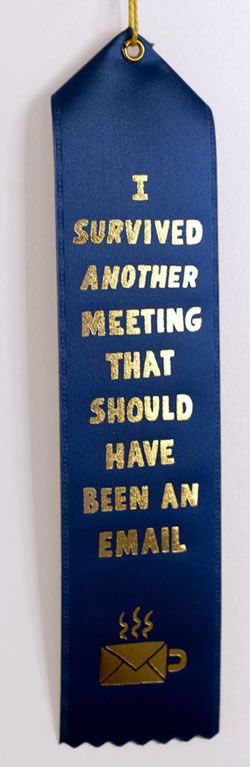
The Simple Sabotage Field Manual has more tips for killing productivity, including my “favorite” pro-tip for managers, “Hold conferences when there is more critical work to be done.” If this trick didn’t work, there’d be no market for an entire line of products with the message “I survived another meeting that should have been an email.”
Email didn’t exist in the 1940s, but carbon copy abuse did. One of the tips in the Simple Sabotage Field Manual was:
In making carbon copies, make one too few, so that an extra copying job will have to be done.
For you younger folks, carbon copying was a method of producing multiple copied of a typed letter in the days before photocopiers, never mind computers. This video shows how it was done (as well as why you should be thankful that we don’t live in the dark ages anymore):
Today, carbon copies live have their descendant: the cc: field of emails; “cc” is short for “carbon copy”. And instead of making too few copies, the internet-era version is to send emails that are cc’d to as many people as possible. In its more innocent form, the sender is just trying to be inclusive, but is likely filling other people’s inboxes with messages that don’t necessarily apply to them. In its nastier version, it’s a way to snitch on someone or throw them under the bus by cc:ing their boss and ensuring that “the wrong words go in the right ears”. No matter the intent, the effect is the same: it disrupts work.
Saboteurs make you think that what they’re talking about is relevant and important when in reality what they’re saying is tangential, unimportant, or even inappropriate. They don’t know they’re doing it, so their earnestness and honesty helps make their case. And the people on the receiving end are instantly, innocently swept off course because they believe what they think they see or hear.
Selling a poop-related product isn’t an easy task, which makes this ad for the Squatty Potty, a stool that your feet on while sitting on the toilet to ease the process, an amazing achievement. With the help of a creepy-cute unicorn that poops rainbow-colored ice cream, a Medieval Times-accurate prince shows of the virtues of the Squatty Potty in the one ad you have to watch this weekend:
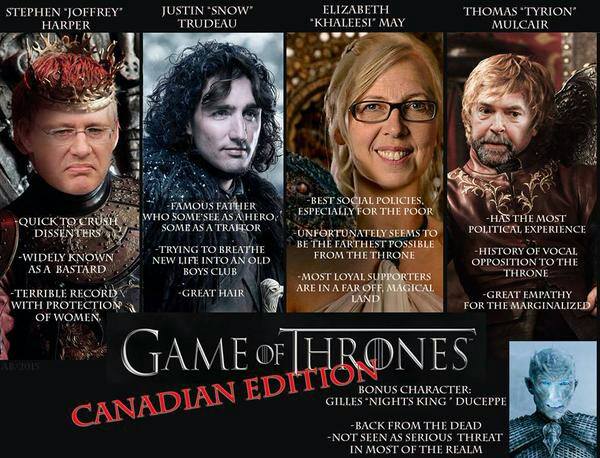
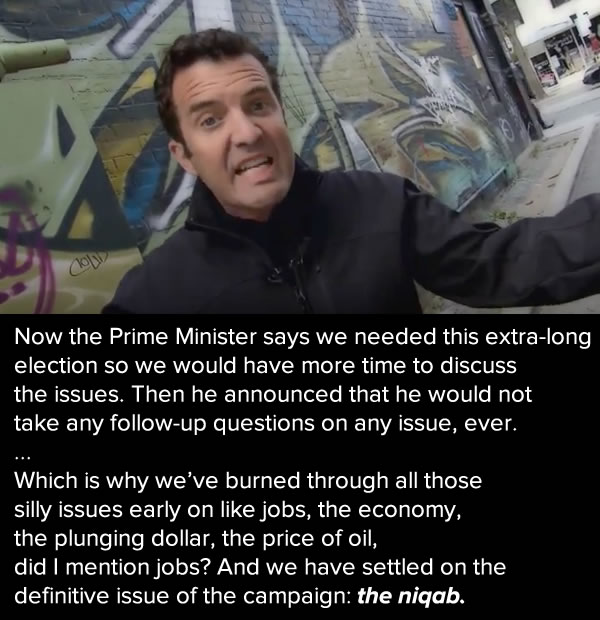
Well here we are in the midst of yet another federal election. Now normally I love an election, but this is not just any election. This is the longest election in modern Canadian history. We are sixty-six days in and I would love to tell you that we can see the light at the end of the tunnel, but with two weeks left to go I can’t even see the tunnel.
So for those of you who are feeling worn down by this campaign, who want to zone out and stay home—I feel your pain. I never thought I would say this: I would rather drink paint than hear the words “the following is a paid political announcement.” We must remain vigilant.
Remember this is not their election. It is ours. They do not get to choose what this election is about, we do. Just like we get to choose who runs this country. That’s our job. All we have to do is show up and do it.