Here’s a photo of a poster I saw on the train on the way to work today:

A quick reminder:
Here’s a photo of a poster I saw on the train on the way to work today:
A quick reminder:
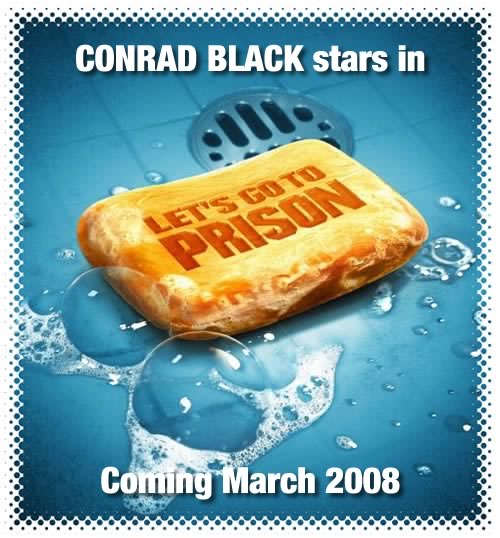
While I have not been following the details of the Conrad Black case, the fact that such questionable characters such as Mark Steyn and Elton John defend him doesn’t help his case as I am concerned.
I took a photo of this “Hillary Clinton” poster done “old school” style, which was hanging in the waiting area of Gabby’s, a pub not far from the office:

Photo by Joey deVilla.
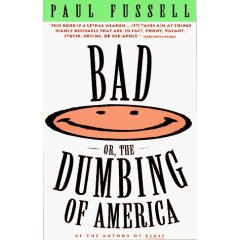
BAD, or The Dumbing of America — A worthwhile read 15 years ago, and still relevant today.
In his book, BAD, or the Dumbing of America, Paul Fussell suggested that one of the best ways to make America a less dumb place would be to eliminate athletic scholarships entirely.
I agree — I think that the term “athletic scholarship” is an oxymoron. They’re also almost completely non-existent in Canada; the rules forbid entrance scholarships based on sports ability. As far as I recall, the only Canadian university to attempt (and fail) to join the NCAA was Simon Fraser University (presumably in an attempt to undo their rep as “The Marxists on the hill”).
Alas, the market does not agree with me and Paul Fussell. Take a look at this graph from the blog Carpe Diem, “Mark J. Perry’s Blog for Economics and Finance”, which compares college professors’ and college football coaches’ average salaries for 2007:
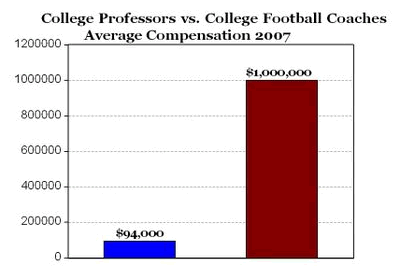
Here an excerpt from an article in USA Today on the topic of U.S. college football coaches’ compensation:
At least 50 coaches are making seven figures, seven more than a year ago. At least a dozen are pulling down $2 million or more, up from nine in 2006. Last season, Stoops was the only one making more than $3 million.
“Is this a favorable trend? The answer is: Of course not,” says LSU Chancellor Sean O’Keefe, who worked out the new deal with Miles. “That said, it’s also market dynamics. The value of things is determined by the demand that exists. There’s nothing unfair about that.”
I often consider the free market to be like the developmentally delayed little brother I never had: I love it dearly, but sometimes it’s as dumb as a bag of rocks.
The recipe that this article points to no longer exists, but there’s an equally good recipe for Maple Bacon Browned Butter Chocolate Chip Cookies here!
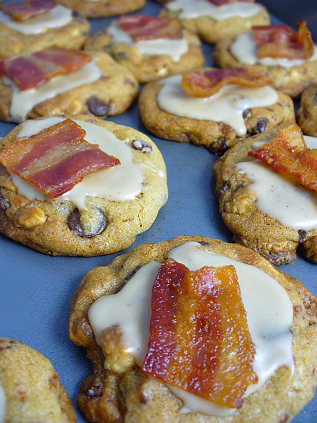
“Muffin”, the author of the blog Ooh, You Tasty Little Things… (a blog that since has been closed), wrote:
This whole thing started the other night when my husband and I were having a conversation about what foods could and could not be made better with the addition of bacon.

You can see the end result of said conversation in the photos that accompany her article, Bacon Chocolate Chip Cookies with Maple Cinnamon Glaze, some of which are reproduced here.

She says they taste good — and why not? She’s not the only person who’s mixed bacon and chocolate: consider the bacon chocolate bar created by Vosges, the gourmet chocolatier and heartily recommended by none other than supersexy celebrity chef Nigella Lawson.

Luckily for those of us with brave culinary spirits, “Muffin” published the recipe for the cookies and the glaze. Who wants to try making a batch of these with me over the Chrismukkah break?
Rich Silverstein of Goodby, Silverstein, and Partners (the people behind the “Got Milk?” ad campaign) put together a series of posters that summarize the current U.S. Administration quite nicely — there’s one made up solely of names, one made up of events and the one below, made up of slogans that you should find both familiar and ruefully laughable:

Click the image to see it at full size on its original page.
Found via my friend Miss Fipi Lele.
For more, see this article at The Huffington Post: Posterizing the Modern GOP.

I’ve picked up a number of new readers in the past couple of months, so I thought I’d showcase this little seasonal blast from the past. It’s an entry from 2002 titled The Best Christmas Present Ever, a tale of Christmas, crablice, friendship and the true spirit of Christmas. Be advised that the story has swearing and — as you might expect — crablice.