North Beach

Photo by Weegee010, and under a Creative Commons Attribution-Share Alike 4.0 license.
Click to see the source.
Friday, February 15th: North Beach is one of San Franscisco’s most lively neighbourhoods. It’s a strange mix of date-worthy Italian resto-bars and strip clubs, as if New York’s pre-Disneyfied Times Square and Little Italy had merged. The sidewalks are crowded with people eating tiramisu at cafe tables and passers-by taking in the sights. The road is packed with cars looking for places to park and limousines and buses full of partygoers toasting each other and people on the sidewalk with cans of beer.
Paul, Scott Hardy and I were being led to The Lusty Lady by Annalee Newitz, sex-and-tech writer extraordinaire, whom we’d met at CodeCon earlier that day. We were joined by her friend Charles Anders, who wore a smart little skirt uniform (Meter maid? Police? I don’t recall.) and sensible red flats.
A little aside: I have a theory that the “Gay Disneyland” part of San Francisco’s Castro neighbourhood stops where Castro Street turns into a steep hill because it’s impossible to climb it in a pair of pumps.
It was the kind of group you might only see in an ensemble cast movie: cross-dressing Charles, Annalee in indie-rock olive drab, Scott (who looks as though he could’ve been a member of Steppenwolf), Paul the tall guy from the Midwest, and the mop-topped Asian guy with the accordion on his back (“…and together, they fight crime!”).
The Lusty Lady

Photo by “Noodle”, and under a Creative Commons Attribution-Share Alike 2.0 Generic license.
Click to see the source.
The Lusty Lady is no ordinary peepshow theatre. It was the setting of a documentary film called Live Nude Girls Unite!, a story about the struggle to form first exotic dancer’s union. In order to supplement her income, comedian Julia Query started dancing at the Lusty Lady and found the work arrangements appallingly bad. Dancers had to pay stage fees — the exotic dancer’s equivalent of the musician’s onerous “pay-to-play” contract, were being asked to “date” the owners’ friends and were being videotaped for porn without their knowledge or being paid. The end result: the Exotic Dancers Union was formed. The Lusty Lady is, as I understand it, the only unionized strip club in North America.
“Do they have a good dental plan?” I asked Annalee. “I’m unemployed, you know. And is it, you know, empowering? I don’t want to be exploitive. I mean, I’m like that guy from the Chris Isaak Show, the guy who had the line ‘You give me a boner…with respect.'”
When we arrived at the Lusty Lady, we were met by more of Annalee’s and Charles’ friends, making our combined group an almost even mix of men and women. How different this scene was from what it was like ten years ago, when many of my women friends shared Catherine MacKinnon’s and Andrea Dworkin’s views: “pornography is the theory, rape is the practice”.
The Lusty Lady’s front desk is in a room painted a very lurid red with cheesy furniture; it would look right at home in a Russ Meyer film. A little weasel of a man sat at the front desk.
“Are the art films still in the video booths?” asked Annalee.
“Art films”, I thought. Yeah, right.
“Yesmam!” he said in an cartoonish Spanish accent with an even more cartoonish sing-song cadence. He sounded like a less gravelly-voiced version of “Cheech” Marin’s character, Chet Pussy, in From Dusk Till Dawn. “De regular pooooorno feelms are on channels hwone t’ru twenny-seven, wit’ the art feelm on channel twenny-h’eight.” He said pooooorno feelms and art feelm with particular gusto, and cupped hands pantomiming the squeezing of breasts. “An’ don’ forget ’bout de nekkid ladies!”
The back area was painted the same lurid red. It was a hallway with closely spaced doors, each with a number and a light overhead that was lit up if the room was occupied.
“Let’s get the corner booth,” said Annalee. “There’ll be more room there.”
The five of us piled into a triangular shaped room with a bench built into the wall. On one wall was a machine that accepted bills. The wall that the bench faced had a plexiglass window that was covered by a shade on the other side. The booth was stuffy and had a vague, mushroom-like odor.
“I just stepped in something slimy,” Paul said.
That’s when I noticed the paper towel dispenser on the wall.
Someone fished out a five-dollar bill and fed it into the machine. The shade on the other side of the plexiglass rose, giving us a view into a small room lined with animal print faux fur and lit by several chaser bulbs. Five women, some completely nude, others wearing tiny pieces of gauzy lingerie looked inside our booth and seemed a little annoyed that we were “cheaping out” and cramming inside.
I raised the accordion so that they could see it.
“What’s in the box?” one of them asked. Oops. I was showing them the back. I turned it around and put it on.
“Let me play you a little song,” I said, and started into Wild Thing.
One by one, they gathered around our window. Three of them lay down on their stomachs, their heads propped up in their hands, as if they were kids watching Saturday morning cartoons. The other two did a sexy dance along to the music.
When the number ended, they appluaded and asked for more. I could not possibly turn down five naked women asking for more. All the women, save the cute blonde one with glasses, took turns dancing; she stayed by the window, watching the show. I smiled at her, she smiled back.
“Take your clothes off!” she yelled.
“I will, but first you have to put money in the machine on your side!” I answered.
We kept feeding the machine for another five songs and left the booth afterwards.
“I tell you, that blonde was checking me out!” I told Paul.
“Yeah, right.”
Paul and I tried one of the video booths next. We opened the door and Paul checked the seat for gooey substances before we sat down. I gave Paul a couple of dollar bills to put into the machine. We cycled through the first twenty-seven channels, which were standard run-of-the-mill porno: anal, vaginal, fellatio, threesome and posing.
“Not much variety,” Paul noted.
The twenty-eighth was quite different. It was a reel of student- and “artist”-produced short films. The first was a close-up of a woman’s mouth licking a one hundred dollar bill, which we found hilarious. The next segment showed a naked woman standing in the woods, with two men in soldier’s uniforms running at her from her left and her right. As they approached her, she raised her arms to face each of them, revealing that she was carrying two handguns. She shot them dead before they could reach her. This repeated in a loop for about a minute.
“Pavlov Video Chicken One,” I said. (You’ll have to ask a fan of the old Saturday Night Live about that one, it doesn’t appear in Google.)
Someone knocked at the door. “Joey,” said Jesse on the other side. “Your presence is requested.”
One of Annalee’s friends, a rubenesque woman with a low-cut black shirt was going to strip for the strippers and wanted some accompanying music. She, Annalee and I piled into the corner booth. I played a blues progression in C minor while she pulled up her top, presenting her breasts for the dancers’ viewing pleasure. Such reciprocity!
I could feel the love in the booth. I just hoped I wasn’t standing in any of it.
After the call-and-response peep show in the booth, we returned to the hallway, where we gathered to talk about what we’d just seen or done. We were interrupted by the guy from the front desk, who spoke over the public address system.
“E’scuuuuse me! I just haf an announcement for all the people jus’ standin’ in de hallway. Eef chu wan’ to talk, please do it outside an’ don’ block de way for de people who are tryin’ to spend their money on de poooooooorno feeelms!” He said poooooooorno with particular gusto and spoke so comically we couldn’t help but laugh. We walked outside.
Hotel Metropolis

We went to a cafe on Columbus street and occupied the sidewalk tables. Jillzilla arrived and joined us.
She and I looked through Charles’ book, The Lazy Crossdresser, a copy of which he’d just received from the printer. It starts with a chapter titled Matter and Panty-matter and continues to be hilarious to the very end. I’m definitely going to purchase a copy and have it on my coffee table to put The Fear into some of my more timid guests.
After some cake and coffee, we all parted ways. Jill and I were still in a partying mood, so we gave Brandon a call and headed towards his hotel. We caught a cablecar, where Jill noticed that someone had altered one of the signs within.
 The sign had four of those red circles with the red diagonal bar cutting across an image within the circle.
Three of them were what’s you’d expect: no smoking, no food or drink, no leaning out of the cablecar. Someone had altered the fourth one so that the pictogram and text said “No IGOR”. Apparently lab assistants aren’t allowed on board.
The Hotel Metropolis is on the edge of San Francisco’s notorious Tenderloin district. I was expecting it to be a complete fleabag, but it turned out to be the one of the nicest hotels I’d ever seen. It looked as if it had been decorated by Asian readers of wallpaper* magazine, complete with a glass wall waterfall behind the concierge’s desk and Delirium being played instead of standard Muzak. We went to Brandon’s room, where he, Bram, Jane, Steve and Liza were relaxing. I told them about our evening at the Lusty Lady.
“I refuse to believe it happened!” said Brandon with a smile. “It’s all lies, Joey! Lies!”
“I want to believe,” said Steve.
“I want to sleep,” said Jane.
Somehow Jill and I managed to convince them to go out for a bite to eat at a nearby restaurant, which made for a lovely end to a fun and unusual evening.
Recommended Reading
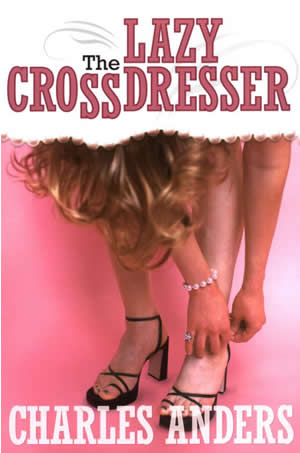
The Lazy Crossdresser by Charles Anders. Be sure to check out Chris ‘site.
A little cross-dressing humour: Transvestites are cross-dressers who hang from the top of the cave, while transvestmites stand on the cave floor. Ha! I slay me!
Annalee’s card says TECHNOLOGY * POP CULTURE * SEX on the front and Must…East…Brains… on the back. How can you not visit her site now? Be sure to check out some of her articles:
I get mentioned in the latest Techsploitation column, which appears in today’s San Francisco Bay Guardian. This column covers blogs and CodeCon.
Thanks, Annalee! You don’t know how much this means to a skanky accordion ho like me!


