[ via Being American in T.O. ] Where would you live in Politopia?
I seem to be in the north-west suburbs of Centerville:

[ via Being American in T.O. ] Where would you live in Politopia?
I seem to be in the north-west suburbs of Centerville:
[ via CarbWire.com ] This Arizona Republic article, Diets all the rage since at least 1087, is a timeline of diet plans for the past millennium. My favourite one:
Not everyone thinks that The Corporation is a book/film with good ideas. Take this news release from epublicrelations.ca:
Activist film aims to destroy the corporation:
Capitalism, democracy, health, education and environment threatened
© ePublic Relations Ltd 2004
Posted February 2004
Contact: rsirvine@epublicrelations.ca
Activists
are sending corporations on wild goose chases. At the urging of
activists, businesses are pursuing ideas such as the triple bottom
line, corporate social responsibility (CSR), and smart growth. But
these pursuits are merely ruses to keep business leaders and their PR
consultants preoccupied and distracted.
While businesses
invest enormous amounts of time and money in attempts to earn
accolades and recognition for successes in these areas, activists
have a different goal. They want to redefine, dismantle, destroy and
reassemble in a manner more to their own liking the entire
corporate world. The first step is to totally malign virtually every
corporation along with its managers, directors, shareholders and even,
in some cases, employees. What better way to do this than through a
movie!
The Corporation
has opened to critical acclaim at movie festivals in Europe and North
America. It recently won the World Cinema Documentary Audience Award at
the 2004 Sundance Film Festival.
For the films producers,
corporations and the pursuit of profit are sources of many social evils
including planetary destruction;
The documentarys web site (http://www.thecorporation.tv) states:
Self-interested,
amoral, callous and deceitful, the corporations operational principles
make it antisocial. It breaches social and legal standards to get its
way even while it mimics the human qualities of empathy, caring and
altruism. It suffers no guilt. Diagnosis: the institutional embodiment
of laissez-faire capitalism fully meets the diagnostic criteria or a
psychopath.
To
reach this judgment the film takes a creative and effective approach.
It runs through a checklist used by psychiatrists and psychologists to
diagnose mental illness. The list is based on the diagnostic criteria
of the World Health Organization and DSM IV. By going through the list,
the film attaches the following characteristics to a corporation:
callous unconcern for the feelings of others
incapacity to maintain enduring relationships
reckless disregard for the safety of others
deceitfulness: repeated lying and conning others for profit
incapacity to experience guilt
failure to conform to social norms with respect to lawful behaviours
Based
on this assessment corporation, the film concludes that corporations
are psychopaths. To support this contention, a former FBI agent
familiar with psychopathy is interviewed.
The Corporation
is playing in theatres across Canada; will be aired by TVO in Ontario,
Canada; and, American distribution is expected. DVD and VHS copies will
be available.
Must viewing for activists
The
Corporation is important viewing for activists around the world.
Regardless of the business or industry you work in - biotechnology,
banking, ranching, agriculture, transportation, manufacturing, fishing,
chemical, pharmaceutical, nanotechnology, financial services, computer,
retail, fast food, etc. -- NGOs and activists who oppose you will be
inspired and motivated by the film. And regardless of where your
business is located Canada, the United States, New Zealand,
Australia, the United Kingdom, Germany, France, Poland, India,
Pakistan, South Africa, Japan, you name it the film will successfully
recruit more activists, invigorated to challenge the corporate world.
(A visit to the films online discussion forum reveals how activists
are reacting to the film.)
In making their anti-corporate
film, the producers interviewed many people from the business world,
including spokesman for the Disney-built town of Celebration Andrea
Finger, Goodyear Tire Chairman and former CEO Sam Gibara, former Royal
Dutch Shell Chairman Sir Mark Moody-Stuart, Landor and Associates CEO
Clay Timon, Initiative Media Vice President Lucy Hughes, Canadian
Council for International Business President and CEO Robert Keyes,
Pfizer Vice President Tom Kline, Burson Marsteller Worldwide CEO Chris
Komisarjevsky, and IBM Vice President Irving Wladawsky-Berger.
The Corporation
is a powerful film. Its perspective is clear. In an interview,
commodities trader Carlton Brown says that when the terrorists directed
planes into the Twin Towers in Sept. 11, 2001, the question on brokers
minds was How much is gold up? In other interviews, the corporations
are described as modern slave owners and CEOs are seen as monsters
because corporations are monstrous.
The anti-corporate
movement is strong and getting strong. Dealing with it is probably the
most difficult and important challenge confronting PR folks. Its
certainly far more important and challenging than dealing with a
crisis. A crisis comes and goes. It’s usually pretty clear-cut and
business generally resumes when it’s over.
Activist attacks threaten democracy, health, education and environment
on the idea of the corporate are attacks on capitalism. They are a
vague and ill-defined. When they start and when they end is impossible
to determine. They occur at anytime from any direction from any of
hundreds of special interest groups and NGOs. If they are successful,
however, they destroy capitalism and the associated democracy, both of
which have paved the way to improved health care, greater longevity,
higher education standards, enhanced environmental standards, and ever
improving standards of living around the world.
This is
grand thinking and conceptualization. Its beyond the scope of most PR
folks who focus on the next news cycle, the next fiscal quarter, and
the bottom line. Yet, if the anti-capitalism movement isn’t viewed in
this larger context, the consequences are much more dire than a merely
tarnished brand.
The Corporation
and its web site provide valuable insight to the
anti-corporate/capitalist movement. All PR folks are encouraged to view
them to understand what activists are really up to.
In the photo below, which person is the direct descendant of an Irish-American school teacher named James O’Hara? The born-in-Manila mocha-skinned gentleman on the left, or the sweet red-haired-and-freckled lass on the right?

Kiss me, I’m 12.5% Irish!
The guy on the left, naturally. Can’t you tell?
During the Great Famine, one James O’Hara left County Cork, Ireland for the United States and a better life. At around the same time, one Catherine Kelly, whose sister was supposed to leave for America but chickened out, took her sister’s steamship ticket and left in her place. Somehow both James and Catherine ended up in Ohio, met each other and got married.
One of their children, also named James, was a teacher. The United States had just won the Spanish-American war, and one of the territories handed over to the U.S. was a Spanish colony called the Philippine Islands. The Americans were establishing a presence there, and there was a call for all kinds of workers, including teachers.
James boarded a ship in San Francisco and set sail for Manila. He ended up outside Manila in the city of Antipolo, where he settled down, got married, had several children and learn to speak and read Spanish and Tagalog fluently.
One of his children is Marietta O’Hara, who was my fair-skinned, green-eyed grandmother. Marietta married Guillermo deVilla Sr., had a kid named Guillermo O’Hara deVilla Jr., who in turn had me. The combination of Irish and Filipino genes makes us great partiers who can hold their drink and have strong family ties and fabulous shoe collections.
Happy St. Patrick’s Day, everybody!
Here’s the first of my notes from last night’s session with Joel Bakan, author of The Corporation. More later today.
Innis TownHall Theatre was packed solid, even with the extra
folding chairs that had been set up. It was decided to open the
balconies which ran the length of the sides of the theatre. Eldon and I
took seats on the atrium steps to the near the front of the theatre,
just to the right of the seats.
They first showed the trailer for the movie, followed by clips. Among the clips were:
“Bad Apples” Sequence: A rapid-fire series of jump-cuts from news
programs in which various interviewees kept saying that the scandals of
2002 (Enron, Worldcom, Arthur Andersen, et. cie.) were either “just a
few bad apples” or “not just a few bad apples”.
talking about the cognitive dissonance between the products we make and
the effects they have, citing his family’s history of working on th
elines at General Motors.
talking about the epiphany he had. His discovery that his business —
carpet tiles — was not an asset to the planet and not sustainable.
This discovery, in his own words, was “a spear through his heart”.
Chomsky
, complete with the finger-wagging that is his stock in trade,talking about the difference between the individuals in corpoations —
very nice people — and the corporations as entities — not very nice.
running through the mind of every trader who wasn’t in the World Trade
Center on 9/11 was “How much is gold up?”
talking about how her book and her studies were not about helping
parents cope with nagging, it’s to help us help kids nag more
effectively in order to sell more children’s products. “Is it ethical?”
she asks, with a grin. “I don’t know.”
came to the conclusion that the reasons why the Canadian Constitution
had little or no impact on social justice was that the rights specified
within dealt with the behaviour of the goverment towards people.
Corporations have more power over people these days.
Mark Ackbar (co-directed “Manufacturing Consent”), who said “Why don’t
I make a film about the book?” “The book doesn’t exist.” from this came
the idea to write the book and make the film simultaneously.
as a lawyer, he is trained in the art of persuading people of certain
things (“often you have to do this for thing you tyourself don’t
believe.”)
can’t just walk to Sony or Miramax and say you want to make a film that
says their institution is psycopathic. He talked to public companies.
has two theories as to why they were turned down: the film idea was (a)
too edgy (b) not edgy enough. He thinks that both were true.
film couldn’t have been made in the US where public broadcasting is
heavily funded by corporations. Testament to the value of public
broadcasting and the public sphere.
Ackbar got a sattelite dish and taped news channels in the wake of the
Enron/Worldcom scandals for source material for this sequence.
I really should take much greater pains to make sure I’m at South By
Southwest Interactive Festival next year. Once again, I missed Bruce Sterling’s usual
excellent keynote, followed by his equally excellent party. Cory took
notes, and here are some snippets:
My next book is a technothriller called Zenith Angle,
near future — it’s an sf novel, but not set in the future. Gibson’s
doing this too. It’s a trend among aging cyberpunks. It’s not cyberpunk, it’s not steampunk, it’s NOWpunk.
You’ve gotta be tired, weary and grey to set your sf in the present day.
This is a genius administration for inspiring angry rhetoric. It’s got
a nice, interesting consistency. I like Rumsfeld, I dig his poetry. Job
one in the Bush Admin is to get it spun: they’re an
info-war-centric outfit. If you get it spun, you don’t need to get it
done.
Controlling the message is more important to them than controlling the
underlying reality. It’s a blatant part of their ideology. Their global
climate change policy is in defiance of the laws of physics, it’s Lysenkoism. The Union of Concerned Scientists has a page documenting the Bushies’ Lysenkoism from climate change to on.
It’s popular to freak out over Indian offshoring, but that’s shortsighted. If you really want 1BB people to remain ignorant and
backward forever, why not embrace it at home? Were we more prosperous
during the century when the American South was backwards and ignorant?
Indians are opposed to this, too! There’s a spinning wheel on the
Indian flag — Ghandi’s wheel, with which he made his own clothes to
frustrate multinational English clothes corporations. Not only was he
relentlessly against offshoring, but in order to effect change, he spun
his own fibres. Always! He was always making his own clothes with his
own hands all the damn time: he made that simple cruddy loincloth with
his own hands.
The Spanish PM lost his job for bullshitting, for spinning the train attack as Basques when it was obviously Al Quaeda. In Spain
they’re tired of bullshit. They followed the PM to the poll and booed
him: Put down that ballot, you lying son of a bitch. They were sick of
the deceit. It wasn’t the war, it was the policy of spin and feeding
lies. It’s the dismal business.
Coming up: Martin Rees, a UK scientist thinks that the chances of our
civilization surviving the 21st century are 50-50. I’ve met him, he’s
got his facts straight.
I’m cheered up by that! 50-50! Those are great damned odds. This year
was the 50th anniversary of the Bikini Atoll test, since the
crust-busting bomb was invented, and we haven’t blown ourselves up.
We’re up to 50-50!
I watch sustainability — the 20th Century isn’t do-able. We need to
work on this. Austin’s a good city to watch people try to solve things.
Austin’s a happy place, and imperiled, but doing the right thing. I
take comfort in Havel’s statement about hope: “This isn’t a facile
expectation that things will turn out well, but the conviction that
what you’re doing makes sense no matter how things turn out.” And
that’s what Austin is up to.
Once again, Cory’s full notes are here.
[ via Boing Boing
] Tom “Plasticbag.org” Coates has come up with another two-axis
classification scheme for working types: the Pirate/Ninja axis, and the
Elf/Dwarf axis. The meat of his essay:
I have always considered the profound distinction between ninjas and
pirates to be an absolute one. One was either ninja or pirate – there
were no inbetweens. One personality type was skilled and proficient,
elegant and silent, contained and constrained, honourable and
spiritual. The other type loud and flamboyant, gregarious and
unrestrained, life-loving and vigorous, passionate and strong. I
thought all people must pledge their allegiance, or be categorised accordingly.
The other day at work, another binary pair was presented to me – a
co-worker who doesn’t declare people pirate or ninja, but instead elf
or dwarf. For him, humanity falls into doers and thinkers – elves being
elegant and timeless, conceptual and refined, abstract and beautiful
while dwarves are practical and structural, hard-working and
no-nonsense, down-to-earth smiths and makers. It’s a view of the world
that’s expounded a bit in Cryptonomicon.
Coates drew the two axes and plotted a number of big bloggers on them, resulting in this chart:
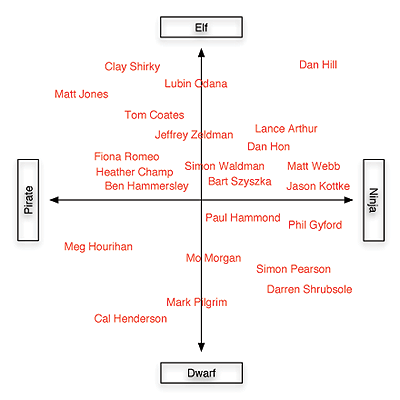
I wonder where I’d fall. Probably much closer to pirate, maybe straddling elf and dwarf. What do you think?
My mother’s family traces its ancestry back to Chinese pirate Limahong, so I guess I should declare my allegiance to the pirates. Besides, I think that hot tub parties are more a pirate thing than a ninja thing.
Very interesting reading. Perhaps I should contact Coates and offer to program the “where are you on this chart?” quiz.
Go read the article, and while you’re at it, read Scott “PvP” Kurtz’ “Pirate vs. Ninja” series of comic strips.