Categories
It Happened to Me Toronto (a.k.a. Accordion City)

Passing the Sniff Test at the CN Tower

One of my favourite bits of dialogue from a “Slappy Squirrel” segment of the old Animaniacs cartoon:

Bumpo (a young dog): Can I sniff you, Uncle Stinky?

Stinkbomb (an old dog): No! Don’t be weird.


It’s been a while since I last visited the CN Tower — it was probably

2001 when I last set foot inside the building. These days, I go only

when showing it to out-of-town family visitors, which we had on Thanksgiving

weekend. Wendy’s parents came up from Boston for a triple-occasion

weekend that covered my nephew Ryan’s christening, her birthday and

Canadian Thanksgiving. We had an extended family party on Sunday;

Monday night was for dinner at the Tower with her parents, my parents

and us.

I was surpised to see a row of three of these devices at the entrance to the hallway leading to elevators:

Photo: Smiths Detection Ionscan Sentinel II security portal.

It’s the Ionscan Sentinel II Contraband Detection Portal, a device manufactured by Smiths Detection. They’re very Star Trek,

from outward appearance right down to the touch panels and female 

female voice. Here’s what the Sentinel II does, according to the

promotional copy on the web site:

Only the SENTINEL offers true head-to-toe screening.  Gentle puffs

of air dislodge any particles trapped on the body, hair, clothing and

shoes.  These particles are then directed into the instrument for

analysis.

IONSCAN®  technology combined with preconcentration technology

developed by Sandia National Laboratories allows for the high

throughput of screening up to 7 people per minute.

Trace amounts of more than 40 substances are detected and identified

in seconds.  Results are displayed in an easy-to-understand fashion. 

Should a detection be made, a digital camera is included to take a

photo of the person for easy identification. 

It detects the following explosives:

  • RDX
  • PETN (a main ingredient of plastic explosives)
  • TNT
  • Semtex (notorious for being difficult to detect due to its “scentlessness”)
  • NG (you probably know this better as nitroglycerin)
  • “and others”

and the following drugs, listed with their stereotypically-associated subcultures:

  • Cocaine (yuppies)
  • Heroin (rock musicians)
  • PCP (freaks and crazies)
  • THC (hipsters, hippies, yuppies, rock musicians)
  • Methamphetamine (bikers, rural working class)
  • Ecstasy (ravers)
  • “and others”

The scanning process is pretty quick. You walk into the portal and

stand on a spot designated by two footprint-shaped markers. A large

number of nozzles that look just like the air nozzles above the seats

in airplanes spray you with a few puffs of air. This process loosens

particulate matter on your clothes and body. This is followed by the

sound of a motor, which I assume powers an air intake pump, which draws

in the loosened particles for analysis. Based on the analysis, you are

then either free to go or quickly dragged off to the body cavity search

room.

The entire scanning process takes less than ten seconds, from entrance

to exit. The promotional copy boasts that it can scan 7 people a

minute, or 420 per hour. Three of these machines gives the CN Tower

checkpoint a total throughput of 1260/hour. This probably would’ve

exceeded the old throughput of the elevators, when there were only four

of them. Back then, you’d occasionally hear of people waiting for about

an hour for an elevator. There are now six elevators; two were added

when they moved to the the stairs to the central core, freeing up room

for more elevator shafts.


All of us save Dad went through the portal. Dad uses a walker, which is

too wide. He was directed to another area to the side of the portals,

where he was chemically analyzed the “old” way — the security guard

rubbed a gauze swab over some of his clothes and his walker and

placed it into a scanner.

Searching people for explosives before they enter a public building

isn’t a new thing. From the World Trade Center’s re-opening in the

mid-nineties until September 11, 2001, it was standard procedure to

undergo search before you could use the elevator, a procedure which

probably added ten minutes to your commute time if you worked there.

They were pretty through when I was last there in 1999; they even asked

me to open my accordion so they could inspect its innards. Terrorism is

partly about being splashy, and blowing up prominent and symbolic

buildings is high on the “splashy” list.

Getting them installed at the CN Tower is also good advertising for

Smiths Detection. It’s a prominent tourist attraction, and having the

Sentinel II prominently displayed at its entrance ensures that people

all from all over the world — or hey, a local blogger — will talk

about them.

In addition to the CN Tower, the Sentinel II has also been installed at “one of Canada’s major nuclear power facilities” (the press release doesn’t get any more specific).

I wonder why you don’t see more of these devices at airports. I suppose it’s still relatively new — JFK installed some late last year

and I’ve heard that they’re also in the Miami airport. I also suppose

that they’re quite expensive, and unlike other expensive airport

amenities, they’re not revenue generators.

(And ‘fess up: when it was time to buy smoke detectors for your apartment or house, did you buy top-of-the-line?)

Addendum:

Also of note: these things only detect explosives and drugs, and drugs,

in spite of what the US Government may tell you, aren’t part of the

terrorist arsenal (the bulk of their money probably comes from your

super unleaded purchases). They

don’t detect guns or knives — remember, the 9/11 terrorists used

boxcutters — and metal detectors can’t detect those newfangled ceramic

blades, such as those Kyocera kitchen knives Rob and Leslie gave to us as wedding presents.
Categories
Uncategorized

Yes, I Know of the Lame-O Explanation of Why Superman’s Lame-O Disguise Works

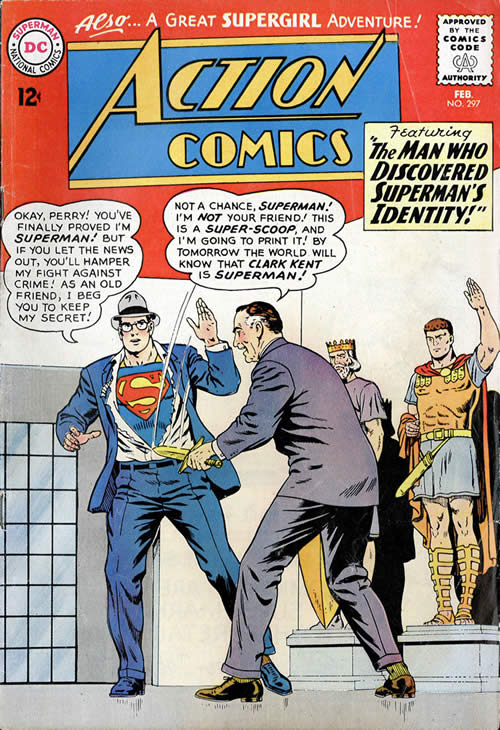
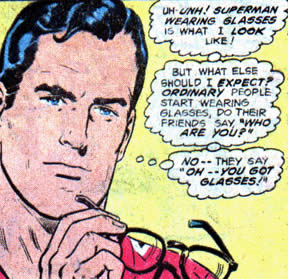
In response to the previous entry, I’ve received a couple of emails pointing me to Superman #330 (December 1978), in which the writers at DC Comics finally decided to tackle the question “Why does anyone fall for Superman’s hokey disguise?”.

I remember reading that issue in the ’80s and having a good laugh at its hokey explanation. The Reader’s Digest version: Superman emits a low-level hypnotic effect emitted from his eyes. People perceive Clark Kent as being more frail and less handsome than he actually is. The effect is a manifestation of his wish that nobody makes the Clark Kent/Superman connection and is amplified by the lenses in his glasses. The lenses themselves are made of “indestructible Kryptonian plexiglass” from the rocketship that carried him to Earth, which coincidentally shattered into convenient glasses-sized circular fragments during the crash landing.

Even in the world of superhero comics, this explanation was so lame that it’s never been referred to again in the continuity of Superman comics. You can experience the explanation in its full lameness by visiting this site, which has the “meat” of the story, The Master Mesmerizer of Metropolis.

When one of your most powerful enemies can repeatedly be defeated by tricking him into saying his name backwards, your critical thinking skills will tend to atrophy.


I believe that the current explanation for why nobody makes the Clark Kent/Superman connection now stems from the Superman half of his identity: when in his Superman persona, he vibrates his face so that he photographs as a blur. It’s not as lame as the “hypno-glasses” explanation, but still…!

Categories
Uncategorized

Damned Liberal Media!

The glasses never fooled anyone, and you could probably see the Superman costume underneath the white shirt.

Categories
In the News

"I am altering the deal. Pray I do not alter it any further."

(Sometimes only a Darth Vader quote will do for an entry title.)

Click the image to see the comic on its own page.

Categories
In the News It Happened to Me

Blogacatmas Makes "The Globe and Mail"

Boss Ross, who coined the name “Blogacatmas“, is even more pleased than I am that it made it into a story in today’s Globe and Mail!

Ross and I both send our thanks to Ivor Tossell for writing the story.

Ross is all giddy; it’s not every day one makes a contribution to

popular culture.

Categories
In the News Toronto (a.k.a. Accordion City)

No Way, Segway

[via Torontoist] Accordion City lawyers say that Segways are catch-22

victims:

  • They’re motor vehicles, which means they can’t be used on sidewalks
  • They lack the safety equipment that meets the standards of the Ontario Highway Traffic Act, which means they can’t be used on roads (the “Highway” in the Act refers to any road).

Thanks to this catch-22, the only place you can legally operate a

Segway is on roadways in city parks (and perhaps Segway rinks, should

they ever come into vogue).

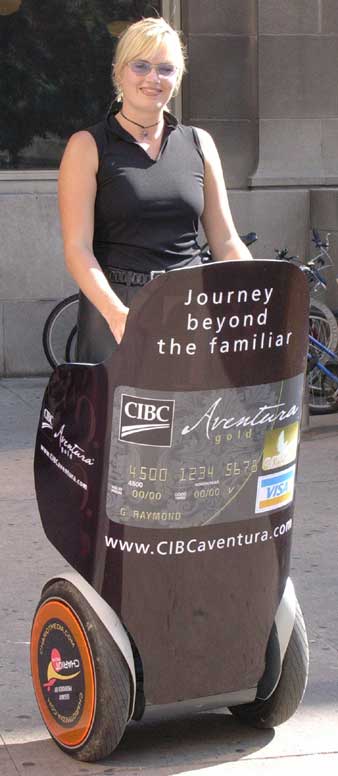
Naturally, Segway of Ontario is upset at this development, and I’m sure

that Chariot Media, who use the innovative cute-woman-on-a-Segway

advertising platform are none too pleased either:

A photo from a blog entry of mine in 2003

— she’s promoting the CIBC outside Union Station. I’ve seen a fleet of

women on Segways advertising Revlon products on Queen Street West too.

Categories
Geek Toronto (a.k.a. Accordion City)

Speaking at the CASCON 2005 Conference

I’ll be speaking at the blogging workshop of the CASCON 2005 Conference

which takes place next Wednesday, October 19th from 1 to 5 p.m. at the Sheraton Parkway Toronto North Hotel and Convention Centre in Richmond Hill.

Here’s the abstract for the workshop:

Many components of pervasive computing are already in place, including

collaborative and communication applications such as instant messaging,

e-mail, text messaging, and conferencing. In addition, mobile devices

are providing ubiquitous computing and communication capabilities.

Improved methods are now needed to support collaboration that goes

beyond explicit authoring, messaging and conferencing. Techniques such

as collaborative filtering (e.g., in book recommendations by Amazon),

social networking (using systems such as Orkut), and blogging, are part

of an emerging domain of social computing. We are interested in the

impact of blogging and related communication and collaboration

activities, and how social aspects such as community building can

enhance the performance of business activities.

This

workshop will provide a forum for the discussion of issues related to

the development and usability of social computing systems and

applications. Part of the workshop activity will include requirements

analysis for applications of social and pervasive computing. Speakers

from academia and industry will describe their experiences in

researching and deploying social computing applications.

Topics of

interest include: blogs and wikis, semantics, creating and building a

community, e-commerce, and information epidemics. Specifically to

blogs, the workshop will address bottom-up (grassroots, personal,

diary) blogs versus top-down (topic-oriented, corporate sponsored,

political party, etc.) blogs. Other topics to be covered will include

musicblogs, photoblogs, mobile phone blogs (moblogs), and videoblogs.

The syndication and aggregation of blogs using RSS (Really Simple

Syndication) will also be discussed.

…and here’s the abstract for my ten-minute talk…

Businesses have adopted a number of technologies that once

weren’t thought of as essential. The telephone, fax machine,

photocopier,computer, web site and high-speed network all made the leap

from niche gadgets to must-have business equipment. Twenty years ago, a

business without a fax machine would have been considered archaic;

today, abusiness without a presence on the world wide web seems equally

so.

My talk will cover the business applications of blogs and related social

software technologies for companies ranging in size from the solo

entrepreneur to the multinational corporation, based on my

own experience and observing other business blogs. We’ll take a look

at some business blogs that I find interesting, and I’ll tell

some stories of the right and wrong ways for companies to make use of

the power of blogs.

Presenting along with me will be:

  • Dr. Ian Graham, Enterprise IT Strategy, BMO Financial Group
  • Alvin Chin, U of T and workshop co-chair
  • Veronica Holmes, Bell Canada

Admission to the conference is free. If you’re interested, visit the registration page today!


You may want to check out these links:


My thanks to Alvin “GadgetMan” Chin and Sascha Chua for organizing the event, inviting me to participate and putting up with my general non-availablity last month!