File it under “Funny Because It’s True”: here’s a chart by Kathy
“Creating Pasisonate Users” Sierra that notes in that
ha-ha-just-serious way how similar group therapy and Web 2.0 are:

File it under “Funny Because It’s True”: here’s a chart by Kathy
“Creating Pasisonate Users” Sierra that notes in that
ha-ha-just-serious way how similar group therapy and Web 2.0 are:
 This
Saturday, Wendy
and I went to the Book City warehouse sale and made out
like bandits, netting about a dozen books for less than CDN$100. I
snagged:
Court
by Mark Twain (a great story, whosepremise got borrowed and mangled by a number of tv shows and
movies)
Neal Stephenson (continuing the Baroque Cycle, which started with Quicksilver,
which I
got for free)
Recognition
by William Gibson (Never got aroundto reading it, no idea why)
Life?
by Po Bronson (I enjoyed his earlierbook,
Shift, and hey, now’s as good a time as any for
a little self-check)
…and finally…
Dictionary
by Marc Okrand.gave me The Klingon
Dictionary
back during our days at Crazy Go
Nuts University. A few months later,
MacDougall,
who needed a copy for his linguistics class (remember,
the Klingon language is a real language designed by a linguist),
borrowed it from me and never returned it. I am pleased to have this
masterpiece again and look forward to peppering my conversation with
gems such as:
targwIj
Ross, the targ ate my weekly report.
veQDuj’oH
Dujllj’e’
Your ship is a garbage scow.
Daghur neH
Struggling only makes it hurt more.
Here’s a little tip: Klingon sentences sound even better
when punctuated with a hearty “beeeyotch!”
When we paid for the books, the cashier, who was sporting the classic
nerd grrrl uniform, took one look at the book and said
“Sweet! I was
jumping for joy when I found out we had this book in stock. Enjoy
it!”
I shall. Qapla’!
 Being a well-groomed owner and operator of a goatee and sideburns, I take an interest in good shaving systems. I use a Remington Precision Titanium moustache and beard trimmer,
and have a mysteriously multiplying set of Gillette Mach 3 razors (one
of which I really bought for the free multi-bit screwdriver that got
included with it), which gives a pretty nice shave. I’m not terribly
satisfied with electric shavers, and the electified version of the Mach
3 — the M3 Power — seems like nothing more than a “plausible deniability vibrator” to me.
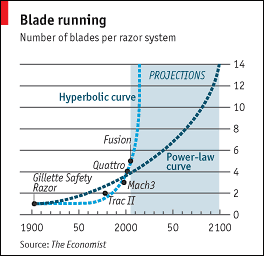
In 2004, after the introduction of the Schick Quattro, with which Schick heated up the razor blade arms race by creating a four-blade razor, The Onion published one of their joke editorials titled Fuck Everything, We’re Doing Five Blades, supposedly written by the CEO of Gillette. It turned out to be their most prescient piece since Our Long National Nightmare of Peace and Prosperity is Finally Over: the Gillette Fusion has not only five blades, but an extra one for fine shaping work.
Not being one to miss such a trend or its implications, The Economist has an article titled The Cutting Edge that suggests that there’s an analogue to Moore’s Law for razors, meaning that we should have 14-blade systems by 2100. If only I could live long enough to see those glorious times.
This photo amuses me every time I see it. Click it to get the full-size version, suitable for desktop wallpaper.

Almost as stilted as her scenes with Hayden Christensen.
 The podcast that I mentioned earlier — the one in which I interviews Tucows’ VP of Product Development, Alain Chesnais — now has a transcript, which I’ve posted on Tucows Developer.
The “podcast-and-transcript” approach is the one that I’ll be taking with the podcasts over at Tucows Developer, as it offers the best of both worlds.
You might ask “Why post podcasts, anyway?”. The preliminary observations of the results of podcasts from technical websites seem to be good. At the Evans Data Developer Relations
Conference that Ross and I attended in early February, we saw that a
number of companies found that podcasts were a good way to explain the
broad strokes of a technology or product.
In his presentation, Bill Roth from BEA systems said that podcasting “lets you touch customers
at points where previously no opportunity existed.” Translated from marketer-speak, podcasting
lets you communicate with your users and customers at times you couldn’t before: on their
commute, at the gym, while running errands, and so on.
There’s also the “high-touch” factor of podcasts. It’s one thing to read
an essay or the transcript of a conversation, but another thing entirely
to hear the speakers say things in their own voice. The spoken word has a different “flow” from the written one, and a conversation between two or more people has a certain spark and spontaneity that a group-written article can’t capture.
There’s a world of great podcasts out there, and their number is growing every day. If you’d like a sample, take a look at the IT Conversations website, which features speeches and interviews with some of the brightest and most interesting minds in high tech. For a fun listen, I recommend Wil Wheaton’s “Just a Geek” presentations at the Gnomedex conference — here’s part one and here’s part two.
For the benefit of people who can’t listen to podcasts, who want to scan a podcast quickly for a specific topic or phrase and search engines, we’re also posting transcripts of our podcasts. Luckily, a service like CastingWords.com exists. CastingWords.com is the podcast transcription service whom we used to transcribe the podcast for us. They did a good job and their rates are very reasonable: they charge by podcast length — 42 cents a minute. We’ll be using their services for future podcasts.
 Here in Canada, we vote in our federal elections using a paper ballot that is standardized across the country; aside from the candidate names, the ballot looks the same no matter where you vote (for more details, see this entry). While this requires a manual counting system, it also has the added benefit of it being much harder to tamper with the results.
In the US, balloting systems vary by region: some ballots are on paper, either marked by hand or punched by voting machine, but some votes are purely electronic. The problem with the electronic systems as they are currently implemented is that they don’t leave a paper trail.
Manufacturers of electronic voting machines like Diebold insist that it’s too hard to add a paper trail system to these machines. This is a bit of a curiosity, considering that Diebold also manufactures ATMs, which are capable of provide paper receipts for each transaction and since cash registers have been able to keep a paper log of everything for decades. It’s also troubling, as voting machine manufacturers have meddled with standards organizations and Diebold’s CEO is active in partisan fundraising (he once wrote in a campaign pitch to Republicans that his company was “committed to helping Ohio deliver its electoral votes to the president”).
The blog Black Box Voting covers this issue regularly. Their most recent entry has a great graphic taken from the Washington Post — it compares Las Vegas slot machines with voting machines. Which one’s the bigger gamble?

 By the way, we here at The Adventures of Accordion Guy in the 21st Century (we reserve the right to use the “Royal we” here) would like to wish all our readers a very happy and snug-fitting Saint Patrick’s Day!

