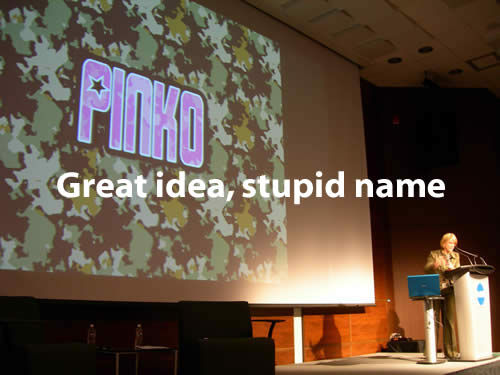
The Brotherhood of Evil Mutants: A Stupid Name

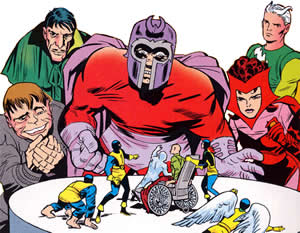 For a comic that was smarter than most at the time, The X-Men comics featured a team of supervillains with a painfully stoooopid name: “The Brotherhood of Evil Mutants”. Worse still, they had two incarnations of this badly-named gang: one led by Magneto and the other led by Mystique, both of whom you’ve seen if you watched any of the X-Men movies.
When the X-Men comic first came out in the 1960’s, it was a standard comic book convention for supervillians or suppervillain groups to have some word along the lines of “evil” in their name, leading to antagonists with lame-o monikers such as “Doctor Doom”, “Count Nefaria” and villian teams with the terribly unoriginal names such as the Alliance of Evil, the Masters of Evil and the aforementioned Brotherhood of Evil Mutants. By the time the 1980’s rolled around, superhero comic books had become a little more “realistic” (at least for comic books), with better writing and grittier characters becoming more popular (witness Wolverine as the “poster boy for mutant cool”). Comic book writers did a lot of “retconning” — a portmanteau of “retroactive” and “continuity” — to either simply excise historical goofiness from old issues (“it never happened!”) or to provide a more “modern” spin on old goofiness. The X-Men writers took the latter approach with the Brotherhood of Evil Mutants: they often flipped between these two explanations:
- That the “Evil” in the name was chosen to be ironic. If humans said that all people born with mutant powers were evil, then evil they would be.
- That the “Evil” in their name was to force Charles Xavier (a.k.a. “Professor X”) into an awkward moral position, as both he and the Brotherhood were both advocates of mutants. The primary difference was that Xavier’s dream was peaceful coexistence with humans, with the Brotherhood were all about mutant superiority.
Both were lame-o ways to explain away the lame-o name of a group of villians. The writers of both the X-Men comics and movies still have a group called the Brotherhood, but they;ve since dropped the “Evil” from the name.
Pinko Marketing: Also a Stupid Name
To my ear, “Pinko Marketing” has the same feel that “The Brotherhood of Evil Mutants” has. Just as the later editions of the X-Men comics claimed that the use of “Evil” in the Brotherhood’s name was ironic, the “Pinko” in “Pinko Marketing” is also ironic in its appropriation of a Cold War slang term and Soviet socialist graphic design.
I have a message to all you people promoting Pinko Marketing:
The name sucks. Commies aren’t cool.
Don’t get me wrong, the general principles of so-called Pinko Marketing are cool. For those not familiar with the concept, it’s a “power to the people” approach to marketing. At the Mesh Conference, Tara Hunt outlined these principles:
- Rely more on inbound, rather than outbound messages. Listen to your customers and give them reasons and ways to promote you. (For excellent writing on how to do this, I recommend Kathy Sierra’s blog, Creating Passionate Users.
- Rather than being the voice of the company to the community, be the voice of the community to the company.
- Be authentic. I have some reservations “authenticity” — I think a lot of people think it means “unpolished” or “amateurish” rather than “genuine” or “”truthful”. I agree with AKMA when he says “The short expression of why ‘authenticity’ vexes me comes down to, “There’s no there there.”
- Serve niche markets. See this entry in Creating Passionate Users for a great explanation behind this principle.
- Follow the principles of open source software — share information, be as transparent as possible.
“Pinko Marketing” views people as customers, as opposed to conventional marketing, which views people as consumers. This may be a fine distinction, but it’s an important one. A customer is a living, breathing person with whom have a relationship as a vendor; a consumer is merely an entity whose role is, as Jerry Michalski put it, “a gullet whose only purpose in life is to gulp products and crap cash”. That part, I can get behind.
What I can’t get behind is this embrace of socialist/communist imagery to symbolize personal empowerment. What is it that’s so attractive about red propaganda, anyway? Is it the long lines for sub-par cabbage and gritty toilet paper, the surveillance society and criminalization of dissent, the gulags, the shoddy workmanship or a kleptomaniacal government? Aren’t many of these symptoms of the current U.S. administration, which we rightfully criticize?
Want a sound bite? Here’s one: Using socialist/communist imagery to promote better relations with your customer is as tasteless as using Nazi imagery to promote punctuality and good information management.
In fact, the bottom-up, power-of-the-individual, customer-is-always-right ethos of so-called “Pinko Marketing” is more American than anything else. The problem is that the use of “America” imagery is pretty much the domain of the ironic (think Colbert Report) and the irony-blind (think Fox News). Isn’t there some concept that captures the spirit of Pinko marketing minus the silly name?
I’ll close by noting that during her presentation on Pinko Marketing, Tara asked the audience to “Please, please, please stop using the term ‘Viral Marketing’! It’s so tired.” In the same spirit, I am now asking you to take the Pinko Marketing pledge: Please, please, please stop using the term “Pinko Marketing” — it’s so “Brotherhood of Evil Mutants”.
(For more on the silly use of communist imagery in high-tech circles, see this entry in the Nielsen Hayden’s blog Making Light, where they take BoingBoing and the copyfighters to task for using Soviet imagery in their campaigns, and rightfully so.)


