Categories


b3ta.com asked: What would the Victorians have made of the Internet?
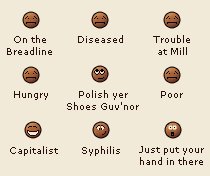
For starters, being such hyphenation maniacs, they would have called it the “Inter-Net”. After that, b3ta readers came up with a hilarious set of graphics depicting the Internet, had it been created by the Victorians. Some examples:
(Click on any of the pictures to see the whole collection.)
Today, we have RateMyRack.com [Not safe for work!]. The Victorians were — at least in public — considerably more prudish:

Here are TLDs (top-level domains, such as .com, .net and .org) in the Victorian era:

An iPod ad:

When I mentioned b3ta’s “Victorian Internet” gag to Boss Ross, he replied that the Victorians did have an Internet of sorts — the telegraph. Was it like this?

…or like this?

(The Morse Code in the window shown above actually deciphers into real text. Deciphering is left as an exercise for the reader.)
It was the heyday of inventors:

And here’s what my employer, Tucows — formerly an acronym for The Ultimate Collection Of Winsock Software — would have been like:

Other goodies:
Occasionally I get my tech news from webcomics, and here’s an example: take a look at today’s Penny Arcade comic. In the news item that goes with the comic, they explain the joke behind their cartoon: on November 4, AT&T were granted U.S. patent 6,643,686: “System and method for counteracting message filtering”. A quick summary:
“A system and method for circumventing schemes that use duplication detection to detect and block unsolicited e-mail (spam.) An address on a list is assigned to one of m sublists, where m is an integer that is greater than one. A set of m different messages are created. A different message from the set of m different messages is sent to the addresses on each sublist. In this way, spam countermeasures based upon duplicate detection schemes are foiled.”
Simply put, it’s a way to defeat anti-spam filters.
In the world of the Internet, this is the moral equivalent of patenting a method of kitten-drowning.
The Register has a short article on the matter, in which they name the guy who filed the patent, one Robert J. Hall:

Robert J. Hall, the New Dark Prince of Spam. Feel free to print out this photo and put it on urinal pucks.
SiliconValley.com’s Dan Gillmour (who at Bloggercon told me that he’s a fan of mine by proxy) writes:
Is it possible that AT&T wants to use the patent to stop spammers — i.e. suing them for violating the patent if they use the anti-anti-spam technique? This seems improbable on several grounds, not least that many spammers are already breaking laws with impunity. A mere lawsuit isn’t going to deter them.
Here’s a new security paper title for you, Mr. Robert J. Hall: System and method for hiding from millions of angry people with inboxes full of unsolicited emails.