Neither this ad nor the tactic would work today:

Neither this ad nor the tactic would work today:
For no apparent reason — other than stumbling into this picture while
riffling through a place on “the internets” that I’m not allowed to
talk about — here’s a photo of a young, nerdy Jennifer Garner.

“Uh…would you like to program some sprites on my Commodore 64 after school?”
The moral of the story: teenage geekiness does not necessarily doom you to a life of adult nerd style.
If you really need a refresher on what Ms. Garner looks like today, here’s a photo from her from a recent appearance in Arena magazine. Happy one-handed browsing, boys (and 10% of girls).
Michael Kupperman draws some very funny comics, and he’s collected them all in Snake ‘N’ Bacon’s Cartoon Cabaret, a book of which I was unaware until recently. Here’s a sample:
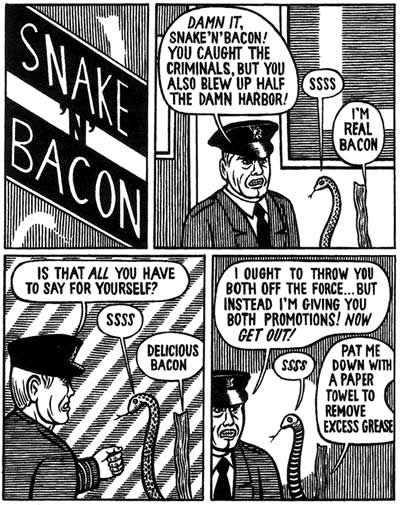
I don’t own a copy of this book, but it might make a nice Christmas present…
[via MetaFilter] A simple way
to make wine taste better is to decant it — to pour it from the bottle
into another container. Decanting wine mixes it with oxygen, which
improves the taste; you can make a $10 bottle wine like a $20 one with
this simple trick.
There are similar tricks with liquor. In an old James Bond novel — I
can’t remember which one — Bond had the habit of shaking pepper into
his vodka shots. He’d picked it up from the Russians, who did it as a
matter of safety rather thasn taste; the pepper dragged fusel oils left
over from their crude distilling process down to the bottom of the
glass.
A more useful trick that you can try at home: filtering cheap vodka through a Brita filter four times. Apparently it makes it as smooth and delicious as the expensive stuff.
Over at Big Story, another famous war poem: Wilfrid Owen’s Dulce et Decorum Est. It’s a good reminder that remembering the courage and sacrifice of our veterans and fetishizing war are two completely different things.
(For those of you whose Latin isn’t so hot — or didn’t learn this poem in high school: the title of the poem is derived from the adage dulce et decorum est pro patria mori, which is also the finale of the poem. It means “How sweet and decorous it is to die for one’s country”.)
[Cross-posted to my professional blog, The Farm]
Clay Shirky has a great
article titled Group as User:
Flaming and the Design of Social Software
in which he says that one of the misconceptions of designers of social
software is that they see the “user” of a piece of social software is
not a collection of individuals, but a group:
When we hear the word “software,” most of us think of things like
Word, Powerpoint, or Photoshop, tools for individual users. These
tools treat the computer as a box, a self-contained environment in
which the user does things. Much of the current literature and
practice of software design — feature requirements, UI design,
usability testing — targets the individual user, functioning in
isolation.
And yet, when we poll users about what they actually do with their
computers, some form of social interaction always tops the list —
conversation, collaboration, playing games, and so on. The practice of
software design is shot through with computer-as-box assumptions,
while our actual behavior is closer to computer-as-door, treating the
device as an entrance to a social space.
We have grown quite adept at designing interfaces and interactions
between computers and machines, but our social tools — the software
the users actually use most often — remain badly misfit to their
task.
Social interactions are far more complex and unpredictable than
human/computer interaction, and that unpredictability defeats classic
user-centric design. As a result, tools used daily by tens of millions
are either ignored as design challenges, or treated as if the only
possible site of improvement is the user-to-tool interface.
The design gap between
computer-as-box and computer-as-door
persists because of a diminished conception of the user. The user of a
piece of social software is not just a collection of individuals, but
a group. Individual users take on roles that only make sense in
groups: leader, follower, peacemaker, process nazi, and so on. There
are also behaviors that can only occur in groups, from consensus
building to social climbing. And yet, despite these obvious
differences between personal and social behaviors, we have very little
design practice that treats the group as an entity to be designed for.
A related entry: Joel on Social
Software.
To my cousin: may your life be as long and as happy as your name!

