
I’ve already overheard this three times at Search Engine Strategies: I need to take a closer look at your tool.”
Bow-chicka-WAH-WAH!
I’ve already overheard this three times at Search Engine Strategies: I need to take a closer look at your tool.”
Bow-chicka-WAH-WAH!
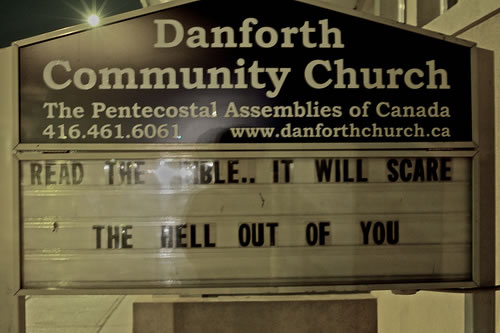
Click the photo to see it on its Flickr page.
Photo by Pete Forde.
Earlier today at the Search Engine Strategies 2008 Toronto conference, a speaker said “[Canadians] as a culture like to watch what people are doing, and we’re right next door to the biggest zoo in the world.”
Moments later, as if in response to this satement, someone instant-messaged me a link to a picture of this button, which was being sold at this past weekend’s Texas State Republican Convention:

Also seen at the convention was merch with these slogans:
Charming. It’s almost as if they’re trying to prove the adage “Liberals by and large are fools, and conservatives by and large are villains.”
On the bright side, Republicans Michael Williams and Mike Huckabee were also there praising the advance of Barack Obama and what it means towards a colorblind society. So maybe there’s still hope.

Once again, I’m at the Search Engine Strategies 2008 Toronto conference, covering the presentations. I’m still working my way through crunching yesterday’s presentations, but I though I’d give you folks a taste with this graphic, which is based on a key point from Fredrick Marckini’s keynote presentation from yesterday morning:

I’ll have more from the conference soon, and I’ll post it both here and in Global Nerdy.
Even Sith lords have rough nights:

Photo courtesy of Miss Fipi Lele.

My thanks to the folks at Yahoo! for loaning me part of their “Code Monkey” costume.
Welcome to Ignatz & Copyright, the first in a series of articles in which I, along with you the readers, will explore the debate over copyright, Canada’s Bill C-61, the American DMCA and related matters. If you want to find the inspiration behind this series, read the entry title Ignatz Zayats and the Copyright Debate, as well as the comments.
I thought I’d start by providing a quick definition of “copyright”, just to make sure that we’re all talking about the same thing. Copyright is a compound word, and in this entry, I’m going to look at the “right” in “copyright”.
The “right” in “copyright” refers to the set of exclusive legal rights granted to creators over their works for a limited period of time. These rights boil down to:
Copyright’s intent, to borrow the words of the “Copyright Clause” in the U.S. Constitution, is to “promote the Progress of Science and useful Arts”. By creating a legal mechanism for creators to be compensated, creators can make a living, and are given an incentive to continue creating works.
As I mentioned earlier, copyright is granted for a limited period of time. Once this period of time passes, the work enters the public domain, at which point it can be freely used and adapted by anyone.