Categories
It Happened to Me

I Have an Advance Copy of Neal Stephenson’s “Anathem”!

Neal Stephenson’s Anathem

A large, thick bubble-wrap-padded envelope arrived for me at the b5media office. As you can see in the photo of the label below, it’s from HarperCollins publishers:

I opened the envelope to my surprise, here’s what was inside:

I was stunned: it’s the much-anticipated Anathem, the upcoming book by T3H DR4K PR1NC3 0F H4X0R F1C7I0N (that’s “1337-speak” for “the dark prince of hacker fiction”), Neal Stephenson. Stephenson has been rather quiet about this one, saying little about the book beyond this oft-bandied-about hint in Gretta Cook’s LiveJournal:

It’s set on another planet and has aliens and so on. It’s really about Platonic mathematics, but he needed the aliens and space opera-ish elements to spice it up a little bit, just like the pirates kept people engaged in the Baroque books.

The Press Release

Here’s what the press release included with the book has to say:

NEAL STEPHENSON WILL BE AVAILABLE FOR INTERVIEWS OUT OF TORONTO OCTOBER 30TH

From the acclaimed New York Times bestselling author of Cryptonomicon and The Baroque Cycle comes a new stand-alone novel that marks a return to science fiction — the very genre that is Neal Stephenson.

Stephenson’s first new novel in four years, Anathem, derails a young monk’s quiet life behind the walls of a 3,400 year-old monastery with a world-wide catastrophe.

Since childhood, Raz has lived behind the walls of the monastery — a sanctuary for scientists, philosophers, and mathematicians. There, he and his cohorts are sealed off from the illiterate, irrational and unpredictable “saecular” world, an endless landscape of casinos and mega-stores that is plagued by recurring cycles of booms and busts, dark ages and renaissances, world wars and climate change.

Until the day that a higher power, driven by fear, decides it is only these cloistered scholars who have the abilities to avert an impending catastrophe. And, one by one, Raz and his friends, mentors and teachers are sent forth without warning into the unknown.

Anathem confirms Time magazine’s assessment that “Stephenson has a once-in-a-generation gift: he makes complex ideas clear, and he makes them funny, heartbreaking and thrilling.”

The Soundtrack (or: Hey! I know that guy!)

The book comes with an audio CD, whose “liner notes” are on the very first page of the book:

Here’s what the “liner notes” say:

IOLET :: Music from the world of Anathem

Track 1: Approximating Pi (6:53)
Track 2: Thousander Chant (5:29)
Track 3: Proof Using Finite Projective Geometry (4:04)
Track 4: Cellular Automata (5:29)
Track 5: Quantum Spin Network (5:49)
Track 6: Sixteen Color Prime Generating Automation (11:23)
Track 7: Deriving the Quadratic Equation (4:29)

Performers
Jeremy Bornstein – David Krueger
Mark Powell – Adam Steele
David Stutz – Thomas Thompson – James Whetzel

In order to conform to the practices of the avout, this disc contains music composed for and performed by voices alone.

One of the performers’ names jumped at me off the page: David Stutz. I had the pleasure of meeting David first on the Microsoft campus and again at various conferences dedicated to “peer-to-peer” technology. I remember talking not just tech with him, but also about music and our respective arenas musical performance — me with playing with rock bands and as a busker, him with baroque and choral ensembles. A quick check of his personal site confirmed that the David Stutz in the liner notes and the David Stutz I know are one and the same.

Why’d I Get Picked for an Advance Copy?

I suppose that I got the promo package because this blog is on the first page of Google results for the search phrase “Neal Stephenson Toronto”. That’s thanks to my attending his reading back in 2003 and winning a copy of Quicksliver and a chance to hang with him backstage. It’s covered in these three articles:

When Does the Book Come Out?

The publication date is September 13, 2008.

Does the Book Have a Website?

The press release says there’s supposed to be one at anathembook.com, but it doesn’t seem to be set up yet.

Am I Going to Ask to Interview Stephenson?

Interviewing authors isn’t normally my thing, but why not? I’ll let you know what happens.

Related Reading

Anathem and the Long Now: “Neal Stephenson’s new novel, ANATHEM, germinated in 01999 when Danny Hillis asked him and several other contributors to sketch out their ideas of what the Millennium Clock might look like. Stephenson tossed off a quick sketch and promptly forgot about it. Five years later however, when he was between projects, the idea came back to him, and he began to explore the possibility of building a novel around it. ANATHEM is the result, and will be released on September 9th, 02008.”

Anathem’s page on Amazon.com: ” Fraa Erasmas is a young avout living in the Concent of Saunt Edhar, a sanctuary for mathematicians, scientists, and philosophers, protected from the corrupting influences of the outside “saecular” world by ancient stone, honored traditions, and complex rituals. Over the centuries, cities and governments have risen and fallen beyond the concent’s walls. Three times during history’s darkest epochs violence born of superstition and ignorance has invaded and devastated the cloistered mathic community. Yet the avout have always managed to adapt in the wake of catastrophe, becoming out of necessity even more austere and less dependent on technology and material things. And Erasmas has no fear of the outside—the Extramuros—for the last of the terrible times was long, long ago.

Now, in celebration of the week-long, once-in-a-decade rite of Apert, the fraas and suurs prepare to venture beyond the concent’s gates—at the same time opening them wide to welcome the curious “extras” in. During his first Apert as a fraa, Erasmas eagerly anticipates reconnecting with the landmarks and family he hasn’t seen since he was “collected.” But before the week is out, both the existence he abandoned and the one he embraced will stand poised on the brink of cataclysmic change.

Powerful unforeseen forces jeopardize the peaceful stability of mathic life and the established ennui of the Extramuros—a threat that only an unsteady alliance of saecular and avout can oppose—as, one by one, Erasmas and his colleagues, teachers, and friends are summoned forth from the safety of the concent in hopes of warding off global disaster. Suddenly burdened with a staggering responsibility, Erasmas finds himself a major player in a drama that will determine the future of his world—as he sets out on an extraordinary odyssey that will carry him to the most dangerous, inhospitable corners of the planet . . . and beyond.”

Ask Neal Stephenson questions about Anathem: A Boing Boing article that says: “For a limited time only, fans have the chance to ask Neal Stephenson questions about his upcoming novel ANATHEM (though, of course, he may or may not answer…). Questions and answers will be on an online video that will be released before ANATHEM goes on-sale September 9, 2008.” It links to this blog for Eos Books, the sci-fi imprint of HarperCollins.

Categories
It Happened to Me Toronto (a.k.a. Accordion City)

The Aftermath of Last Night’s Storm

Last night’s storm, in which the sky turned a greenish colour, was a pretty impressive if brief one. The wall of rain that came down reminded me monsoon/typhoon weather in southeast Asia. Although the storm lasted just over an hour, we got 52 millimetres (2 inches) of rain, 430 lightning strikes and a number of flooded-out roads. One of those lightning strikes killed a man who was taking shelter under a tree, which goes against every bit of thunderstorm safety advice I’ve ever heard.

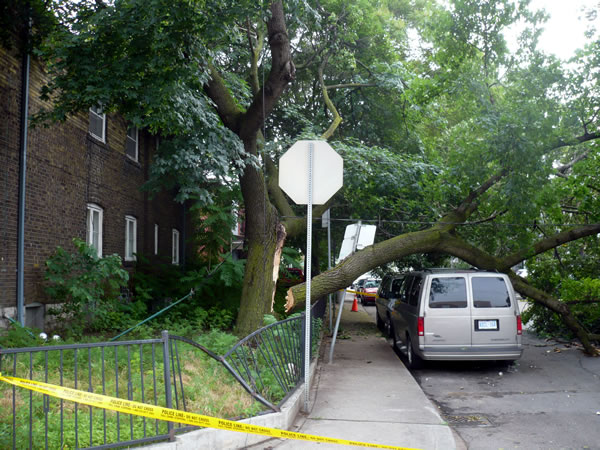
While biking on the way to work this morning, I saw this felled tree at the corner of Dundas and Golden:

Police and city workers cordoning off Dundas and Golden Streets

Police cordoned off the street and people from Accordion City’s public works department were working out how to remove the tree without crushing the van pinned under it:

Felled tree at Dundas and Golden

Here’s a closeup of where the branch split from the trunk:

Close-up of felled tree at Dundas and Golden

Categories
It Happened to Me

My First Brush with the Music Industry

This article also appears in Global Nerdy.

Clay Shirky: Gin, Television, and Social Surplus

Gin and television

If you’re a reader of the usual sites with links that nerds like, you’ve probably seen the video or read the writeup of Clay Shirky’s presentation at Web 2.0 on “Gin, Television, and Social Surplus”.

In his presentation, he describes a conversation with a TV producer, in which he talked about the effort that people put into the “Pluto” entry in Wikipedia. The producer, hearing this story, rolled her eyes and asked “Where do they find the time?”

Clay suggests that the producer believed that “free time”, which he refers to as “cognitive surplus” or “social surplus”, was TV’s by divine right. He posits that the mental energy once devoted to television watching and other equally passive ways of filling one’s spare time is being better spent — on the internet.

(I’ve always found that saying someone has “too much time on their hands” is an intellectually dishonest way of dismissing someone: see my entry Too Much Spare Time? and Cory Doctorow’s essay, Too Much Time on His Hands.)

If you haven’t seen the video of Clay’s presentation, here it is — it’s 16 minutes of your free time well spent:

The TV producer reminded me of a record executive whom I encountered at my first job out of school. It’s an interesting story about programming work and technology in the mid-90’s, the music industry and how predictions about technology can be way, way off.

My First Job Out of School

Main screen of the 1991 \"Mackerel Stack\"
A screenshot from the 1991 version of the Mackerel Stack, a HyperCard stack the promoted Mackerel’s design work.

My first job fresh from getting my computer science degree at Crazy Go Nuts University was developing multimedia applications in Director at a little company called Mackerel Interactive Multimedia.

The year was 1995, when Myst still defined the cutting edge of multimedia, CD-ROMs and sound cards were still fairly novel peripherals and the only other opportunities for a wet-behind-the ears developer seemed to be at a bank or insurance company, neither of which seemed to be appealing. While the pay wasn’t great — I used to call us the “hos of technology” and did a Full Metal Jacket-esque routine that ended with me shouting “Me so geeky! Clicky-clicky! Me hack for long time!” — the place wasn’t soul-killing like a bank or insurance company might have been. I could wear whatever I wanted, I could dress up my office space however I pleased, the hours were flexible and the co-workers were great: a hip and cool set of young people, with a near 50:50 gender balance. It seemed like Douglas Coupland’s Microserfs, which had just been published at that time, right down to the ill-advised office romances (one of which was mine).

While the dream at the company was to write the next Myst, we paid the bills by writing multimedia apps for clients — typically interactive advertising or educational pieces that would eventually be distributed on CDs or even multiple floppies.

The company went under after a disastrous merger in 1997. Its story was covered by Cory Doctorow wrote an article for Wired about the Mackerel’s demise; unfortunately, it never got published in the magazine. The Mackerel story is told from a different angle by co-founders Dave Groff and Kevin Steele at the Smackerel site, which is subtitled A Biased History of Interactive Media.

Enter the Record Exec

All-female band
One of the bands represented by the record exec’s company. You can try to guess who they are, and you should be able to figure out the record company as well.

One day during the summer of 1996, one of the founders came into the area where the developers hung out and told us that we’d landed a contract with an independent record label belonging to a major record company.

“Isn’t that a contradiction in terms?” I asked.

Apparently it wasn’t. The indy label turned out to be merely a new branch of the major record company. It would sign up-and-coming underground and alternative acts and use the major label for distribution. If the major label was pin-striped and buttoned-down, the indy label was its edgier nephew, clad in faux Hot Topic-esque cred. In spite of their trying-too-hard-to-be-cool aspects, we thought they’d make an interesting client.

The record company exec was a woman who was about five years past their twenty-something demographic. She gave off more of a business school vibe than a rock vibe. She peppered her speech with business-school-isms like “target audience” and “units sold”. She used the word “product” several times and didn’t use the word “music” or even “album” once. Everything she knew about music didn’t come from being a fan; it came from what she’d read in her market research reports.

“That’s why they don’t call it show art,” one of us quipped.

The Brainstorming Session

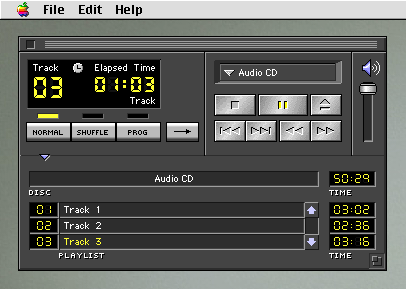
CD player app from Apple System 7
The CD player application from System 7, the version of Mac OS from 1996.

One of the goals of this initial meeting was to brainstorm some ideas for interactive apps that we could build for them. I had been working on an idea that I was rather proud of: CD player apps customized for specific albums. For any CD other than the one for it was customized, it would show a mostly plain interface, plus some promos for the album. However, if you used the player to play the album for which it was customized, it would “come alive” with lyrics, liner notes, album art and so on. It was an attempt to bring back what was lost in the move from LPs to CDs.

“Nice try, kid,” said the exec with great disdain. “We did some market research and we’ve determined that no one will ever listen to music on their computer. People see them as machines for getting work done. We’re aiming for the rec room, the den, the living room and the bedroom, not the home office. You computer guys are aiming for home office.”

“You sure about that?” our production manager asked. “We all use the CD players on our machines. For some of us, our computers are in our bedrooms and living rooms, and they’re also our primary stereos now.”

“That may be true for you,” she replied, “but you guys are the exception. Computers are great, but they’re office equipment. You don’t keep a typewriter or photocopier in your living room, so why would you have a computer there? And that’s where people listen to their music. Office equipment and entertainment: apples and oranges. Trust me – I’ve been in the music industry for a while – no one’s going to listen to music on their computer.”

I listened as a few other people had their ideas shot down in similar fashion. It was a matter of her knowing the music industry better than we did.

The Hail Mary MP3 Play

At some point during the increasingly futile brainstorming session, I remembered something that I’d brought back from the Macromedia User Conference. I reached into my laptop bag and fished out a floppy disc.

Set of three 3.5\" floppy disks

“Here, check this out,” I said, slotting the diskette into my laptop. “It’s something called Shockwave, which lets you embed multimedia applications inside web pages.”

“We don’t think there will be much interest in the world wide web outside of technical people. The pictures are tiny, you’re stuck with default fonts, and your customers have to go buy a modem. Too much tech hassle, too little payoff.”

“You should give this a look,” I insisted. “The company that makes the tool we use to write multimedia software is using MPEG layer 3 [the term “MP3″ hadn’t made common parlance yet] compression to squeeze music files into less space. There’s a small multimedia program on this floppy, and a whole three-minute song. It would normally take about 8 floppies to hold this song.”

I put the disk in my laptop and launched the Shockwave application, which started a tune playing.

“Sounds like crap,” she said. “And who’s the band? The Spin Doctors? They’re so over.”

“Ignore the band,” I said, trying to remain patient. “Just think of the possibilities. This three-minute single is only a megabyte in size. It fits on a floppy, which you can hand out, or you’d be able to download it in a reasonable amount of time. The download will be even faster on the new 56K modems.”

“Blah, blah, blah,” she said, making that opening-and-closing hand gesture signifying pointless chatter. “It only means something to you because you’re a techie. I’ve seen the market research, and I will tell you now: people are not going to be getting their entertainment from computers or the internet. It’s going to come from set-top boxes and MiniDisc recharging stations at their record stores.”

At this point, I decided that discretion was the better part of valour. “Well, you seem to have all the market research, so maybe the best thing would be for you to come up with ideas for an interactive application, and then we can hammer out the details with you in a later meeting.”

“I think that would be a good idea,” she said. She rose from her seat to leave the room, shaking her head.

“I don’t know about you,” I said to the others after confirming that she was out of earshot, “but I think the music industry needs to be destroyed.”

Categories
It Happened to Me Toronto (a.k.a. Accordion City) Uncategorized

The Honour System at High Park Station

To the north of High Park station, it’s practically all houses, apartments and condos, while to the south, there’s its namesake, Accordion City’s largest park. On weekday mornings, it’s only really busy between 7:30 and 8:45, after which it receives a trickle of passengers (relative to the downtown or major suburban stations) until the evening rush.

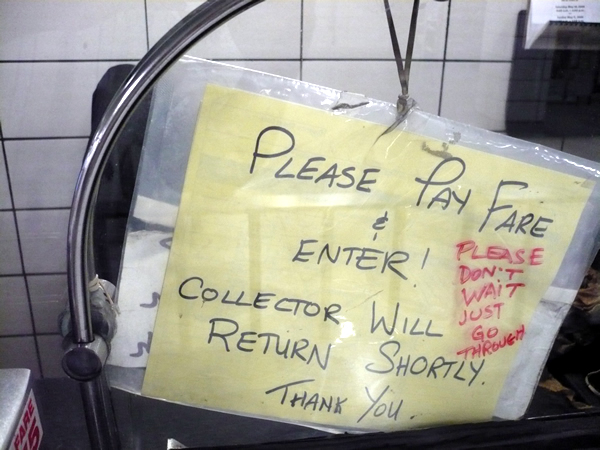
As a result, High Park station doesn’t seem as heavily staffed, which means that the ticket collector is often alone, with no one to relieve him or her when it’s time for a bathroom run (or to use the increasing popular office culture term, a “bio break”). When nature calls, the collector answers, and this sign goes up:

Sign at the ticket collector booth at High Park Station: \"Please pay fare and enter! Collector will return shortly. Please don\'t wait, just go through.\"
Photo taken by Yours Truly this morning at 9:03 a.m.

While it would’ve been as easy as pie to glide through the turnstile without paying, I and four other people who showed up at the same time dutifully deposited our fares into the collection box. I’m pretty pleased that the honour system still works in my little corner of the city, and seeing this little example of civilization in action made my morning.

Categories
Accordion, Instrument of the Gods It Happened to Me

Nine Years as “The Accordion Guy”

Here’s a blast from the past: me with purple hair, rockin’ out at Queen’s Park on Saturday May 1st, 1999:

Joey deVilla playing accordion and “throwing the horns” at Queen’s Park
I had no idea what was coming up next.

Yesterday marked the 9th anniversary of my playing the accordion on the street for the first time. I’ve got a longer entry about that fateful Saturday, when my friend Karl Mohr and I took our accordions out on the street that morning and ended the day as goth rock stars, and I’ll post it this weekend.

Categories
Geek It Happened to Me

Cory Doctorow’s Reading of “Little Brother”

Cover of Cory Doctorow’s novel, “Little Brother”

Last night, the Ginger Ninja and I attended Cory Doctorow’s reading of his new novel, Little Brother at the Merrill Collection (the collection of sci-fi books located in the upper floor of the library on College Street just east of Spadina). Little Brother is Cory’s first foray into writing a “young adult” book (memo to my friend Stacy Dillon: read this book!).

Here’s the publisher’s summary of Little Brother:

Marcus, a.k.a “w1n5t0n,” is only seventeen years old, but he figures he already knows how the system works–and how to work the system. Smart, fast, and wise to the ways of the networked world, he has no trouble outwitting his high school’s intrusive but clumsy surveillance systems.

But his whole world changes when he and his friends find themselves caught in the aftermath of a major terrorist attack on San Francisco. In the wrong place at the wrong time, Marcus and his crew are apprehended by the Department of Homeland Security and whisked away to a secret prison where they’re mercilessly interrogated for days.

When the DHS finally releases them, Marcus discovers that his city has become a police state where every citizen is treated like a potential terrorist. He knows that no one will believe his story, which leaves him only one option: to take down the DHS himself.

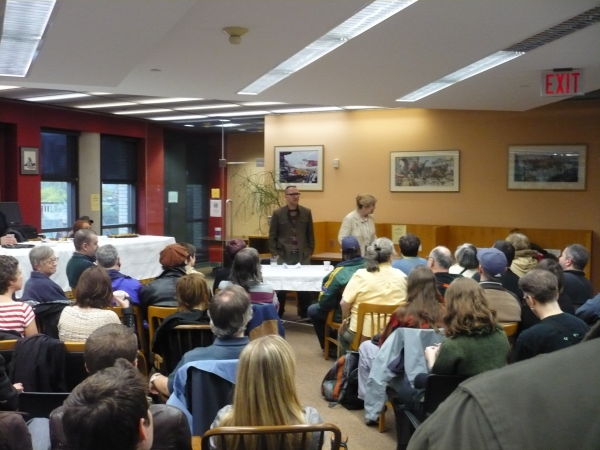
Cory Doctorow being introduced at his reading of “Little Brother” at the Merrill Collection
Cory being introduced to the crowd.

The room was packed to overflowing with Cory’s fans, largely a slice of Accordion City’s sizable nerd community, but a different branch from those you see at gatherings like DemoCamp. Cory’s family were also there: Alice and Poesy (who’s a very sweet, well-behaved baby) and the doting grandparents (whom I’ve mentally filed as the “Docto-‘rents”). I also saw some people I hadn’t seen in a good long while, including OpenCola alumni Chris Smith, Michael Skeet and Karl Schroeder, who writes sci-fi that’s harder than Chinese math.

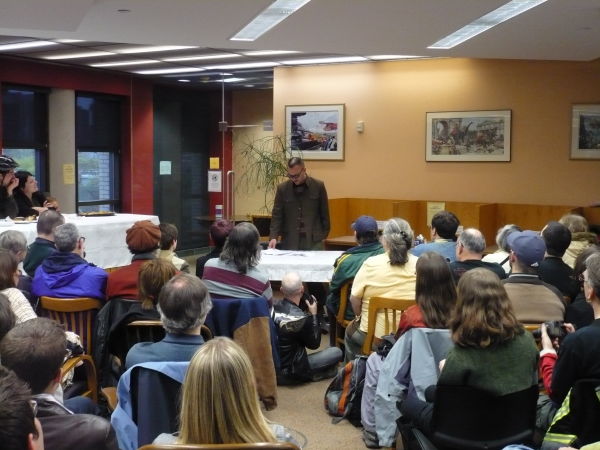
Cory reading from chapter 12 of his new novel, “Little Brother” at the Merrill Collection

In order to let some latecomers straggle in and not miss the reading, Cory opened the session by taking a couple of questions from the audience.

One member of the audience asked Cory for his opinion of the proposal that the SFWA — that’s the Science Fiction and Fantasy Writers of America — open their membership to comic book and graphic novel writers. Apparently this has sparked some controversy among science fiction and fantasy writers, who don’t want their roster muddied by funny-pages people. In response to this, Cory said that he supported the SFWA opening their doors to comic book people, stating “If science fiction writers and comic book writers have nothing to say to each other, then someone should tell Neil Gaiman.”

Another person asked about Cory’s being a Canadian writing about the Department of Homeland Security, whose methods and approaches are basically an American problem. Cory answered that a number of Americans have taken up the same challenge, and that being a Canadian gives you a little distance from the situation, which in turn can give a better perspective. He used a couple of comparisons: first, how being a bit of an outsider in high school can give you a better view into the social machinery of the popular kids’ cliques (a feeling that I’m sure everyone in this crowd was familiar with), and second, “It’s like we’re Animal House and they’re Dean Wormer.”

“Would you consider Little Brother a sequel to 1984?” asked someone else in the audience, to which Cory replied, “Don’t think of it as a sequel to 1984, think of it as 1984 fan fiction.”

Cory read chapter 12 of Little Brother. A lot of his descriptions of San Francisco’s Mission district come directly from experience; when he and I worked together down there, we ate at a lot of the little Mexican restaurants that fit those he described in the book, right down to the description of brain burritos and our never quite getting up the gumption to order them, even after watching the dinner scene near the end of Hannibal. (And I could swear that he wrote the make-out session near the Mission church by following me and my then-girlfriend back in 2001.)

The chapter was good solid present-day cyperpunk, and in addition of bringing back memories of San Francisco, it also brought back memories of being young, going to concerts and ditching my alcohol and running from the cops after they busted a bush party. As a forty-year-old, I enjoyed this snippet of the story, and I’m sure that teenagers — whom Cory says read not only for pleasure but also to figure out the world — will get a lot out of it.

Joey deVilla and Cory Doctorow
Posing with Cory after he signed my book.

It was good to see Cory and his family at the gathering — it’s a shame that he, Alice and Poesy live so far away! I’ll have to visit them in Merrie Olde Englande sometime soon.

Categories
It Happened to Me

Colossal Cake

We have team lunches (on the company dime, whoo-hoo!) reasonably often at b5media. Sometimes it’s dim sum, sometimes it’s shwarma, sometimes it’s pub food. Last week, we ended up at Wayne Gretzky’s, where we saw this colossal cake in the desserts display:

A whole colossal cake sitting in the dessert fridge at Wayne Gretzky’s
Damn, that’s one seriously stacked cake!

Naturally, we had to order a slice of this sucker. From what we could see, it’s a tricky cake to slice and carrying it to the table is a two-handed operation:

Darcie Vany, Jeremy Wright and a slice of “Colossal Cake”
My coworkers Darcie Vany and Jeremy Wright marvelling at the slice.

The slice fed 7 people quite nicely, and one can be yours for the low price of CDN$13.99. You might want to drop by Gretzky’s and get one if you’re entertaining hockey fans from out of town.