Categories
In the News

What World War III Might Have Looked Like

Here’s something fascinating yet spooky: the newly-elected Polish government has opened its military archives from the days of the Warsaw Pact, which includes a 1979 scenario called “Seven Days to the River Rhine” based on the ridiculous assumption that NATO would be the aggressor in a nuclear exchange. Here’s a map that outlines the scenario…
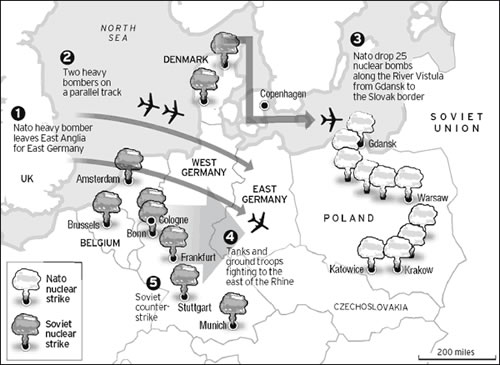
Map:  1979 map revealing the Soviet bloc's vision of a seven-day atomic holocaust between Nato and Warsaw Pact forces.

According to the Telegraph:

Radek Sikorsky, the Polish defence minister, displayed a map of USSR strikes which shows a barrage of Soviet multi-megaton nuclear strikes on key river lines, including the Rhine and the Meuse, and a Nato counter strike with smaller more accurate nuclear warheads on the Vistula as it runs through Poland.

The Nato strikes are supposed to have been mounted to interdict the movement of Soviet reinforcements from Russia to the battle front.

The whole scheme, codenamed Seven Days to the River Rhine, is predicated on the idea that Nato would be the aggressor and that the Warsaw Pact, under Soviet control, would respond only in self-defence.

Yeah. Right.

Sikorsky didn’t consult with Moscow before opening the archive, which is sure to ruffle some feathers in Russia. In an article in The Independent, who covered the event in the sensationalistically-titled Soviet Plans to Annihilate Europe Revealed, Sikorsky is quoted as saying:

“We need to know about our past. Historians have the right to know the history of the 20th century. If people did some things they were not proud of, that will be an education for them too.

I think it is very important for a democracy for the citizens to know who was who, who was the hero and who was the villain. On that basis we make democratic choices.

I think it is also important for the health of civic society for morality tales to be told: that it pays to be decent and that if you do things that did not serve the national interest, one day it will come out and you might be called to account.”
Categories
In the News

Maciej on Secret Prisons in Poland

Maciej Ceglowski, former hacker, painter and all-round interesting guy, commented on the Washington Post article that refers to secret outside-the-law prisons run by the CIA.

The article teases by saying that these prisons are in “eastern

European democracies”. The Post knows which specific democracies, but

won’t divulge them at the request of the U.S. government, for reasons

of security. Maciej writes that there is a considerable body of

evidence that suggests that his home country, Poland, is one of the

eastern European democracies in question.

Like most first-generation immigrants from oppressive regimes to North America

— myself included — Maciej holds America and its

principles — if maybe not its current administration — in high

regard. (He and I also hold Canada in rather high regard, but he trumps

me for having coined the Ceglowski Axiom,

“Any sufficiently advanced society is indistinguishable from Canada”.)

That’s why his closing paragraphs ring particularly true to these ears:

There’s an almost absurdist irony to the situation. The reason Poland

and other countries in Eastern Europe are so unabashedly pro-American

is that for fifty years, America stood for the antithesis of this kind

of behavior. Poles knew full well about secret prisons, torture,

incarceration without trial, and secret services that operate outside

the law, and they looked to the United States as a society that stood

against this kind of arbitrary exercise of state power.

Fifteen years later, we have television shots of

Polish and American generals standing side by side in in fraternal

solidarity in Iraq, and now perhaps hosting a special little Polish

branch of an American secret prison system. There’s a deja vu to this

that I hope other Poles will find as upsetting as I do. And I get to

feel the shame from both directions, since my adopted country is

colluding with my native one to break the laws of both.

Categories
In the News

Remembrance Day [Updated]

It’s November 11th, the anniversary of the singing of the Armistice, marking the end of World War I. It’s commemorated as Remembrance Day in Canada, various Commonwealth countries and in France and Belgium and as Veterans’ Day in the U.S.

Here in Canada, we often read this poem on this day:

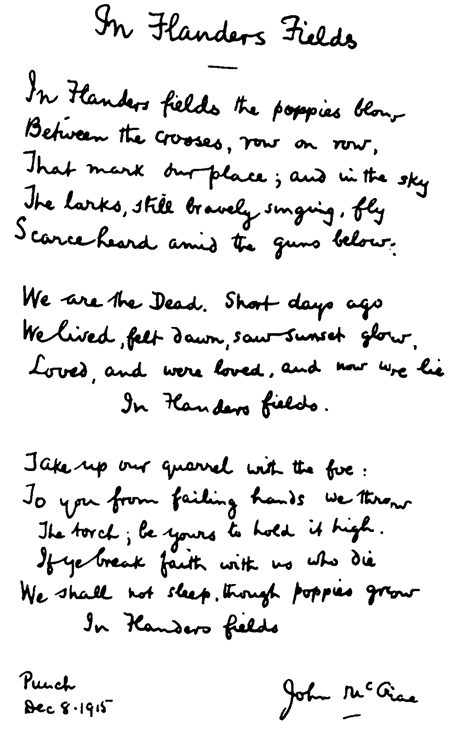
Photo: 'In Flanders Fields', in John McCrae's own handwriting.

In Flanders Fields was written by Lieutenant Colonel John McCrae MD, a field surgeon assigned to the First Field Artillery Brigade. It was written after a particularly bloody battle in Ypres that started on April 22, 1915 and that lasted 17 days. McCrae later wrote about the experience:

I wish I could embody on paper some of the varied sensations of that seventeen days…Seventeen days of Hades! At the end of the first day if anyone had told us we had to spend seventeen days there, we would have folded our hands and said it could not have been done.

In early May 1915, after performing a funeral for Alexis Helmer, who was both a student and friend (there was no chaplain available), McCrae sat in the back of an ambulance, from which wild poppies could be seen growing in a nearby cemetery.

(Poppies thrive in disturbed and upturned soil. The vastly improved artillery of the era and the introduction of trench warfare provided plenty.)

He wrote the following into his notebook:

In Flanders Fields the poppies blow,
Between the crosses row on row,
That mark our place; and in the sky
The larks, still bravely singing, fly
Scarce heard amid the guns below.

We are the Dead. Short days ago
We lived, felt dawn, saw sunset glow,
Loved and were loved, and now we lie
In Flanders fields.

Take up our quarrel with the foe:
To you from failing hands we throw
The torch; be yours to hold it high.
If ye break faith with us who die
We shall not sleep, though poppies grow
In Flanders fields.

He showed the poem to a Cyril Allinson, a 22 year-old sergeant-major, who was delivering mail at the time. Allinson is quoted as saying:

His face was very tired but calm as we wrote. He looked around from time to time, his eyes straying to Helmer’s grave.

The poem was exactly an exact description of the scene in front of us both. He used the word blow in that line because the poppies actually were being blown that morning by a gentle east wind.

It never occurred to me at that time that it would ever be published. It seemed to me just an exact description of the scene.

McCrae wasn’t satisfied with the poem and tossed it away. Luckily, a fellow officer retrieved it, and it was submitted to two British magazines: The Spectator and Punch (both of which still exist today). The Spectator rejected it, but Punch published it in December 1915.

Update: This commenter informs me that Punch stopped publishing in 2002.

Categories
In the News

And Now, the French Weather Report…


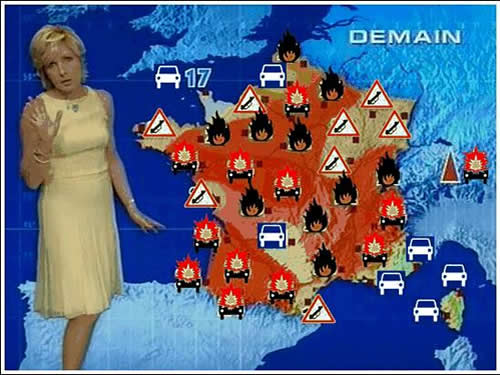
“Scattered explosions and a 99% chance of gloating on Little Green Footballs…”

Categories
In the News

When News and Advertising Synchronize

Take a look at the random ad that got served along with the news story titled Gigantic Apes Coexisted with Early Humans, Study Finds:

Categories
In the News Toronto (a.k.a. Accordion City)

Because You’re Curious: Ashlee Simpson’s Tantrum at the Bloor Street/Avenue Road McDonalds

A late-night post-drinking snack at McDonald’s is generally a bad idea, but one after having eaten at a great Italian restaurant like Spuntini is even more ill-advised. Worse still is throwing a temper tantrum because you’re not getting the B-list celebrity respect to which you believe you entitled, especially when someone is capturing the whole thing on their cellphone videocamera [2.4MB Windows Media video].

Categories
In the News

By Posting this Poppy Image, I’m Courting a Nastygram

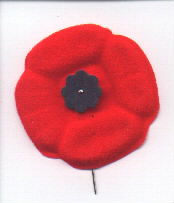
Photo: Rememberance Day Poppy.

If you’re Canadian, you recognize the image shown here: it’s a poppy pin, which is traditionally worn on lapels during the days leading up to Remembrance Day (November 11th), the day on which Canadians commemorate the sacrifices made by our veterans.

Here on this blog, it’s been a tradition to honour the veterans that day by posting a poppy image (here are my 2003 and 2004 entries). A number of other Canadian bloggers have done the same.

This may change. The Royal Canadian Legion gave Pierre Bourque some static for posting a poppy image on Bourque Newswatch, something he’s done for the past eight years. The reason:

…one Steven Clark, Secretary, Poppy and Remembrance Committee of the Royal Canadian Legion, who, in an inspired twist of bad PR, fired off a pointed email and demanded that I remove the poppy from Bourque.Com, the biggest and most powerful one-page website in the country.

“The Committee”, reprimands Mr. Clark, “acknowledges your effort to promote Remembrance but, as we do not have control over website content, the use of the Poppy image is not authorized.”

After receiving hundreds of emails in response from Bourque and his readership, here’s what Bob Butt (a man whose surname is so appropriate it’s downright Dickensian) had to say in reply:

“Hi, Sorry you’ve run into this but the poppy is a trademark of the Legion and anyone who wants to use it has to apply. Otherwise it would be all over the place. There are numeorus (Sic) examples where it has been used for sales and other purposes. As it is not in the public domain and because it is a registered trademark of the Legion the organization is taking every step it can to protect it (and I do mean every step). All this can be avoided in the future if you ask to use it on your site and you get the proper approval. Sorry, I know your heart and many others are in the right place. Unfortunately we have to protect this image or lose its use as a symbol of Remembrance.”

Colby Cosh sums up my feelings on this matter quite nicely, so I’ll let him do the talking:

I never thought I was helping to remove a piece of our cultural heritage from the public domain by buying Remembrance Day poppies. And I am certainly surprised to learn that “Remembrance” itself has become anyone’s formal property. I won’t pay for or wear one ever again. And neither should you.