Categories
Uncategorized

Accordion City in Forbes’ “World’s Most Economically Powerful Cities”

Toronto at night

Accordion City has made Forbes’ list of the World’s Most Economically Powerful Cities list, which goes like this:

  1. London
  2. Hong Kong
  3. New York
  4. Tokyo
  5. Chicago
  6. Seoul
  7. Paris
  8. Los Angeles
  9. Shanghai
  10. Accordion City (sometimes known as “Toronto”)

Here’s what Forbes has to say:

  • GDP (2005): $209 billion
  • GDP (2020): $327 billion
  • Growth rate: 3%
  • MasterCard ranking: 13
  • Population (2007): 5,213,000
  • Purchasing power (NYC=100): 113.8%

Toronto only narrowly edged out Madrid, Spain; Philadelphia and Mexico City, Mexico, to hang on at No. 10. Toronto is still the economic heart of one of the world’s wealthiest countries, and it’s projected to keep humming through 2020. Along with London, Toronto is the fastest growing G7 financial center.

For more on the Forbes piece, see their article as well as the commentary in the National Post blog Posted Toronto.

This story is doubly interesting, as it comes not long after the Fraser Institute, Canada’s conservative-and-sometimes-crazy think tank, published a report that said that Toronto was a city in decline, citing factors like median income and a decline in management jobs. I might buy the median income argument, but having dealt with management people of all sorts, a decline might be a good thing and would probably boost productivity (looking at their roster, the Institute seems to be largely made of “managers” as opposed to people who do actual work).

This article in Posted Toronto on the report brought out the usual parade of losers who beat that tired “since my family came to Canada, we’ve had nothing but trouble from the immigrants” drum.

Also Worth a Look

In BusinessWeek’s The World’s Best Places to Live 2008, Canadian cities make a strong showing, with Vancouver in 4th place, Toronto in 15th and Ottawa in 19th. Take these with a grain of salt: the highest-ranking cities were Zurich, Vienna and Geneva, which while nice places, could stand a good dose of laxatives; the highest-ranking U.S. city was Honolulu, with came in at 28th place.

Categories
Music

“Musical Key to Unlocking Teenage Wasteland”

Mrs. Lovejoy: \"Won\'t somebody please think of the children?!\"

In Australian newspaper The Age, an article titled Musical Key to Unlocking Teenage Wasteland took the results of a study in the most recent Australasian Psychiatry journal and created a chart which seems designed to make parents paranoid about the music their teenagers listen to. I’ve reproduced the chart below:

Your Sounds: What Studies Say:
Pop Conformists, overly responsible, role-conscious, struggling with sexuality or peer acceptance.
Heavy Metal Higher levels of suicidal ideation, depression, drug use, self-harm, shoplifting, vandalism, unprotected sex.
Dance Higher levels of drug use regardless of socio-economic background.
Jazz / Rhythm and blues Introverted misfits, loners.
Rap Higher levels of theft, violence, anger, street gang membership, drug use and misogyny.

I must be severely screwed up, as my music collection has healthy doses of all the above!

Buried in the middle of the article is a statement by the author of the published study: “it’s important to point out that music doesn’t cause these behaviours. It’s more a case of teenagers who may have a mental illness or are involved in these antisocial behaviours being drawn to certain types of music.”

The remainder of the article is just the same sort of freak-out fuel for parents that’s been around since the dawn of rock and roll.

Recommended Reading

In this Southern Spotlight article, Professor Kevin Dettmar observes that rock and pop music have historically been attacked during moments of national crisis: “fears of communism and greater teen independence in the 1950s; anti-war movements in the late 1960s and early 1970s; concerns with lyrics and formation of the Parents Music Resource Center in the mid-1980s; or the emergence of rap and hip-hop music today.”

“If you look carefully at those moments, you’ll find that we are not dealing with the real issues,” he said. “We are displacing a lot of nervousness, insecurity or anxiety onto rock ‘n’ roll. It becomes a scapegoat for bigger issues and bigger problems.”

Categories
Uncategorized

But I Want To and Have To!

\"Sandwich board\" on street: \"Hey! If you don\'t want to be a rock star, you don\'t have to be! -- Johnny Rotten\"
Found via yes yes.

Categories
Uncategorized

Handy Pizza Cutter or Cry for Help?

Optimist Club has this photo of a pizza spatula with integrated scissors taken from the Skymall catalog:

Pizza spatula with integrated scissors

“Every new utensil is another cry for help,” they say. If that’s true, then the Skymall and Brookstone catalogs are the twenty-first century’s equivalents of The Bell Jar.

Categories
Uncategorized

The Ring Finger – Index Finger “Gay” Test / Safety Dance!

Does anyone remember this myth? I remember first hearing it in high school…

\"If your ring finger is bigger than your index finger, you\'re a real MACHO MAN. But if your ring finger is equal to your index finger...you can be...GAY!!!\"
Image courtesy of Miss Fipi Lele.

(Wait…wasn’t Macho Man a big Village People single and a gay club culture anthem?)

I’ll bet that you looked at your hands right now, didn’t you? I’ll bet everybody looked at their hands. And when that happens, you know what it’s time for: Safety Dance!

Categories
Uncategorized

The “Business Shorts” Look

With the notable exception of prep school uniforms for the under-10 set and AC/DC’s Angus Young (whose trademark onstage look is modeled after a prep school uniform), I don’t think the “shorts-plus-business-attire” look works:

Men displaying \"officewear shorts\"
Looking at these guys, especially the one on the left, all I can think is “Hey, it’s the NAMBLA accountants!”
Photo from the International Herald-Tribune.

Pairing shorts with business attire is bad enough — especially in the case of the guy on the left, who looks like he had the pants from his suit tailored into shorts — but the “dress shoes minus socks” look takes these outfits into a new realm of horrible.

Perhaps these fashionistas dream of a future like the one shown in the first season of Star Trek: The Next Generation, where some crew members of either sex wore “skants” — a cross between a skirt and pants — a subtle note by the series’ creators that gender equality had been achieved in the 24th century:

Star Trek: TNG crewmember in a skant
“Even Wesley Crusher is laughing at me!”

There’s a reason that even in the hottest countries in the world, long pants are the only acceptable business attire. Shorts are fine, but they work best with shirts and shoes that match them.

For more on these business attire shorts, see the International Herald-Tribune article Shorts Crack the Code.

Categories
Uncategorized

To Defeat Al Qaeda, You Have to End the “War” on Terror

How Terrorist Groups End

According to How Terrorist Groups End, a paper put out by a certain group, military force is unlikely to stop Al Qaeda. “Which group?” you might ask, “Cindy Sheehan’s fan club? International Socialists? The League of Overeducated Underemployed Grad Students Who Hate Freedom?”

Nope. It’s the RAND Corporation. That’s RAND as in Research ANd Development, the global policy think tank first formed to offer research and analysis to the U.S.’ armed forces and now does thinking on social, economic, international and security policy. Their 2005 annual report says that about half their research covers issues of national security.

How Terrorists Groups End (which you can download for free and in full here) has this to say about the reasons terrorist groups end:
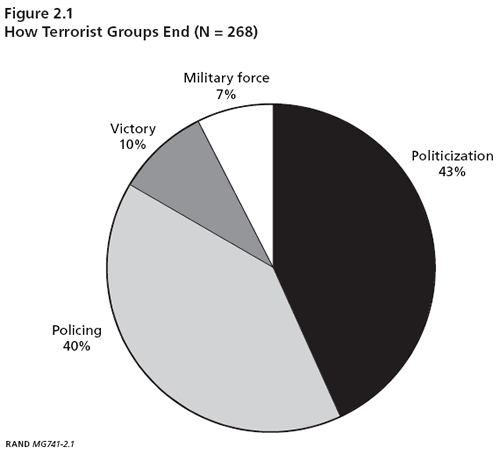
Pie chart showing the various reasons how terrorist groups end: Politicization (43%), policing (40%), victory (10%), military force (7%)

Terrorist groups end for two major reasons:

  1. Members decide to adopt nonviolent tactics and join the political process (43 percent), or
  2. Local law-enforcement agencies arrest or kill key members of the group (40 percent).

Military force has rarely been the primary reason for the end of terrorist groups (7 percent), and few groups since 1968 have achieved victory (10 percent).

“Sarcasm Tongs”

By the way, those sneering quotes (a.k.a. “sarcasm tongs”) around the word “war” in the phrase “War” on Terror? Those aren’t mine, they’re the RAND Corporation’s. The final chapter in their paper is titled Ending the “War” on Terrorism.

The Conclusion

I’ll close with the final section of How Terrorists Groups End:

The good news about countering al Qa’ida is that its probability of success in actually overthrowing any governments is close to zero. While bin Laden enjoys some popular support in much of the Muslim world, this support does not translate into the mass support that such organizations as Hizballah enjoys in Lebanon. This is not surprising, since there are few al Qa’ida social-welfare services, hospitals, or clinics. In 2005, Ayman al-Zawahiri urged Abu Musab al-Zarqawi to prepare for the U.S. withdrawal from the country by not making the same mistakes as the Taliban, which had alienated the masses in Afghanistan: “We don’t want to repeat the mistake of the Taliban, who restricted participation in governance to the students and the people of Qandahar alone. They did not have any representation for the Afghan people in their ruling regime, so the result was that the Afghan people disengaged themselves from them.” In addition, al Qa’ida continues to expand its list of enemies. It now includes virtually all Middle Eastern governments, Muslims (include Sunni and Shi’a) who do not share its views, Western governments, Asian governments (including Afghanistan, India, and Pakistan), the United Nations, and international nongovernmental organizations. Making a world of enemies is never a winning strategy.

But the bad news is that U.S. efforts against al Qa’ida have not been successful. They have now lasted longer than U.S. involvement in World War II. Despite some successes against al Qa’ida, the United States has not significantly undermined its capabilities. Al Qa’ida has been involved in more attacks in a wider geographical area since September 11, 2001, including in such European capitals as London and Madrid, than it was before that date. Its organizational structure has also evolved, making it a dangerous enemy. This means that the U.S. strategy in dealing with al Qa’ida must change. A strategy based on military force has not been effective. Based on al Qa’ida’s organizational structure and modus operandi, only a strategy based on careful police and intelligence work is likely to be effective.

“Police and Intelligence Work.” Where Have I Heard That Before?

If it sounds familiar, it might be because that’s the formula proposed by computer security expert Bruce Schneier, who’s been saying for a while that old-fashioned police work, not “security theatre” costing billions of dollars, is the key to countering terrorism.

It’s also what Noam Chomsky said:

Actually the fact that the terrorist act succeeded in September 11th did not alter the risk analysis. In 1993, similar groups, US trained Jihadi’s came very close to blowing up the World Trade Center, with better planning, they probably would have killed tens of thousands of people. Since then it was known that this is very likely. In fact right through the 90’s there was technical literature predicting it, and we know what to do. What you do is police work. Police work is the way to stop terrorist acts and it succeeded.

When the RAND Corporation and Chomsky agree on security policy, something’s going on.