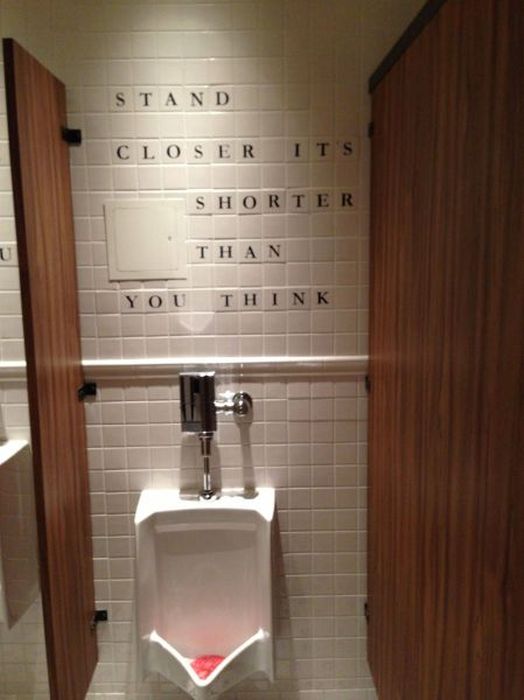
Ouch.
Ouch.

That’s why the water from the fountain tastes like Labatt Blue.

Click the photo to see it at full size.

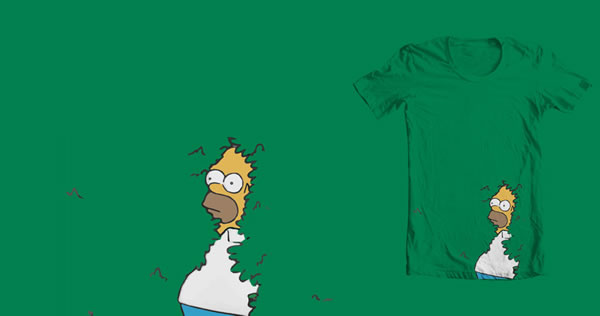
In honour of the 25th anniversary of The Simpsons, the T-shirt company Threadless asked a slew of artists to come up with new designs that you, the Threadless shopper, can vote on. Here are some of my favourites, which includes the muumuu Homer wore in the episode King-Size Homer (where he purposely gains a lot of weight to avoid the new exercise program at work, claim disability and work from home).

Update: Fair’s fair; if O’Connor gets a “Mopey Millennial” meme, Glass, Lewis & Co. get a “Scumbag Steve” meme, which appears near the end of this article.

The “Mopey Millennial” meme picture from Quickmeme. Click here to make your own.
 In The Awl, a New York-centric site devoted to long-form essays, there is an article with the I-know-you-want-to-click-me title of Millennial Fired for Tweet. I suspect that this was not the title that its author, Brendan O’Connor, gave the article; this suspicion is backed by the fact that the title of the page is I Got Fired for Tweeting. The difference between the two titles is a pretty good sign that the editors and O’Connor differ in opinion about the point of the story.
On Monday, July 22nd, O’Connor was still an employee of Milk Truck Grilled Cheese, a food truck known for gourmet grilled cheese sandwiches. He brought about the end of his stint in the mobile gastronomics sector when a group of customers placed an order that totalled about $170:
I asked some of the group as they were picking up their orders if they had intended to not tip. They hemmed and hawed and walked away.
Well. I could have not said anything. I could have made it a subtweet. I probably should have made it a subtweet. But I didn’t, because of some misguided notions about having “the courage of your convictions,” or whatever.
Shout out to the good people of Glass, Lewis & Co. for placing a $170 order and not leaving a tip. @glasslewis
— Brendan O’Connor (@OConnorB_) July 22, 2013
A couple of days afterwards, O’Connor got a call from the owner, who in turn had received a call from Glass, Lewis & Co., where concern about their being called out online was being expressed in places as high up as their head office in San Francisco. The owner apologized in the Twitter exchange below:
@glasslewis rgrding yest. tweet by an employee–it was flat out wrong. we do NOT in any way support or condone this behavior-our apologies.
— Milk Truck (@milktrucknyc) July 23, 2013
@milktrucknyc We appreciate it, and look forward to doing business with you again!
— Glass Lewis & Co. (@GlassLewis) July 24, 2013
…and in a move that isn’t all that surprising — except to O’Connor — the owner fired him. O’Connor writes:
And it was unfortunate but he was going to have to let me go. The company has a way of doing things and he thought I’d understood that. I had embarrassed him and the company and that was that.
…
What did I get out of this? Hmm. A “story,” maybe. A lesson about employers—at least in the food service industry—and what they think of workers advocating for themselves.
 The first hint about O’Connor’s feelings about his former job is how he describes it at the end of the first paragraph: “Grilled cheese: gamified”.
In case you’re not familiar with the term gamification, it’s the injection of game elements — play, challenge, competition, rewards — into non-gaming situations in order to get positive results, such as increased interest and involvement, greater effort, camaraderie, and learning. The idea is that unlike life, the best games have clearly-defined goals, offer challenges, and provide incremental, fair rewards that are directly connected to effort, and these elements often motivate people to excel. It’s something that productive people have already internalized; gamification exposes it to everyone in an attempt to raise the average. If you’ve ever been in some kind of competition at work where the person who sells the most widgets or answers the most support questions gets some kind of bonus, and especially if there’s a ranking, points-scoring, or Xbox-style “achievements” system involved, you’ve seen gamification in action.

Gamification, when done right, is win-win for everyone. Unfortunately, many attempts at gamification at work are cynical, manipulative attempts to squeeze more value out of the employees, who — from a bottom-line balance-sheet point of view, anyway — are just more costs to be cut.
A special bonus based on social media reviews has some flaws: there’s always the chance you could provide excellent service to someone who doesn’t mention it on Facebook, or someone having a bad day might end up taking it out on you on Twitter for no good reason. Still, I think that it’s reasonable to offer a small, special reward to teams that do so well that people sing their praises. Not O’Connor; apparently to him, the idea of a special reward for doing your job superlatively is outright manipulation. While not all millennials subscribe to the “everyone gets a trophy” philosophy, the fact that O’Connor makes the iTunes card his first example of Milk Truck’s employee-unfriendliness speaks volumes. He might even think that he should get one just for showing up. Based on the way he tells the story, you’d think he was one of the harried salesmen from Glengarry Glen Ross:
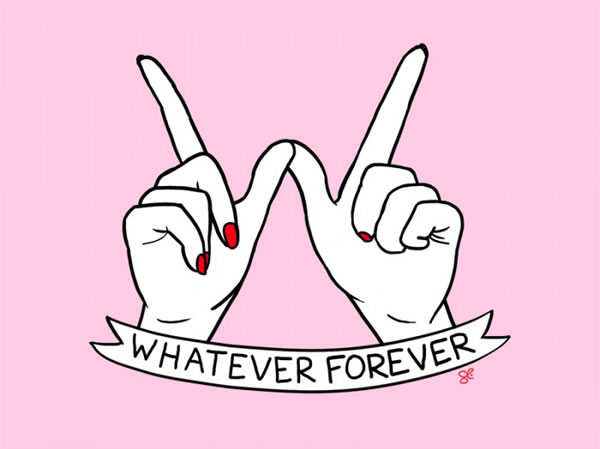
Image by Sara M Lyons – click to see the source.
Here’s the very first thing O’Connor writes about his decision to call out the non-tippers on Twitter:
Well. I could have not said anything. I could have made it a subtweet. I probably should have made it a subtweet. But I didn’t, because of some misguided notions about having “the courage of your convictions,” or whatever.
Let me take a moment to point out that nothing negates the high-minded phrase “courage of one’s convictions” — or any other similar phrase — like following it “or whatever”.
Go ahead, try tacking on “or whatever” to the end of your favourite quote: “‘Tis better to have loved and lost, or whatever.” “We shall never surrender, or whatever.” “Give me liberty, or whatever.” “Bitches leave, or whatever.”
Later on, the half-heartedness continues:
Obviously I knew it was a possibility that I’d get fired. I guess I had hoped that the owner would have my back if they complained, but that was a miscalculation. And the stakes weren’t too high, or I wouldn’t have done it: I’d been thinking about quitting and focussing on freelancing, so I had a luxury of speaking, and then tweeting, my mind.
He was thinking of leaving anyway, so at worst, getting fired would’ve moved his personal timetable forward a few weeks. The point, it would seem, is that he was denied his hard-earned share of the $34 tip (20% of $170, divided among the crew). Or whatever.
Some parts of O’Connor’s article are so wrong that I have to respond with animated pictures.
When I read these paragraphs…
To be fair, maybe I’m not the best employee for a gamified grilled cheese truck. About a month earlier, I’d come into work on a Saturday and was told I’d need to work late the next day. (Our schedules are established on a weekly basis, so this was very late notice.) I believed this gave me some degree of leverage. So I started bargaining. If they needed me to stay late on Sunday with only 24 hours notice, surely it was only fair that they let me go early that night?
They weren’t too happy about this and my bargaining failed—they just found someone else to work late on Sunday. I suppose this is why ‘collective bargaining’ is a thing.
…my reaction was:

Collective bargaining is for things like asking for a living wage or demanding the right not to be fired because you can’t accept a last-minute request to work the next day. It’s not for guaranteeing a “yes” answer when you ask to leave the business short-staffed on Saturday night in exchange for taking another shift assigned at the last minute, nor is it for guaranteeing you that shift.

Brendan O’Connor’s Twitter profile photo, enlarged and lightened. Not helping his cause.
And then there’s this gem:
And also: If social media is going to be used in one way to monitor worker productivity, why can it not also be used to advocate for a more civil exchange between worker and consumer? And why wouldn’t a food service entity, while it’s judging employees on social media, also judge its customers? The business practice of running a restaurant is to cultivate great customers and spurn bad ones.
My reaction:

This reminds me of a story from 1990s, when Russia was about to open its first McDonald’s. During a training session, in which the future McDonald’s staff were being taught customer service, there was one trainee who was getting more and more upset as the trainer kept emphasizing how important it was to treat the customer as well. Having grown up accustomed to only Communism, he’d finally had enough and blurted out:
“Why should we be nice to them? We have the burgers!“
Yes, there is a social contract in which customers must provide some comity in exchange for a business’ hospitality, but what customers really exchange for service is money. Unless the customers are doing harm to the business or its employees, the business is poorly served by scolding customers it disagrees with, and that goes double for employees who don’t own the business and can’t properly speak on its behalf. Restaurants and food trucks live and die by word-of-mouth, especially in competition-dense places like New York City; people there have tens of thousands of places to choose where to eat. In such environments, bad service — or outright naming bad customers — can hurt a business badly.
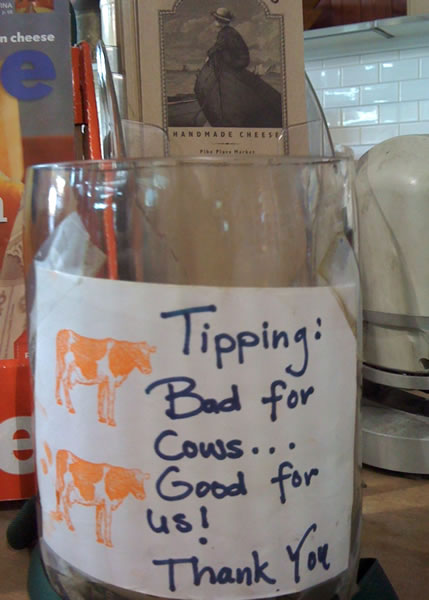
I would argue that even though there is debate about tipping at restaurants where you’re not waited upon, such as fast food places and food trucks, Glass, Lewis’ employees committed a faux pas by not tipping on a big order. I would also state that it was a bad call for Glass, Lewis to not let O’Connor’s tweet go and take up the issue with Milk Truck — in the end, it just generated more bad publicity for them (it even gets mentioned in their Wikipedia entry). I’m sure that in light of the Twitter kerfuffle and news coverage, they’ve instructed their employees to not appear so stingy, especially with the negative PR Wall Street is facing in times when most people have it bad (a lot of it due to the finance industry) while they’re riding high on taxpayer-funded bailouts and outsourcing-fuelled profits.
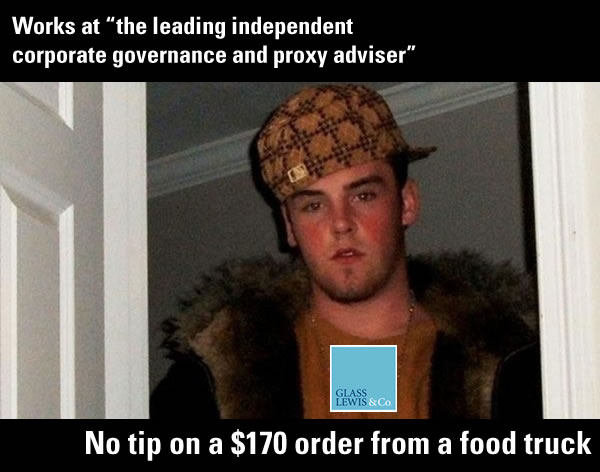
Still, in this competition in the Ongoing Entitlement Olympics, O’Connor took the gold medal.
I’ll close with a video I posted back in June, which seems only appropriate right now:
Toronto alt-weekly paper The Grid has an article that makes the same point I’ve been making in conversations about Toronto’s mayor, Rob Ford, and the video allegedly showing His Worship smoking crack. While the video has not surfaced, both a reputable news organization and Gawker will attest to its existence, and there’s still too much suspicious evidence that Ford’s ties to drugs are a little too close for comfort.

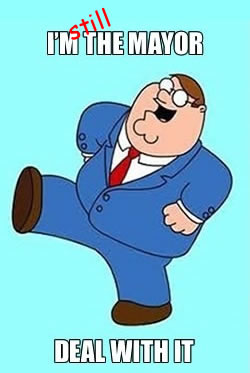 In the article, appropriately titled The Photo That Gets More Incriminating All the Time, Edward Keenan explains who and what are in the now world-famous photo of the Mayor. While it warms the heart-cockles to see Ford making nice with minorities, there are a number of disturbing things in the photo, which I’ve taken the liberty of annotating. Consider:
As for the most suspicious-looking photo foursome of all time? It’s these guys:

What happens when you cross the trailer for Pacific Rim…

…with the audio and promotional style of old-school Toho films from the original Godzilla era…

…and run it through some processing to make it look like it was made in the 1960s?

You get something quite wonderful:
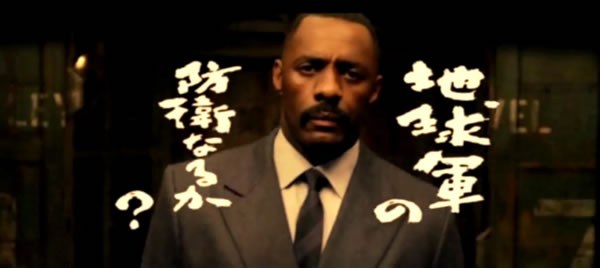
Here it is — a Pacific Rim trailer, done as if it were a trailer for Godzilla vs. Mechagodzilla (which is actually a ’70s film, but it feels like a ’60s one) — which is essentially what Pacific Rim is, anyway.