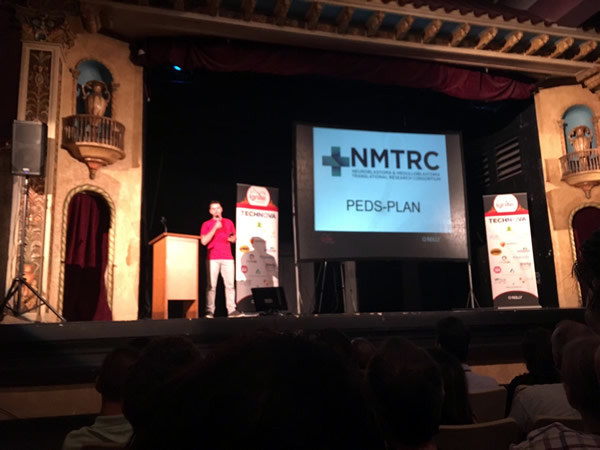
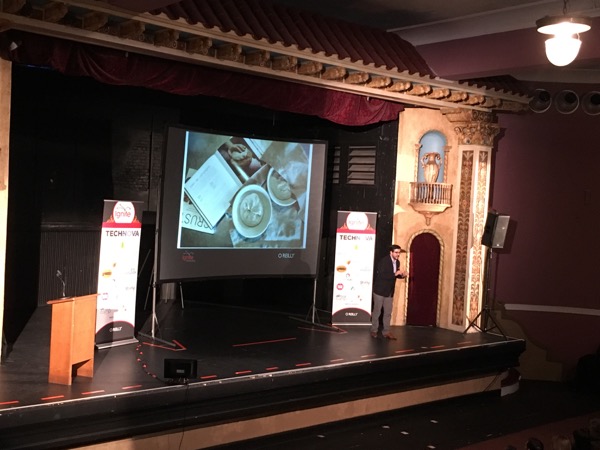
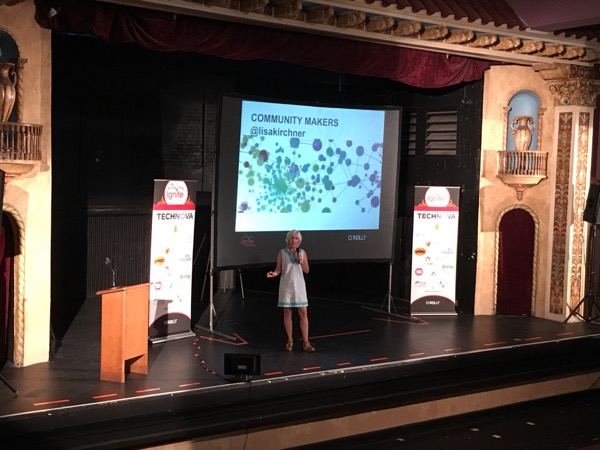
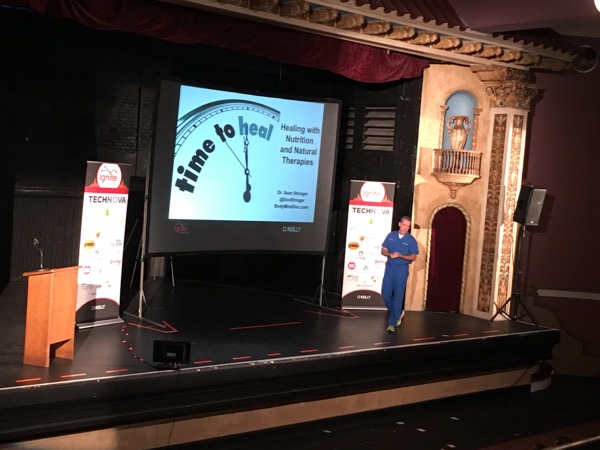
On Thursday, Anitra and I went to the 2016 edition of Ignite Tampa Bay, the sixth gathering where people from the Tampa Bay Area gathered to see presentations in the Ignite format, which has these constraints:
Each speaker is limited to exactly 5 minutes for his or her presentation.
Each presentation is accompanies by 20 slides, no more, no less.
The speaker has no control over when the slides advance; they automatically advance every 15 seconds.
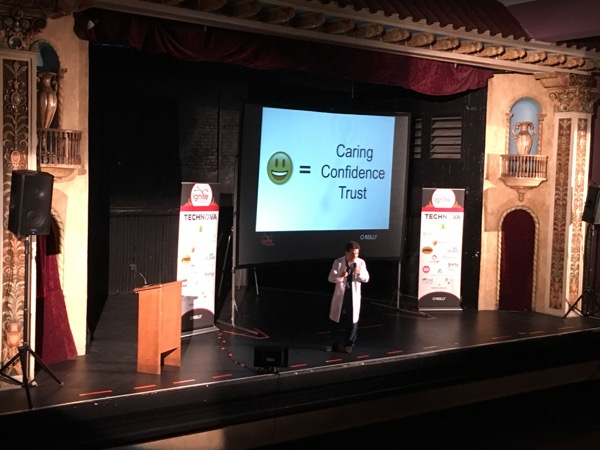
“This goes much better if you laugh at the jokes,” quipped Schwagler, after which he welcomed us to FetishCon 2016, which got a laugh.
He told the audience about his trip from St. Pete to Ybor City, which wasn’t made easy by a traffic jam on the causeway and the fact that his car had no air conditioning. In spite of an unpleasant trip, he said that he still arrived in Ybor City a smile on his face, because he was glad to be with the creative, passionate, and involved people participating in Ignite Tampa.
This is my favorite work on display at the Dali Museum. If you stand close to the piece, you see a somewhat surreal portrait of Salvador Dali’s wife Gala looking at the Mediterranean Sea as the sun, which doubles as the image of Christ, shines overhead. From a distance, or if you squint, the image morphs into a 121-pixel icon depicting the head of Abraham Lincoln. You can find out more about this painting and how it was inspired by Scientific American on the Dali Museum site.What you see in the painting depends on how you look at it.
The next thing he showed the audience was this image of a wheelbarrow:
He pointed out that while its design may seem “wrong”, there are cases where such a design would be useful. First, you don’t lift the handles on this wheelbarrow; you push down on them instead. This would be well-suited for moving heavy loads with precise steering, such as on skyscraper construction projects, where you might have to push a wheelbarrow while walking down an I-beam. Given the right circumstances, the “wrong” solution is actually the right one.
He then asked the audience to close their eyes and form a mental picture of Death Valley. He then showed this photo of a superbloom in Death Valley:
Even though Death Valley is the hottest, driest desert in North America, it experiences heavy rain every ten years or so, which leads to a super bloom like the one pictured above.Given the right conditions, even the biggest apparent wasteland is a bed of flowers waiting to happen.
He encouraged the audience to:
Learn in new ways, just as they did by looking at Dali’s painting differently
Think in new ways, just as they did with the wheelbarrow
Imagine new possibilities, just as they did with Death Valley
Schwagler saved the best story for last: a “Christmas miracle” story for creatives.
A friend had given him a set of Thomas the Tank Engine toys in a bag to give to his son. His son opened the bag of toys on Christmas morning, and mixed in with the toys was a wooden lion. The son took a fascination with the wooden lion and brought it to the kitchen, where they had a lion fridge magnet. He tried to stick the wooden lion to the fridge to match the other lion, but being made of wood, it simply feel to the floor. He tried and tried again.
“It’s not going to work,” said Schwagler to his son. “It’s not a magnet; it’s not going to stick.”
Schwagler proceeded to make coffee, and a short while later, he felt a tug from his son. He turned around and saw that his son had rearranged the other fridge magnets so that they held the wooden lion to the fridge.
That’s when Schwagler realized that he’d just done the opposite of what he does every day: encourage people to find creative solutions. His son, on the other hand, was doing just that. “It’s too easy to forget that new things can happen too.”
Bee Sting: John Foster
I’m an entrepreneur, and have been my entire life
I struggle with work-life balance, but I do have hobbies
My beer brewing hobby led to making mead, which in turn got me interested in bees
Maybe you think of bees as pests, but they’re incredibly important to this planets ecosystem
[Showing a photo of him as a geeky kid on an Apple II computer] When I was around 6 or 7, I had a feeling that I was going to do something extraordinary with my life
I always carried it with me, and I carried it out to world
I’ve performed on Broadway, recorded with Grammy-nominated musicians, written books, and started my own marketing firm, but I felt that I had failed anyway
I couldn’t point to one thing that I considered a success
I felt that I didn’t matter, and saw life through that lens
So I did what any rational person would do: pack up my family and run away, from New Jersey to Florida
I started an unsuccessful blog about SEO. I think it had 2 readers and I was both of them.
I changed my voice and got more visitors to my blog; about 1000 a day
One day, a reader sent me a picture of what looked like a car buried in snow, and my name was written in the snow
It came from a guy who’d quit his job and worked on a glacier preservation project
He wrote me a letter: telling me “What you are doing does matter. At least to me. What you wrote a year and a half ago still rings in my head encourages me to keep going.”
It became clear to me that the photo was of a glacier, not a car covered in snow
You don’t have to walk across the country or build a school to do something that matters. Do one thing that matters for you, your family, your community, the world, or the internet. That’s how you change the world
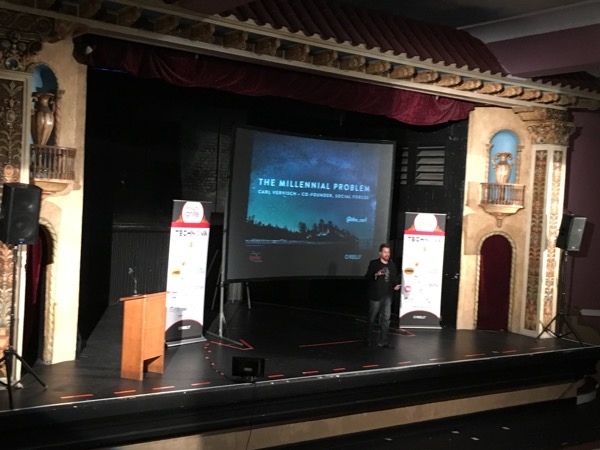
When you type “Why are millennials” into Google and look at the auto-suggestions, you’ll see a lot of bad stuff
I don’t take pictures of food, that’s not what food is for
I don’t take pictures of myself, that’s what strangers are for
I’m not like the millennials you hear about
Or maybe I am, which is why I’m claiming I’m not like them. Am I pushing away from their sinking ship and claiming a moral victory? That might explain my hipster moustache
Do millennials lack the loyalty that my dad’s generation had? The lesson we learned was that loyalty to company was rewarded with corporate mugging
Are millennials entitled in the workplace? Maybe it’s just that they want to take charge because they’re dying to make a difference, stand up for who they are, and face the challenge they were born to take on
Why can’t put down their damned phones? Maybe it’s because it’s amazing computing power that’s never been seen before in the world, with access to a world of knowledge and communication, in their hand.
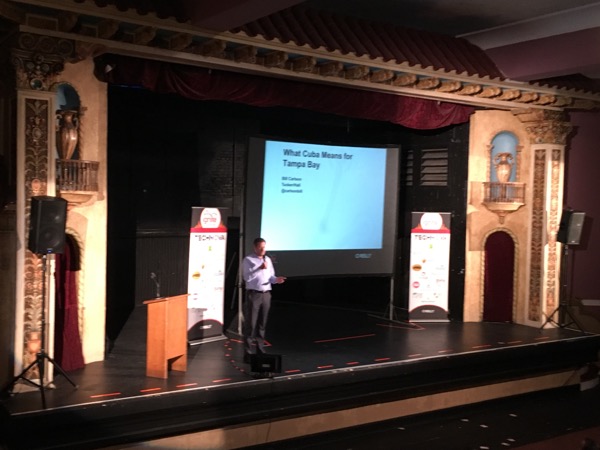
In 1930, a fledgling airline came to Tampa Bay, wanting to build a waterplane hub with links to the Caribbean and Cuba. Tampa said “no”, worried about the noise. That airline became Pan Am. Let’s not pass up the Cuban opportunity again!
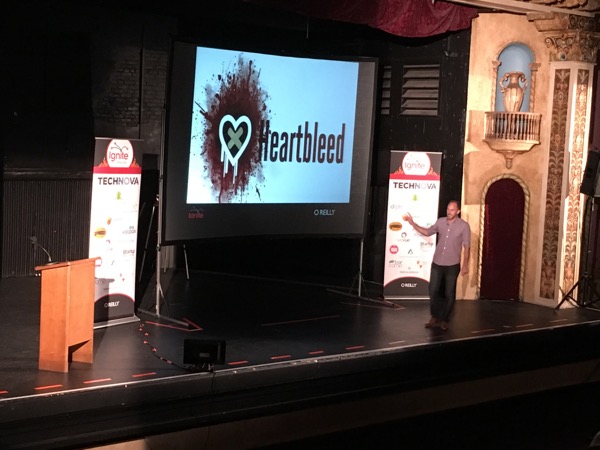
It was a seious vulnerability in a key piece of software called SSL, which is used all over the internet for secure communications
Part of its cause was that only $2000 a year was set aside to pay developers to work on it, making it a low priority
We need to find ways to fund the open source projects that we all depend on
I’ve come here to ask you for a few things:
If you’re a user, businessperson, or cretive, I want your ideas
If you’re software developer: I want you to become an open source software developer
Going open source typically gives developers a 20% to 30% pay raise because their source code is out there and potential employers can really see what they can do
The economic models for open source are not yet figured out
This comes from the way we learn: statistical learning. Everything you experience is encoded in your brain’s neural structure, brain makes mental model of world based on this
What we learn gets sorted out in a process called consoldation. It happens while you’re asleep, which means if you want to learn better, get more sleep
Our brains form schemes, which are organizations of thought based on our experiences. No two people have same experiences, and thus no two people have the same schemes
We know that memory can be reconstructed, and people are prone to inclusion errors and false memories. People can create memories or details of events that never happened
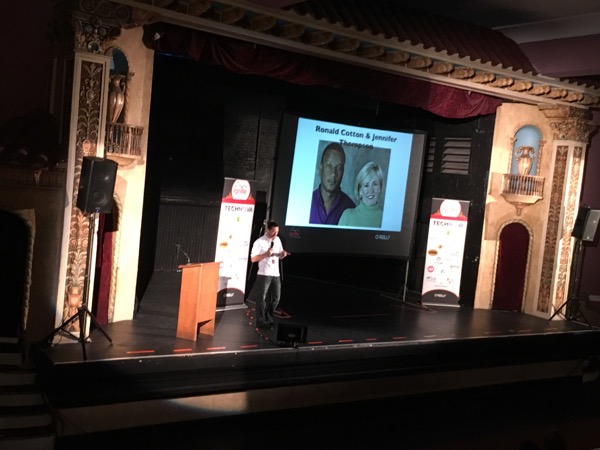
Example: Ronald Cotton and Jennifer Thompson [From the Innocence Project: Ronald Cotton was exonerated in 1995, after spending over 10 years in prison for crimes he did not commit. His convictions were based largely on an eyewitness misidentification made by one of the victims, Jennifer Thompson-Cannino. Cotton and Thompson-Cannino are now good friends and leading advocates for eyewitness identification reform.]
When we choose not to talk about the diversity that defines us, we become more polar, repressed, and intolerant
Religious belief is an identity, similar to political identity or sexual identity
It isn’t just “believer” and “non-believer”, but occupies a spectrum: fundamentalist on one end to progressive on the other
The problem with religion today is not holy wars, but the fact that progressives get along better with progressives in other faiths that with the fundamentalists in their own faith.
There is a rich diversity in all these traditions, but we end up creating cardboard cutout flat stereotypes insteads
Religion has refused to evolve. Religion needs to be disruptive and revolutionized
Most doctrine still divides us from ourselves, each other, and nature
What does modern spirituality look like? It’s people with a highly attuned bullshit detector, who turn to things that work for them: ecology, environment, volunteering, neighborhood, and a spirituality speaks to their soul without the need for a chaperone. It’s not a spirit of “either or”, but of “with and”
We need science and spirituality
We need something that captures the salvation of Christianity, the study of Judaism, the mindfulness of Buddhism, the submission of Islam
We’re still writing sacred texts today that show the world through a spiritual lens, and they include Star Wars and Harry Potter
The best scripture is the one you write every. Our meditation is our relationship
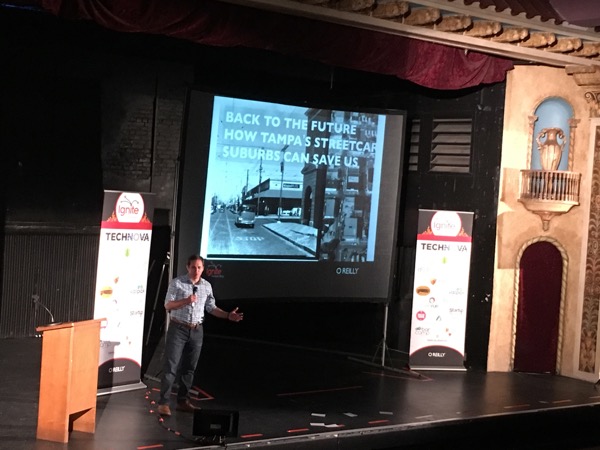
Back to the Future – Tampa’s Streetcar Neighborhoods Can Save Us: Brian Willis
There’s a big misconception about Tampa Bay — that it’s separate from rail and mix use development
We were built to be a streetcar and rail-compatible area
The place we now know as University of Tampa was not just a hotel, but a terminus for Henry Plant’s rail network
Safety Harbor had compact, walkable urban rail grids built around rail system
Lutz and Citrus Park [presently car commuter suburbs] were built around rail lines
You could take rail line from Lutz to Tampa via a system that was 59 miles of rail cars
Tampa’s original form was the streetcar suburb, but we tore it all up and replaced it with the automobile, which is worse. The more roads you build, the more traffic you create
We can go back to the future
Tampa’s compact blocks make it rail friendly
Urbanism values walkability, connectivity, and mixed-use public space
Go to Curtis Hixon Park and Tampa Riverwalk, once places that nobody went to and are now places to be. They show how high equality public space pays dividends
We need good transit; we’re a community the size of Rhode Island
In our future, there may not be flying cars, but there will be better transit
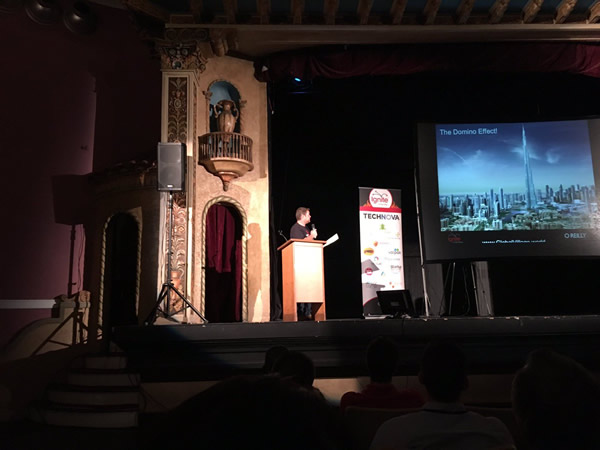
It’s a city where people of 120 nationalities are collaborating and living in harmony
Dubai’s second growth came from the formation of the smart city
It came from the realization that Dubai was not competing with just the region, but the world
They created free zones: mini cities for different industries, with collaboration centers, where 500 competitors would share a common space. It fostered relationships and collaborations.
I see Tampa as a Dubai waiting to happen. The stars have aligned, and the tipping point is here:
We’re spending $1 billion on doubling the size of the airport. The capacity of the combined Tampa and Orlando airports will be about the same as Dubai’s
At 5,000 acres, Tampa’s port is the largest in Florida, and it’s expected to quadruple in size
You see industry clusters forming in Tampa, just as they did in Dubai: beer, franchise restaurants, and home shopping, to name a few
I read Peak Performance, and recommend it. One thing I learned from it is that you cannot brute force the voice in your head into submission
I calm down through visualization and relaxation, letting me exceed what I can do. It help you get in your head the things that matter the most to you, what motivates you and drives you
Do that, then write them down, make them concrete
For 20 to 30 minutes every day, lie down, pick a spot on your ceiling, look at it, and feel yourself start to relax
Take intensity and internalize it
Remember, your brain will break before your body does
You have to make it intense and train your brain and body to relax. Visualize the most intense workouts you’ve ever done, then do them, and keep going

 On Thursday, Anitra and I went to the 2016 edition of Ignite Tampa Bay, the sixth gathering where people from the Tampa Bay Area gathered to see presentations in the Ignite format, which has these constraints: