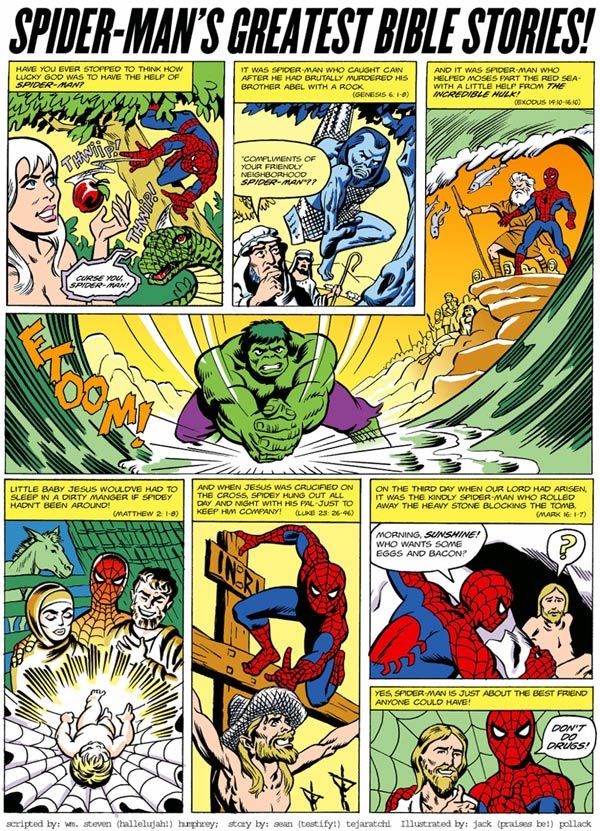
Here’s an oldie but a goodie created by the people at The Wittenburg Door, which is quite possibly the funniest religious magazine ever: Spider-Man’s Greatest Bible Stories!
Also worth checking out: The Rephrasing Spider-Man!
Here’s an oldie but a goodie created by the people at The Wittenburg Door, which is quite possibly the funniest religious magazine ever: Spider-Man’s Greatest Bible Stories!
Also worth checking out: The Rephrasing Spider-Man!
I’ve posted more notes from the Search Engine Strategies 2008 Toronto conference over at my technical blog, Global Nerdy:
Searcher Moms: Microsoft researcher Pavan Li talked about her research of the search behaviour of mothers, an important demographic not just ’cause they’re moms, but because they have the magic combination of education, buying power and being the primary purchasers of goods for the family.
The Golden Triangle: Enquiro Research’s Gord Hotchkiss talks about some new discoveries related to “The Golden Triangle”, the most valuable piece of real estate on any search engine’s results page.
The Daily Show came up with a pretty good “Obama campaign graphic” about the recent story in two of of his volunteers kept two women wearing headscarves out of a campaign photo:

“Baracknophobia,” said host Jon Stewart, “the irrational fear of hope, has gotten so bad it’s infected Barack Obama’s own campaign.”
You can watch the Daily Show clip at these locations:
Here’s a shot that I took of Accordion City’s New City Hall, taken last Sunday just moments before a serious downpour:

Click the photo to see it on its Flickr page.
More notes from Search Engine Strategies 2008 Toronto — this set is from the session Introduction to Search Engine Marketing, whose description is:
“Search Engine Marketing” (SEM) is a general term that encompasses the entire field of web search visibility, including paid search ads (sometimes called “PPC” for pay-per-click) and improving visibility in unpaid organic search listings (generally referred to as SEO, for “search engine optimization”). This session will provide a broad-ranging and concise survey of how search engines work, where to prioritize your time and effort, and key marketing concepts. The session is particularly useful for newcomers to the field, and first-time SES attendees.
Search engine marketing (SEM):
One of the things Google will admit: there are over 200 factors in their algorithm. They won’t say what those factors are, though. In spite of this, you can still take Google and boil it to these two components:
Google has been getting cleverer with how they treat the words on your page. Features like latent semantic indexing allows them to recognize synonyms and related words. They also have the flexibility to respond to challenges such last year’s SEOmoz campaign to make Stephen Colbert the number one result for the search term “greatest living American” through Googlebombing and similar gaming. “Every now and then, when you think you have Google figured out, they’ll surprise you.”
The first phase in any SEO/SEM campaign is keyword research. For this, we recommend The Search Engine Marketing Kit by Dan Thies and Dave Davies.
The old way of marketing was: we create a slogan, then hammer it into people. It doesn’t fit search. When people are looking for an affordable hotel, they type the search term “cheap hotel”. “Cheap hotel” is not something that a brand manager would want associated with his or her hotel, but it’s what potential guests are looking for.
The first step in keyword research is thinking like your customer. Think about the words users would type to find your pages. Brainstorm keyword categories that address your customers’ wants. Compile the brainstormed keywords for further review of traffic potential, competition and other factors.
Recommended keyword research tools:
Once you have the data, the temptation is go for most popular keyword. Typically, it’s one word, and the likeliness of “winning” the one-word term is nil. Besides, the average search term is two or three words long, so use two- and three-word key phrases. Examples: “Russian nesting dolls” and “online press release” (which also contains the often-looked-up “press reelase”). Build each page around the top two or three phrases that you would like it to be for: company or description, products or categories, benefits or lcoations.
Follow Google’s design, content, technical and quality guidelines. Make sure that you keep up with the webmaster guidelines, as they’ve been updated a lot. The guidelines, used to be cryptic and vague, with suggestions like “It’s good to have links, but not bad links”. Google doesn’t really want to be cryptic, but they also don’t want to be gamed.
Over the last couple of years, they’ve creating some webmaster tools that will help diagnose your site and show you what they’re having trouble crawling. You have to sign up for it.
Good SEO requires a mix of “writing and crossword puzzle” skills.
Some page writing tips:
<title> tag.SEO copywriters need to learn white-hat linkbaiting techniques — see Matt Cutts’ January 24th, 2006 blog entry for more on this. In fact, be sure to follow his blog: he’ll clarify issues even faster than Google’s official pages, and what he writes often becomes policy.
Link building is as hard as getting publicity in the Globe and Mail. Quantity, quality and relevance of links count towards your rating. One high-quality link is better than many low quality links.
Getting listed on directories is tricky. Being listed on some directories is okay with Google, being listed on some others is not. There’s always some confusion: welcome to our world!
Another good source of links is the “Buzzing Blogosphere”. You need to understand blogger link love!
Be sure to read Eric Ward’s blog entry titled LinkMoses’ Linking Commandments, Part One (there’s only one part). If you follow only one of them, follow this one: “Thou shalt not use the name of Matt Cutts in vain (at least not publically or where it could be dugg)”.
Social Media Optimization: a new frontier, a new world shaped by Digg, Flickr and so on.
Analytics tells you more than how many visitors you got this month.
A thought about Google Analytics: Google is selling you the ads and knows what people are clicking on. Some people think that’s too much information for a sales vendor to have. Use multiple vendors so you can maintain control over your information — split it up, use tools that belong to different entities.
Vertical search has been around a long time. Not much attention has been paid to it, but there are all sorts: B2B, book search, blog search, local search, image search, news search.
Here’s an important tip: optimize press releases for search. A well-optimized press release can hold its ranking for a long time. I’ve seen a 2003 press release that’s still a #4 result in searches today.
Google Universal Search: one of those things that search engine companies are creating that we’re still inventing words for. “This is the challenge that you have entered into.” It blends results from its vertical searches — images, news, video — with the organic results. Search results aren’t just about text anymore! If you’re thinking about optimizing your multimedia assets, now is the time to do it!
Google has not rolled out universal search universally. Only about 17% of searches will feature universal search results.
(Today’s been a rather tech-heavy day here at The Adventures of Accordion Guy in the 21st Century, but I promise that the regular stories will keep coming, such as this one…)
You might recall the story of Brad Jayakody, the guy who wasn’t allowed to board his flight at London’s Heathrow airport because it had a picture of the Transformer robot “Megatron”, who appeared to be holding a gun (In fact, Megatron turns into a gun). He was declared a security risk because of his T-shirt:

Brad Jayakody and the T-shirt image that got him in trouble with Heathrow airport security.
If there are T-shirts that will get you stopped by airport security, could there be T-shirts that would let you breeze past them with nothing but a wave? I think the guy pictured below in line at the airport in Fort Lauderdale, Florida, has the answer:

Taken this week in Fort Lauderdale, Florida.
Photo courtesy of Miss Fipi Lele.
Stay classy, Fort Lauderdale! No wonder FARK.com has a whole category devoted to Florida alone.