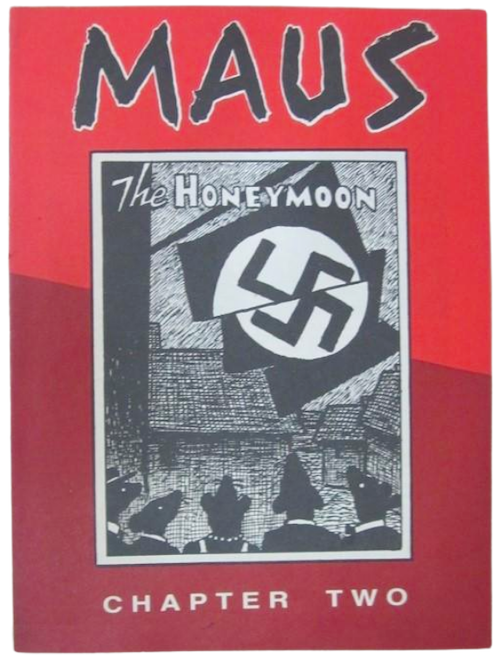
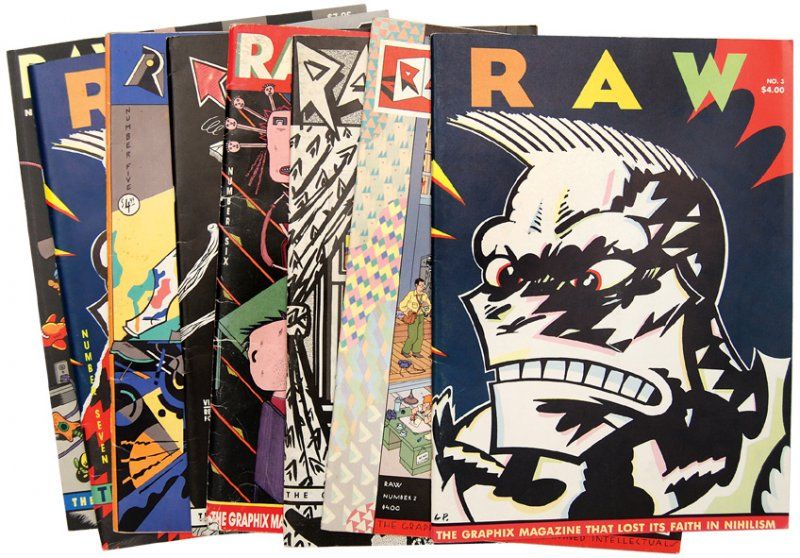
My first encounter with Maus — the graphic novel recently banned by the school board in McMinn County in Tennessee — was in 1987. It was, as far as I knew then, a work in progress: a small comic book inserted into issues of a larger magazine called Raw:
Peter had started playing guitar a few months prior. He was a natural with the instrument, and his playing skill was growing in leaps and bounds. We started playing music together often — him on guitar, me on synthesizer.
With his growing interest in writing and playing music, he was getting less interested in his collection of comics and graphic novels. One day, while jamming at his house, he pointed at a box of comic books and graphic novels and said “take whatever you want”.
One of them was issue 3 of Raw. It captured my interest with its subtitle: “The Magazine That Lost Its Faith in Nihilism”.
While the magazine had some great stuff (including an amazing article about Wonder Bread), the most interesting part was a smaller magazine within the magazine: chapter two of Maus, titled The Honeymoon.
Raw felt like a zine, but a zine that has somehow found some of the best artists in the genre (RAW alumni include folks like Lynda Barry, Charles Burns, Kaz, Ever Meulen, Alan Moore, Gary Panter, and Chris Ware), and published them in giant-size high-quality paper format instead of as photocopies stapled together.
Spiegelman included Maus in serial form in Raw. It would later get anthologized into a book, which in turn would go on to win the Pulitzer Prize in 1992.
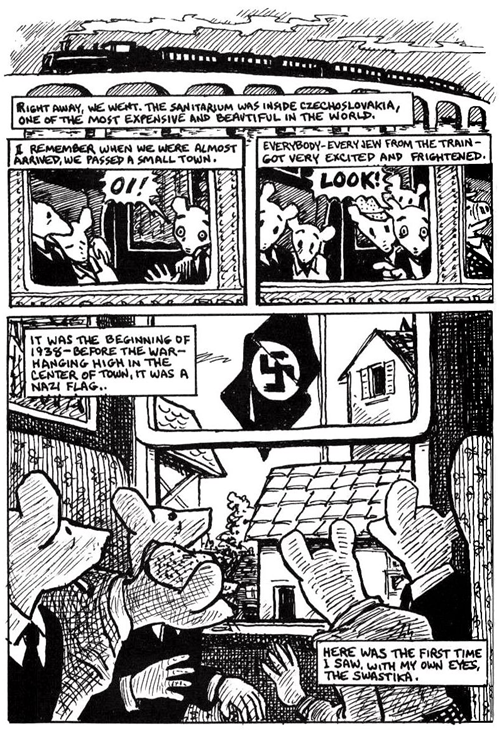
Maus is a story depicting Spiegelman talking with his father Vladek, a Jewish Polish immigrant to the U.S., about his experiences during World War II. Most of the story is told from the point of view of Spiegelman’s father.
Spiegelman used anthropomorphics as a story-telling device, depicting Jews as mice, Germans as cats, and Poles as pigs. Later issues would feature Americans as dogs, the English as fish, the French as frogs, and the Swedish as deer.
Maus was by far the best part of Raw issue 3. When it got turned into a book, I picked up the book, and somewhere in my mother’s house in Toronto, both the book and that issue of Raw are on a bookshelf in the basement. I’ve got to dig them up the next time I visit.
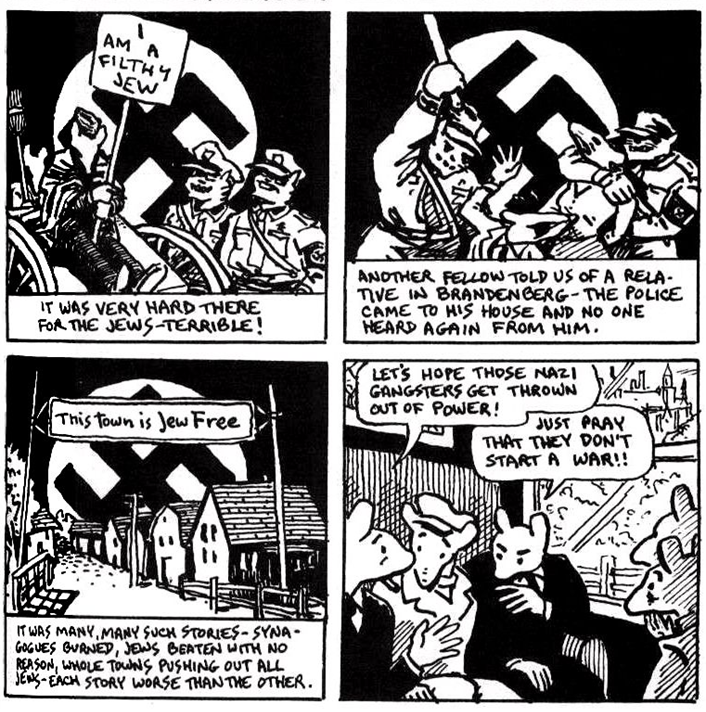
Maus is more than just a story with comic book animals, and it’s also more than a story about of the horrors of the Holocaust. It also tells a story of generational trauma brought on by institutionalized and nationalized cruelty — the kind that we’re regrettably test-marketing here in the U.S. today.
It also tells the story of a son and father trying to come to an understanding, challenged by the differences in their life experiences and the fact that the father grew up in “the old country” while the son grew up “here”. Being in the same situation myself, that resonated with me.
If you get the chance, read Maus. It’s excellent.
Check out these videos…
If you’re looking to get into the erotic waffle business on a limited budget, there’s…
Whoo-hoo! We managed to get a reservation to visit Yamaha’s Innovation Road museum in Hamamatsu,…
It’s Sunday, and it’s time for another “picdump,” but this is no ordinary picdump. This…
Is it just Florida, or do campaign ads for Governor in other states feel like…
Why this photo? Because the accordionist pictured above, who could easily be a stunt double…
The Sourdough Co. in St. Pete has some pretty nice digs now in St. Pete’s…

View Comments
"The cruelty is the point" this line really struck me. Thank you for sharing your personal connection to this important piece of literature. Beautifully written and curated.
Wonderful article. Great to rediscover your blog.