Yup, another article originally published in my tech blog, Global Nerdy. As with the previous two, this one is of interest not just to programmers, but anyone using portable and mobile computing devices, such as smartphones, netbooks and laptops.
If you’re pressed for time, the graphic below – which takes its inspiration from these articles by Kathy “Creating Passionate Users” Sierra — captures the spirit of this article rather nicely:
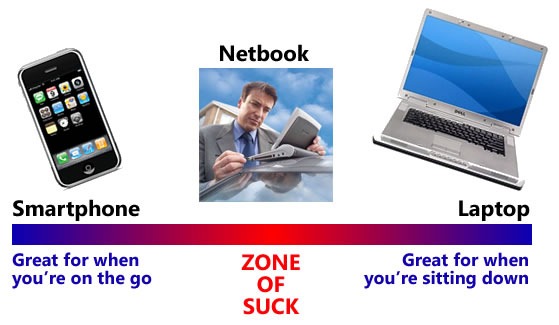
If you have a little more time to spare, I’m going to explain my belief that while netbooks have a nifty form factor, they’re not where the mobile computing action is.
A Tale of Two Pies
When I was Crazy Go Nuts University’s second most notorious perma-student (back in the late ‘80s/early ‘90s), I took a handful of business courses at the recommendation of my engineering and computer science professors. “You’re going to have to learn to speak the suits’ language,” they said. Crazy Go Nuts University has a renowned business school and I thought it would be a waste not to take at least a couple of business courses. I especially liked the Marketing couse, and one lecture stands out in my mind: a case study comparing the dessert offerings of two major fast food chains.
In the interest of not attracting the attention of their lawyers, I’m going to refer to the chains as:
- Monarch Burger, whose mascot is a mute monarch with a glazed-over face, wearing a crown and associated paraphernalia, and
- Jester Burger, whose mascot is a clown in facepaint and a brightly-coloured jumpsuit who loves to sing and dance.
Both Monarch Burger and Jester Burger offered a dessert that went by the name “apple pie”. Let’s examine them.
Monarch Burger’s Pie
 Monarch Burger went to the trouble of making their apple pie look like a slice of homemade apple pie. While it seems appealing in its photo on the menu, it sets up a false expectation. It may look like a slice of homemade apple pie, but it certainly doesn’t taste like one. Naturally, it flopped. Fast-food restaurants are set up to be run not by trained chefs, but by a low-wage, low-skill, disinterested staff. As a result, their food preparation procedures are designed to run on little thinking and no passion. They’re not set up to create delicious homemade apple pies.
Jester Burger’s Pie
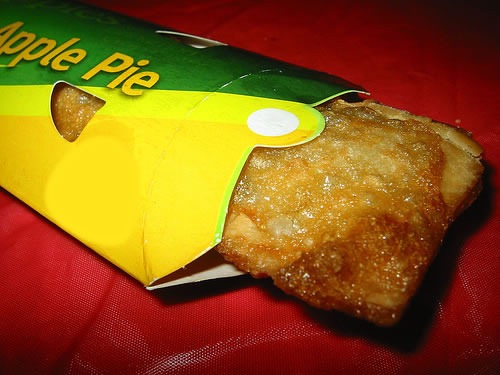
Jester Burger’s approach was quite different. Their dessert is called “apple pie”, but it’s one in the loosest sense. It’s apple pie filling inside a pastry shell shaped like the photon torpedo casings from Star Trek. In the 70s and 80s, the pastry shell had bubbles all over it because it wasn’t baked, but deep-fried. After all, their kitchens already had deep fryers aplenty – why not use them?
Unlike Monarch Burger’s offering, Jester Burger’s sold well because it gave their customers a dessert reminiscent of an apple pie without setting up any expectations for real apple pie.
Jester Burger’s pie had an added bonus: unlike Monarch Burger’s pie, which was best eaten with a fork, Jester Burger’s pie was meant to be held in your hand, just like their burgers and fries.
At this point, I am obliged to remind you that this isn’t an article about 1980s-era desserts at fast food burger chains. It’s about netbooks and smartphones, but keep those pies in mind…
Netbooks are from Monarch Burger…
Netbooks remind me of Monarch Burger’s apple pie. Just as Monarch Burger tried to take the standard apple pie form and attempt to fit it into a fast food menu, the netbook approach tries to take the standard laptop form and attempt to fit it into mobile computing. The end result, to my mind, is a device that occupies an uncomfortable, middle ground between laptops and smartphones that tries to please everyone and pleases no one. Consider the factors:
- Size: A bit too large to go into your pocket; a bit too small for regular day-to-day work.
- Power: Slightly more capable than a smartphone; slightly less capable than a laptop.
- Price: Slightly higher than a higher-end smartphone but lacking a phone’s capability and portability; slightly lower than a lower-end notebook but lacking a notebook’s speed and storage.
To summarize: Slightly bigger and pricier than a phone, but can’t phone. Slightly smaller and cheaper than a laptop, but not that much smaller or cheaper. To adapt a phrase I used in an article I wrote yesterday, netbooks are like laptops, but lamer.
Network Computers and Red Herrings
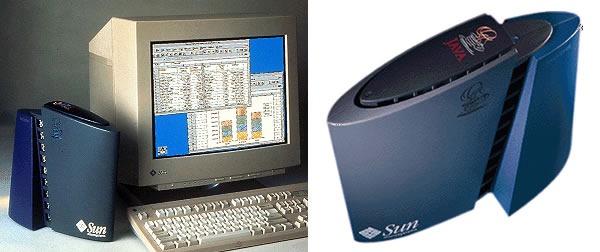
The uncomfortable middle ground occupied by the netbook reminds me of another much-hyped device that flopped – the network computer, which also went by the name "thin client". In the late 90s, a number of people suggested that desktop computers, whose prices started at the mid-$1000 range in those days, would be replaced by inexpensive diskless workstations. These machines would essentially be the Java-era version of what used to be called "smart terminals", combining local processing power with network-accessed storage of programs and data.
A lot of the ideas behind the network computer ended up in today’s machines, even if the network computer itself didn’t. Part of the problem was the state of networking when the NC was introduced; back then, broadband internet access was generally the exception rather than the rule. Another major factor was price – desktop and even laptop computers prices fell to points even lower than those envisioned for NCs. Finally, there was the environment in which the applications would run. Everyone who was betting on the NC envisioned people running Java apps pushed across the network, but it turned out that the things they had dismissed as toys — the browser and JavaScript, combining to form the juggernaut known as Ajax — ended up being where applications "lived".
When I look at netbooks, I get network computer deja vu. I see a transitory category of technology that will eventually be eclipsed. I think that laptops will eventually do to netbooks what desktop machines did to network computers: evolve to fill their niche. Just as there are small-footprint desktop computers that offer all the functionality and price point of a network computer along with the benefits of local storage, I suspect that what we consider to be a netbook today will be just another category of laptop computer tomorrow.
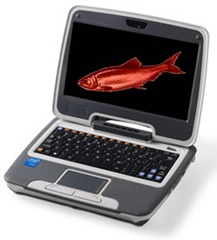
I’m going to go a little farther, beyond stating that netbooks are merely the present-day version of the network computer. I’m going to go beyond saying that while their form factor is a little more convenient than that of a laptop, the attention they’re getting – there’s a lot of hoo-hah about who’s winning in the netbook space, Windows or Linux – is out of proportion to their eventual negligible impact. I’m going to go out on a limb and declare them to be a dangerous red herring, a diversion from where the real mobile action is.
…and Smartphones are from Jester Burger

A quick aside: The photo above is not of a Jester Burger fried apple pie. In response to their customers’ so-called health concerns (really, if those concerns were real, they’d stop eating there), they started phasing out the fried pies in 1992 in favour of the baked kind. There are still some branches of Jester Burger that carry the fried pies, but a more reliable source is a fast food chain that I’ll refer to as “Southern Chicken Place”, or SCP for short. Those pies in the photo above? They’re from SCP.
Jester Burger made no attempt to faithfully replicate a homemade apple pie when they made their dessert. Instead, they engineered something that was “just pie enough” and also matched the environment in which it would be prepared (a fast food kitchen, which didn’t have ovens but had deep fryers) and the environment in which it would be eaten (at a fast food restaurant table or in a car, where there isn’t any cutlery and everything is eaten with your hands). The Jester Burger pie fills a need without pretending to be something it’s not, and I think smartphones do the same thing.
Smartphones are truly portable. They really fit into your pocket or hang nicely off your belt, unlike netbooks:

And smartphones are meant to be used while you’re holding them:
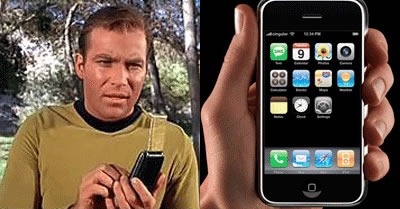
Just try that with a netbook. In order to really use one, you’ve got to set it down on a flat surface:

The best smartphones make no attempt to faithfully replicate the laptop computer experience in a smaller form. Instead, they’re “just computer enough” to be useful, yet better fit the on-the-go situations in which they will be used. They also incorporate mobile phones and MP3s – useful, popular and familiar devices — and the best smartphones borrow tricks from their user interfaces.
Smartphones, not netbooks, are where the real advances in mobile computing will be made.
Smartphone vs. Netbook: The People Have Chosen
One again, the thesis of this article, in graphic form:
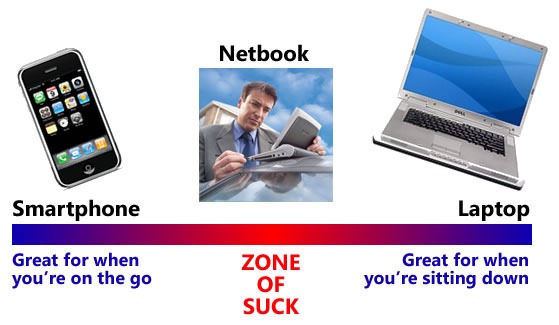
In the late 80s and early 90s, the people chose the fast food apple pie they wanted: the convenient, if not exactly apple pie-ish Jester Burger pie over Monarch Burger’s more-like-the-real-thing version.
When people buy a smartphone, which they’ve been doing like mad, they’re buying their primary mobile phone. It’s the mobile phone and computing platform that they’re using day in and day out and the device that they’re pulling out of their pockets, often to the point of interrupting conversations and crashing the trolley they’re operating.
When people buy a netbook, they’re often not buying their primary machine. It’s a second computer, a backup device that people take when their real machine – which is often a laptop computer that isn’t much larger or more expensive – seems like too much to carry. It’s a luxury that people might ditch if the current economic situation continues or worsens and as the differences between laptops and netbooks vanish. Netbooks, as a blend of the worst of both mobile and laptop worlds, will be a transitional technology; at best, they’ll enjoy a brief heyday similar to that of the fax machine.
The people are going with smartphones, and as developers, you should be following them.
151 replies on “Fast Food Apple Pies and Why Netbooks Suck”
Transitional technology or not I love my netbook. When my smartphone makes it as easy to do everything that I can do with my netbook I might reconsider the value of the netbook. In the meantime, I’m quite happy using my netbook to surf (with having to scroll and zoom all over a page to read it), send emails (at a speed about a gazillion times faster than I can with my two thumbs on a smartphone), write code and run it (something I can’t do on my smartphone), watch movies (on a screen that I don’t have to squint to see), etc. There is nothing besides make a simple phone call that a netbook can’t do better. Sure I can’t shove it in my pocket but the things are so light weight they can go in a backpack, purse or briefcase no problem.
While not on the go, my netbook sits in the living room, an non-intrusive device sitting quietly in the corner ready for us to Google things on a whim.
Everyone I know with a netbook thinks it’s the greatest thing since sliced bread. I expect smartphones to surpass them someday, but I’m convinced we still have several years to go before this is this case.
Food for thought: That smartphone costs you at the very least $199 plus a 3 year data+call plan contract ($30 just for the data plan every month). It’s good for small apps, but will not be useful if you actually need to type anything longer than a tweet (hello finger cramps!). That laptop will run you, bare minimum, $1149. It’ll come with 2 gigs of ram, a 120gb hard drive, and on board graphics with a small 13 inch screen. You won’t be playing much more than WoW on it, the hard drive is tiny, and for the price you get ripped with the small amount of ram (by today’s standards).
A decent netbook (not Asus, thinkin’ more Acer and HP) will come with a gig of ram, a 160gb hard drive (or a smaller solid state one, for the same price), on-board graphics, a screen res of 1024×600 (not HD, but not far off from the 14 inch laptops of 2-3 years ago either), have 3 usb ports plus card readers, and will only set you back between $299 and $349, depending on the brand. If you buy into the Apple line of products, you have a lot of money to spend on computer hardware (when a comparable PC costs about half the price). I totally get that there is definite value in buying the whole hardware suite: your iPod works best when it’s synced up with your mac book and Apple TV over AirPort. I’ve seen this in action, and, when it works, it’s really effin’ slick.
But, if you just need to use Firefox (which does any email account, will run Open Office, a huge host of online photo/video editing and storage applications, less processor hungry games like Peggle/Bejeweled and the like, and I’d bet Quake Live and Battlefield Heroes), then spending $1150 on a Macbook plus another $400-$700 a year on iPhone contract costs (before the cost of the phone itself) is absolutely ridiculous. I’ve yet to meet someone who has actually thought they’d carry an Acer Aspire in their pocket, but I know several who swear by how small they are (they’ll fit in their purses) and easy to carry (they weigh almost nothing). Everything, including smartphones, netbooks, 13 inch pc laptops and 17 inch macbook pros, and avid video editing work stations, they all have their place. For $299 you’ll have a hard time doing better, especially if you don’t need to check your twitter feed constantly while having dinner with friends.
I hate it when people do that.
[…] (haven’t written Objective-C since I worked on a NeXT box in 1994 at UWaterloo). Joey deVilla talks about why mobile is the platform for the next billion users and why netbooks are a red herring for computer […]
[…] Fast Food Apple Pies and Why Netbooks Suck — The Adventures of Accordion Guy in the 21st Centu… – while netbooks have a nifty form factor, they’re not where the mobile computing action is […]
I see netbooks as the portable browser of the future.
As long that writing a mail; or browsing the internet will be painful on mobile devices, netbooks are here to stay.
[…] a netbook. I keep looking at a MacBook Pro, a Dell m1330 and a Sony Vaio Z. And I realized why, Joey deVilla describes the problem with netbooks Slightly bigger and pricier than a phone, but can’t phone. Slightly smaller and […]
The netbook does fill a unique niche for me; if all I wanted was email and surfing the net, sure, a smartphone would suit me fine. But right now I need to be accessible to work at pretty much all times (yay clients and co-workers in multiple timezones), and my netbook has freed me tremendously. I can leave the house, walk for hours without feeling like I’m carrying any extra weight (2.4 pounds vs 11 for my laptop), and plunk down at any point to VPN into the network, use internal tools, open Eclipse and get some work done on the codebase… maybe it’s not for everyone but it’s given me an amazing amount of freedom and I love it.
And hey, when I’m at home I plug my media drive into it and bingobangobongo, movies on demand next to my home workstation. Fabulous.
Smartphone = Cheapish + Monthly Fees = Expensiveish
Netbook = Cheapish. Great for couch surfing / writing / email / youtube / skype / IM.
Laptop = Expensiveish
“send emails (at a speed about a gazillion times faster than I can with my two thumbs on a smartphone)”
Then you must be really slow on your phone. Both of us are standing in line at the bank and think of an email we need to send. I promise you I’ll be finishing by the time you’re sitting down somewhere ready to type. Not even close. Any emails sent to me I’ll get long before you do.
Netbooks are great if you sit on your butt a lot. Mine stayed in my backpack. I gave it away after I realized I could do 90 percent of what I did on my netbook on my phone. And the other 10 percent were fine for my laptop.
I agree with the “somewhere in between” form factor, but I’m not that radical with the “lame” statement. Smartphones are powerful machines, and will be even more powerful, but their form factor makes it difficult to perform longer tasks. I already have a laptop but it’s not that piece of hardware to have on the go (either short or longer trips).
Well, I think this article is partial. And I will explain why!!!
I have a smartphone, I have a 3kg powerful laptop, and I have a Samsung NC10 Netbook.
At home I use the laptop, and when travelling abroad or even when travelling in the city, or going to my classes, I use the netbook.
In my netbook I can have all my files anywhere, and play all the formats. Smartphones are not compatible with many file formats. Try to run an MPGE video on a blackberry, or Iphone, it’s impossible. Try to edit a 600dpi TIFF file on a smartphone, that’s impossible.
Everytime I miss a connection flight, who saves me? My netbook. Just 1kg, I can do most of my work, have a nice keyboard, can chat on MSN using my the webcam, connect anywhere, access my internet banking and many other sites that my blackberry browser is not capable of accessing because it’s not compatible with scripts, CSS sheets, and so on.
Also, a Netbook is lighter, 1kg against 3kg of my home laptop. Try to walk 2 hours with a laptop on your rucksack and you’ll end up with back problems. So, netbooks are perfect for travelling around. You can save your travel pics on the hard drive, and edit them and share instantly online, however try to do that on a smartphone.
And of course you can make calls from a Netbook, just use Skype. Perfect for talking and much cheaper than paying roaming when you’re in another country.
So, I do recommend people who travels a lot and enjoy having all their files handy to buy a netbook. And at the destination, if you need a more powerful computer to process something, than you can transfer files, use a friend’s computer, whatever is better for you.
Just the money you will spend using your smartphone abroad to transfer data at miserable data rates and making calls, you can buy a Netbook, so I do recommend as Netbooks are great for travellers. 🙂
I’m reading a lot of defense for the netbook, and it makes sense — for now.
But, from what I see, the main thinking behind Joey’s post is the future. By then Smartphones will be be more versatile, and laptops more portable — the two things that are presently compensated by the netbook.
If it’s not the “zone of suck” it fills a gap that’s progressively closing.
Some thoughts:
The deep-fried apple pie had more calories than a traditional apple pie. A netbook, on the other hand, uses less energy than a traditional notebook. The future is green.
My daughters can’t do their school homework on a smart phone, and laptops are pretty expensive to buy for teens.
Two month’s usage of an iPhone in Canada would be about the same as the purchase price of a Netbook. I don’t have to buy into any provider’s service plan with a netbook.
Netbooks are so cheap that Microsoft can’t make any money licensing Windows on them, and Apple can’t make any money putting shiney logos on the back of them. What’s not to love?
I can order a netbook from Dell or Acer with Linux preinstalled.
[…] Fast Food Apple Pies and Why Netbooks Suck — The Adventures of Accordion Guy in the 21st Century […]
People defend netbooks with such devotion… I just don’t get it. Let’s face it people — Netbooks are just cheap laptops. Is there any other device out there that is solely defined by it’s price point?
With the upcoming release of the Asus 1008HA, we can no longer say a netbook is defined by it’s small size. The 1008HA (and many others to come) have larger than 10″ screens.
Netbooks are just cheap laptops and once everyone agrees to that, we’ll be in a better place for these discussions. After we get past that, we can then start talking about how “small notebooks” are important, which I most will agree with.
Let’s consider another aspect of both (pie and portable computing device) products. If you are talking a 12-25 demographic, I think the article is right on the money. “TC” is correct, netbooks are “cheap laptiops:. If you are buying for the fourth grade class, netbooks (cheap, durable with SSD as in Asus Eee), you are looking at a different niche. If you are looking for an appliance to throw in the purse or attache, and cost is a consideration, the netbook is an appealing alternative to the Palm TX or HP pocket computer for coffeeshop wifi and open office applications.
Where the marketing people may be correct is the area “Who is willing to spend money”? Raise you hand if you have 1 $1000+ Apple laptop AND a PDA phone that has been upgraded within the last 12 months, and a “plan” that runs close to or more than $100. There’s no point in marketing the frugal, the indigent, or the careful comparison buyer. That is not where the money is.
[…] Philosophy of Netbooks June 3rd, 2009 Back in the olden days I used to read Joey Devilla’s blog all the time. He was – and is – known as Accordion Guy and he produced consistently cool content. […]
[…] in the olden days I used to read Joey Devilla’s blog all the time. He was – and is – known as Accordion Guy and he produced consistently cool content. […]
[…] Subjective Vision Powered by Max Banner Ads Back in the olden days I used to read Joey Devilla’s blog all the time. He was – and is – known as Accordion Guy and he produced consistently cool content. […]
[…] Joey Devilla latest philosophical posts on tech – netbooks vs. smartphones. […]
[…] in the olden days I used to read Joey Devilla’s blog all the time. He was – and is – known as Accordion Guy and he produced consistently cool content. […]
While I agree with the facts that Joey argues upon, I wont buy his arguements.
Comparing Netbooks with Dodo, well. How can you say its the netbooks that die and the laptops that evolve? I can say that the laptop will die and the netbook will evolve, which basically implies the same thing!
Actually the fault lies in the way netbooks have been marketed and the way they have been named. Damn, a netbook is as good as a laptop!
If you look closely, then the 12/13 inch laptops are weaker than the 15/17 inch ones and the desktops are in a whole different league of power.
There’s a continuum everywhere in nature. People are tall, short, black, white, rich, poor and everything in between. And when you take all the parameters, it results into a large permutation. Whats there to debate?
Hell, I even expect Network Computers/Thin Clients to make a comeback, a lot sooner than people expect them to. Look at all those Online Apps, Data Storage facilities that have cropped up among the whole Web 2.0 goodness. Whose to say that they wont be more popular as time passes by and Internet gets faster?
As for now, netbooks(damn, I hate the name) are a lucrative segment, and I doubt they wouldnt exist is some form or the other, 10 years from now. And Smartphones are gonna evolve too. Its just that we will be having a larger choice in future.
So, yes, netbooks fall into the gap between smartphones and laptops, but that shouldn’t imply that there is no market for them. The real question is “What percentage of people with a smartphone and a laptop will buy a netbook too?” If it is 1%, ok, you’re right. Ho hum. But what if that number creeps up to 10, 15, or 25% as netbook prices fall?
As Bikalpa Paudel has already said in the comments, a netbook *is* a laptop, not a different type of device; it just happens to be smaller and cheaper than the average laptop. Some people want a laptop that’s small and light (netbook lovers tend to be these), and some people want a laptop that’s cheap (more on them below).
Most people who make their living from technology can justify buying an expensive computer, and the computer industry is (as usual) too myopic to understand that the majority of the general population is in a different situation. It took a Taiwanese company to do what the American companies thought was a stupid idea, and the result was immense popularity, yet the North American computer industry still insists on trying to pretend netbooks out of existence. Most people will be perfectly happy with what a geek would call a lame machine, and for them anything more is just wasted money. And as Microsoft limits sales of the relatively cheap Windows 7 Starter Edition to what it thinks are lame machines, it will find to its surprise that most people are perfectly content with them and won’t pay more.
[…] in the olden days I used to read Joey Devilla’s blog all the time. He was – and is – known as Accordion Guy and he produced consistently cool content. […]
I have a smartphone, but I am keenly aware of its limitations: fat fingers make it a trial to use for email, and 46-year-old eyes make the web browser’s tiny text almost indecipherable. (And face it, >90% of web pages are designed for 1024×768 or better these days.)
I want a physical keyboard with keys wider than my fingers, and a screen bigger than a the cover of a mass-market paperback; but I also want a device as light and luggable as a clipboard. And I don’t have a spare two thousand dollars to give to Apple for their gold-plated solution, the Air. So why is a netbook a bad choice?
Yes, we agree that netbooks and notebooks, currently marketed as separate categories, will eventually blur together. But which way will they blur? Will notebooks shrink (and will Microsoft be willing to shrink the price of Windows accordingly)? Or will netbooks, with one foot still in the cellular world, grow up?
Or to put it another way: which operating system will the unified note/netbooks of the future use: Windows, or Android?
Nobody here has yet mentioned that netbooks qualify as a “disruptive innovation”. The established companies keep moving their products higher and higher, and eventually technological advances make it possible to introduce new products that are cheap yet good enough for the masses (e.g. no-frills airlines and $7 wristwatches). The established companies always ridicule the low-end entrants, but over time the challengers take most of the market. Eventually the established companies, those that survive, serve only the high end of the market.
Judging from the phenomenal and ongoing sales of netbooks, I’d say most folks think they DON’T suck. Smartphones versus laptops versus netbooks is like comparing kiwis versus watermelons versus oranges.
Smartphone developers have already proven the most popular apps for those devices tend to be fart machines and the like. Talk about your “zone of suck.” As a developer I’d rather keep developing web-based apps that work on ANY of these devices.
The Tragedie of Hamlet
Phones are useful for ultra-short messages. Let’s see what fine literature looks like on Twitter. Give me a keyboard and enough memory to store some text.
Netbooks: Content without limits!
Actus Primus. Scoena Prima.
Enter Barnardo and Francisco two Centinels.
Barnardo. Who’s there?
Fran. Nay answer me: (OOPS, No More. Will send the rest later!)
Nice theory. Totally wrong.
Netbooks kick ass for getting real work done on the go. Phones are ridiculous w.r.t. text entry.
I look forward to the 180º turnaround after Apple announces their netbook.
What is the laptop in that pic, a Titanium G4 PowerBook?
So _that’s_ what happened to those fried apple pies. Aaarrgh! I loved those 🙂 Damn you Jester Burger, and damn you as well Southern Chicken Place — why are you so hard to find in Chicago?
Hm. I’ll actually offer a defense of Joey’s theory by asking all the netbook-philes above: how many of you are, right now, using your netbooks as your primary computer? I’m guessing about zero hands are going up. How many of you actually have a laptop or desktop computer and a smartphone already? Probably just about all of you.
And that’s kind of what the point was, I think.
To put it another way, the niche that netbooks are filling isn’t “cheap computer for cheap times.” They aren’t the Original Beetle of the computing world. The niche is, when push comes to shove, “cool toy for people who have enough money to have multiple computers.”
I’d actually like a netbook myself. I’d like to run Ubuntu on it. I think it’d be a great traveling machine. But I already have an iPhone and a MacBook Pro (and a PowerMac G5 and an Apple TV), and I’m the kind of nerd who can deal with running Ubuntu. I am the target market for netbooks — but I am not most consumers.
If smartphones get smarter and “full power” laptops get cheaper and lighter, how much lifespan will the netbook category as we know it today really have? The commenter above who referred to Microsoft and Apple not being able to make money at it was witty, but if you read the business press recently, you’ll learn that Asus and Dell aren’t able to make money at it, either: the margin is so low that they frequently lose money on each sale. They’d much rather get you to spend $700 on a 12″ notebook than $300 on a 10″ one.
And if the notebook is going to actually be your primary machine, the chances are you’re gonna pony up the extra cash, aren’t you?
I love the argument that you netbook-lovers leave your laptops at home. If you’re too weak to carry around a laptop, why did you spend so much on one in the first place? Why not get a cheap desktop, and then make the case for a netbook.
Reread the essay more carefully before vomiting consumer comments. The reason you bought a netbook is because the marketing worked on your demographic: you’re the target market for netbooks.
I’m sorry, but I have to disagree with this. And let me tell you why:
I went traveling to Japan. Have you tried to roam there or catch 802.xx wireless? For the cellular network it’s fscking expensive. And open 802.xx wireless is NON-EXISTENT.
However, cat5x grows like trees in the biz hotels. Do *that* with your smarty*ss phone.
Also: When was the last time you lugged a full lappie in a nomad’s backpack? And put it under the tender mercies of the US TSA? The TSA can bite me, it’s QUITE EASY to mirror a 32 gig SSD before going off on a trip. Plus I have all my encrypted data accessible and don’t have to use public terms. So there.
You may call it the ‘zone of suck’ but for [sometimes transoceanic] road warriors like me something like a Dell Mini9 with either Linux or OSX is a ‘zone of godsend’.
Also, you don’t sync your assets via DropBox or MobileMe, do you? Try THAT with your namby-pamby smart*ss phone not iPhone…. it. won’t. happen.
Even better: Why do a need a Kindle when a netbook is small enough to cock on its side? I can read comics, PDFs, or texts in this way. Oh, and I can put a whole drama season on the SDHC card in the bay and watch via VLC or MPLAYER. Again, your smartphone won’t do that.
The netbook. The ULTIMATE entertainment / traveler’s tool.
I like my iPhone; I like my Macbook. But there is a middle ground filled by neither, transitory though it may be. If I could get a tiny, tiny Macbook on which I could type while, say, sitting in a waiting room, that would make me very happy. Trying to write essays or scenes in my current story-arc project using my iPhone strikes me as a losing proposition—unless somebody markets one of those Palm-accessory-style external folding keyboards for the iPhone and I can obtain a genuine word processor or even text editor. Writing on my Macbook is better, of course, but it’s still a bit heavier than I care to lug around. A small, ultra-lightweight, inexpensive minimalist “netbook” that I could carry in a hand (I’ll carry things that way routinely without complaint) or drop in a shoulderbag would be a delight.
Thank you for mentioning the fax machine. Though I certainly enjoyed the apple pie analogy, for me the fax machine is the ultimate symbol of, as you put it so well, a transitional technology.
There is no good reason anymore to use a fax machine. No good reason to think about network computers. No reason to eat a fast food apple pie and no reason I’ve yet seen to invest any money at all in a netbook.
Somebody commented on why netbooks are a category defined by price.
While that may seem strange, I don’t think it’s unreasonable.
Extremely small laptops of various kinds have been around for a long, long time. They’re not new. What is new is that the price has come down to the point where people can buy them simply to fill that gap. In the past the price was high enough that you had to have a really good reason to buy one.
Until it was stolen, my primary laptop was a 17″ MacBook Pro. Not exactly lightweight. I loved it. Big screen is *beautiful*. Big hard drive. Worth the weight on the back most of the time.
I also have an iPhone. I can do a *lot* on it. I can read my email, I can let people know I’m going to deal with something when I get to my real laptop, I can even book rental cars and buy stuff online. I can’t write a lot of text very comfortably, though.
There’s a big gap between those two devices. An 8 or 9 inch screen and a full sized keyboard let you write a *lot* more text than an iPhone. They let you edit real documents. Those are nice features.
Price fits into this because what you’re buying here is convenience. I have my laptop – I can do all my work on the go. I have my smartphone – I can do stuff without carrying a bag. Halfway between those is a space that I can’t justify filling unless it’s cheap. It doesn’t get me anything new, it just gets me more convenience.
The other issue about price is, most netbooks are severely limited. Same as many of the ultra-portable laptops of the past. Small, cramped keyboards and screens are endemic. When the price is high and the comfort is low, few people will bite. You want me to spend *more* than a laptop, for something that I can’t use as comfortably?
I think the $300 to $500 price point is a killer because it lets many people get that extra convenience without feeling like they’re spending a huge amount of money.
What I want to see: Apple’s version of the Sony VAIO P. I’ve used the VAIO P at Sony stores a couple times. I adore the screen size and the weight. The pointing device is quite poor. The keyboard is surprisingly bad. Not very good industrial design overall. A device like that with a multi-touch display would be wonderful – I don’t think that anything other than a touch screen will be effective for such small form factors. Small trackpads are annoying – no matter how perfect they are. Big touch screens require exercise to move your hand around a lot. That Sony display is about the same size as a keyboard – easy to move your hands around and point at things.
With the upcoming release of the Asus 1008HA, we can no longer say a netbook is defined by it’s small size.
You’ll get a lot of arguments if you try to say a netbook is larger than 10″. No matter what Asus calls it.
I agree 100%.
I don’t understand why people think netbooks are any different than crappy laptops. I’m not saying crappy laptops are bad. There are benefits to being crappy: weighing less, cheaper, uhm, that is about the only valid arguments I’ve heard.
Two criticisms: first about your writing. second about your argument. If you’ve ever worked as a writer, for a magazine, for instance, you’d know the term “burying your lead”. You need an editor. Your set up is long, slow and boring. It’s so full of self importance it was a chore to get through to the meat of your story.
2. Functionality is pretty much the idea behind the netbook. It’s not all marketing. I just returned from a trip abroad and bought a netbook for that trip. It was the first time I’d been away from my Mac in years. No exaggeration. But I was so pleasantly surprised with the functionality and efficiency of the form factor and the workings of the netbook (albeit Windows) that I have to disagree with you. The netbooks are a success. It’s too bad we have all this baggage that we can’t recognize simple utility for what it is.
What about a tablet form? More powerful processor to do more things, can be used while standing up without a table/desk/counter? I’m no expert on such machines, having never owned or used one, but it seems to me that folks are getting better at non-keyboard interfaces, which should allow greater development of this part of the market. I would love to have something workable in this category.
Anyone who believes that the point of this article was “netbooks are useless,” go back and read it again. But this time, leave your defensive reflex at the door.
The point of the article is that the niche currently occupied by netbooks is being encroached upon from both directions and will eventually shrink to nothing (or close enough to nothing so as to be unprofitable). Right now, that space still exists, but in the near future there will be no more need for it.
To put it another way, the article wasn’t advising readers to buy smartphones instead of netbooks. It was advising them to not invest all of their resources into the production and sales of netbooks.
I take it that means I was Crazy Go Nuts University’s most notorious perma-student. As such, I will limit my remarks to the following.
Deep-fried apple-semblance goo is pretty tasty.
Many people will buy Netbooks for their first computer.
There will be people who can’t afford bigger computers. There are millions and millions of people who use the Internet first on their phones and will eventually graduate to a Netbook. Maybe even billions of people will do this.
Then there are kids who want their parents to get them a computer, and their parents who don’t want to spend for a big computer.
The other good thing about Netbooks is that they drive the price and weight of 13 inch computers down.
Very insightful but what I really enjoyed was the superbly written article. It was almost like watching a lively textual conference presentation: strong points, clear graphics, and funny asides.
I think the same of the current Flip and Kodak mini video cameras – they serve the niche of simple digital video really well but inevitably digital still cameras and smartphones are gaining video features with increasing regularity.
It is already happening. The latest generation of Netbooks are coming with bigger screens, more powerful graphics, faster processors, and more storage. The price is also raising into notebook range. The change is pushed by consumer demand, in essence Netbooks are morphing into what people really want… a laptop.
There is a subset of consumers that really want an 8″ screen (would love one strapped to my leg when flying for example), but believe history will prove this is a niche market. A nice niche market? Absolutely.
Sunfly (Full disclosure -MBA)
The netbook apologists intrigue me. Bill, above contrasts the netbook with his ELEVEN POUND laptop. Others make similar arguments. Um, yeah, I can see that. But why not but a 4.5lb laptop (My Macbook, several PC laptops)? OK, you have a large laptop or a desktop NOW… but when you replace it and think “Gee, it’s really been nice to take my netbook more places” aren’t you going to look at smaller 13″ laptops that will cost $1000 or under and give you 90% of the weight and size advantages and none of the syncing disadvantages?
“But that’s $1000!!!” Well, yes, bit 1) The price will continue to drop and 2) it’s your primary machine. How are you better off buying a $600 laptop and a $200 netbook vs one $1000 machine? If the $200 is really that important, well…
Eventually people who have discovered that they love the portability of netbooks will be replacing their promary machines and I can’t see any reason that almost all of them won’t simply opt for a Macbook or a PC with similar capabilities.
My theory as to why is different than yours, but my conclusion was the same.
To me, a laptop is something I pull out of a large bag, unfold, set on a table and boot up. Thus, to me, a “netbook” is not a different product category; it’s a small, cheap laptop: I pull it out of a (smaller) large bag, unfold it, set it on a table and turn it on. It’s why I hate the “netbook” term: the term “netbook” is an attempt to convince us that the low-end of the laptop spectrum is really a new product category rather than a cheaper older product category. Given there is only a couple of inches difference between an MSI Wind and an Apple MacBook Air, why is one a laptop and the other a netbook, other than price?
To me, a hand-held computer (like a mobile handset or a hand-held calculator) is something I pull out of my pocket, turn it on (in less than a second), and can hold it with one hand while I use it with another.
What differentiates the two products is how we interact with them: one fit in a pocket while the other in a bag, one turns on instantly while the other has to boot, one can be used one handed while the other needs to be put on a table. There is no “range” of product with a zone of suck because the way we interact with these two different devices are radically different. And it is that difference in interaction that differentiates the products into separate categories.
If there is a new product category here, it had better be something that does something useful that we interact with in a way that is different than hand-held computers and briefcase-sized (or purse-sized) laptops. It’s possible that the Kindle or a tablet computer may be such a form factor: it can be used one-handed but the larger size means we can interact with it more like a clipboard or a large book rather than a small calculator. I dunno. But a “netbook” is just a cheap, tiny laptop.
why don’t you do some research about thin client usage before bagging it?? each device has the niche and the buying figures for each device support that, not your wanky graphic.
[…] named CEO of Palm Apple finalizes PowerPC divorce with OS upgrade New Atom N450 CPU due in October Fast Food Apple Pies and Why Netbooks Suck Google’s Schmidt: Bing Can’t Buy Search Love With Ads iPhone 3G S processor specs: 600MHz […]
Mmmm, love these Sony Vaio ladies! Beat the apple pies photos.
geez-a-loo looks like you wrote this article to the wrong crowd! 😉
i envision a day in which one can whip out a fold-up keyboard they’ve stored in their briefcase, attach the smartphone (lengthwise), and use it to type out those long emails and/or code this or that. for the people the keyboard is important for, that will do nicely. netbooks will, i believe, disappear as quickly as they came.
The argument for the netbook seems to be based on price and weight. Unfortunately, this is being achieved right now by reduced size keyboards, smaller screens, and less processing power. I overheard a discussion last week between two netbook owners who basically claimed flaw-as-a-feature in regard to these drawbacks. In a future market where laptops are cheap and lightweight, I would be surprised if people shopping for laptops ask “Well do you have slower one with a smaller keyboard and screen?”
One overlooked development in the netbook vs. smartphone debate: practical voice input. Most of us can speak faster than we type. A sufficiently accurate voice input program that works well for most current “keyboard tasks” is not that far off. That eliminates the biggest advantage of netbooks over smartphones.
In a very few years, there will also be high quality projection technology to allow smartphones to produce virtual dispays that are bigger than those of today’s laptops, or maybe there will be wireless heads-up displays built into glasses or contact lenses. in any case, I’m confident both the keyboard and the display disadvantages of smartphones are temporary. So in a couple of years, why carry a 1kg netbook instead of a 200g (or maybe 20g on your wrist a la Dick Tracy) smartphone?
[…] Fast Food Apple Pies and Why Netbooks Suck — The Adventures of Accordion Guy in the 21st Centuryjoeydevilla.com […]
Netbooks have no future. This is the god honest truth.
I don’t agree laptops will evolve to fill the netbook niche. That makes no sense because that’s exactly what a netbook is, a laptop that evolved to fill that niche.
What will evolve to fill the netbook niche is the smartphone. Smartphone are going to be the shit. They will find ways to make it possible to expand or unfold the screen, input is similarly going to become a non-issue.
I predict the following from Apple and possibly other companies within 5 years:
They will release an iphone that contains your entire home folder. The iphone will also be able to dock _inside_ your choice of macbook, ranging from 12″ to 17″ which contains a better cpu, more memory, an optical drive, supporting storage with fullblown apps, and USB, FW, sound in/out etc, ports. When docked, you can send and receive calls from your macbook using a headset, paused itunes and all. SMS messages will appear on your screen. When you eject your phone and close the lid of your macbook, all your files and work are stored on your phone where you can view/listen to any of them and edit most of them using light versions of the Mac apps, much like quicklook. Of course you don’t want to do hardcore editing in this case, but it’s good enough to get by until you have time and a flat surface to pop open your macbook.
When you get back home from traveling, you can store your laptop in your briefcase away from sight until it’s time to go to work the next day. You will take your iPhone to an iMac that it slides into, just like it did in the Macbook. Now you have a pro desktop setting with all of the same files, full expansion capabilities, peripherals, what have you. It will be networked with a home media server with archives and large files you don’t need to carry around all the time. It will also be able to serve those files to you over the internet should you suddenly need one from your iphone remotely one day. Your settings, passwords, and files never change, never have to be synced between various devices, and you are never without them.
When you step out to a bar later that evening, you leave behind the laptop and the (of course) desktop. But you take your iphone, and it’s just as if you had your entire “computer life” with you in case there’s anything you need, any detail you forgot, any presentation you want to share, anything.
Now, where does a ‘netbook’ fit into this picture?
I agreed about how the netbooks where so much better than the smart phones, but once I got an iPhone 3G I changed my mind. To me, any smart phone with at least this level of usability has already replaced the netbook for me.
I use a notebook at home but when travelling I take my iPod touch. Smaller, in the pocket and email is good when at the internet café. Once I purchased the touch the laptop stayed at home.
I am torn between two devices for a future upgrade path, I have been waiting for a new iPhone but would really like an iPod touch with a 6″ display. The keyboard etc will be much bigger.
A client needed me to do some pretty heavy-duty website production work on short notice recently while traveling. Not just text editing but complex tasks, including some image work with Photoshop files, and searching/managing a large set of project documents. My subnotebook (which is above a netbook in size and power) sounds perfect… but it was IMPOSSIBLE to do what I needed on my subnotebook. For three reasons:
1. It’s just a companion to my big-screen main machine. It has a lot on it–but not everything. I needed stuff it didn’t have on it.
2. It didn’t have Internet on the go! People complain about the monthly fees on a smartphone… well that’s not for the phone it’s for the always-available Internet. I was riding in someone else’s car in the middle of the mountains. Cell signal was weak but usable. WiFi was non-existent. My subnotebook couldn’t even receive the email TELLING me to do the work, much less deliver the resulting product.
3. My subnotebook wasn’t with me in the car. It’s super thin, super light, but it’s not pocketable. A netbook wouldn’t be either. I wasn’t carrying a backpack or a briefcase. I carrying the one and only thing I always do: my phone. No matter how small your netbook may be (and the smaller it is, the less productive) you don’t ALWAYS have it.
Any one of those three can make a subnotebook or netbook entirely useless. And ONE of the three is almost always true.
So what did I do? I did the work on my iPhone. The small screen sucked. The weak/slow cell signal in the mountains sucked. The task took three times as long as it would have on my desktop computer. And it was a million times BETTER than my notebook because the job was POSSIBLE instead of impossible. For me and my clients that means everything.
The solution: Jaadu VNC. I actually did the work on my main desktop machine–from my iPhone. Not ideal but surprisingly practical considering I didn’t even have a 3G signal. I had my full DESKTOP computer–not my subnotebook–in my pocket!
You could do that with a netbook too, and have a bigger screen and bigger keys. You’d have to buy that dreaded monthly plan, though, and have a cell modem. And you’d have to have that netbook WITH you. On a road trip in someone else’s car, when you least expected to need it. Come on–you KNOW you’d have left the netbook at home. But you’d have your phone! Preferably a smartphone.
And then there are all the less-extreme situations, which the iPhone (a pocket computer with a UI designed FOR a pocker computer) handles really well–not a last resort but really well, and with native apps instead of VNC. Those situations happen constantly every day. Including the many hours a day when my subnotebook bag is not on my shoulder. And other times when my subnotebook IS nearby but I don’t feel like opening the case and firing it up. I just take my smartphone from my pocket, fire up mobile Safari or Mail with a tap, and let the laptop sleep.
All I can say is that the people above who are criticising smartphones and their keyboards and/or browsers are very obviously using the wrong smartphone! If you can’t type a lengthy reply on your phone or can’t browse the web easily then there is either something wrong with you or there is something wrong with the phone you are using.
Also, for those doing “real work” on their netbook – face it, what you really want is something as light as a netbook but as powerful as a laptop. The way things are heading (e.g. once optical drives become obsolete and SSD become predominant), this is what you’ll get. However, that doesn’t change the fact that what you have right now is just a crap laptop. It might be “good enough” but it is still just a really crap laptop. The proof of that pudding would be to answer this question “if my netbook could do everything that a laptop could do but was the same weight and similar dimensions as my netbook, which would I prefer to have?” Actually, this is already answered – just look how Netbooks are becoming more and more like small laptops (i.e. their size has increased) rarther than staying Netbook sized. The market is already phasing the Netbook out and you folks just aren’t noticing it.
I would have liked this article a lot more if it just said McDonalds and Burger King instead of making up names to be cute. No one’s going to get sued for talking about talking about apple pies. Photon torpedos FTW though.
By the way, that lengthy reply was brought to you by my smartphone. In a matter of minutes. Just like a Netbook.
News flash: phones are easier in a “need it right now” environment. Notebooks/netbooks are best for a “need to set it down and get real work done” environment. Big yawn.
At the end of the article deVilla addresses developers.
The truth is no one develops for a netbook. You can develop computer applications (be it on a desktop, laptop, or netbook), you can develop mobile applications, and you can develop web applications.
The thing is netbooks don’t run many computer apps well and so there is a chance your user will have a bad experience. While there seems to be a market for netbooks as cheap and light laptops, there is no market for netbook applications as there isn’t a separate experience other than size and being limited. In any scenario a user is using a netbook, it could hypothetically be replaced with a laptop that does the same thing better.
Web applications can actually be broken down into mobile web apps and computer web apps. If it being on the web makes it a good experience for all platforms than facebook would not have designed a separate interface for mobiles and youtube would not have made the iphone app.
Smart phones offer a separate experience from the computer and have unique attributes not shared by desktop, laptop, or even netbook. They are almost always with a user, on, location aware, have connection to the internet through data plans, and can be used with one hand while standing. Hence, deserving recognition as a platform
Netbooks should not be discussed as a development platform as they are still laptops ( just crappy ones.) There is really no comparison, but if you still want to develop for the netbook, I’m sure the market is screaming for more text editors : ]
Until very recently (as in this week) I spent 18 months regularly commuting between Leeds and London by train – towards the end I would say about 1/3 of the computers people were using were Netbooks. They work in space constrained environments.
Another point is that they may not fit in a pocket, but they do fit in a handbag.
Xofis – don’t underestimate until used. I slowly found myself using mine for reading email and RSS feeds, if not actually doing a lot of typing(i.e. I don’t disagree that phones – all phones – are poor text entry devices, but there are a lot of ways to use them.
Ry – you can’t get an equivalent Windows laptop to a MacBook at half the price – I’ve tried costing up equivalent Dell systems for some of my developers and the cheapest Dell with a 1066 FSB and DDR3 RAM, as well as the same CPU, was more like $200 cheaper than Apple’s list price (which can be undercut). I would say the price difference is more around the 15% mark. It does annoy me when technically minded people who should understand what ‘equivalent’ means fudge the figures.
However, that is not to deny the point that you can get a usable Windows laptop for half the price of a MacBook, particularly if (as people increasingly are) it’s just going to be a portable web browser.
45 million netbook users by the end of 2009 (including the 08 sales) are telling a different story.
No need to argue about it, the market says it all.
Funny how people are trying to fight the trend of affordable mobile computers with a great formfactor. Let me guess… you have an iPhone and a MacBook… talking about stereotypes 😉
Netbooks are cheaper than smartphones. Period. Why do people insist on leaving out the 2 year contract and monthly fee when talking about phones? The real price of a new iPhone if you want to buy it with no contract is at least $600. That’s twice the price of a netbook.
My opinion is that the device which will replace netbooks is some sort of tablet device. The only thing making netbooks cumbersome is the need to open the lid and type on a borderline-unusable keyboard. This would change with a decent on-screen keyboard technology (such as that found in the iPhone, but scaled up for a 10″ tablet screen). I can hold my netbook in one hand and type on the keyboard, but it’s annoying since the lid does not open enough. With a tablet device, it would be quite comfortable to hold the device on one arm and type with the other hand.
The main reason netbooks are bad right now is the low resolution of the screens, bad keyboards and generally cheap and shoddy construction that comes with a low-cost piece of equipment. All it needs is for some manufacturer to up the bar on those things and the whole market will turn around.
The word “netbook” is meaningless. I was hoping that you would define what it means to you, since you bandy it about as though it had inherent meaning. From context, I guess it means “portable computer that is smaller than a typical laptop/notebook computer”. But all of these devices under examination connect to the internet, and none have to do with fishing, so “netbook” in and of itself makes little sense. Someone reading this article ten years in the past or ten years in the future will be fascinated and somewhat perplexed.
Yes, this is a pet peeve of mine (along with much of the other faddish technology jargon-du-jour).
That said, I agree with your general thesis, and particularly enjoyed your company name placeholders.
-b
Fast Food Apple Pies and Why Netbooks Suck…
…
Using Joeys own flawed argument I could claim that there is no market for a laptop computer – you’ve got a desktop with a full sized keyboard and big screen when you’re at home, or a smartphone for when you go out. Laptops are a ‘dangerous red herring’.
The thing about netbooks is that they are laptops but they are actually portable! You can put a netbook in your bag and take it on holiday, to the shops, to a cafe without noticing the weight.
If anything smartphones are the red herring – locked down, tiny screen, crap keyboard. Nobody would dream of replacing their main computer with a phone.
If anything I’d say netbooks are going to replace laptops for the simple reason there is nothing a netbook cant do that a laptop can – they are just smaller and they are the inevitable future of computing.
Wil netbooks be hip if Apple introduces one? 😉
I think netbooks are in the “zone of good enough”. Not as capable as a full-fledged laptop when you’re sitting down, but still pretty usable. Not as portable as a smartphone when you’re on the go, but still very bearable. “Good enough” devices may not look like much, but they can be fierce competitors in the wild. I wouldn’t write them off just yet. Back in the 1970s, the minicomputers laughed their asses off when they heard of the first personal computer. “He’s just like us, only lamer ROTFL!!!11” 🙂
Of course netbooks “suck” – Apple doesn’t make one!
You say it yourself towards the end of your post: “I suspect that what we consider to be a netbook today will be just another category of laptop computer tomorrow.” That’s all a netbook is, a thin and light laptop. Everyone who extols their virtues uses them as they would use a laptop.
Your argument makes a lot more sense when applied to those 7″ UMPCs and MIDs. (Yes, I suppose the original Eee falls into this category, but I’m mainly thinking the various slate or slider type device actually marketed as UMPCs or MIDs.) They’re a little too big to fit in your pocket, too small too offer a good laptop experience, but the software isn’t there too offer a good experience of its own.
What I wonder about though are the smaller UMPC/MIDs, the ones with the 4.8″ screen or smaller. (e.g. Viliv S5, or XpPhone.) The XpPhone really is a cellphone and Viliv has announced an S5 with a 3G radio. They’re both large by cellphone standards, but they both fit inside a pant pocket. If the software is there to offer a compelling experience, we may see the growth of the “large cellphone” as well as the “small laptop.”
I don’t think they will meet in the middle though, for precisely the reason you articulate. In the middle, it’s too large to be truly mobile, but too small to do laptop like things convincingly. (Everyone with 10″ netbooks who disagree with me, your netbook is really a cheap laptop.)
I won an iPhone and a Dell Mini 9 Hackintosh and an iMac. I use all three , but in different capacities. I have to type a lot of texts on the go, for which the small size and weight of the Dell is just perfect (although the keyboard is a bit of a nightmare, though not more so than the iPhone). I use my iMac mainly for entertainment purposes these days: downloading movies, music, watching them, using it to update my iPhone. You’re wrong about the price and power difference, imo. This Mini 9 sometimes feels faster than my iMac, and I can have several programs open at once (Pages, Endnote, Safari, iTunes, Papers) with no noticeable slowdowm, and all that for just €300. There is just no Mac alternative available that will allow me to carry a low cost one kilo OSX unit with me. I can slip it into my bag and never notice it’s there until I need it. I was never able to do that with my white MacBook.
Frankly, I hope Apple comes out with, if not a netbook, at least a small (and dare we dream) affordable laptop.
As I don’t have a big “proper” laptop, my netbook fills the niche between the iphone and the big desktop-based tower i have at home. Light emailing, dumping photos from my camera, running presentations, writing/editing documents on the train/plane (where the small form factor allows for more comfortable fit on those horrid tray things). And yes, if I did have a laptop, I’d get less use out of the netbook…but as TC notes above, it’s the price point that makes it more of a disposable commodity device that has its uses.
YES!!!! Finally someone with sense, I’m sick of hearing all the Linux crowd arguing about whos winning the netbook space and shouting “year of the linux desktop……on netbooks” when really its not going to matter at all, netbooks will be one of those things we’re all laughing at in 5 years when smartphones have become as omnipresent as the iPod.
Oh and all the people wishing for an Apple netbook, it already exists its called the iPod Touch
I think you may be right in practice, even if you might be wrong (as several of these other fine folks have suggested) in principle.
As they have noted, there is a space between laptop and smartphone where netbooks can comfortably sit.
However, I think that’s going to change when we can roll/fold/pull out a fabric keyboard and display from the smartphone and have it suddenly be as big for reading and typing as the netbook.
~ TGC
[…] Joey Devilla hace un interesante punto sobre la basura que las netbooks realmente son, estando en la mitad entre un smartphone y un portátil normal, una zona incómoda en donde el equipo no hace “ni lo uno ni lo otro”. […]
Wow such a long winded report on netbooks and amusingly compared with deep fried pies.
I can confirm that as a student the netbooks are perfect.
No one wants to type lecture notes on a smartphone.
Full size laptops are heavy to take around and take too much space.
Netbooks are light, affordable and cover all the main bases when it comes to student computing.
Well you mentioned that smartphones are computing enough, well it might not be enough for other people. Viewing websites on an iPhone is quite tiring and involves a lot of scrolling around. Granted netbooks don’t have large full size screens but its still much more enjoyable than browsing the web on any smartphone.
In conclusion, contrary to your opinion I believe netbooks are here to stay. With increasing amounts of computer power on the web and increasing internet speeds, I believe unlike the UC, the netbooks will continue to grow.
Some quick points of information:
1. It’s interesting to be called a Mac fanboy, as I’m a developer evangelist with Microsoft Canada whose particular focus is on the web, mobile and gaming. I suppose some people assumed that because it was John “Daring Fireball” Gruber who linked to this article.
2. The reason I referred to the burger chains as “Jester Burger” instead of McDonald’s and “Monarch Burger” instead of Burger King is because I was originally going to post the article to Canadian Developer Connection, a Microsoft-owned blog and didn’t want a visit from the legal department.
3. My belief is that some vendors — one of whom is my employer, Microsoft — are paying too much attention to netbooks because they see them as a brand new category of computing device. I see them as simply the smallest, cheapest laptops available, as time goes on, the distinction between “laptop” and “netbook” will disappear. My real concern is that Microsoft isn’t putting in enough visible effort into Windows Mobile, which — and remember, opinions expressed on this blog are not necessarily those of Microsoft — looks pretty limp compared to the offerings aby Apple, Google and Palm.
4. The laptop pictured in the graph is some kind of Dell.
On the other hand, pretty much the same logic can be applied to laptops. I have never owned a ‘full-size’ laptop because they are pretty much overpriced, underpowered, back-breaking pieces of luggage that’s easily lost. Since I don’t travel that much and can usually wait to send an email there is no point in getting a laptop.
But with my netbook I just don’t think about it. I just drop it in my back pack and go. Sure, it’s underpowered, but perfectly able to do what I need on the move and for the rest of the time I have a desktop that’s at least twice as powerful as any laptop and probably one-third as expensive. And because a netbook is far from overpriced, losing or damaging it is no big financial hit. For me ‘full-size’ laptops are right in the ‘Zone of Suck’
My first netbook is now a test web server at home that I can leave on all the time and access remotely from my second one.
I agree
and for what I see, netbooks are geeks tools or cheap computers never satisfying their user for long.
the trend is clear in fact : smartphone for the go. thin and light laptops computers at home or works.
the future is NOT a 9″ unreadable screen with a tiny horrible keyboard.
I have always liked the old design engineering maxim that says, “Form follows Function.” That’s why a 2009 Honda Accord doesn’t look like a gas guzzling 1955 Cadillac with big tailfins.
I have an iPhone and a MacBook Pro 17″. My wife has an iMac with a 24″ display that’s upstairs in her office. Each of these devices is better for certain functions.
The iPhone is better for phone calls and mobility because of small size (fits in my shirt pocket) and 3G connectivity. I can use it anywhere. It works great for checking realtime traffic conditions while driving and for GPS mapping apps. It’s also best for streaming music to my car radio.
My MacBook Pro is better for web surfing, typing a long document, accessing my database at the office, and watching HD Movies in the full screen 1920 X 1200 view. However, it isn’t very good for checking something on the web while having lunch at a restaurant. The iPhone is better for that.
My wife’s iMac has a big external disk running 24 hours a day that handles TimeShare backups for both our Macs. It also has a couple printers attached that we can both print to with WiFi. Neither my iPhone or my MacBook Pro can host those services very conveniently.
Thinking ahead in terms of form follows function, I can see a place in our house for one more device. I’d call it a ‘coffee table’ computer that is neither ‘my wife’s’ computer or ‘my computer.’ It would be a battery operated wireless toss around device that you could just pick up whenever you wanted to look up something on the web, check email, chat, play games, or perhaps make a Skype call. It might also stream music to our stereo system. Something evolved from today’s netbooks could be one possibility. A tablet computer might be even better for these functions (think of an iPod Touch with a 10 inch screen).
One thing for sure is that I don’t want to pay AT&T for two separate data plans on different devices. But I think it might be nice is that coffee table computer could operate on 3G. The obvious solution here would be for my iPhone to have the capability to tether both my MacBook Pro and the coffee table computer. That way I could use the data plan that I’m already paying AT&T for with any of these three devices. That would make my ‘coffee table computer’ a great travel accessory.
Bottom line is that I see more convergence to come between the mobile phone and the mobile computer. The device manufacturers (like Apple) and the software providers will be able to open up huge market potentials if they can somehow manage to reign in the greedy self-serving cellular network service providers like AT&T and Verizon who seek to put a toll booth at every Internet node and on every device.
To all those saying or implying that netbooks have only a one time cost:
When you stop living with your parents, and/or graduate school, exactly, pray tell, where shall you get 24×7 free internet access? Or shall you live in a coffee shop?
I don’t think I’ve ever read anything so stupid. Of course, that wasn’t until I actually went to your blog.
Netbooks are perfect for people that need a portable device that they can actually do work on – not a smartphone. People that work on their feet all day, but also need to occasionally sit down and work, love the netbook.
Smartphones will NEVER replace netbooks/laptops. Laptops will NEVER replace smaller devices that do the exact same thing, with almost just as much power and speed.
Anyone that says you can do “real” work on a smartphone should be emabarrassed.
[…] Joey Devilla hace un interesante punto sobre la basura que las netbooks realmente son, estando en la mitad entre un smartphone y un portátil normal, una zona incómoda en donde el equipo no hace “ni lo uno ni lo otro”. […]
I think the netbook form factor is here to stay, though I can see some category blurring with budget laptops and ultraportables (Dell has a Mini 12 for example). Many commenters praised netbooks’ balance of portability and functionality, in comparison to the small and cramped experience on a smartphone, so unless smartphones develop some kind of game changing technology like Timothy Collett mentioned, lots of people will continue to find them unsuitable.
I guess it’s not fair to accuse the author of Mac fanboy-ism, but I still think if Apple came out with some sort of inexpensive laptop counterpart to the Mac Mini (which would surely not be called a netbook), a good fraction of the netbook hatred would suddenly disappear.
Nice argument and a good read, but I’m sure this has been said already in response – netbooks are selling so well, they threaten to make other computer offerings by the same companies less viable. So as nice as your analogies are, they kind of ignore the fact netbooks sell like the ol’ deep fried apple pies (so delicious).
Is this a good thing? Hell no. I hate netbooks for all the reasons you stated. But I think they might be around for a lot longer than you think.
The problem I see from this way of looking at netbooks is that smartphones make lousy input devices for decent sized bodies of text. Heck, I don’t even like commenting on blogs from my smartphone.
They can be great for any number of other things, but they are severely limited for content creation, generally. (Obviously, the New Yorker cover proves that is is possible, but it doesn’t prove that it is easy enough for regular usage.)
Until smartphones get better for serious text input, there will continue to be a big place for something with a larger keyboard. Carrying an folding attachable or bluetooth keyboard is one answer, but so long as you are carrying both, why not just carry a netbook? With bluetooh earpieces and voice driven interaction with phones and media devices — see the latest iPhone3GS, whose voice driven interaction is two way — the fact that the netbook in is a purse, backpack or shoulderbag does not prevent it from being used as a phone and media player, too.
I will go ahead and disagree with Ian, William Woody, Andy Patel, MattH and everyone else that thinks an Apple Tablet/netbook is a great idea.
What good is a 10″ screen if you can’t carry it in your pocket or use it with one hand while you drink coffee or stand in the subway.
There isn’t a need for some other type of device. You’re either sitting or standing and we have excellent devices both those human conditions.
Maybe we’ll get a tablet MacBook, but it will be more of a laptop and much less like an iPhone.
Excellent article, Joey. You nailed what I was thinking.
[…] An excellent article that explains my troubles with netbooks. (Via John Gruber.) […]
I look at the cheap netbooks, I look at my white MacBook, and while there is a difference in price (which I am perfectly willing to pay, it’s not that much compared with all the other stuff in my life) there really isn’t enough of a difference in size to make me want to consider a “netbook”. They really are just cheap, small laptops that I expect will leave many users unsatisfied over the long run. You still have to set them down, boot them up and use them in a stationary position – 3 strikes against them while I am standing in line for coffee.
My hunch is that “netbook” as a separate category will evolve over the next year into various small laptops as users decide that they just cannot live without ______ (DVD, big keyboard, bigger screen, etc.). I think Apple is right to wait it out and see.
I use an iPhone as well, and I won’t argue that they replace laptops – just different and good for different circumstances due to physical form factor and input limitations. This category of device is far less constrained by comparisons to bigger cousins like laptops.
[…] Posted in 1 http://www.joeydevilla.com/2009/05/26/fast-food-apple-pies-and-why-netbooks-suck/ […]
I lurve my netbook.
It’s my portable TV/Radio/Email/surfing device, and I love it.
But when we want to edit video, or update a website, or even blog, we use the iMac in the office. Perhaps I missed the memo somewhere, but when did netbook users start using their netbooks as a primary machine? I bought it specfically for streaming video/internet radio for the kitchen when I’m cooking (instead of buying a TV), why would I want to do that on a smart phone? Man, dinners would suck!
I guess I’m a vast minority with my position. I had an iPhone and eventually got a unibody mac. for the price, it seemed basically like an expensive toy. I had a pc desktop that I used for gaming and photoshop, which are really the only things besides the basic computer functions I used. I moved and left the desktop behind, and just lived with the lack of those two activities.
with my macbook, I found myself skype video chatting, iming, using iTunes, web browsing, and as a media drive for photos. a netbook can do all of these for 800$ cheaper and be more portable. I’m also beginning to travel more and it seems the netbook would be a better choice for this as well. as I always have a bag of some sort, the fact it can’t fit in my pocket is no loss.
now don’t get me wrong, I’ve been an apple fanboy for over 15 years, and absolutely loved the MacBook, but I just didn’t /need/ what it had to offer – especially for almost 1000$ more
so I sold it and will be buying a netbook within the next few months. as far as the smartphone goes, I really love the iPhone. google maps and mobile browser basically ensured my survivability, or at least my general comfort after moving to los angeles. there’s a lot it can’t do, though. other than the fact I need /some/ way to browse the net, google maps is the only thing that’s making me keep it. I want something I don’t have to baby/worry about so much. also something less than 80 a month. I know I can get a mobileroadband adaptor for computer, but I still need to research before I mess with that.
to summarize, browsing on my phone leaves me wishing for a
bigger screen and keyboard. I’m more alone than I expected in the matter that I’ll be using a netbook for my primary computer – cheap, portable, and while maybe not “good,” it’s “good enough.”
Netbook bashers seem to be mostly Mac users. Shame really, I have a Mac Book Pro 15″, but spent nearly a year traveling all over Asia with just a MSI Wind netbook. There is no way I was lugging a 5.5 lb machine on my back (I travel with only one small backpack). The netbook let me do everything (!) I would normally do on my laptop — Lightroom and Photoshop for digital photos, update my blog, video conference, write research reports, run SPSS (which sucks on a Mac), etc. This in NOT an underwhelming experience, and I value the form factor. Try doing any of that on a phone.
[…] es que, realmente vale la pena adquirir una netbook? Joey Deville ha escrito un interesante artículo donde pone su apreciación de porque las netbooks está sobrevaloradas y apestan. Su resultado […]
Most people here seem to miss the point, Netbooks are a diversion from the development really exciting, imaginative mobile computing – sure small light and more portable laptops, or for some of you ‘netbooks’, are important, but they’re not what will drive the mobile world.
Just a small note. I love what is said about notebooks. Having recently bought a laptop, i agree they don’t deliver ENOUGH of anything to be signifcant unless you were literally looking for something to do very ‘LIGHT’ work light writing word docs, inputing excels, etc (i.
But in contrast I’m just not on board with how he uses smartphones. Because most of them also lack form factors that you need on the go and can’t get at times. If you need things are a glance or check it or jot notes smarts phones are the most awesomest gadgets ever. But once you need more you’re lost. If you need to stop and write and article, doing some light redesigns, input info into your excel (quickly), your smart phone is freaking useless or atleast not very useful.
I don’t know if there’s a middle ground or not but that’s my two cents.
Expanding on the post by John C. Welsh.
Most people have a cell phone already, to those people insisting you need to add the cost of the cell phone plan to the smartphone may have a point but as there will already be a cell phone bill anyway the only thing you should factor in is the additional cost of your data plan if any.
On an unrelated point I prefer to have a phone and iPod touch separate because if one device fails I have not lost everything. This is more important to me than carrying one lightweight item.
Ok, so netbooks are lame because they’re not the best for mobile computing… but what if that’s not why you want one?
You say that netbooks will “evolve” to be another kind of laptop, but they already are. Most people who buy netbooks – including me – aren’t looking for a mobile computing experience. They’re looking for a laptop that doesn’t cost an arm, doesn’t weigh a ton, and does what they need it to do – in my case, allow me to write easily when I’m away from home.
I own a smartphone. When I want to check my e-mail quick, I grab that. When I want to write, no smartphone is anything but extremely annoying for the task. The fact that my netbook has wifi only means that I don’t have to go between two devices if I’ve got wifi coverage – it’s a convenience, not a necessity.
[…] Fast Food Apple Pies and Why Netbooks Suck — The Adventures of Accordion Guy in the 21st Century […]
You can say that the laptop is the computer in the zone of suck. Somewhat more powerful then a netbook but more expensive and much less portable. It more portable then a desktop but also much less powerful and more expensive,
[…] Fast Food Apple Pies and Why Netbooks Suck — The Adventures of Accordion Guy in the 21st Century (tags: netbook smartphone technology hardware iphone tech blog humor) […]
Ry said:
I have my iPhone 3G on Prepay. I’m a lite user and spend around $10 a month.
[…] Fast Food Apple Pies and Why Netbooks Suck – Joey Devilla on why smartphones are where it’s at. (via) filed in internet/technology tagged with netbook, smartphone […]
A few more thoughts:
1) ‘The smartphone is expensive!!! $3000 or so over the life of the contract.’ What, if you didn’t have the smartphone you wouldnt have a cell at all? You’d incur some or most of that cost anyway with a regular cell.
2) ‘I have a big desktop that does everything I need, the netbook is nice for occasional portability’, ‘I traveled the world’ etc. Yep. but when you replace that desktop I bet most of you will consider a laptop and for most people the difference in power is not important. But of course there will always be people who want a big desktop to render stuff or who are taking long trips around the world… those are edge cases though.
3) ‘Netbooks are selling well!’ Yep. let’s see in 3 years. Initially, they’re cheap enough to try out and see what the fuss is. Come on, $200? Most people will bu one out of curiosity alone. You don’t need a lot to justify that purchase… but will they buy another when this one dies? Or have a lot of those buyers gone “eh, it’s not bad” and aren’t enthused enough to buy a second one in 2,3 or 4 years?
I have my iPhone 3G on Prepay. I’m a lite user and spend around $10 a month.
1) I don’t think you can even get data on a US iPhone without a contract.
2) How much did the iPhone cost without a contract?
Btw, for those suggesting that Apple is late to the game with their own Netbook, they effectively sold one roughly 12 years ago. The eMate 300 (http://en.wikipedia.org/wiki/EMate_300) is about as close to being a Netbook as the original Netbook was, sans the Wi-Fi networking that didn’t exist as a consumer option back then: it was much smaller than the laptops of the time yet had a full keyboard, it was lightweight, had desktop class apps (though running on a lightweight OS, Newton), and for its time was comparatively cheap. Unlike netbooks though, it also had very decent battery life (over 20 hours on a single charge). 😉
Posted to provide some perspective to the impression that Netbooks are somehow a new phenomenon (btw, I don’t mean to imply that Apple invented this form factor either – there were plenty of small Windows laptops back then too, e.g. from Sony, which would probably be called Netbooks today).
netbook just like a big toy.
With all due respect to Michael Critz, I never said an Apple tablet would be a great idea.
What I said is that a tablet form factor may be a different product category from a laptop and a hand-held device because you interact with it in a different way. In other words, my thesis is that different product categories come about when we have a thing we interact with in a different way. Thus, a toaster is different from a toaster oven because we interact with a toaster in a different way than we interact with a toaster oven–despite the fact that both have heater elements and both can make toast. Thus, my in-car navigation system is different from my hand-held GPS, despite the fact that both draw maps and plot my location on a map, and both can give directions to a given location–because one is a hand-held thing I hold, and the other is in my car.
A netbook is not a different product category than a laptop; it’s just a small, cheap laptop. However, the iPhone is a different product category because we interact with it in a different way. A tablet may be a different product category; if it is designed so we interact with it in a different way then it’s a different product category. But if a tablet requires me to boot it up and use it on a table top, and runs the same old operating system (MacOS X, Windows XP, etc) then it’s just a laptop I don’t have to unfold.
Netbooks are likely to stick around, though only the geekiest will pretend they’re anything other than small, cheap laptops. People knocking the subscription fees are delusional because netbooks are bought by the ultra-cheap, never-buying-a-data-plan consumer or by people who already pay for a smartphone (and a $2k+ main system, a media server, etc).
iPhone launched only 2 years ago and only now are we starting to see real competitors in functionality. It will take a few more years, but smartphone functionality will get much better. In the laptop space, products like the MacBook Air will also become more common and powerful. There will always be the small and cheap, but laptops of usable size (12″ and 13″) will become the new hotness. Dell’s 12″ mini @ $400 will converge with the 13″ Air @$1500, both at approximately 3 pounds. As others have noted, netbooks are creeping up in size and power.
Regardless of how cheap a 9″ unit can be, people complaining about small phone screens are going to be the first ones to buy 12″ and 13″ laptops that actually fit their hands.
[…] Do netbooks truly inhabit the zone of suck? […]
I love your names for the different fast food chains. The more popular “apple pie” wins not just because of its form factor, but because the taste is a triumph of modern food technology – see Schlosser’s book Fast Food Nation.
I didn’t know you could get “fried pies” at Southern Chicken Place.
[…] Fast Food Apple Pies and Why Netbooks Suck — The Adventures of Accordion Guy in the 21st CenturyAccordion Guy nails the uneasy feeling I’ve had about netbooks all along. They’re cool because they’re cheap and almost like a real computer. But that “almost” is huge. […]
[…] Very interesting take on why mobile smartphones will own the mobile internet as opposed to netbooks. Probably one of the most cogent analyses of why it’ll be smartphones and laptops until another form factor comes around. […]
The article has some points, but it ignores several important things about netbooks.
The price: if you compare an non contract iphone to a netbook the iphone costs 300% more. Even with the contract subsidy they are almost equal in price, and the netbook can be used without a contract.
Handheld use: with a swivel hinge and a touchscreen a netbook becomes a tablet that is easily used handheld.
Volume: with the economy in the toilet and the CA interest in open source textbooks and netbooks becoming cheap enough to become the etextbook, schools are going to be purchasing zillions.
Browsing and using web apps is much more practical on a netbook.
Netbooks can run standard desktop apps, so they are easily your backup work machine.
A phone, u operate w/ only one hand. It’s really light & tiny, barely noticeable, strapped to the wrist when running. In the meantime, even though, I’m eligible for a upgrade, I’m keeping my Verizon Wireless RAZR V3m. It’s my GPS device, music & videos player, Facebook updater, games player, songs identifier, yahoo mail & hotmail accesser. @ 2.82 oz, too bad, the Samsung Juke doesn’t have mobile web. Instead of a full-sized laptop, my ~2 lbs Acer Aspire One, 9 in, w/ a 6 cell always on standby, Verizon Wireless broadband & Google Chrome, fits nicely n my extra-small Timbuk2 messenger bag, & I’ve carried carried it n my Camelbak Hawg on hikes. @ home & work, it’s desktops w/ big screens. No smartphone 4 me. Dock? synch? isn’t that what the cloud’s 4? In the future, I’d like to have one of those HUD glasses, or a brain implant.
Ubiquitous Computing…
An insightful article over at JoeydeVilla.com that explains why one type of fast food apple pie failed while another did not, and why the netbook will fail as a product category, while smartphones and laptops will not. What’s the connection? Hint…
[…] Hardware – Fast Food Apple Pies and Why Netbooks Suck – Joey deVilla (Suggested by Brad Wilson) […]
Drew said:
Joey says to look at what people are buying. When people buy their primary computers, they buy laptops, not desktops.
Nobody would dream of replacing their desktop computer with a laptop. Nobody would dream of replacing their PDA with a phone.
Michaelc said:
An iPhone off contract costs $600. What netbook can I buy for $150?
Those definitely cost more than $150, and the interaction still is different.
California spent about $55 per student last year on textbooks and other instructional materials. You’d have to get netbooks for $165 and make them last three years to fit that budget. A low-end netbook costs about $200 to manufacture. They wouldn’t last three years in kids’ hands; the batteries wouldn’t last three years, period. Even if you could get free content for every class, you’d have no budget for other materials. Computers don’t manage themselves, but you’d have nothing left over for IT. And you’d be spending just as much, when the whole point was to cut the budget.
The Kindle has lower manufacturing costs right now, even with $50 in wireless chips that a textbook replacement doesn’t need. They’d be cheaper still if they were selling in the millions. They’d be easier to administer and probably last longer.
Most likely, though, schools will use print on demand.
Here’s the golden question:
Who actually owns a netbook and still agrees with the conclusions of this article? Most of the people mocking netbooks have never used one, let alone own one. The last person I told about them thought that their iPod Touch was ‘just as good’.
I do. MSI Wind 120. Lived with it for a few weeks, still use it for testing various mobile Linux versions floating around there, like Moblin.
And yes, owning and using one, I still agree with the conclusions of this article, though from my earlier comment it should be clear my conclusion was arrived differently.
That said, if you don’t have a lot of money and want a small portable laptop, I would definitely recommend a small, cheap laptop. However, you’d be silly to think it was something other than a small, cheap laptop.
[…] ★ "If you have a little more time to spare, I’m going to explain my belief that while netbooks have a nifty form factor, they’re not where the mobile computing action is." […]
[…] of my former co-workers recently sent me Joey deVilla’s article about netbooks and the “zone of suck.” This article makes a good case for why […]
[…] Fast Food Apple Pies and Why Netbooks Suck – […]
[…] Fast Food Apple Pies and Why Netbooks Suck Preach it. Netbooks are a passing fad, nothing more. (tags: technology iphone hardware laptop netbook apple trends fad) […]
[…] “You’re dead wrong!” camps (the article on Global Nerdy got a fair number of comments, but the same article on the Accordion Guy blog got a hundred […]
[…] hasta qué punto son cómodos estos equipos. Hace un tiempo leí un post en ALT1040, donde Eduardo cita a Joey Devilla: Joey Devilla hace un interesante punto sobre la basura que las netbooks realmente son, estando en […]
Being an owner of all three types of device, I must say I respectfully disagree with everything in this article. For mobile computing, I have an N97 (I work for Nokia as a test engineer). For netbook, I have an Asus 1000H, and for laptop, I have an HP Pavillion.
I’m not going to get into a full heated debate, but there are many tasks that a mobile phone cannot do effectively compared to a netbook. For example, you can’t really effectively use any Window based software on a mobile phone, such as MATLAB or powerpoint. You might argue that you can do it on a Laptop, but 90% of the time, I honestly do not need the full capability of a heavy dual core 15″ screen laptop. A 1.7GHz netbook is more than capable. I move around a lot too, and having a 2lb netbook provides the best compromise compared to a 6lb laptop.
Not to mention that the Intel atom chip used by most netbooks is very fast, very battery efficient, and very cheap. Technology and support for netbooks will only get better.
YOU WANNA MEET UP AND PUT THINGS IN MY BOT BOT?
Cheers,
Alexander.
[…] Fast Food Apple Pies and Why Netbooks Suck — The Adventures of Accordion Guy in the 21st Centu… […]
Joe, I am I complete agreement. Netbooks are a luxury “bed-side” item of questionable utility. I’d even go one step futher and say that even laptops will be phased out by smartphones that will be able to connect wirelessly to keyboard AND large screen. One device is all we need.
Baton – i share your dream, that a tiny device with wirelessly connect to larger screen and keyboard. i actually expected the itouch or iphone to do just that, but they just haven’t gotten on the ball yet. So until then, laptops will stick around.
Joey – i couldn’t agree with you less. Well, maybe I could. I see your point on the terminal-style net/computers. They never really caught on. But netbooks are already on an entirely different scale. Just look around. They’re producing and selling more models every month. People are actually dropping thier old laptops and moving to smaller, cheaper computers that perform the same tasks. And why shouldn’t they?
In honesty, I believe one of two things. This article was either written just for points on the search engines, or it was based on the very earliest of netbooks, the EEE 701, which was extremely limited as a device. In the case of the EEE 701 and other netbooks like it, I certainly agree. The screen was too small (7 inches and 800×640 WTF??) the keyboard was useless, a 600mhz processor (!!?) and the hard drive was only up to 4 gigs. It was a pile of almost useless crap hardware that only ran a watered-down version of a Linux operating system.
However, netbooks have much better keyboards, screens, full sized 250 gig hard drives and run Windows XP, and Vista, meaning you can install all the same software as you could on your other computers.
-Shrug-
Happy computing!
If you want to have a car crash some day use a Smarphone, Smarthpones claim to be all, but are all and nothing at the same time:
-Poor for SMS texting, chating, Web surfing
-Stupid to try edit on an Office document (imagine you have to do some VBA =S)
-html browsing very limited
but have some pros
-You can have a real portable audio stream divice (connect to any audio system as a car audio)
-Take a pic and publish it in the fastest way on facebook and others
but a Netbook is less or nothing pretentious than smarphones, im running autocad 08, corel draw x4, adobe flash cs4, office, ares, audio and video converters, windows media, real player, quicktime, itunes etc etc on my acer aspire one!! 😉
In fact im still using my vintage nokia 1100 (the one with the lamp and capable to lid off my beers 😉
phones are to talk,
cameras are to take pictures,
pc’s laptops, netbooks are for computing
My netbook has more performance than my 5-yr old laptop minus the CD player. 90% of my computing is word processing and internet.
I bet half the laptop snobs don’t go anywhere near the capability of their machines, and if they do, more power to them, but I know what I need. It’s like bragging about how badass your Ferrari is while driving the speed limit.
I’ve got a machine that does exactly what I need for 1/4 the price, 60% of the weight., and 50% of the volume.
Personally, I hate smart phones. A million features I never use. Read a smartphone review these days… whens the last time any review covered the quality of the antenna, voice quality, or range. All they ever talk about is how good the camera or music player is.
One of these days though, the dream of something the power of a netbook, the size of a smart phone, and can use a external monitor, keyboard, and mouse will come along…. that will be a dream machine.
[…] base. Netbooks are selling like hotcakes and evidence suggests that Linux is a non-starter. Some people would argue that it won’t last, but that remains to be […]
[…] Fast Food Apple Pies and Why Netbooks Suck Preach it. Netbooks are a passing fad, nothing more. (tags: technology iphone hardware laptop netbook apple trends fad) […]
[…] I built a custom gaming PC and bought a netbook. Eventually, I realized that I don’t even really play PC games, and that yes, netbooks are kind of sucky and pointless. […]
Perhaps the iPad would work well for the Jester burger analogy here instead of smartphones?
You’re blog post seems very reminiscent of how Steve Jobs introduced the iPad. He said that netbook try to fill in the third pillar, in between smart phones and notebooks. But the netbook isn’t better than a smart phone or a notebook; they are just smaller and cheaper. Eventually this is how I believe the third pillar will come into play:
Smart phones (Portable)—- Tablets (Best for Consumption)—- Notebooks (Best for creation)
-Michael Greenberg, graphthe.info
I disagree with the article. Netbooks were created for a specific segment of the consumer population and made specifically to fill these people’s needs : It’s tailored for people that want a small, battery efficient portable computer with a proper keyboard for typing they can take with them everywhere and actually use for many hours before getting it charged.
Yes, we get it, Notebooks are much better as a desktop replacement nowadays… You can get high-end Notebooks that can run most software and games a thousand time better than a netbook, which will struggle multitasking internet browsing with MSN messenging… Let alone be able to play any modern day game.
But let’s face it, your so called Notebook can only run on battery life for a couple of hours before being being a dead heavyweigt in it’s carrying bag. On the other hand, netbooks are designed exclusively for low power consumption, giving you 8 and more hours of battery life per charge…
I’ll be the first one to agree, in the near future, Netbooks will probably be phased out in favor of better, more energy efficient Notebooks of smaller size and weight, but the very existence of Netbooks made people realise that a Portable PC actually needs to be portable, not requiring to be constantly tethered to a power line to be of any use.
For anyone that needs daily computing on the go, having about 8 hours without a charge (which is coincidently the duration of a workday or school day) is a godsend . Besides, in the end of the day, you have a great PC at home anyway, so the need for a portable Notebook that can play high-end content is relatively low… Netbooks are the truly portable alternative to home PCs…
I bought a netbook because I wanted a power efficient PC that would last me for a whole school day of Microsoft Word, Powerpoint and internet reaserch in the middle of an amphitorium where no power sockets are avialable.
I’m sure I’m not the only person in need of such device, and I really don’t think anybody is stupid enough to try to use Smartphone or even Ibook to take notes during a course, unless they fancy trying to keep up with vocal speech on a virtual keyboard while typing on their viewing screen… And I doubt anyone with a 3 hour battery life Notebook can even think of using his device as a writing medium, let alone as a truly portable computer.
(How about looking at your screen and pressing your touch screen for 8 hours everyday).
Because many people want to use their PC in school during a 6 hour course
But having a portable Netbook you can use while sitting in the middle of an amphitorium during an university course
typing your course or watching a teacher’s power p
so why even need a beat of a Notebook when you can lug around a small notebok that allows you to check your mails, run Power Point presentations, and need a Portable PC for stuff like
, but Notebooks have crappy battery life… I mean why even make a battery powered device when the hardware inside drains said batteries in two hours, leaving you out of juice and scrambling for a power outlet. In the end, Notebooks are anything but portable… Sure it’s more useful than lugging arround a PC screen, speakers, a Tow
Of course you have smartphones and ibooks with virtual keyboards and similar things
. It’s not a ferrari and it won’t run high-end games and software, but it’s capable
I did buy a netbook as a primary computer, and I’m typing this on it. I use Debian on it, and it’s fast enough for everything I need and want to do. I have a monitor, speakers, keyboard, and mouse that I can plug into this thing. Suddenly, it’s a desktop! I get to carry my primary system around campus in a normal backpack, and when I’m home I can reap the benefits of a larger screen and full-sized input devices.
I got myself a Sony Vaio netbook last year. A W Series to be exact. It’s functionality is fine when I am taking notes for class, browsing the web in the most BASIC of sites, and little else.
I can’t make PowerPoint presentations, play games, use iTunes, or edit videos without significant slowdown, and the system was not that much cheaper than a standard laptop despite its rather compressed 1GB hard drive and barely-cuttin-it 1.6Ghz processor speed. The resolution is a joke and I can’t even install the software for my new camera (which I just got for Christmas), or my Blackberry because it does not have a disk drive.
Indeed, I got my netbook knowing that it would not perform up to the level of my previous laptop (a 17″ high end Sony Vaio which crashed, leaving half the hard drive inoperable), but my semi-functional laptop outperforms the netbook in almost every aspect, and it is a 2007 model!
I am getting a Sony Vaio CE series soon, and will keep the W as a backup. Nonetheless, I can’t wait to shelf it. I don’t think netbooks should be made “transitional” technology, they need to be rendered obsolete.
[…] I built a custom gaming PC and bought a netbook. Eventually, I realized that I don’t even really play PC games, and that yes, netbooks are kind of sucky and pointless. […]
[…] cues from Apple (witness the “ultrabook” trend, an admission by the industry that netbooks suck). Their recent Surface announcement is a signal that Microsoft realizes that with a disruptive […]
[…] motherhood, apple pie, and technology: Why Netbooks are better than Smart Phones. This article nicely captures why I chose the Macbook Air, at an admittedly considerably higher […]